Category Archives: Global Temperatures

Forecasting Solar Cycle 25 Using The Solar Polar Field Strength


Forecasting the strength of Solar Cycle 25 will not  be easy.  The expert’s track record for their Cycle 24 predictions show how hard it is.   For example, Doctor David Hathaway is quoted in December 2006 that cycle 24 would “be one of the most intense since record keeping began 400 years ago.”   He forecast 160+/- 25 as the peak Smoothed International Sunspot Number (SISN). His prediction as charted in 2006 below:

hathaway2billsunspot_med

Continue reading

Solar Cycle 24— August 2013 Update


Solar Cycle 24’s Sunspot number bounced up a little as did the F10.7cm radio flux.   However, Cycle 24 is still on track to be the least active Cycle since the first part of the last century.  The Sun’s North pole appears to have firmly switched its polarity but the South Pole may be months away from switching its polarity.  A cycle’s “maximum” is usually called when both poles have done the swap.

The August Sunspot and the F10.7cm radio flux are shown below (Click on Charts to enhance view):

Continue reading

There Is A Difference Between “Warm” And “Warming”


The National Oceanic And Atmospheric Administration (NOAA) released its State of the Climate in 2012: Highlights on August 2. The report says:

Many of the events that made 2012 such an interesting year are part of the long-term trends we see in a changing and varying climate—carbon levels are climbing, sea levels are rising, Arctic sea ice is melting, and our planet as a whole is becoming a warmer place,” said acting NOAA Administrator Kathryn D. Sullivan, Ph.D.   

The report itemizes those things from which they have developed the theme that the planet is becoming a warmer place. The first on the list was this one:

Warm temperature trends continue near Earth’s surface: Four major independent datasets show 2012 was among the 10 warmest years on record, ranking either 8th or 9th, depending upon the dataset used. The United States and Argentina had their warmest year on record.  

Now you are forgiven if you interpret that item as saying that the Earth is getting warmer, and indeed most of the media jumped to that conclusion.  But what are the facts?  Look at the HadCrut* temperature chart for the period from 1998 to 2012 that NOAA made this claim:

Continue reading

Svensmark Theory—Cosmic Rays Contribute To Lower Global Temperatures


The previous posting closed with: Low Sunspot numbers and low F 10.7 indicate low solar activity.  How this activity translates to cooler weather is not clear.  The correlation between low activity and cooler weather has been know for several hundred year (or perhaps longer— recently read that the Chinese recorded Sunspot numbers many century’s ago and reported this correlation.)

One possible explanation is the Svensmark theory. This theory begins with high energy galactic cosmic rays (GCR) entering the Earth’s atmosphere where they collide with atmospheric molecules of oxygen. The collisions shatter the molecules and the resulting particles become nuclei for cloud droplets from which clouds are formed. Clouds reflect a significant amount of the Sun’s radiation back into space.  The weaker the Sun’s magnetic field (low solar activity),  the more GCR enter the atmosphere.  The more clouds, the more cooling.   This is opposed to the situation where the Sun’s activity is high, fewer GCR result in fewer clouds.

Continue reading

Solar Cycle 24 July Update


NASA predicts a solar magnetic field reversal in about 3 to 4 months.  When that happens, Solar Cycle 24 will have reached what is known as the cycle maximum.  After that the Sunspot numbers will decrease with time. There is a possibility that a  short period of none at all  will happen before Cycle 25 kicks in. NASA has produced a video that discusses the mechanism and the implications of the solar magnetic field reversal.  The video can be viewed by clicking here.

The July charts for Sunspots and F10.7 cm Radio flux are shown below.

sunspotjuly13

Continue reading

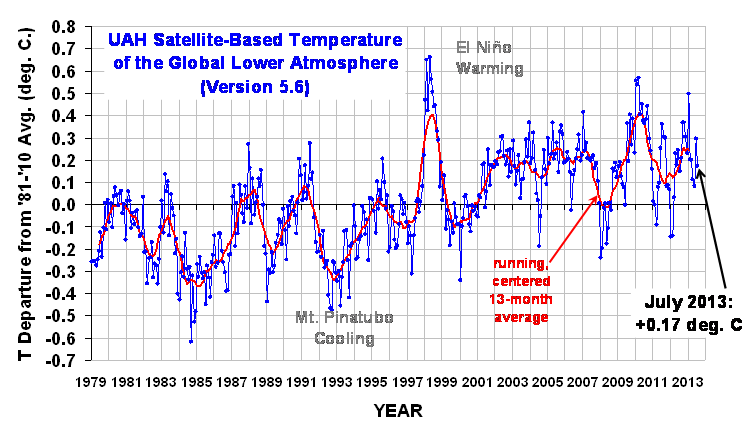
July Satellite Global Temperature Update


The UAH satellite program for measuring global temperatures reports the July anomaly was +0.17°C which is a drop of 0.12°C from last month’s report.  Dr Spencer points out that this reading is from two new satellites.  He says that the old version would have read a smaller positive temperature anomaly but he believes that is due to an uncorrected diurnal drift in satellite NOAA-18.  That satellite’s reading are not in the current version.

UAH_LT_1979_thru_July_2013_v5.6

cbdakota

Climate Cycles-Part 2 Earth’s Obital Cycles Control Glacial Periods


There are several theories for the cause of glacial periods–Cycles of glaciers followed by  interglacial warm periods and then repeating that cycle. Of those theories, the Milankovitch Cycles theory seems to have a broad base of adherents who believe it to have the best answer that question.   The Milankovitch theory has some weaknesses.  So this posting remains skeptical, however, it appears that there are good reasons why it is probably the most accepted theory.  That Richard Lindzen is a supporter of the theory is one of the good reasons.

The Milankovitch theory says that moving in and out of glacial periods is a result of variation in the Earth’s orbit and orientation.  Three parameters—Earth’s eccentric orbit around the Sun, the planet’s axial tilt and the procession of its axis are the basis of the theory.   These parameters are pretty well defined.   The coincidence with certain combinations of the three parameters and the paleohistory of glacial periods is reasonably close.   A posting by Doug Hoffman on his blog, the Resilient Earth “Confirmed! Orbital Cycles Control Ice Ages” is very good.  I could not say it as well, so this posting  will lift much from his.  


From Hoffman’s posting:

Earth’s orbit goes from measurably elliptical to nearly circular in a cycle that takes around 100,000 years. Presently, Earth is in a period of low eccentricity, about 3%. This causes a seasonal change in solar energy of 7%. The difference between summer and winter is a 7% difference in the energy a hemisphere receives from the Sun. When Earth’s orbital eccentricity is at its peak (~9%), seasonal variation reaches 20-30%. Additionally, a more eccentric orbit will change the length of seasons in each hemisphere by changing the length of time between the vernal and autumnal equinoxes. (Click on the Chart to enlarge.)

relisearthEccentricity_Obliquity_Precession-noaa_dlh-500

Variation in Axial Obliquity, Orbital Eccentricity, and Polar Precession.NOAA.

Continue reading

Joe Bastardi Says Obama’s Energy Policy Based On Easily Disproven Assumptions.


Joe Bastardi, Chief Forecaster at WeatherBell Analytics LLC says that the EPA has based the Administration’s energy policy on three easily disproven assumptions.  In Bastardi’s posting “Evidence That Demands A Verdict” he list the following:

There are three lines of evidence the EPA uses to back their environmental policies.

  1. Greenhouse Gas Trapping Hot Spot Theory.
  2. The so-called unusual rise in GAST (Globally Averaged Surface Temperatures).
  3. Assumed validity of climate models, used for policy analysis purposes. (See, for example, SOUTHEASTERN LEGAL FOUNDATION, INC., ET AL., Petitioners, v. ENVIRONMENTAL PROTECTION AGENCY, ET AL. Nos. 12-1268, 12-1269, 12-1272.)

Continue reading

Climate Cycles-Part 1 Glacial Periods


Climate cycles are continuously happening on Earth since its beginning estimated to be some 4.5 billion years ago. Detailing the earliest climate cycles can only be done by painting with the broadest of brushes.  In more recent times, proxies, such as ice cores and oxygen isotope measurements are available for use in reconstructing these cycles. The globe has experienced glaciers in relatively recent times and in the not too distant future will surely experience glaciers again. The profound changes that take place resulting in glacial periods are of great interest.

greenlandglacierhelheim533

Greenland Glacier–NOAA

Continue reading

Solar Cycle 24 Update-June 2013


Solar Cycle 24 activity was low in June.  Sunspots took a sizable drop from about 77 in May to 52 in June.  Solar flux dropped as well.  (Click on charts to enhance clarity.)

sunspotjune13

solar24fluxjune13

The experts believe that Cycle 24 will match Cycle 14.  NASA is predicting Cycle 24 Sunspot peak at 67 whereas Cycle 14’s peak was 64.   Cycle 14 began February, 1902 and ended August, 1913.  Temperatures during that time were much colder than the average since that time.  My March 8, 2013 posting has some interesting statistics to make comparisons of Cycle 24 and other Solar Cycles.  There is a plot of temperature anomalies from 1880 to 2010 that you can compare to Solar Cycle size. You can access that data by clicking here.

cbdakota