Category Archives: sun and climate

SOLAR CYCLE 24 APRIL UPDATE// RUSSIAN TEAM SAYS COOLING MAY LAST FOR MORE THAN 200 YEARS.


There was an uptick in Sunspot numbers and F10.7cm radio flux.   Sunspots monthly average went up to 72  versus  55 in March.   Cycle 24’s  pattern seems somewhat reminiscent of Cycle 23 during its time at or near maximum. (Click on charts to enlarge.)
cycles23_24APRIL13Chart curtsey of Solen.com
Sunspots appear to be in sync with the predicted path shown as the green line in the chart.

GLOBAL WARMING AND CLIMATE CHANGE: SCIENCE AND POLITICS


A referred paper in Quaestiones Geographicae* written by Cliff Ollier titled “Global Warming and Climate Change: Science and Politics “ maintains the idea that global warming will bring on devastation is a dangerous belief.  Ollier challenges the belief that CO2 is a major force in defining the globe’s climate.   He also takes on the corollary issues such as sea level, the Sun and climate.  The abstract to the paper follows:
The threat of dangerous climate change from anthropogenic global warming has decreased.
• Global temperature rose from 1975 to 1998, but since then has leveled off.
• Sea level is now rising at about 1.5mm per year based on tide gauges, and satellite data suggests it may even be falling.
o Coral islands once allegedly threatened by drowning have actually increased in area.
o Ice caps cannot possibly slide into the sea (the alarmist model) because they occupy kilometres-deep basins extending below sea level.
o Deep ice cores show a succession of annual layers of snow accumulation back to 760,000 years and in all that time never melted, despite times when the temperature was higher than it is today.
o Sea ice shows no change in 30 years in the Arctic.
• Emphasis on the greenhouse effect stresses radiation and usually leads to neglect of important factors like convection.
o Water is the main greenhouse gas.
o The CO2 in the ocean and the atmosphere are in equilibrium: if we could remove CO2 from the atmosphere the ocean would give out more to restore the balance. Increasing CO2 might make the ocean less alkaline but never acid.
• The sun is now seen as the major control of climate, but not through greenhouse gases.
o There is a very good correlation of sunspots and climate.
o Solar cycles provide a basis for prediction. Solar Cycle 24 has started and we can expect serious cooling.
• Many think that political decisions about climate are based on scientific predictions but what politicians get are projections based on computer models.
o The UN’s main adviser, the IPCC, uses adjusted data for the input, their models and codes remain secret, and they do not accept responsibility for their projections.
The issues listed in the Abstract are explored in some detail in the full paper that you can access by clicking here.
cbdakota

Solar Cycle 24 March Update


There was a small upward spike in Sunspot numbers in March.   Dean Pesnell of NASA’s Goddard Space Flight Center thinks this will make Cycle 24 a double peak “maximum” event.  He says that the second peak may even last into 2014.
(Click on the Charts for more Clarity)
March13sunspots

Solar Cycle 24 Activity Compared To Previous Solar Cycles


Solar Cycle 24 activity dropped off in February.  Charts for sunspots and F10.7 cm radio flux follow:
sunspotmarch13

Collapsing Consensus–Next Targets Are The Professional Societies


In my previous posting I wondered when the “consensus” scientists would begin to openly call into question the theory that CO2 is the primary forcing agent driving global warming. The longer the “pause” in global warming continues, (the IPCC head, Dr. Pachuri said the pause is now at 17 years), the harder it must be to steadfastly hold to the CO2 theory. Skeptics largely agree that CO2 is a forcing agent but have maintained that natural forces were probably the dominate force. In my opinion, the Sun is most likely the major forcing agent even though the exact mechanism has yet to be proven.

Continue reading

Solar Cycle 24 Update-January 2013


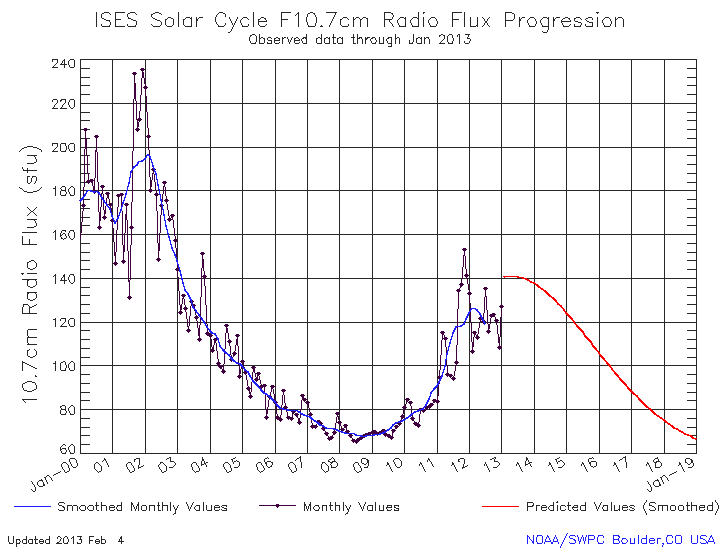
Solar Cycle 24 experienced a small uptick in the number of Sunspots and F 10.7cm solar flux in the month of January.  First the Sunspot chart:
solarcycle24sunspot4feb13
And the F 10.7cm solar flux chart:
solarcycle24f10.7cm4feb13

NASA Revises Cycle 24 Sunspot Prediction.


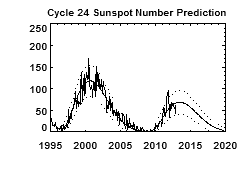
David Hathaway, NASA solar cycle expert, has a revised forecast for Solar Cycle 24 Sunspot number and Maximum timing.  In May 2012, he forecast the smoothed sunspot number maximum at 60 and the timing of the maximum as the spring of 2013.  His January 2013 Cycle 24  revised forecast is for 69 spots and maximum in the Fall of 2013.  He adds:
“ We are currently over four years into Cycle 24. The current predicted and observed size makes this the smallest sunspot cycle since Cycle 14 which had a maximum of 64.2 in February of 1906.”  
 jan13hathawayssn_predict
       Hathaway’s  NASA Revised January 2013 Sunspot Number Prediction

Solar Cycle 24 Nearing Maximum


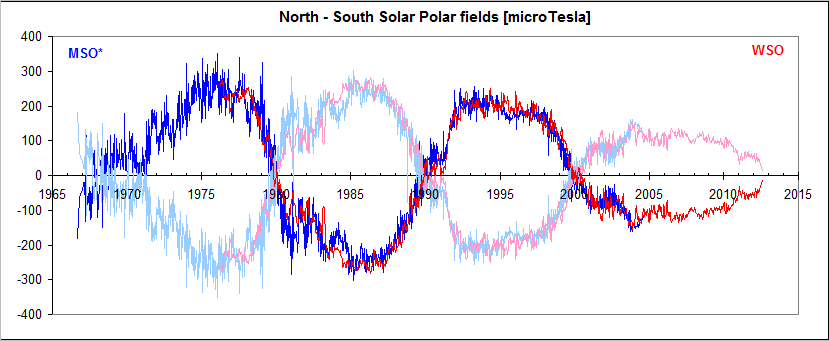
Solar Cycle 24 is nearing its maximum after which the solar activity will decline.     The maximum is often pegged as the time when the Sun’s  north and south poles swap. The chart below shows the current position of the poles. Projecting their current position suggests that the swap will occur early next year.
(Click on Charts to improve clarity)
december12Solar-Polar-Fields-1966-now
    Solar Polar Field 1966 to Present –Wilcox Solar Observatory

That 97% Solution, Again–Reboot


There are many—mostly non-scientists—that like to tell the public that 97% of the world’s climate scientists believe in the catastrophic man-made global warming theory.  If you disagree with their theory,  you are said to be one of the 3% who are “deniers”.  They also tell you that the “deniers” are heavily funded by the fossil fuel industry which makes them not only wrong on science but morally wrong for carrying the water for those evil oil and gas companies. In fact Oil and Gas provide more funds for alternative energy studies than funds provided to the skeptics. Most  skeptics are not funded at all. The winners of the funding wars are the believers of the man-made global warming theory. They get the large cash awards from Governments and Environmental organizations worldwide as long as they produce work that supports the man-made global warming theory. 
 
I set out to post the facts to demonstrate that the 97% claim is bogus.  I ran across the following National Post posting “That 97% Solution, Again”  by Larry Solomon and concluded I could not come up with anything that would surpass Solomon’s arguments on this topic.  So here is what he wrote:
 
That 97% Solution,Again.
Source:  National Post (Canada)
by Larry Solomon
 
How do we know there’s a scientific consensus on climate change? Pundits and the press tell us so. And how do the pundits and the press know? Until recently, they typically pointed to the number 2500 – that’s the number of scientists associated with the United Nations Intergovernmental Panel on Climate Change. Those 2500, the pundits and the press believed, had endorsed the IPCC position.
To their embarrassment, most of the pundits and press discovered that they were mistaken – those 2500 scientists hadn’t endorsed the IPCC’s conclusions, they had merely reviewed some part or other of the IPCC’s mammoth studies. To add to their embarrassment, many of those reviewers from within the IPCC establishment actually disagreed with the IPCC’s conclusions, sometimes vehemently.
The upshot? The punditry looked for and recently found an alternate number to tout — “97% of the world’s climate scientists” accept the consensus, articles in the Washington Post and elsewhere have begun to claim.
This number will prove a new embarrassment to the pundits and press who use it. The number stems from a 2009 online survey of 10,257 earth scientists, conducted by two researchers at the University of Illinois. The survey results must have deeply disappointed the researchers – in the end, they chose to highlight the views of a subgroup of just 77 scientists, 75 of whom thought humans contributed to climate change.  The ratio 75/77 produces the 97% figure that pundits now tout.
The two researchers started by altogether excluding from their survey the thousands of scientists most likely to think that the Sun, or planetary movements, might have something to do with climate on Earth – out were the solar scientists, space scientists, cosmologists, physicists, meteorologists and astronomers. That left the 10,257 scientists in disciplines like geology, oceanography, paleontology, and geochemistry that were somehow deemed more worthy of being included in the consensus. The two researchers also decided that scientific accomplishment should not be a factor in who could answer – those surveyed were determined by their place of employment (an academic or a governmental institution). Neither was academic qualification a factor – about 1,000 of those surveyed did not have a PhD, some didn’t even have a master’s diploma.
To encourage a high participation among these remaining disciplines, the two researchers decided on a quickie survey that would take less than two minutes to complete, and would be done online, saving the respondents the hassle of mailing a reply. Nevertheless, most didn’t consider the quickie survey worthy of response –just 3146, or 30.7%, answered the two questions on the survey:
1. When compared with pre-1800s levels, do you think that mean global temperatures have generally risen, fallen, or remained relatively constant?
2. Do you think human activity is a significant contributing factor in changing mean global temperatures?
The questions were actually non-questions. From my discussions with literally hundreds of skeptical scientists over the past few years, I know of none who claims that the planet hasn’t warmed since the 1700s, and almost none who think that humans haven’t contributed in some way to the recent warming – quite apart from carbon dioxide emissions, few would doubt that the creation of cities and the clearing of forests for agricultural lands have affected the climate. When pressed for a figure, global warming skeptics might say that human are responsible for 10% or 15% of the warming; some skeptics place the upper bound of man’s contribution at 35%. The skeptics only deny that humans played a dominant role in Earth’s warming.
Surprisingly, just 90% of those who responded to the first question believed that temperatures had risen – I would have expected a figure closer to 100%, since Earth was in the Little Ice Age in the centuries immediately preceding 1800. But perhaps some of the responders interpreted the question to include the past 1000 years, when Earth was in the Medieval Warm Period, generally thought to be warmer than today.
As for the second question, 82% of the earth scientists replied that that human activity had significantly contributed to the warming. Here the vagueness of the question comes into play. Since skeptics believe that human activity been a contributing factor, their answer would have turned on whether they consider a 10% or 15% or 35% increase to be a significant contributing factor. Some would, some wouldn’t.
In any case, the two researchers must have feared that an 82% figure would fall short of a convincing consensus – almost one in five wasn’t blaming humans for global warming — so they looked for subsets that would yield a higher percentage.  They found it – almost — in those whose recent published peer-reviewed research fell primarily in the climate change field. But the percentage still fell short of the researchers’ ideal. So they made another cut, allowing only the research conducted by those earth scientists who identified themselves as climate scientists.
Once all these cuts were made, 75 out of 77 scientists of unknown qualifications were left endorsing the global warming orthodoxy. The two researchers were then satisfied with their findings. Are you?
LawrenceSolomon@nextcity.com
cbdakota

Solar Cycle 24 Is Underperforming Its Predecessors


Solar Cycle 24 is underperforming its predecessors, Cycles 21, 22 and 23. The chart below, using sunspots as proxy for solar activity, shows the progress for Cycles 21, 22 and 23 over their nominal 11 year life cycle. Solar Cycle 24’s current progress is clearly less active than 21, 22 or 23. This level of activity, if it continues at its current pace, will be the least active Solar Cycle in the last 100 years.The chart maker is Solen. (Click on the chart for clarity.)

<am,.

How much longer will Cycle 24 go before its maximum activity occurs and quiets down? Experts are forecasting that in the first part of 2013. When the maximum occurs the Sun’s poles switch. So if you want to make your own guess, lets look at how close the poles are to switching right now. The chart below records the position of the North and South poles with time. The three previous Cycles polar locations are shown and you can see when the poles swapped sides. Cycle 24 poles are drawing near that now and it seems likely they will switch soon. If so, it will be a very weak–solar activity–Cycle. (Click chart for clarity.)


Solar Polar Field – Wilcox Solar Observatory (WSO) – 1976 to Present

Solar experts are predicting that Cycle 25 will be less active than 24. In the past, several Cycles with such low solar activity were associated with cooling global temperatures. The global temperature has plateaued for the past 15 to 16 years. The Warmers say that it has to go at least 20 years to disprove their CO2 man-made global warming theory. We may be heading for a period that will be much longer than 20 years of plateaued or even falling global temperatures. This should send the CO2 theory to the trash bin, but it does not necessarily bode well for mankind. Cooler global temperatures have not provided the era of plenty we now enjoy. Food production will likely be less than optimal and that can’t be a good thing with the continued growth of global population.
cbdakota