Category Archives: Solar Activity

Dr Judith Curry Is No Longer A Member Of the Warmer Tribe.


Dr Judith Curry believes that CO2 is warming the Earth. But she thinks that the forecasts of temperature rise by the IPCC and other warmers are vastly curryUnknownoverstated. Thus she is labeled a lukewarmer. Because most skeptics are in some sense lukewarmers, she is readily accepted by the Skeptics. But warmers do not tolerate those who don’t strictly follow their religious like beliefs that allow no deviation from their catastrophic views.   She says she has been tossed out of the warmer tribe of which she was once a welcome member.

Her credentials are solid gold. Wikipedia cites her publications as follows:

Curry is the co-author of Thermodynamics of Atmospheres and Oceans (1999), and co-editor of Encyclopedia of Atmospheric Sciences (2002). Curry has published over 130 scientific peer reviewed papers. Among her awards is the Henry G. Houghton Research Award from the American Meteorological Society in 1992.

She (Curry) wrote: “I have a total of 12,000 citations of my publications (since my first publication in 1983).

The new.spectator.com.uk posted “I was tossed out of the tribe’: climate scientist Judith Curry interviewed”. This is how it happened:

“Curry’s independence has cost her dear. She began to be reviled after the 2009 ‘Climategate’ scandal, when leaked emails revealed that some scientists were fighting to suppress sceptical views. ‘I started saying that scientists should be more accountable, and I began to engage with sceptic bloggers. I thought that would calm the waters. Instead I was tossed out of the tribe. There’s no way I would have done this if I hadn’t been a tenured professor, fairly near the end of my career. If I were seeking a new job in the US academy, I’d be pretty much unemployable. I can still publish in the peer-reviewed journals. But there’s no way I could get a government research grant to do the research I want to do. Since then, I’ve stopped judging my career by these metrics. I’m doing what I do to stand up for science and to do the right thing.’”

Curry says that the COP 21 will be driven by the warmer’s belief that global temperature rise is a direct function of the atmospheric CO2 concentration.   She says there is no such relationship:

“This debate will be conducted on the basis that there is a known, mechanistic relationship between the concentration of carbon dioxide in the atmosphere and how world average temperatures will rise. Any such projection is meaningless, unless it accounts for natural variability and gives a value for ‘climate sensitivity’ —i.e., how much hotter the world will get if the level of CO2 doubles. Until 2007, the UN Intergovernmental Panel on Climate Change (IPCC) gave a ‘best estimate’ of 3°C. But in its latest, 2013 report, the IPCC abandoned this, because the uncertainties are so great. Its ‘likely’ range is now vast — 1.5°C to 4.5°C.

Curry says that reaching 2°C is likely much farther away than the warmers think because the recent research shows a climate sensitivity of around 2°C rise per doubling of the CO2 in the atmosphere versus the 3°C rise.  See Recent “Research Papers Show That IPCC Climate Sensitivity Is Too High”

 Curry also believes the warmers need to look at natural sources that cause the climate to change. She says:

“Meanwhile, the obsessive focus on CO2 as the driver of climate change means other research on natural climate variability is being neglected. For example, solar experts believe we could be heading towards a ‘grand solar minimum’ — a reduction in solar output (and, ergo, a period of global cooling) similar to that which once saw ice fairs on the Thames. ‘The work to establish the solar-climate connection is lagging.’”

Curry closes her interview by the David Rose of the New Spectator UK with this:

She remains optimistic that science will recover its equilibrium, and that the quasi-McCarthyite tide will recede: ‘I think that by 2030, temperatures will not have increased all that much. Maybe then there will be the funding to do the kind of research on natural variability that we need, to get the climate community motivated to look at things like the solar-climate connection.’ She even hopes that rational argument will find a place in the UN: ‘Maybe, too, there will be a closer interaction between the scientists, the economists and policymakers. Wouldn’t that be great?’

cbdakota

(I previously post the Spectator interview on my Facebook sans my comments.)



Little Ice Age By 2030?


Professor Valentian Zharkova of Northumbria University presented her results Cold-Weather-Cartoonfor a new model of the Sun’s interior dynamo to the Royal Astronomical Society. Zharkova and her team believe they have made a discovery that allows them to predict solar activity. From the Royal Astronomical Society’s National Astronomy Meeting 2015 – report 4” posting:

“We found magnetic wave components appearing in pairs; originating in two different layers in the Sun’s interior. They both have a frequency of approximately 11 years, although this frequency is slightly different [for both] and they are offset in time,” says Zharkova. The two magnetic waves either reinforce one another to produce high activity or cancel out to create lull periods.

The model predicts that the magnetic wave pairs will become increasingly offset during Cycle 25, which peaks in 2022. Then during Cycle 26, which covers the decade from 2030-2040, the two waves will become exactly out of synch, cancelling one another out. This will cause a significant reduction in solar activity. “In cycle 26, the two waves exactly mirror each other, peaking at the same time but in opposite hemispheres of the Sun. We predict that this will lead to the properties of a ‘Maunder minimum’,” says Zharkova”

Continue reading

New Solar Cycle Charts Now Reflect The Revised Sunspot Counting System.


bigspotfd_thumbRevised Sunspot number as discussed in previous posting of July 2015 numbers can be seen below:new #solarterrestialjuly

Below is the Sunspot number posted before the numbering was changed to match the new criteria discussed in the “Sunspot Number History Change Is Underway“.

solarterrestrialjuly1-2015

The only thing different is the green line the “30 day Wolf Number. The new number is greater than the old one.

Quoting SILSO: “In the values themselves, the most prominent change will result from the elimination of the 0.6 factor formerly used by the Zürich Observatory to scale the modern numbers down to the scale of the initial Wolf observations. This factor has always led to some confusion and now has lost its sense more than 130 years after Wolf’s observations. This change will thus raise the scale of the entire sunspot number time series by a factor 1/O.6, which may significantly affect software using the sunspot number as input.”

cbdakota


Sunspot Number History Change Is Underway


For those readers of this blog that follow the monthly update of Solar Cycle 24, things are about to change. For the better I think, but until the final report is 400yrsofsunspotcyclesUnknownreleased, we wont know for sure. Sunspot Index and Long-term Solar Observations (SILSO) a part of the World Data Center has issued a Sunspot Bulletin that says:”

                                           Warning of Major Data Change

Over the past 4 years a community effort has been carried out to revise entirely the historical sunspot number series. A good overview of the analyses and identified corrections is provided in the recent review paper: Clette, F., Svalgaard, L., Vaquero, J.M., Cliver, E. W.,”Revisiting the Sunspot Number. A 400-Year Perspective on the Solar Cycle”, Space Science Reviews, Volume 186, Issue 1-4, pp. 35-103.

Now that the new data series has been finalized, we are about to replace the original version of our sunspot data by an entirely new data set on July 1st. On this occasion, we decided to simultaneously introduce changes in several conventions in the data themselves and also in the distributed data files.

Continue reading

Skeptic Reference Sources—1350+ Peer-Reviewed Papers


This is the second posting of skeptic reference sources. This time it is “1350+ Peer- Reviewed Papers Supporting Skeptic Arguments Against ACC/AGW Alarmism”.   The papers have been sorted by categories to Cooling_is_the_New_Warmingmake the desired documents easily located. It is interesting that PopularTechnology.net supplied “Rebuttals to Criticisms” in the beginning. These are also a leg-up for you in discussions with warmers.

Click here to enter the PopularTechnology.net website.

cbdakota

Solar Cycle 24 Activity Continues To Decline


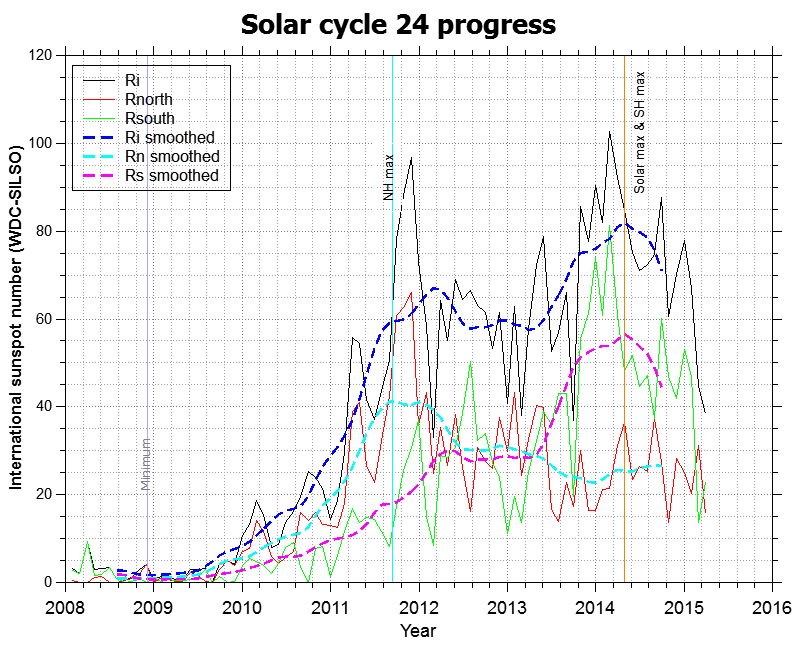
The April 2015 Solar Cycle 24 Sunspot number rose somewhat in April, but the forecast is for a continued decline in activity.   The 2015 monthly Sunspot counts were: January = 67.0, February=44.8, March=38.4 and April=54.4.   The daily Sunspot counts seesawed, but definitely with a downward trend, Ri(black).  This can be seen be examining Rsouth (green). While Rnorth has been reasonably quiet for a year or so, Rsouth has been the major contributor to the total number since late 2013.

Continue reading

Bosse And Vahrenholt: Solar Cycle 24 Observations


German scientist Frank Bosse and Fritz Vahrenholt, on 12 March,  bluesunUnknownprovided another way to look at Solar Cycle 24. It is worth sharing. They posted “The Sun In March 2015” on the Notrickszone.com website. They begin by saying:

“Last month our sun gave a really sluggish impression. The sunspot number (SSN) was only 38.4: only 46% of what is normal at this time into a cycle for all the cycles observed since 1750.

The following chart illustrates their assertion:

solarcycle24sspotsgermanmaerz1Fig. 1: The current solar cycle 24 compared to the mean of all previous cycles (blue) and to solar cycle no. 1, 1755-1766, (black).

solarcycle24ssanomalygerman Figure 2 Comparing the individual cycles to each other further confirms that the current cycle is a quiet one compared to those we saw in the second half of the last century.

(March was the 76th month since the start of Cycle 24. These numbers will change as the Cycle 24 progresses, but the low activity will likely to continue to result in under performing almost all of the previous Cycles. )

The posting discusses the Sun’s polar fields.  Click on the link above to see the entire posting.

{Vahrenholt is co-publiser of the highly regarded book “Die kalte Sonne: warum die Klimakatastrophe nicht stattfindet[6] (The Cold Sun: Why the Climate Crisis Isn’t Happening).}

cbdakota


Now For Something Entirely Different


VOX.com has a page with “40 maps that explain the universe”. Photos and drawing plus text are there for your review. Some of the illustrations are really eye catching. For example:

Even a single comet is pretty darn big

meteoronlaf0ba1pE.0


This is the comet 67P/C-G — which the Philae probe landed on in November 2014 — superimposed on Los Angeles. In terms of space, the comet is absolutely tiny: just 3.5 miles wide.

Continue reading

Solar Cycle 24 And Solar Wind Storm


Solar Cycle 24 activity, using Sunspots as the proxy, is slowing down considerably. The International number for March was 38.4. The smoothed International Sunspot number is estimated at 56.1. The March number will not be official for another 6 months. The chart below, the black line, labeled Ri is the International number which is the sum of the Rnorth (red) and Rsouth (green) Sunspot numbers.

march15cycle24

Continue reading

Solar Cycle 24—Ending February At Low Activity


Solar Cycle 24 activity is relatively low as the month of February comes to a close. On February 27, only three visible Sunspot clusters could be seen. Solar Cycle 24 International Sunspot smoothed number for February 2015 looks like it will be about 65.

regions_feb27

Continue reading