Category Archives: crop yields

Earth Is Greening And It Is Caused By Atmospheric CO2


Because the Earth is greening and the cereal crops are setting new records for production, one needs to ask why, especially since the catastrophic man-made global warming crowd have predicted that can’t happen. Drought, you know. Temperatures too high. Etc..

Yet  NASA ‘s “Carbon Dioxide Fertilization Greening Earth, Study Finds” posted on 26 April 2016 states the following:

“From a quarter to half of Earth’s vegetated lands has shown significant greening over the last 35 years largely due to rising levels of atmospheric carbon dioxide, according to a new study published in the journal Nature Climate Change on April 25.”

The greening represents an increase in leaves on plants and trees equivalent in area to two times the continental United States.”

“Results showed that carbon dioxide fertilization explains 70 percent of the greening effect, said co-author Ranga Myneni, a professor in the Department of Earth and Environment at Boston University.”


Because they don’t want to be ostracized, their press release also adds the usual about how CO2 is in fact a bad thing. Further they say it CO2 levels can get too high and all this will stop.

Continue reading

NIPCC Reference: Biological Impacts


A number of you have written telling me that you liked the Nongovernmental International Panel on Climate Change—Science. So I will add the NIPCC’s second reference book: Biological Impacts. Click here to link.

cbdakota

COP 21 “…make-or-break Paris conference on climate change”


Beginning 30 November through 11 December, the UN Framework Convention on Climate Change (UNFCC) will hold the 21st Conference of Parties (COP 21) in COP21imagesParis. As usual this one like the preceding annual COP meeting is being described as the last chance to save planet Earth from the ravages of carbon dioxide (CO2).

COP attendees from all over the world will attempt, once again, to agree on the reduction of the amount of CO2 emitted into the atmosphere and settle on compensation payments to the 3rd world countries that have emitted little CO2. Each of the 146 nations that emit 90% of the global CO2 emissions are being asked to submit the amount of CO2 emissions they will reduce by 2030 based away from the amount emitted in 2005 by that nation. They believe this is necessary to keep global temperature growth to two degrees Celsius.

The compensation side is contentious as those getting the compensation want more than those expected to provide it are willing to part with. For example, India says they will reduce their emissions by 33 to 35% but they need $2.5 trillion to accomplish that goal. Even China, the world’s largest emitter of CO2 is one of the nations expecting compensation.   What a deal—-they have recently achieved an agreement with President Obama that lets them continue increasing their emissions until 2030 at which time their emissions should be three times those of the US.

Of course the concept of emission reductions and compensation that the COP wishes to accomplish ignores the data that shows that this is probably not necessary.   CO2 is the life blood of the plant world. Without it there would be no plant life and that means of the end of humankind. Studies show that the increased CO2 in the atmosphere have had a beneficial effect on food production world-wide.   Further the CO2 effect on the global temperatures appears to be secondary to natural forces.  And fossil fuel use by the underpowered nations is a better answer to their needs than sending compensation to some dictator who will just pocket it and the people will receive no benefit.  Subsequent postings will enlarge on these observations.

Continue reading

Bjorn Lomborg Says Global Warming Is A Poor Place To Spend $


Bjorn Lomborg, a Danish economist, joins the “consensus” supporting the theory of man-made global warming (AGW), but not catastrophic man-made global warming (CAGW). He is disliked intensely by the wamers but not because he doesn’t believe in CAGW. He gets this lack of love because he believes that the money spent in the name of global warming is largely misspent. He says the money would be better spent to reduce malnutrition, make immunizations available, better education, prevention of AIDs, providing electrical power to reduce air pollution, etc. These beliefs are laid out in the TED talk video below.

This a fascinating talk.  He shows how much improved Earth has become from 1900 to 2013 and projects changes to 2050.

Continue reading

10th International Conference On Climate Change—June 11 & 12 in Washington DC


This year the International Conference On Climate Change will be held in Washington DC on the 11th and 12th of June.   The presenters are Major League skeptics. Among the panel participants are Singer, Idso, Monckton, Legates, Fred SingerSoon, Briggs, Michaels, Watts, Carter, Loehle, Ball, etc..  The keynote speakers are Senator Jim Inhofe, Journalist Mark Steyn, Representative Lamar Smith and Princeton Professor William Happer.

S. Fred Singer

Full information, regarding registration, location, program & speakers and hotel reservations can be found by clicking here.

Continue reading

Is Greenpeace Behind Destruction Of Field Trials Of Golden Rice?


Philippines’ environmental groups destroyed a “Golden Rice” development test plot. Golden Rice is genetically modified rice that is being developed to combat vitamin A deficiency in the developing world.  The Hellen Keller International organization says the around 670,000 children world-wide will die each year from vitamin A deficiency and about 350,000 will go blind from the lack of vitamin A.  It is reported that one cup of Golden Rice will supply half an adult’s recommended daily intake. The International Rice Research Institute reports that: “The rice has been modified by adding extra genes that turn on the plant’s ability to produce beta-carotene, which humans can convert into vitamin A.”

Continue reading

Solar Cycle 24 Is Underperforming Its Predecessors


Solar Cycle 24 is underperforming its predecessors, Cycles 21, 22 and 23. The chart below, using sunspots as proxy for solar activity, shows the progress for Cycles 21, 22 and 23 over their nominal 11 year life cycle. Solar Cycle 24’s current progress is clearly less active than 21, 22 or 23. This level of activity, if it continues at its current pace, will be the least active Solar Cycle in the last 100 years.The chart maker is Solen. (Click on the chart for clarity.)

<am,.

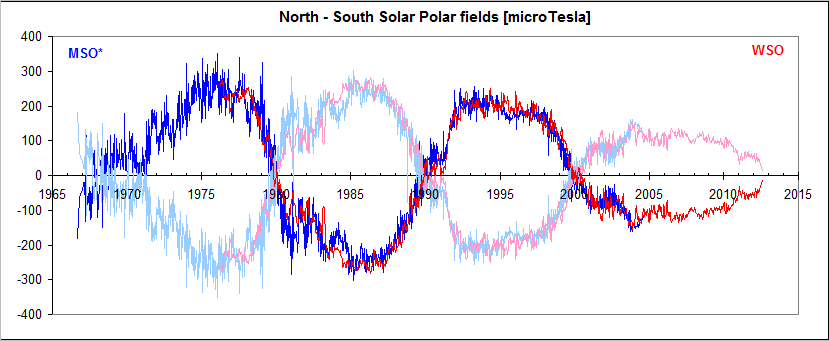
How much longer will Cycle 24 go before its maximum activity occurs and quiets down? Experts are forecasting that in the first part of 2013. When the maximum occurs the Sun’s poles switch. So if you want to make your own guess, lets look at how close the poles are to switching right now. The chart below records the position of the North and South poles with time. The three previous Cycles polar locations are shown and you can see when the poles swapped sides. Cycle 24 poles are drawing near that now and it seems likely they will switch soon. If so, it will be a very weak–solar activity–Cycle. (Click chart for clarity.)


Solar Polar Field – Wilcox Solar Observatory (WSO) – 1976 to Present

Solar experts are predicting that Cycle 25 will be less active than 24. In the past, several Cycles with such low solar activity were associated with cooling global temperatures. The global temperature has plateaued for the past 15 to 16 years. The Warmers say that it has to go at least 20 years to disprove their CO2 man-made global warming theory. We may be heading for a period that will be much longer than 20 years of plateaued or even falling global temperatures. This should send the CO2 theory to the trash bin, but it does not necessarily bode well for mankind. Cooler global temperatures have not provided the era of plenty we now enjoy. Food production will likely be less than optimal and that can’t be a good thing with the continued growth of global population.
cbdakota

Corn Should Not Be Used To Make Automobile Fuel


US farms that grow corn are mainly located in the Midwest.  The Midwest is experiencing a drought that the head agriculture meteorologist with MDA EarthSat say is the worst since 1988.  The MDA EarthSat group is estimating a corn yield of about 118 bushels per acre this year.  In a good year, the corn yield is about 150 to 160 bushels per acre which suggests that this year’s yield will be about 75% of normal.  Shortages always have a way of driving the price of a commodity upward.  However making the likelihood of even higher prices for corn is the fact that the ethanol mixed with gasoline is essentially produced from corn.

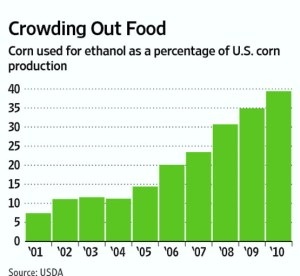
It is estimated that about 40% of the corn produced last year was used to make ethanol fuel.  The refiners are required to use ethanol and most filling stations have a 10%ethanol/90% gasoline blend.  Last year 14.2 billion gallons of ethanol were blended with gasoline.   By law, in 2012,  15.2 billion gallons of ethanol must be used.  Of that total, 13.2 must be from corn ethanol.  The remainder must be not corn based.  In order to get a better understanding of what is going on, a brief review of the Renewable Fuel Standard will probably be helpful.

In 2005, Congress enacted the Energy Policy Act of 2005.  It mandated minimum ethanol use.  However, two years later the Energy Independence and Security Act superseded and expanded the Energy Policy Act of 05 and set new, larger use requirements as well as added requirements for cellulosic based ethanol. Cellulosic means from corncobs, wood chips, straw, grass, etc.—by and large almost anything but from the corn kernel (corn starch).  These two acts combined are often referred to as Renewable Fuels Standard (RFS2).  Further RFS2 set a maximum use level for cornstarch-based ethanol at 15.0 billion gallons.  The Environmental Protection Agency(EPA) is responsible for establishing and implementing regulations to ensure that the nation’s transportation fuel supply contains the mandated biofuels volumes.

RENEWABLE FUEL STANDARD 2—BILLIONS OF GALLONS

YEAR TOTAL RENEWABLESFUELS CORN ETHANOL CELLULOSIC ETHANOL BIO AND OTHER FUELS
2011 13.95 12.6 0.0066 1.1
2012 15.20 13.2 0.0085 1.5
2015 20.50 15.0 3.00 TBD
2020 30.00 15.0 10.5 TBD
2022 36.00 15.0

16.00

TBD

If you are wondering if the EPA will enforce the law designating mandated minimum use, the following story will be instructive:  The 2011 requirement for minimum usage of cellulosic ethanol is 6.6 million gallons.—(See chart above and note 0.0066.)  No one is making cellulosic ethanol so there is none available for use.   None-the-less, the companies that supply motor fuels are being fined $6 million because they failed to mix cellulosic ethanol into their motor fuels.   Go figure.

Corn is a major source of food for humans and it is also it is a major source of animal feed.  The price of beef, pork and chicken for example are directly affected by the increase in livestock feed prices. Much has been written about the negative impact of soaring corn prices on the well being of people all over the world.

As noted earlier, ethanol is mandated to be used in gasoline. It is said that the some of the corn used for making ethanol is somewhat different from the corn that normally goes into the food chain.  But that corn will also suffer a loss due to the drought making it necessary for the ethanol manufacturers to buy more food corn to supply ethanol to the gasoline suppliers. Thus the fuel chain will be bidding against the food chain for the limited supply of corn.
The commodities markets are showing this now.  According to reliable sources, corn that was going for $2.00 a bushel in 2005 when this legislation was enacted now sells for over $8 per bushel.  Because ethanol is mandated, the cost of ethanol for blending has little meaning to a gasoline producer as all gasoline producers must use it regardless of cost.  The cost of the ethanol will be passed on to the motorists.

Actually, ethanol is not viable economically but only used because of the mandate.  It will never be in sufficient supply to be a replacement for gasoline.  According to a study reported by Wikipedia, if you are concerned about greenhouse gases, ethanol’s use is a negative:  “A team led by Searchinger from Princeton University concluded that once direct and indirect effect of land use changes are considered, both corn and cellulosic ethanol increased carbon emissions as compared to gasoline by 93 and 50 percent respectively.”

The driving force for the use of corn to make ethanol is the votes that politicians get from their farming constituents. The other reasons weigh against using an important food source to make an automobile fuel.

cbdakota

Ethanol Subsidies: Not Gone, Just Hidden a Little Better


Mother Jones, an organization with a very liberal viewpoint posted that the subsidies for ethanol fuel have expired but that this doesn’t trouble the ethanol fuel producers.  Kevin Drum authored the posting and I will let him tell you why.

A few years ago I called subsidies for corn ethanol “catastrophically idiotic.” And why not? Corn ethanol, it turns out, is actively worse for the environment than even gasoline. Farmers responded to the subsidies by reducing the amount of farmland used for food production, and this drove up the price of staple food worldwide.  At the end of last year, ethanol subsidies quietly expired and no one tried to extend them.

So why did the powerful corn ethanol lobby let it expire without an apparent fight? The answer lies in legislation known as the Renewable Fuel Standard (RFS), which creates government-guaranteed demand that keeps corn prices high and generates massive farm profits. Removing the tax credit but keeping the RFS is like scraping a little frosting from the ethanol-boondoggle cake.

The RFS mandates that at least 37 percent of the 2011-12 corn crop be converted to ethanol and blended with the gasoline that powers our cars…[As a result] the current price of corn on the Chicago Mercantile Exchange is about $6.50 per bushel—almost triple the pre-mandate level.

 You might not be aware that when the EPA does mpg ratings for new cars, they use gasoline that does not contain any ethanol.  Adding ethanol at 10% of the fuel mix, the energy in a gallon of fuel is about 96.7% of a fuel not containing ethanol.  Ethanol has less energy per gallon than normal unleaded gasoline.  So the MPG rating is probably just a bit high.    See

cbdakota

Global Warming Not Causing Honeybee Colony Collapse


So “global warming” is not killing the honeybees.  So much for another panic announcement by the Alarmists.   It seems that there are a number of reasons for high levels of bee deaths (Colony Collapse Disorder) and the latest find is a little fly that bores into the bee.  It causes the worker bee to leave the hive and then die.  On average, 7 days later larva emerges from the dead bee.  The study

“A New Threat to Honey Bees, the Parasitic Phorid Fly Apocephalus borealis” has been posted on the Plosone.org website and the abstract can be read by clicking here.  Two photos from the study are shown below:

Parasitic Fly on Bee –above

Larva Emerging From Dead Bee–below.

Studies of Colony Collapse find that parasites and fungal diseases as well as pesticides are also partially responsible for the bee deaths.

Perhaps you remember that frog deaths and malformations were also said to be caused by global warming.  Now it seems clear that it is flukes, unrelated to global warming, that are largely responsible for these deaths and malformations.  See here

It is well known in the scientific community that if you say the problem is caused by global warming, there are monies available from our government and environmental advocate associations for the researcher to continue studying this “alarming” discovery.   But this could result in destruction of the researcher reputation when real scientist determine the actual cause.  Think Michael Mann.

cbdakota