Category Archives: Sun

CO2 And Climate Change Science–Part 2: A Summary Of The Science


The website CO2 Coalition has a post titled “Climate Change: A summary of the Science”.  It one of the best summaries I have come across lately.  It is fairly long, so I could do my usual and summarize it, but there is virtually nothing in it that I would want to skip over.  So, I will not deprive the reader. I will put it in, in its entirety.  I hope that my posting yesterday will fill in any blanks you may have otherwise had.

cbdakota

==========================================================

News 26 Feb, 2017

Climate Change: A Summary of the Science

The climate change science is settled, but not how the climate alarmists want you to think.

Continue reading

CO2 And Climate Change Science–Part 1 Carbon Cycle


This posting sets out a preliminary understanding of the “carbon cycle” that you may not be aware of. The next posting will build off of this to lay out the science of climate change.

The Sun is the Earth’s source of energy. The energy is transported in the form of waves (radiant energy) known as electromagnetic energy. The Sun’s enormous surface temperatures generates these waves. The waves have a wide range of frequencies. In general, the waves are known familiarly as x rays, ultraviolet, sunlight, short wave infrared, radio waves, and microwaves. These waves heat the Earth.  Not all of the waves get through to the Earth’s surface.  Some are absorbed like Ultraviolet by ozone;  some are reflected back into space by clouds; and some are scattered by encountering mater in the atmosphere.

Much of the  Suns energy is reemitted from the Earth as longwave infrared. Some of the reemitted energy is delayed on its way back out into space by the so called greenhouse gases and water vapor. This slowdown is the reason the Earth has a habitable temperature. The primary greenhouse gas is carbon dioxide (CO2).  However, water vapor is the largest factor, by far, in the greenhouse effect.

Continue reading

German Solar Scientists Say Solar Cycle 25 Will Look Like Cycle 24.


German solar scientists, Frank Bosse and Fritz Vahrenholt say that Solar Cycle 24 is the “..third weakest cycle since observations began in 1755.”  The Accumulated Sunspot Anomaly until 97 months after cycle start is shown on the figure below:

Figure 2: Comparison of all the solar cycles.  The chart shows the accumulated sunspot number anomaly from the mean value.

The mean value is noted at zero and Cycle 24 is running 3817 spots less than the mean and only two other Cycle had fewer.    Note that the seven Cycles that preceded Cycle 24 had more sunspots than the mean.

Continue reading

Svalgaard Discusses How He Forecasts Solar Cycle Activity–Cycle 25 Will Be Up Soon


Before Solar Cycle 24 began, estimates of how active it would be were made by many experts. Because the Sunspot counting system has changed, the estimates have to be translated from the predictions made before the change. NASA’s top Expert using Sunspot as a proxy for activity, estimated it would be in the well over 160 (new system number ca. 265). Most of the estimates at the time were like NASAs. However, Cycle 24 has been much less active than most of the experts expected. The count using the new numbering system for Cycle 24 peak Sunspots at the Solar Maximum is 117. On the other hand, Leif Svalgaard and his partners estimated about 70 (new system ca. 117) which turns out to be as good as it gets. Estimating what Solar Cycle 25 will look like is already underway with many expecting Cycle 25 to be less active that has been the case with Cycle 24.

Because Svalgaard had forecast that Cycle 24 would be much less active and the forecast came reasonably close to the actual number count, it makes me curious about how he did it and what is he is predicting about Cycle 25 now. Well, I have already given that away in my 22 March 2016 blog titled “Dr Svalgaard makes a preliminary prediction of Cycle 25 size.” He thinks it will be close to the size of Cycle 24 and prehaps a little bit bigger. Once again he seems to be the contrarian.

So, how does he make these predictions. This blog will let you see the method he uses.

Continue reading

Solar Cycle 24 Update—-October 2016


Solar Cycle 24 continues on its way to a Sunspot minimum. The thirty day average Sunspot number for September (Ri) was 44.7, a little less than the August number of 50. The black line of the chart Ri is the sum of the north and south solar magnetic fields. While a year or so ago, the southern magnetic field (Rsouth) was creating the majority of the Sunspots, the north magnetic field (Rnorth) is dominate now. In April the Sun had a period of low activity with a thirty day average of 20.9.

cycle24

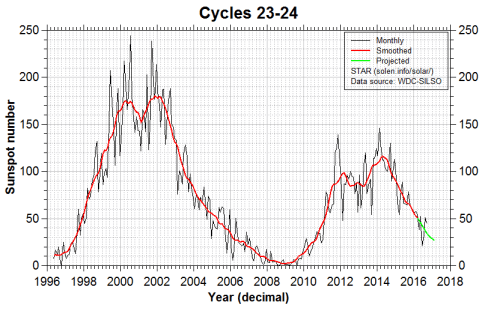
Looking at a comparison of Solar Cycles 23 and 24 shows that the Cycle 24 has been much less active than 23. This, of course, has prompted many to declare we are on our way to another minimum with corresponding cooling of global temperatures. But first a few comments on the difference one of the ways that Sunspots numbers are reported.
cycles23_24

Looking at the far right of the chart, the black line is the monthly average Sunspot number and it is 44.7 as noted above. The red line is the official Sunspot number. It is a thirteen month lagging calculation. It is always 6 months behind the current date. It is the means by which the number is smoothed. The green line is a forecast of what it will probably be when the official smoothed number arrives at September 2016 . The green lines forecasts the September Sunspot number at 34.5. It will probably not be exactly 34.5 at that time but the difference will likely be small..

A comment on my blog by azleader@yahoo.com provided a concise summary of the official number calculation methodology. It can be seen at the at the end of this blog.

Lastly as a reminder of how Cycle 24 looks in comparison to the preceding Cycles, the chart below gives the needed perspective:


This chart illustrates how much more active recent Solar Cycles have been in comparison to Cycle 24. Cycle 21 began in March of 1976. The peak International Smoothed Sunspot number for Cycle 21 was 232, Cycle 22 was211,Cycle 23 was 180 and Cycle 24 was 117.


A look at a Solar Cycle 25 projection is on my list of topics to post—hopefully soon.


All Charts a courtesy of Soleninfo/solar

cbdakota

International Smoothed Sunspot Number calculation.

The smoothed count is a 13-month averaged sunspot count using this Belgium’s formula:
Rs= (0.5 Rm-6 + Rm-5 + Rm-4 + Rm-3 + Rm-2 + Rm-1 + Rm + Rm+1 + Rm+2 + Rm+3 + Rm+4 + Rm+5 + 0.5 Rm+6 ) / 12

Rs = smoothed monthly sunspot count
Rm = One month’s actual sunspot count

The “-6” through “+6” appended to each Rm is the number of months before or after the month whose smoothed count is being calculated. The beginning and ending months in the formula are only given half the value of the others.


Indian, Japanese and Chinese Scientists Publish Research That Predicts Little Ice Age or Maunder Minimum Coming Soon.


The Times of India posted “Sunspots point to looming “little ice age” quoting scientists and astronomers from Physical Research Laboratory in India and their counterparts in China and Japan have fresh evidence that Earth may be heading for another “little ice age” or maybe even another Maunder Mimimum.

Their findings are very similar to those of our scientists. They report that:

“….our blazing sun has been eerily turning quiet and growing less active over the last two decades.”

Continue reading

Solar Cycle 24 Activity Report- Mid-May 2016


Solar Cycle 24 activity has peaked and it is on its way to a minimum.   Of course the exact date of the minimum and the start of Solar Cycle 25 is not known.  Because normal Cycle life is nominally 11 years,  start of Cycle 25 should be in 2019,   The Sunspot number   (Wolf number 30 day average) for April was 38!!  The chart below shows the rather sharp drop from March’s 54.9.

The black line (Ri) is the 30 day average—if you look carefully you will see it is the sum of the green line (Rsouth) and the red line (Rnorth).   The dashed blue line is the “official Sun Spot number.  It is the smoothed count of a 13 month average monthly Sunspot count divided by 12. The oldest and newest monthly count are reduced to half and the other numbers are given their full count.  And is always 6 months behind the most recent month.  This is the way it has been done for many years; hence it has a history record to use for comparing Solar Cycles.

May is showing an up-tick in the Sunspot count.  This up and down, mostly down, will countinue  for several years.

Activity chartNote the change in the 30 Day Wolf Sunspot number–its about 50 now.

The final chart is a comparison of Solar Cycle 23 and Solar Cycle 24:

Solar irradiance was said to have dropped more than usual.  It will have to fall off for months before it is likely to an event of consider “very interesting”.

cbdakota

All charts  by Solen.info/solar


The smoothed count is a 13-month averaged sunspot count using this Belgium’s formula:
Rs= (0.5 Rm-6 + Rm-5 + Rm-4 + Rm-3 + Rm-2 + Rm-1 + Rm + Rm+1 + Rm+2 + Rm+3 + Rm+4 + Rm+5 + 0.5 Rm+6 ) / 12

Rs = smoothed monthly sunspot count
Rm = One month’s actual sunspot count

The “-6” through “+6” appended to each Rm is the number of months before or after the month whose smoothed count is being calculated. The beginning and ending months in the formula are only given half the value of the others.
 

Climate Change Reconsidered II: Physical Science–An Unbiased Report


The International Panel on Climate Change (IPCC) issues a report every three or four years about global warming. This UN agency’s charter is not to examine the science of global warming but rather to show that man produced greenhouse gases will result in catastrophic damage to the globe.   IPCC does as directed by giving little consideration to data, science or reports that would contradict the charter.

A relatively new report, compiled by the Nongovernmental International Panel cover of part2FrontCover2on Climate Change (NIPCC) has been written to answer the IPCC’ reports. The first installment is Climate Change Reconsidered II: Physical Science (CCR-II). This installment is an independent, comprehensive, and authoritative report on the current state of climate science. It is the fourth in a series of scholarly reports produced by the (NIPCC), an international network of climate scientists sponsored by three nonprofit organizations: Center for the Study of Carbon Dioxide and Global Change, Science and Environmental Policy Project (SEPP), and The Heartland Institute. Real data and unbiased studies were used in the preparation of this installment.

You can link to Climate Change Reconsidered II: Physical Science (CCRII) by clicking here.

cbdakota


The Perilous Business Of Predicting The Future


The National Review.com posted “Why Climate Change Won’t Matter in 20 Years”. They subtitled the posting “The perilous business of predicting the future.” The subtitle accurately depicts what happens when politicians or anyone for that matter, think they can safely make the future an extension of the present.

First of all, the warmers should be willing to take seriously the abject failure of their vaunted climate models to make prediction on any time frame. Yet they insist that the Earth in 2100 will be x degrees hotter and the sea level will be y meters higher than today because the climate models told them so. The odds are that they might do just as well talking to Madame Charmaine, the village palm reader.

The author of this posting, Josh Gelernter, put in a lot of effort into showing why projecting the present as a representation of the future is very unlikely to be successful. So I will let him speak:

“Michael Crichton — the brilliant novelist and thinker — posed this horsespulling streetcarquestion in a speech at Caltech in 2003, re climate predictions for 2100. What environmental problems would men in 1900 have predicted for 2000? Where to get enough horses, and what to do with all the manure. “Horse pollution was bad in 1900,” said Crichton. How much worse would someone in 1900 expect it to “be a century later, with so many more people riding horses?”

Continue reading

Club du Soliel Posts Supportive Studies For Solar Forcing Climate Change


The warmers contend that no one studies the role the Sun plays in global warming any more. It is true that measurements of the Sun’s electromagnetic radiation received at the top of the Earth’s atmosphere, hardly changes. There are annual variations in the Sun’s energy received because the Earth’s orbit around the Sun is elliptical rather than circular. We are further away from the Sun in June than in January. However the distance effect averages out as it is essentially the same from year to year.

earths eliptical orbit600px-Seasons1

Continue reading