Category Archives: Solar Cycle 25

Forecasting Solar Cycle 25 Using The Solar Polar Field Strength


Forecasting the strength of Solar Cycle 25 will not  be easy.  The expert’s track record for their Cycle 24 predictions show how hard it is.   For example, Doctor David Hathaway is quoted in December 2006 that cycle 24 would “be one of the most intense since record keeping began 400 years ago.”   He forecast 160+/- 25 as the peak Smoothed International Sunspot Number (SISN). His prediction as charted in 2006 below:

hathaway2billsunspot_med

Continue reading

Svensmark Theory—Cosmic Rays Contribute To Lower Global Temperatures


The previous posting closed with: Low Sunspot numbers and low F 10.7 indicate low solar activity.  How this activity translates to cooler weather is not clear.  The correlation between low activity and cooler weather has been know for several hundred year (or perhaps longer— recently read that the Chinese recorded Sunspot numbers many century’s ago and reported this correlation.)

One possible explanation is the Svensmark theory. This theory begins with high energy galactic cosmic rays (GCR) entering the Earth’s atmosphere where they collide with atmospheric molecules of oxygen. The collisions shatter the molecules and the resulting particles become nuclei for cloud droplets from which clouds are formed. Clouds reflect a significant amount of the Sun’s radiation back into space.  The weaker the Sun’s magnetic field (low solar activity),  the more GCR enter the atmosphere.  The more clouds, the more cooling.   This is opposed to the situation where the Sun’s activity is high, fewer GCR result in fewer clouds.

Continue reading

Solar Cycle 24 July Update


NASA predicts a solar magnetic field reversal in about 3 to 4 months.  When that happens, Solar Cycle 24 will have reached what is known as the cycle maximum.  After that the Sunspot numbers will decrease with time. There is a possibility that a  short period of none at all  will happen before Cycle 25 kicks in. NASA has produced a video that discusses the mechanism and the implications of the solar magnetic field reversal.  The video can be viewed by clicking here.

The July charts for Sunspots and F10.7 cm Radio flux are shown below.

sunspotjuly13

Continue reading

Solar Cycle 24 Update-June 2013


Solar Cycle 24 activity was low in June.  Sunspots took a sizable drop from about 77 in May to 52 in June.  Solar flux dropped as well.  (Click on charts to enhance clarity.)

sunspotjune13

solar24fluxjune13

The experts believe that Cycle 24 will match Cycle 14.  NASA is predicting Cycle 24 Sunspot peak at 67 whereas Cycle 14’s peak was 64.   Cycle 14 began February, 1902 and ended August, 1913.  Temperatures during that time were much colder than the average since that time.  My March 8, 2013 posting has some interesting statistics to make comparisons of Cycle 24 and other Solar Cycles.  There is a plot of temperature anomalies from 1880 to 2010 that you can compare to Solar Cycle size. You can access that data by clicking here.

cbdakota

SOLAR CYCLE 24 APRIL UPDATE// RUSSIAN TEAM SAYS COOLING MAY LAST FOR MORE THAN 200 YEARS.


There was an uptick in Sunspot numbers and F10.7cm radio flux.   Sunspots monthly average went up to 72  versus  55 in March.   Cycle 24’s  pattern seems somewhat reminiscent of Cycle 23 during its time at or near maximum. (Click on charts to enlarge.)
cycles23_24APRIL13Chart curtsey of Solen.com
Sunspots appear to be in sync with the predicted path shown as the green line in the chart.

Where Are The “Consensus” Scientists Hiding?


Dr Rajendra Pachauri admits that there has been no global warming for 17 years.  Dr Pachauri is, if you don’t know, the leader of the Intergovernmental Panel on Climate Change (IPCC), a branch of the UN.  The IPCC has issued reports on climate change which conclude—- burning of fossil fuels releases CO2 causing a “dramatic” increase in global temperatures.  The IPCC documents have had widespread influence. For example, the US EPA successfully used these reports as the technical justification to declare CO2 a hazardous pollutant that needed to be regulated. The IPCC’s belief is that natural forces are inconsequential.
For the last 17 years, CO2 emissions resulting from fossil fuel burning have increased.  The measurement of atmospheric CO2 has climbed steadily over these 17 years and yet the global temperature has not risen.  Proving that the natural forces indeed are consequential.

Solar Cycle 24 Update-January 2013


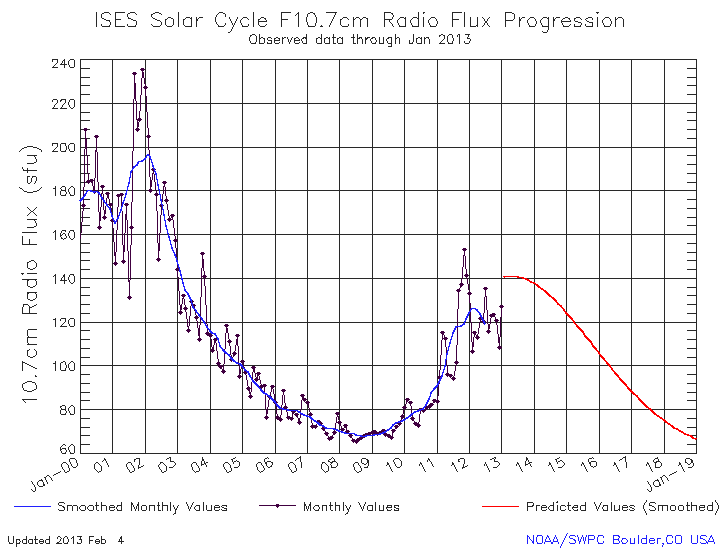
Solar Cycle 24 experienced a small uptick in the number of Sunspots and F 10.7cm solar flux in the month of January.  First the Sunspot chart:
solarcycle24sunspot4feb13
And the F 10.7cm solar flux chart:
solarcycle24f10.7cm4feb13

Global Temperature Anomaly For November Shows Slight Drop


The UAH satellite global temperature data for November has been published by Dr Spencer.  It shows a slight drop.   See chart below.

UAH_LT_1979_thru_Nov_2012_v5.5

Considering that the Sun’s current Solar Cycle is one of the least active in years and that the experts are predicting the next Cycle to be even less active, I am guessing that the global temperatures will be trending lower over the next several years.   Probably below his 0.0 reference line.  We will have to wait and see.

cbdakota

Solar Cycle 24 Nearing Maximum


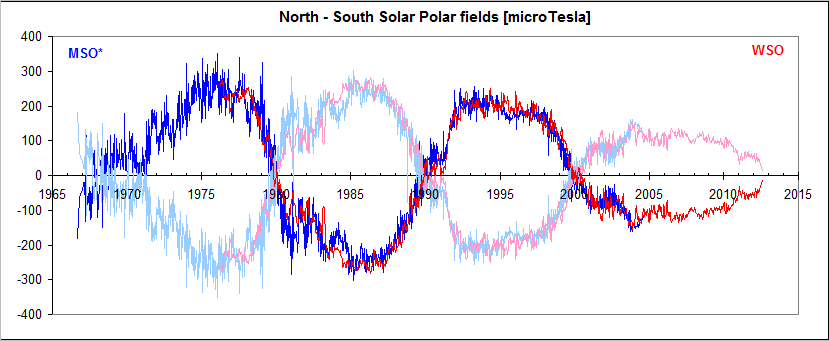
Solar Cycle 24 is nearing its maximum after which the solar activity will decline.     The maximum is often pegged as the time when the Sun’s  north and south poles swap. The chart below shows the current position of the poles. Projecting their current position suggests that the swap will occur early next year.
(Click on Charts to improve clarity)
december12Solar-Polar-Fields-1966-now
    Solar Polar Field 1966 to Present –Wilcox Solar Observatory

Solar Cycle 24 Is Underperforming Its Predecessors


Solar Cycle 24 is underperforming its predecessors, Cycles 21, 22 and 23. The chart below, using sunspots as proxy for solar activity, shows the progress for Cycles 21, 22 and 23 over their nominal 11 year life cycle. Solar Cycle 24’s current progress is clearly less active than 21, 22 or 23. This level of activity, if it continues at its current pace, will be the least active Solar Cycle in the last 100 years.The chart maker is Solen. (Click on the chart for clarity.)

<am,.

How much longer will Cycle 24 go before its maximum activity occurs and quiets down? Experts are forecasting that in the first part of 2013. When the maximum occurs the Sun’s poles switch. So if you want to make your own guess, lets look at how close the poles are to switching right now. The chart below records the position of the North and South poles with time. The three previous Cycles polar locations are shown and you can see when the poles swapped sides. Cycle 24 poles are drawing near that now and it seems likely they will switch soon. If so, it will be a very weak–solar activity–Cycle. (Click chart for clarity.)


Solar Polar Field – Wilcox Solar Observatory (WSO) – 1976 to Present

Solar experts are predicting that Cycle 25 will be less active than 24. In the past, several Cycles with such low solar activity were associated with cooling global temperatures. The global temperature has plateaued for the past 15 to 16 years. The Warmers say that it has to go at least 20 years to disprove their CO2 man-made global warming theory. We may be heading for a period that will be much longer than 20 years of plateaued or even falling global temperatures. This should send the CO2 theory to the trash bin, but it does not necessarily bode well for mankind. Cooler global temperatures have not provided the era of plenty we now enjoy. Food production will likely be less than optimal and that can’t be a good thing with the continued growth of global population.
cbdakota