Category Archives: Solar Activity

German Solar Scientists Say Solar Cycle 25 Will Look Like Cycle 24.


German solar scientists, Frank Bosse and Fritz Vahrenholt say that Solar Cycle 24 is the “..third weakest cycle since observations began in 1755.”  The Accumulated Sunspot Anomaly until 97 months after cycle start is shown on the figure below:

Figure 2: Comparison of all the solar cycles.  The chart shows the accumulated sunspot number anomaly from the mean value.

The mean value is noted at zero and Cycle 24 is running 3817 spots less than the mean and only two other Cycle had fewer.    Note that the seven Cycles that preceded Cycle 24 had more sunspots than the mean.

Continue reading

Solar Cycle 24 Update—-October 2016


Solar Cycle 24 continues on its way to a Sunspot minimum. The thirty day average Sunspot number for September (Ri) was 44.7, a little less than the August number of 50. The black line of the chart Ri is the sum of the north and south solar magnetic fields. While a year or so ago, the southern magnetic field (Rsouth) was creating the majority of the Sunspots, the north magnetic field (Rnorth) is dominate now. In April the Sun had a period of low activity with a thirty day average of 20.9.

cycle24

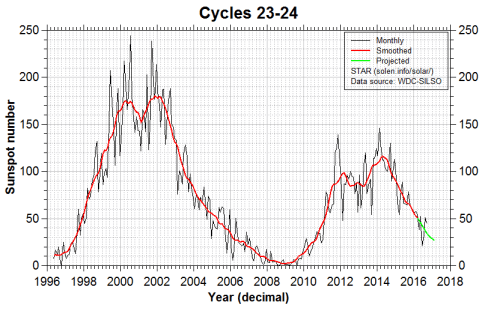
Looking at a comparison of Solar Cycles 23 and 24 shows that the Cycle 24 has been much less active than 23. This, of course, has prompted many to declare we are on our way to another minimum with corresponding cooling of global temperatures. But first a few comments on the difference one of the ways that Sunspots numbers are reported.
cycles23_24

Looking at the far right of the chart, the black line is the monthly average Sunspot number and it is 44.7 as noted above. The red line is the official Sunspot number. It is a thirteen month lagging calculation. It is always 6 months behind the current date. It is the means by which the number is smoothed. The green line is a forecast of what it will probably be when the official smoothed number arrives at September 2016 . The green lines forecasts the September Sunspot number at 34.5. It will probably not be exactly 34.5 at that time but the difference will likely be small..

A comment on my blog by azleader@yahoo.com provided a concise summary of the official number calculation methodology. It can be seen at the at the end of this blog.

Lastly as a reminder of how Cycle 24 looks in comparison to the preceding Cycles, the chart below gives the needed perspective:


This chart illustrates how much more active recent Solar Cycles have been in comparison to Cycle 24. Cycle 21 began in March of 1976. The peak International Smoothed Sunspot number for Cycle 21 was 232, Cycle 22 was211,Cycle 23 was 180 and Cycle 24 was 117.


A look at a Solar Cycle 25 projection is on my list of topics to post—hopefully soon.


All Charts a courtesy of Soleninfo/solar

cbdakota

International Smoothed Sunspot Number calculation.

The smoothed count is a 13-month averaged sunspot count using this Belgium’s formula:
Rs= (0.5 Rm-6 + Rm-5 + Rm-4 + Rm-3 + Rm-2 + Rm-1 + Rm + Rm+1 + Rm+2 + Rm+3 + Rm+4 + Rm+5 + 0.5 Rm+6 ) / 12

Rs = smoothed monthly sunspot count
Rm = One month’s actual sunspot count

The “-6” through “+6” appended to each Rm is the number of months before or after the month whose smoothed count is being calculated. The beginning and ending months in the formula are only given half the value of the others.


Indian, Japanese and Chinese Scientists Publish Research That Predicts Little Ice Age or Maunder Minimum Coming Soon.


The Times of India posted “Sunspots point to looming “little ice age” quoting scientists and astronomers from Physical Research Laboratory in India and their counterparts in China and Japan have fresh evidence that Earth may be heading for another “little ice age” or maybe even another Maunder Mimimum.

Their findings are very similar to those of our scientists. They report that:

“….our blazing sun has been eerily turning quiet and growing less active over the last two decades.”

Continue reading

Solar Cycle 24 Activity Report- Mid-May 2016


Solar Cycle 24 activity has peaked and it is on its way to a minimum.   Of course the exact date of the minimum and the start of Solar Cycle 25 is not known.  Because normal Cycle life is nominally 11 years,  start of Cycle 25 should be in 2019,   The Sunspot number   (Wolf number 30 day average) for April was 38!!  The chart below shows the rather sharp drop from March’s 54.9.

The black line (Ri) is the 30 day average—if you look carefully you will see it is the sum of the green line (Rsouth) and the red line (Rnorth).   The dashed blue line is the “official Sun Spot number.  It is the smoothed count of a 13 month average monthly Sunspot count divided by 12. The oldest and newest monthly count are reduced to half and the other numbers are given their full count.  And is always 6 months behind the most recent month.  This is the way it has been done for many years; hence it has a history record to use for comparing Solar Cycles.

May is showing an up-tick in the Sunspot count.  This up and down, mostly down, will countinue  for several years.

Activity chartNote the change in the 30 Day Wolf Sunspot number–its about 50 now.

The final chart is a comparison of Solar Cycle 23 and Solar Cycle 24:

Solar irradiance was said to have dropped more than usual.  It will have to fall off for months before it is likely to an event of consider “very interesting”.

cbdakota

All charts  by Solen.info/solar


The smoothed count is a 13-month averaged sunspot count using this Belgium’s formula:
Rs= (0.5 Rm-6 + Rm-5 + Rm-4 + Rm-3 + Rm-2 + Rm-1 + Rm + Rm+1 + Rm+2 + Rm+3 + Rm+4 + Rm+5 + 0.5 Rm+6 ) / 12

Rs = smoothed monthly sunspot count
Rm = One month’s actual sunspot count

The “-6” through “+6” appended to each Rm is the number of months before or after the month whose smoothed count is being calculated. The beginning and ending months in the formula are only given half the value of the others.
 

Dr Svalgaard Makes Preliminary Prediction Of Solar Cycle 25 Size


Solar science expert Leif Svalgaard of Stanford University, makes a prediction of Solar Cycle 25 size: “Preliminarily it looks like a repeat of Cycle 24, or at least not any smaller.”

Svalgaard uses a technique that is based upon the dipole moment when the preceding Solar Cycle reaches the minimum. He used this technique for his prediction of Solar Cycle 24 sunspot number that turned out to be very close to what actually took place. He predicted Cycle 24 Sunspot numbers would be much smaller than Cycle 23 when at the same time most of the other forecasters were predicting a rerun of Cycle 23.

Continue reading

Observed GlobalTemperatures Well Below IPCC 1990 Forecast


The “pause” in the global temperature rise is at 18+ years. This is disconcerting the warmer scientists because atmospheric carbon dioxide (CO2) content has been increasing during this period. The warmers have resorted to very poorly disguised attempts to alter the temperature record. Despite their temperature record alterations, the global temperature is well below that forecast by the IPCC in their 1990 report. How much altering of the record must the warmers do to get back in step with the IPCC forecasts? Lord Monckton of Brenchley has posted on the WUWT website “The abject failure of official global-warming predictions”. In his posting he compares land-based temperature organizations and satellite based temperature organizations versus the prediction by the IPCC.

Two charts follow: The first is the UAH plot of global temperatures for an 18 years and 6 months long pause. UAH is a satellite-based record. The second is the RSS satellite based temperatures which differs slightly from the UAH data. The RSS data yields a pause of 18 years and 8 months duration.

UAHtemppuaseclip_image002_thumb2

UAH Global Temperature Chart Showing Duration of the Pause. The left hand scale shows temperature anomalies (plus and minus) in degrees C. The right hand scale shows atmospheric CO2 concentration in PPM. The heavy blue line is the global temperature trend line for the period In small(er) print in the middle of the chart is the trend line slope. For this chart, the trend is a -0.01C temperature change per century.

Continue reading

Climate Change Reconsidered II: Physical Science–An Unbiased Report


The International Panel on Climate Change (IPCC) issues a report every three or four years about global warming. This UN agency’s charter is not to examine the science of global warming but rather to show that man produced greenhouse gases will result in catastrophic damage to the globe.   IPCC does as directed by giving little consideration to data, science or reports that would contradict the charter.

A relatively new report, compiled by the Nongovernmental International Panel cover of part2FrontCover2on Climate Change (NIPCC) has been written to answer the IPCC’ reports. The first installment is Climate Change Reconsidered II: Physical Science (CCR-II). This installment is an independent, comprehensive, and authoritative report on the current state of climate science. It is the fourth in a series of scholarly reports produced by the (NIPCC), an international network of climate scientists sponsored by three nonprofit organizations: Center for the Study of Carbon Dioxide and Global Change, Science and Environmental Policy Project (SEPP), and The Heartland Institute. Real data and unbiased studies were used in the preparation of this installment.

You can link to Climate Change Reconsidered II: Physical Science (CCRII) by clicking here.

cbdakota


Club du Soliel Posts Supportive Studies For Solar Forcing Climate Change


The warmers contend that no one studies the role the Sun plays in global warming any more. It is true that measurements of the Sun’s electromagnetic radiation received at the top of the Earth’s atmosphere, hardly changes. There are annual variations in the Sun’s energy received because the Earth’s orbit around the Sun is elliptical rather than circular. We are further away from the Sun in June than in January. However the distance effect averages out as it is essentially the same from year to year.

earths eliptical orbit600px-Seasons1

Continue reading

A Difference Of Opinions on Entering A Mauder Minimum


Forbes.com posting “Sun Flatlining Into Grand Minimum, Says Solar Physicist on JANUARY 20, 2014. Yes, the posting is nearly two years old. But the snowdriftsimagesdiscordance about the Sun’s influence in the Earth’s climate could not be more evident in the posting.

From the posting:

“My opinion is that we are heading into a Maunder Minimum,” said Mark Giampapa, a solar physicist at the National Solar Observatory (NSO) in Tucson, Arizona. “I’m seeing a continuation in the decline of the sunspots’ mean magnetic field strengths and a weakening of the polar magnetic fields and subsurface flows.”

Continue reading

November 2015 Solar Cycle 24 Update


Solar Cycle 24 activity has peaked and it is trending down to minimal Sunspot numbers. As most Solar Cycles are nominally 11 years in length, one might guess that December 2019 would be the end of Cycle 24 and the start of Solar Cycle 25. hotsunimagesBut don’t bet too much money on that date. Eleven years is 132 months. But Cycle 23 was not completed until 149 months after it began. The chart (courtesy of Solen.info) below shows the current state of Cycle 24:

solartressactive6dec15

Looking at the Solar Cycle 24 progress chart (courtesy of Solen.info) below one can see that the South Polar Field (green line) has been the source of most of the Sunspot activity the past year or so.   And it has really taken a tumble since midyear.

Continue reading