Category Archives: Interglacial periods

Are Seafloor Volcanoes Altering The Climate?


I have received some interesting email of late that states that seafloor volcanoes are altering the Globe’s climate. So, I have been combing through the internet to see what I could find on this topic.

One theory is that seafloor volcanoes are more active in the time of glaciations than at time of the warming period in between. The thinking is that the increased weight of the ocean’s water, as it rises due to glaciers melting, reduces the activity of the many seafloor volcanoes.   The converse is true about the land-based volcanoes that would become more active as the weight of the glacial ice disappears. The ash emitted from land-based volcanoes can cause cooling of the atmosphere but seafloor ash does not get into the atmosphere.

Continue reading

NIPCC Reference: Biological Impacts


A number of you have written telling me that you liked the Nongovernmental International Panel on Climate Change—Science. So I will add the NIPCC’s second reference book: Biological Impacts. Click here to link.

cbdakota

Climate Change Reconsidered II: Physical Science–An Unbiased Report


The International Panel on Climate Change (IPCC) issues a report every three or four years about global warming. This UN agency’s charter is not to examine the science of global warming but rather to show that man produced greenhouse gases will result in catastrophic damage to the globe.   IPCC does as directed by giving little consideration to data, science or reports that would contradict the charter.

A relatively new report, compiled by the Nongovernmental International Panel cover of part2FrontCover2on Climate Change (NIPCC) has been written to answer the IPCC’ reports. The first installment is Climate Change Reconsidered II: Physical Science (CCR-II). This installment is an independent, comprehensive, and authoritative report on the current state of climate science. It is the fourth in a series of scholarly reports produced by the (NIPCC), an international network of climate scientists sponsored by three nonprofit organizations: Center for the Study of Carbon Dioxide and Global Change, Science and Environmental Policy Project (SEPP), and The Heartland Institute. Real data and unbiased studies were used in the preparation of this installment.

You can link to Climate Change Reconsidered II: Physical Science (CCRII) by clicking here.

cbdakota


“The Most Comprehensive Assault On ‘Global Warming’ Ever”.


Mike Van Biezen is a physicist and former believer in catastrophic man-made global warming. His epiphany occurred about 7 years ago, he says, when he realized that between 1940 and 1980, global temperatures had actually declined mallorcatempsscreen_shot_2015-12-23_at_9.47.41_ama bit all the while CO2 was accumulating in the atmosphere at a high rate. Since then, his research into the theory of global warming has converted him to skepticism. Van Biezen says there are many scientific problems with the assumption that human activity is causing “global warming” or “climate change”. He has picked 10 of the many scientific problems and listed them in his posting on the Dailywire.com. titled “The Most Comprehensive Assault On ‘Global Warming’ Ever”.

I will use his heading for each of the ten problems and pick out parts of his explanation of the nature of that specific problem. Of course you will get much more out of this if you use the link to his posting and read all of his explanation.

Continue reading

Forecast US Winter Temperatures and Precipitation


Will the current El Nino be a record setter? Will it create bigger temperature and precipitation events than the current record holder that happened in 1997-98?

The National Oceanic and Atmospheric Administration (NOAA) say for the moment, they do not think so, but it still too early to rule out that possibility.

For the US, this probably means a warmer and drier period from December through mid-March in the North and Northeast and a cooler and wetter period in January through April in the South and Southwest.   The December’s temperatures in the Northeast are high enough to be record setters. NOAA says that there is typically about a month’s delay to see the effect in the South and Southwest.

NOAA forecasts of the US weather resulting from El Nino can be seen in the following two charts. NOAA hedges their bet by showing three possible forecast US weather bands. The highest percentage being the most likely.  First the forecast temperatures:

ELNINOtemp

The Northern part of the US has a 62% chance of a warm winter. And almost no chance of being cooler than normal. The midsection is a coin toss. The South will be cooler than normal.

Continue reading

Fireworks At Senate Subcommittee Testimony On Global Warming


Some fireworks at yesterdays hearing  of the Senate’s subcommittee on Commerce Science and Transportation.  Senator Ted Cruz is the Chairman of the subcommittee.  He invited 4 guests to demonstrate that the current theory of catastrophic man-made global (CMGW) warming is far from proven.   Cruz’s guest were Judith Curry, John Christy, William Happer and Mark Steyn.

The fireworks came about after Senator Markey made is own presentation.  Clearly Markey does not have much in the way of the science but he is able to parrot what the warmers tell him.  The Youtube that follows is very interesting:

Continue reading

COP21: Dreams From My (Father?) Climate Computer Models


Data dominates the skeptic’s view of the state of the globe’s temperature and where that temperature may be heading. The climate computer models dominate the warmers view. Temperature is at the heart of the global warming issue in that just about every other indicator is a function of the temperature. For example, sea level change is the product of melting ice at the South Pole and Greenland along with the lesser masses of ice in the high elevations of the mountain ranges. Rainfall, and its shadow drought are said to be forced by changes in the temperature. Higher ocean temperatures, we are assured, breed the hurricanes and typhoons. So this posting will focus on global temperatures.

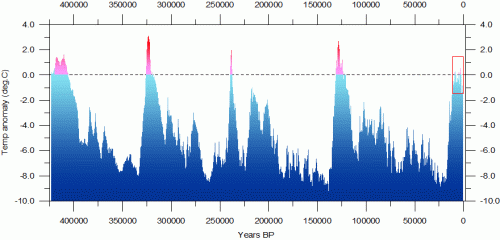
First it would be well to try to understand the past. Ice core analyses from the Antarctica were used to reconstruct global temperatures for the last 420,000 years. Figure 2 below, from climate4you.com illustrates the temperature for that period of time:
VostokTemp0-420000 BP-2

Fig.2. Reconstructed global temperature over the past 420,000 years based on the Vostok ice core from the Antarctica (Petit et al. 2001). The record spans over four glacial periods and five interglacials, including the present. The horizontal line indicates the modern temperature.

From climate4you.com comes the following discussion: “The present interglacial period (the Holocene) is seen to the right (red square). The preceding four interglacials are seen at about 125,000, 280,000, 325,000 and 415,000 years before now, with the longer glacial periods in between. All four previous interglacials are seen to be warmer (1-3°C) than the present. The typical length of a glacial period is about 100,000 years, while an interglacial period typical lasts for about 10-15,000 years. The present interglacial period has now lasted about 11,600 years.

Continue reading

Little Ice Age By 2030?


Professor Valentian Zharkova of Northumbria University presented her results Cold-Weather-Cartoonfor a new model of the Sun’s interior dynamo to the Royal Astronomical Society. Zharkova and her team believe they have made a discovery that allows them to predict solar activity. From the Royal Astronomical Society’s National Astronomy Meeting 2015 – report 4” posting:

“We found magnetic wave components appearing in pairs; originating in two different layers in the Sun’s interior. They both have a frequency of approximately 11 years, although this frequency is slightly different [for both] and they are offset in time,” says Zharkova. The two magnetic waves either reinforce one another to produce high activity or cancel out to create lull periods.

The model predicts that the magnetic wave pairs will become increasingly offset during Cycle 25, which peaks in 2022. Then during Cycle 26, which covers the decade from 2030-2040, the two waves will become exactly out of synch, cancelling one another out. This will cause a significant reduction in solar activity. “In cycle 26, the two waves exactly mirror each other, peaking at the same time but in opposite hemispheres of the Sun. We predict that this will lead to the properties of a ‘Maunder minimum’,” says Zharkova”

Continue reading

Skeptic Reference Sources—1350+ Peer-Reviewed Papers


This is the second posting of skeptic reference sources. This time it is “1350+ Peer- Reviewed Papers Supporting Skeptic Arguments Against ACC/AGW Alarmism”.   The papers have been sorted by categories to Cooling_is_the_New_Warmingmake the desired documents easily located. It is interesting that PopularTechnology.net supplied “Rebuttals to Criticisms” in the beginning. These are also a leg-up for you in discussions with warmers.

Click here to enter the PopularTechnology.net website.

cbdakota

Predicting Solar Cycle 25. Are We Heading For Another Maunder Minimum?


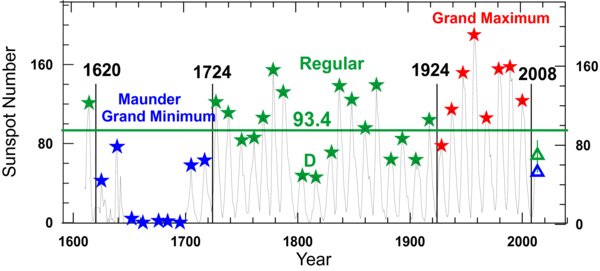
A study was published in 2012, Sudden transitions and grand variations in the solar dynamo, past and future” by Cornelis DeJager and Silvia Duhan . The authors attempt to predict whether Solar Cycle 25 will transition to a “Grand Minimum” or “Regular “ Episode. They believe the Sun is transitioning from a “Grand Maximum” to one or the other aforementioned Episodes. This study is being used because their prediction was based upon knowing the Solar Cycle 24’s maximum Sunspot number which we now have.

First a look at the “Episodes” that the authors have placed the Solar Cycles from 1620 to the present.

grandcyclesswsc120009-fig4The diagram shows the sunspot numbers plotted against time. The three Grand Episodes are marked by their different colors. They are separated by vertical black lines.

Continue reading