The catastrophic global warmers, often known as the alarmists, have created several forecasts of how much carbon dioxide (CO2) will reside in the atmosphere to the year 2100. The different forecasts range from massive amounts to lower than today’s 420 ppm. As discussed in my previous blog, “Climate Warming has been cut in half over the past 5 years”- Part 2 Former Numbers were implausible. the scientific community is split by those that believe the massive amounts of CO2 are unlikely to ever exist and those using the massive amount to terrify youths (and gullible) adults. The mainstream media is primary the conveyer of these scare tactics.
Climate catastrophism may be contributing to the youth mental health crisis. In a recent international youth survey, 45% reported thoughts of climate change negatively affecting their daily lives and functioning, and 40% reported being hesitant to have children (10).
In summary, a wide range of climate scenarios should be explored, but, with implausible catastrophic scenarios already a major focus of scientific research, calls for a greater emphasis in this direction risk crowding out a needed focus on more plausible futures.
A 2020 survey by the American Psychological Association supports their concern. “Nearly half of those age 18-34 (47%) say the stress they feel about climate change affects their daily lives,” said Arthur C. Evans Jr., PhD, the Psychological Association’s chief executive officer.
Just to magnify the illegitimate use of forecasts to spread these despicable ideas of the world to come to an end soon is shown in the following chart.
Click on chart to enlarge. Chart courtesy of PNSA
The box on the right portrays the CO2 in the atmosphere forecasts made by groups within the UN’s Intergovernmental Panel on Climate Change (IPCC). The Y axis charts the CO2 emissions in the outgoing years where the top line is the massive CO2 prediction that will produce very high global warming temperature forecasts. The line just below is the most probable forecast which is a mix of renewables and fossil fuels. The others are fantasy IMHO.
The box on the left’s Y axis show the percent of forecasts made using the various CO2 emissions paths. The X axis is the forecasts during the IPCC Assessment Report (AR5) in 2014 and the IPCC AR 6 in 2022. The bars show the use of the different CO2 forecasts to make their predictions. It is apparent that the Alarmists felt that they need to do more frightening by the fact that more predictions using the massive CO2 atmosphere prediction than they did in 2014. The forecast using the line I said was the mix of renewables and fossil fuel was nearly non-existent. The massive CO2 was used more than any of the remaining lines that essentially forecasting fossil fuel use going to zero.
Growing realization by the climate establishment that the threat of future warming has been cut in half over the past 5 years.
Summary: The climate “catastrophe” isn’t what it used to be. Circa 2013 with publication of the IPCC AR5* Report, RCP8.5 was regarded as the business-as-usual emissions scenario, with expected warming of 4 to 5 oC by 2100. Now there is growing acceptance that RCP8.5 is implausible, and RCP4.5 is arguably the current business-as-usual emissions scenario. Only a few years ago, an emissions trajectory that followed RCP4.5 with 2 to 3 oC warming was regarded as climate policy success. As limiting warming to 2 oC seems to be in reach (now deemed to be the “threshold of catastrophe”),[i] the goal posts were moved in 2018 to reduce the warming target to 1.5 oC. Climate catastrophe rhetoric now seems linked to extreme weather events, most of which are difficult to identify any role for human-caused climate change in increasing either their intensity or frequency.
The main stream media is currently awash with articles from prominent journalists on how the global warming threat less than we thought. Here are some prominent articles:
At the heart of this good news is abandonment of RCP8.5 from UNFCCC policy making. The hero of science behind this abandonment is Justin Ritchie, a recent Ph.D. graduate (whose work has been cited.
The COP26 and now the COP27 have quietly dropped RCP8.5 (and SSP5-8.5) from their considerations, focusing on the envelope between RCP4.5 and RCP2.6. The grand poohbahs of the IPCC apparently didn’t see this coming (or preferred to keep spinning the alarm), since they instructed climate modelers for CMIP6 to continue a focus on SSP5-8.5, and climate researchers continue to focus on this scenario in their impacts publications. The IPCC AR6 prominently featured SSP5-8.5, although WGI did make this lukewarm statement
The second so-called scientific advance is lower values of climate sensitivity. The so-called advance is associated with the IPCC AR6 decision NOT to include values derived from climate models (which have dominated previous IPCC reports). They implicitly acknowledge that climate models are running too hot and that you can pretty much get whatever value of climate sensitivity that you want from a climate model (this has been blindingly obvious to me and many others for over a decade). The IPCC AR6 lowered the upper likely bound of ECS to 4.0oC (from 4.5oC previously); this further acts to reduce the amount of projected warming. The IPCC AR6 also raised the lower likely bound of ECS to 2.5oC (from 1.5oC). Raising the lower bound of ECS is on very shaky ground, as per the recent publication by Nic Lewis
The COP27 is working from a value of expected warming of 2.5oC by 2100. This is arguably still too high for several reasons. IPCC expert judgment dismissed values of climate sensitivity that are on thelower end (that should not have been dismissed as per Nic Lewis’ paper). Further, the IPCC projections do not adequately account for scenarios of future natural climate variability. See these recent posts:
In addition to an insufficient number of solar and volcanic scenarios, the climate models ignore most solar indirect effects, and the climate model treatment of multidecadal and longer internal variability associated with ocean circulations are inadequate. While in principle these factors could go either way in terms of warmer vs cooler, there are several reasons to think these natural factors are skewed towards cooler during the remainder of the 21st century:
Baseline volcanic activity since 1850 has been unusually low
Most solar researchers expect some sort of solar minimum in the mid to late 21st century
Solar indirect effects are inadequately treated by climate models, which would act to amplify solar cooling
A shift to the cold phase of the Atlantic Multidecadal Oscillation is expected in the next decade, which influences not only global temperatures but also Greenland mass balance and Arctic sea ice.
Once you include alternative scenarios of natural variability, temperature change by 2100 could easily be below 2oC and even 1.5oC. Recall that this warming is with reference to a baseline of1850-1900; 1.1oC warming has already occurred.
*AR stands for Assessment Report. These are based upon the content in the Intergovernmental Panel on Climate Change (IPCC) full reports, assembled by working groups. AR6 is the most recent report. The reputation of the ARs is in dispute. The full report, the 6th, is condensed to an AR6. The dispute is that many nonscientific personnel, such as delegates from industry, NGOs, etc. can force change that make the AR inconsistent with the full report.
Bloomberg posts: “China to prioritize energy security over transition to renewables, Xi Says”. President Xi Jinping never has intended to stay with his promise to stop emitting CO2 by 2030. Time and again, the warmers have said how wonderful China is and how bad the US is regarding CO2 emissions. This despite the fact that in the past ten years the US emissions have declined (more than any other nation) while China’s emissions have increased massively. The warmers just recently learned that China had decided in their 5-year plan to up the number of coal plants they planned to install. The warmers just knew that was not going to happen, but sure as the Sun Rises in the east, they were wrong.
Now, Xi says:”
“He will use prudence about governing China’s efforts to peak and eventually zero out carbon emissions.”
So, 2030 is not a firm date anymore.
It happens that I agree with his reasoning (that I underlined). Bloomberg posting related this:
”Xi speech made China’s path to decarbonization clear saying It won’t stop burning fossil fuels until it’s confident that clean energy can reliably replace them. The speech shows more emphasis on energy security and the significant role of coal in China’s energy supply given the resources endowment.
The Bloomberg posting gives the reader background on China and promises:
China is the world’s largest emitter of greenhouse gases, and Xi electrified climate activists two years ago when he vowed to reach carbon neutrality by 2060 after peaking emissions before 2030. The announcement sparked a massive surge in investment in clean energy by local governments and state-owned firms.
But last year focus began to return to China’s mainstay fuel of coal after a shortage triggered widespread power curtailments to factories, slowing economic growth. The country vowed to increase mining capacity, and production has risen to record levels this year, keeping storage sites well stocked and reducing imports.
China will also expand exploration and development of oil and gas resources, and increase reserves and production as part of the measures to ensure energy security, according to a congress work report released after Xi’s speech.
Does this sound like someone planning to cut back.?
Sorry warmers!
No nation should cut back on fossil fuels until wind and solar can prove they are be reliable suppliers. And that may be never.
cbdakota
Hat tip to Net zero posting. “China to prioritize energy security over transition to renewables, Xi Says”
The comparison of Solar Cycle (SC)25 to its predecessor SC 24 currently indicates that there is little difference in activity at the same point in time after they began. Looking at the chart below, the two bottom lines, are SC 24 and 25. Several months ago, SC 25 was more active than SC 24 and that lead to the thought it would be much more active than SC24. The expert forecasts mostly said that they would be much the same. At this point, the forecasts of similarity appear to be accurate
The following chart shows the history of the recorded SCs. Sunspot numbers have only been collected for recent centuries. When a series of SCs having low numbers of sunspots occur, historically, the result is global cooling. When a series of SCs occur with high numbers of sunspots, the result seems to be warming.
Beginning in the early part of the last century, SCs were highly active, peaking with SC19. SC19 has the record for most sunspots. The SCs that followed were highly active until SC 24. This period has been called a solar maximum.
The timing of the solar maximum and the increase in atmospheric CO2 are rivals for the reason that global temperatures have risen beginning in the latter part of the last century. Perhaps they both have been complicit.
I believe that the Sun is the major factor determining global climate. The trajectory of the SC 24 and probably SC 25 would suggest a global cooling is in the offing. This should be a defining period.
This is the sixth posting of a series listing things that the alarmists and the mainstream media do not want made public. At the top of this posting is a link to the preceding postings.
The Paris Agreement (PA) has been a flop, so far. The PA’s target is lowering CO2 emissions. Since the PA was signed in 2015 by some 180+ nations, the CO2 emissions have risen.
The chart below, from Rhodium, shows the percentage of the total global emissions of the so-called greenhouse gases made by the top 8 emitters in 2019. China is far and away the leading emitter and will be increasing the difference in the future. CO2 from fossil fuels is nominally 80+ % of the total emissions. The rest of the total is from cement manufacturing, methane, and fluorocarbons, etc. In 2020, the emissions dropped due to COVID but are forecast to be back up in 2021.
The International Energy Agency forecasts that 2021 will exceed the emissions in 2019. Their forecast is 33GtCO2 for the year 2021.
China and India as well as many nations in Africa and Asia are installing coal-based power plants at a breakneck speed. Because coal combustion produces more CO2 per Megawatt hour, than any other commonly used fossil fuel, it is the primary target of the alarmists. Bloomberg Green data reports on the primary users of coal int 2019:
COAL USER
% OF TOTAL COAL USED
CHINA
51.7
INDIA
11.8
US
7.2
REST OF THE WORLD
29.3
The US has been reducing the use of coal by using natural gas as a replacement.
The premise of the PA is to essentially eliminate all global manmade CO2 emissions to prevent the global temperature to have risen to 2C since 1900. Or else, awful things are going to happen the alarmists tell us.
If the US were able to totally reduce their emissions, would that prevent the global temperature to rise to 2C?
“Not when almost 90 percent of all of the planet’s global emissions come from outside of US borders. We could go to zero tomorrow and the problem isn’t solved,” Kerry conceded.
All the signers of the PA must submit their Nationally Determined Contribution (NDC), a plan to reduce CO2 emission. Then every 5 years they are to make a new set of NDCs more robust than the preceding submittal. There are no penalties for not meeting your NDC nor are there any for not making a sufficient effort. The burden for accomplishing this objective is laid on these 42 nations that signed the PA. This group consists of the 27nations within the EU, Australia, Canada, Chile, Iceland, Israel, Japan, Korea, Mexico, New Zealand, Norway, Switzerland, Turkey, the US, and the UK. These nation are accused of creating the problem because they have used fossil fuels to discontinue the use of horses, whale oil, backbreaking labor, inadequate living conditions, child labor, while at the same time providing affordable and available electricity— just to mention a few reasons.
The first submission of NDCs were underwhelming. And since then, the story is:
President Xi and the then President Obama met. Obama was going to bring China into the PA. The deal was that China could continue increasing their emission until 2030 without disapproval of the PA organization. From China’s perspective it was a perfect opportunity to build up their manufacturing/economy while the other nations were destroying theirs.
China has disappointed in every way, especially those who thought China was really into environmental stuff. China recently announced that wind and solar are too unreliable to depend upon. An added that they were reducing support to renewables. That was followed by the fact that they were going to build more coal plants. They offered to buy the UKs steel business. Does that sound like someone who worries about the global warming theory? Their new five-year plan that was expected to be based upon using less coal, turned out to be based on more coal.
“At a time when China is so obviously saying one thing and doing another, and clearly not fulfilling its share of the world’s commitments to reducing CO2 emissions — as the world’s second-largest economy– sends all the wrong signals. What China and others see is that no matter what it does — even if it deceives the world and continues its predatory behavior — the US is willing to reduce its own competitiveness, leaving China a thick red carpet to become the world’s dominant superpower, the very role to which it aspires. “
This same Gatestone posting also reminds that the Chinese government are not people of their word:
“It is extremely unlikely that China will deliver on its climate commitments and there are enough precedents to show that the CCP’s pledges cannot be trusted. In 1984, China pledged that Hong Kong’s autonomy, including its rights and freedoms, would remain unchanged for 50 years under the principle of “one country, two systems” after the 1997 return to Chinese sovereignty. By June 2020, however, when China introduced its iron-fisted national security law in Hong Kong, China had reneged on its pledge, and the CCP continues to crush Hong Kong.
China also broke its 2015 commitment not to militarize artificial islands that Beijing has been building in the Spratly Islands chain in the South China Sea and it has never honored at least nine of the commitments it made when it joined the World Trade Organization, to name just a few instances.
The list of broken pledges does not even include the lies that China told the world about the supposed non-transmissibility of the Coronavirus, which originated in Wuhan and has so far taken more than three million lives and ravaged countless economies.”
And another pact, the Montreal Protocol on Ozone is another example of a broken pledge. Jonathan Turley’s post titled China found in massive violation of the Montreal Protocol:
“A study in Nature shows a massive violation by China in the release of ozone-depleting gases like chlorofluorocarbons. China agreed to the Montreal Protocol to stop such CFC pollution. However, it now appears that the Chinese regime is violating the Protocol. A concentration of increased CFC pollution was traced to the northeastern provinces of Shandong and Hebei.”
“We find no evidence for a significant increase in CFC-11 emissions from any other eastern Asian countries or other regions of the world where there are available data for the detection of regional emissions. “
“Several considerations suggest that the increase in CFC-11 emissions from Eastern mainland China is likely to be the result of new production and use, which is inconsistent with the Montreal Protocol agreement to phase out global chlorofluorocarbon production by 2010.”
“If China cannot comply with the Montreal Protocol to control these most dangerous pollutants (particularly with the availability of alternatives for industry) the nation undermines its already low credibility on environmental compliance.”
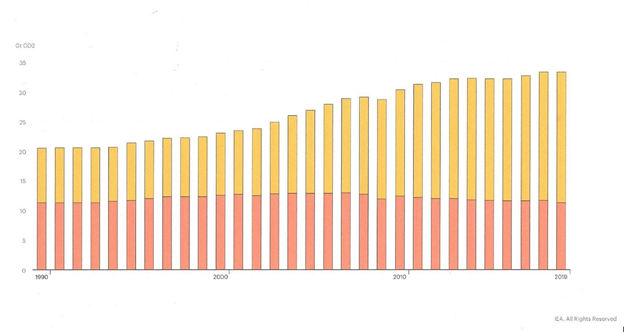
Look at what is already under way. This chart by IEA shows the Energy Related CO2 Emissions. The table that follows illustrates that the Advanced Economies have a diminishing role in controlling CO2 emissions.
Yellow is “Rest of the World” and rust is “Advanced Economies”.
IEA Chart
2010 2019
GtCO2
% of Total
GtCO2
% of Total
Advanced Economies
12.6
54.5
11.3
34
Rest of the World
10.5
45.5
22.0
66.0
Total
23.1
100
33.3
100
Energy Related C02 Emissions
IEA Data
In ten years, the advanced Economies reduced their energy related emissions by 1.3 GtCO2. The Rest of the World increased their emissions by 11.5 GtCO2. Neither China, nor India nor Brazil nor Russia nor the other Asian and African nations are going to stop installation of fossil fuel-based energy. Their reasons for this are many but they want their people to have electricity and other products of fossil fuels, too.
So, John Kerry nailed it, ““Not when almost 90 percent of all of the planet’s global emissions come from outside of US borders. We could go to zero tomorrow and the problem isn’t solved,”
If the West attempts to decarbonize, it will not succeed. I think that the further they get in this futile and misdirected attempt will be disastrous —not to the climate but to the viability of the West. The public will eventually wake up to the facts. Price rises for everything and sharp rises for electricity and gasoline, the new name for renewable will be unreliables, jobs will disappear as manufacturing leaves our shores for lower cost energy, and an unease about the US loss of stature and ability to protect its citizens. These things are likely to create public awareness that the government programs have had disappointing results.
If the West attempts to decarbonize, it will not succeed. I think that the further they get in this futile and misdirected attempt will be disastrous —not to the climate but to the viability of the West.
There is another party that wants to see the West fail. That is a movement titled the Great Reset. This blog will discuss the Great Reset in the next posting.
From a recent Dr. Roy Spencer blog: Seldom is the public ever informed of these glaring discrepancies between basic science and what politicians and pop-scientists tell us. Why does it matter? It matters because there is no Climate Crisis. There is no Climate Emergency. Yes, irregular warming is occurring. Yes, it is at least partly due to human greenhouse gas emissions. But seldom are the benefits of a somewhat warmer climate system mentioned, or the benefits of more CO2 in the atmosphere (which is required for life on Earth to exist). But if we waste trillions of dollars (that’s just here in the U.S. — meanwhile, China will always do what is in the best interests of China) then that is trillions of dollars not available for the real necessities of life. Prosperity will suffer, and for no good reason.“
This is the fifth posting of a series listing things that the alarmists and the mainstream media do not want made public. At the top of this posting is a link to the preceding postings.
To hear the global warming alarmists, carbon dioxide (CO2) is poison. It is on a mission to destroy the Earth. It is a pollutant that must be stopped. There are some people convinced that if fossil fuels burning was completely stopped, there would be no more CO2 anywhere. The alarmists do not want you to know how beneficial CO2 is.
“Carbon is the backbone of life on Earth. We are made of carbon, we eat carbon, and our civilizations—our economies, our homes, our means of transport—are built on carbon”. That is a quote from NASA’s posting, the Carbon Cycle.
POISON
Let us begin by disposing of the myth that CO2 is a poison. Do you know that every time you exhale, your breath contains about 40,000 parts per million (ppm) CO2. That contrasts with air you breathe that has a concentration of about 415ppm.
MAN-MADE CO2 IS A SMALL FRACTION OF THE CARBON CYCLE
The NASA chart below tells the story of the CO2 from manmade sources, and natural source. The natural sources are in white and the man-made sources are in red. The numbers are gigatons of carbon presumably because the form that carbon assumes in this chart might not always be in the form of carbon dioxide **.
According to this chart, five of the nine manmade gigatonnes of carbon are removed from the atmosphere. The “greening” of the Earth’s surface is attributable to an increase in atmospheric CO2, that would explain the “Net terrestrial uptake shown on the chart.
\
Into Atmosphere
Man Made
Fossil Fuels, Concrete etc.
9-5 GtC/Y
in
Plants
Respiration
60
in
Soil
Respir & Decomp
60
in
Ocean
Respir & Decomp
90
Out of Atmosphere
Plants
Photosynthesis &Biomass
120 + 3
out
Ocean
Photosynthesis
90+ 2
Atmosphere Net
In
214 G tC/Y
Atmosphere Net
Out
210 GtC/Y
GtC/Y is gigatonnes of carbon per year. (1 gigatonne =billion tonnes.) (1 tonne =2205 pounds)
** CO2’s molecular weight is 44 because it is made up of 12 from carbon and 32 from two oxygens. Thus, the gigatonnes of CO2 are larger than the fraction of carbon (C) numbers shown on the chart.
The most accurate number on the chart is probably the net increase in the atmosphere as it is considered well mixed. Measurements of atmospheric CO2 concentration are made frequently and in several places around the globe.
It is likely, that the fossil fuel, etc. number is the next most accurate number on this chart. Emission sources are reasonably known so a fairly good estimate can be made. The other numbers may be swags (Scientific Wild Ass Guess).
The amount of manmade CO2 relative to the amount of natural CO2 is quite small. It is about 4% of the total.
CROP PRODUCTION SETS RECORDS DUE TO INCREASED ATMOSPHERIC CONCENTRATION OF C02.
Trend in Annual Average Leaf Area 2000 to 2017
Satellite images show that plant cover has become lush all over the world. This increase in green biomass worldwide is equivalent to a new green continent twice the size of the US.
It has been long known that increasing CO2 benefits plant growth through the CO2 fertilization effect. Recognizing the benefits of this, greenhouses often increase CO2 to 1,500 ppm. Research from laboratory studies by the Center for the Study of CO2 and Global Change has documented that a 300 ppm rise in CO2 levels would increase plant biomass by 25 to 50%. This significant boost in plant productivity, along with a boost from lengthening growing seasons, means that we are better able to feed a hungry planet.
An additional significant benefit from this increasing CO2 fertilization is that the plants have smaller stomata (pores) and have lessened water needs. Less water used means that more stays in the ground and is leading to increased soil moisture across much of the planet and a “greening” of the Earth. According to NASA, up to 50% of the Earth is “greening,” in part due to higher CO2 levels. This increased soil moisture is a primary cause for the long-term decrease in forest fires and droughts worldwide.
A group of scientists from Australia, focusing on the southwestern corner of North America, Australia’s outback, the Middle East, and some parts of Africa studied satellite imagery by teasing out the influence of carbon dioxide on greening from other factors such as precipitation, air temperature, the amount of light, and land-use changes. The team’s model predicted that foliage would increase by some 5 to 10 percent given the 14 percent increase in atmospheric CO2 concentration during the study period. The satellite data agreed, showing an 11 percent increase in foliage after adjusting the data for precipitation, yielding “strong support for our hypothesis,” the team reports.
In addition to greening dry regions, the CO2 fertilization effect could switch the types of vegetation that dominate in those regions. “Trees are re-invading grass lands, and this could quite possibly be related to the CO2 effect,” Donohue said. “Long lived woody plants are deep rooted and are likely to benefit more than grasses from an increase in CO2.”
And food crops are setting new records in addition to its record forecast for global wheat production in 2021, the FAO said it’s expecting a new and higher estimate for world cereal production in 2020, now seen at 2.76 billion tonnes, a 1.9% increase from the previous year, lifted by higher-than-expected outturns reported for maize in West Africa, for rice in India, and wheat harvests in the European Union, Kazakhstan, and the Russian Federation.
“ … the global wheat out turn is seen at a record, while maize is placed at the second largest ever and barley at the highest in a decade,” the report said.
The leader in studying CO2 effects on plant growth is the CO2 Science Organization. One of their studies is as follows:
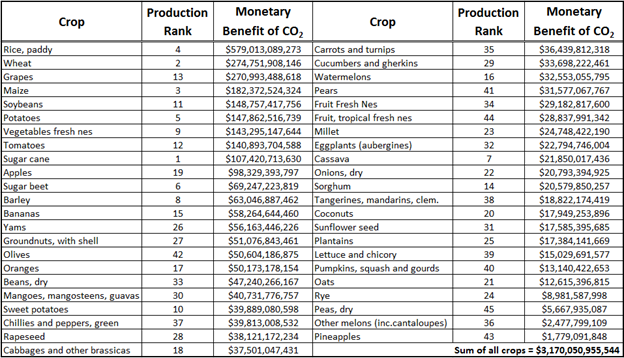
The first step in determining the monetary benefit of historical atmospheric CO2 enrichment on historic crop production begins by calculating what portion of each crop’s annual yield over the period 1961-2011 was due to each year’s increase in atmospheric CO2 concentration above the baseline value of 280 ppm that existed at the beginning of the Industrial Revolution.
To summarize what they did was begin with the wheat body mass and yield that occurred in 1961 and what it would be 50 years later using the CO2 growth factor. The atmospheric CO2 concentration went up during those 50 years by 37.4 ppm. They did account for the factors such as new improvements in the wheat seed, the amount of planting of during those years for example. This was to make sure that only the CO2 enhancement part would be used to determine the money benefits. The resultant value of 4.35% indicates the degree by which the 1961 yield was enhanced above the baseline yield value corresponding to an atmospheric CO2 concentration of 280 ppm. They also used constant dollars for the study.
Table 3. The total monetary benefit of Earth’s rising atmospheric CO2 concentration on each of the forty-five crops listed in Table 1 for the 50-year period 1961-2011. Values are in constant 2004-2006 U.S. dollars.
.
As can be seen from Table 3, the financial benefit of Earth’s rising atmospheric CO2 concentration on global food production is enormous. Such benefits over the period 1961-2011 have amounted to at least $1 billion for each of the 45 crops examined; and for nine of the crops the monetary increase due to CO2 over this period is well over $100 billion. The largest of these benefits is noted for rice, wheat, and grapes, which saw increases of $579 billion, $274 billion and $270 billion, respective.
Yes, the monetary benefit of all the crops, is $3,170,050,955,544. $3+trillion.
This report also calculates what the benefit would be by 2050. That sums up to $9.765 trillion. The full report can be seen by clicking this link.
These results will be rehashed when this series discusses the Social Cost of Carbon.
The following, recent study found that the greening was playing a “beneficial role of the land carbon sinks……”
CO2-induced planetary greening leads to an enormous expansion of Earth’s carbon sink.
By 2100 this greening-sink effect will offset 17 years of equivalent human CO2 emissions.
This easily supersedes the effect of the Paris Agreement’s CO2-mitigation policies.
In a break from the deflating global news of viral infections and rising death rates, a groundbreaking new study (Haverd et al., 2020) affirms the “beneficial role of the land carbon sink in modulating future excess anthropogenic CO2 consistent with the target of the Paris Agreement” via the fertilization effect of rising CO2.
There has been a 30% rise in global greening since 1900. CO2 fertilization is the “dominant driver” of these greening trends, with an additional positive contribution from climate warming.
When CO2 levels double (to 560 ppm), this CO2-fertilization-greening effect is expected to increase to 47%.
Growth in the land’s carbon sink – absorbing excess CO2 emissions – will reach 174 PgC by the end of the century.”
This is the equivalent of eliminating 17 full years of human CO2 emissions.”
There are still some government groups and alarmists that are denigrating the crops produced by the CO2 greening effect.
“In their Summary for Policymakers issued in 2014, the UN intergovernmental Panel on Climate Change acknowledges that the planet has greened, but they say that major crops that 1C above preindustrial levels will negatively impact yields, further they say that thereafter median yields will be reduced by 0 to 2% per decade”.
We are 7 years down the road, and the greening and crop records just keep rolling in despite this forecast by the IPCC.
“We analyzed the impact of elevated CO2 concentrations on the sufficiency of dietary intake of iron, zinc and protein for the populations of 151 countries using a model of per-capita food availability stratified by age and sex, assuming constant diets and excluding other climate impacts on food production. We estimate that elevated CO2 could cause an additional 175 million people to be zinc deficient and an additional 122 million people to be protein deficient (assuming 2050 population and CO2 projections). For iron, 1.4 billion women of childbearing age and children under 5 are in countries with greater than 20% anaemia prevalence and would lose >4% of dietary iron.”
Don’t you like how these experts think they can detail the numbers of people that will be harmed. They are not good at this. Never do these IPCC types ever find anything but doom for any theory but theirs.
“And Prof Judith Curry, the former chair of Earth and atmospheric sciences at the Georgia Institute of Technology, added: “It is inappropriate to dismiss the arguments of the so-called contrarians, since their disagreement with the consensus reflects conflicts of values and a preference for the empirical (i.e., what has been observed) versus the hypothetical (i.e., what is projected from climate models).
“These disagreements are at the heart of the public debate on climate change, and these issues should be debated, not dismissed.”
NASA has not hidden this information, but the alarmists and the mainstream media have done their best to prevent you from seeing it.
No matter how they try to eliminate CO2 it just keeps making life more livable. It is part of the energy making process in plants and animals. without which we would all die. The mass starvation predicted by the alarmists as the world’s population ballooned, did not happen because CO2 increased the food supply.
From a recent Dr. Roy Spencer blog: Seldom is the public ever informed of these glaring discrepancies between basic science and what politicians and pop-scientists tell us. Why does it matter? It matters because there is no Climate Crisis. There is no Climate Emergency. Yes, irregular warming is occurring. Yes, it is at least partly due to human greenhouse gas emissions. But seldom are the benefits of a somewhat warmer climate system mentioned, or the benefits of more CO2 in the atmosphere (which is required for life on Earth to exist). But if we waste trillions of dollars (that’s just here in the U.S. — meanwhile, China will always do what is in the best interests of China) then that is trillions of dollars not available for the real necessities of life. Prosperity will suffer, and for no good reason.“
In the previous postings, the computers predicting global temperatures were shown to be much higher than the actual measured temperatures and that you are not being told that the actual measured global temperatures are currently falling and do not seem to have a link with the rising CO2 accumulating in the atmosphere. This posting looks at the future predictions of global temperatures and how they are biased to make you think they are going to be rising quickly.
To have some understanding how the computers are programed one needs to be acquainted with Equilibrium Climate Sensitivity (ECS) and Representative Concentration Pathways (RCP).
ECS
Firstly, an examination of ECS. The 1979 Charney Report, named for the Chairman of an Ad Hoc group stated:
“We believe, therefore, that the equilibrium surface global warming due to doubled CO2 will be in the range IC to 4C, with the most probable value near 3°C”.
That means, for a doubling of atmospheric CO2, global temperature will rise approximately 1C due to CO2, and the CO2 induced increase in temperature will result in more water vapor. Water vapor is a powerful greenhouse gas. That and some other minor changes in atmospheric gases will result in an additional rise of 2C. Thus, CO2 doubling does not just create 1C rise but rather a 3C rise. They acknowledged that there was a lot of uncertainty about this number. How water vapor and clouds interact are not yet known with any certainty.
Climate sensitivity is expressed two ways. Transient Climate Sensitivity (TCS) is the initial effect of the change in CO2 concentration. ECS does not happen until the oceans heat come into equilibrium with atmospheric heat, for example.
ECS is controversial. There are those that do not believe in the CO2 effect at all. They may not appreciate this postings discussion of ECS and RCP but the posting is addressing what the Alarmists believe. Also, many others buy into the concept but conclude that the effect is much lower than the 3C rise due to a doubling of atmospheric CO2. Down as low as 1C. As well, there are alarmists that use ECS in the 4C range.
As can be seen in the Part 1 posting, the ECS being used has yielded too high of global temperatures.
It has long been known that previous generations of climate models exhibit excessive warming rates in the tropical troposphere. With the release of the CMIP6 (Coupled Model Intercomparison Project Version 6) climate model archive we can now update the comparison. We examined historical (hindcast) runs from 38 CMIP6 models in which the models were run using historically observed forcings. We focus on the 1979–2014 interval, the maximum for which all models and observational data are available and for which the models were run with historical forcings. What was previously a tropical bias is now global. All model runs warmed faster than observations in the lower troposphere and midtroposphere, in the tropics, and globally. On average, and in most individual cases, the trend difference is significant. Warming trends in models tend to rise with the model Equilibrium Climate Sensitivity (ECS), and we present evidence that the distribution of ECS values across the model is unrealistically high.”
If you are a climate computer programmer, you can increase the ECS, and it will result in an increase in forecast temperature.
RCP
Representative Concentration Pathway (RCP) is an estimate of the amount of CO2 in the atmosphere at any given time. After studying numerous scenarios, more than the available computer time would allow, they settled on just 5 RCPs.
It is my understanding that the upcoming IPCC’s 6th Assessment Report will use somewhat revised versions of the original 5 pathways. These revisions are to accommodate current thinking about the options and potential pathways. Only RCP 8.5 remains as orginally conceived. At least one of the pathways will meet Paris Agreement goal of of keeping global temperature rise below 1.5C . In between 1.5 and 8.5are three others that do not meet the objective but are considered potential outcomes depending on mitigation policies. The pathways keep track of the forecast fossil fuel emissions of CO2” versus “years” beginning at the current time continuing out to the year 2100.
The alarmists and many other warmers are using RCP8.5 as Business As Usual. Most are not notifying the reader that the forecast CO2 in the atmosphere for their predicted temperatures is the HIGHLY UNLIKELY pathway. Some postings have said that it is physically impossible, requiring such things as all the minable coal would have to be burned. What does this amount to? The alarmists are using the Highest CO2 concentration. They are also using a Equilibrium Climate Sensitivity that historically is too high. This combination will deliver Highly Unlikely predicted global temperatures. They need to scare you into going along with the alarmist’s program.
Some scientists and engineers do not believe that carbon dioxide emissions and other so-called greenhouse gases are causing global temperature to rise. My guess is that most of the scientists and engineers believe that those gases do influence the globe’s temperature. Within the believing group, however, there is a divide as to how much temperature rise can be attributed to the greenhouse gases. (Your host, cbdakota, is an agnostic skeptic that believes that on-the- whole, the sun is in control).
From a recent Dr. Roy Spencer blog:
“Yes, more CO2 must produce some warming. But the amount of warming makes all the difference to global energy policies. Seldom is the public ever informed of these glaring discrepancies between basic science and what politicians and pop-scientists tell us. Why does it matter? It matters because there is no Climate Crisis. There is no Climate Emergency. Yes, irregular warming is occurring. Yes, it is at least partly due to human greenhouse gas emissions. But seldom are the benefits of a somewhat warmer climate system mentioned, or the benefits of more CO2 in the atmosphere (which is required for life on Earth to exist). But if we waste trillions of dollars (that’s just here in the U.S. — meanwhile, China will always do what is in the best interests of China) then that is trillions of dollars not available for the real necessities of life. Prosperity will suffer, and for no good reason.“
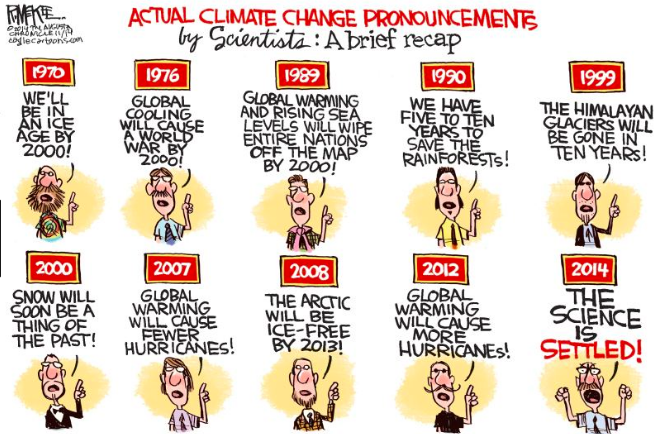
Recent global temperatures are said to be all time records. Without any doubt, they say, a degree more will cause severe damage and perhaps be existential. That is just another salvo of “we are all going to die” misinformation. Unfortunately there seems to be no member of the media willing to publish a list of the many times we have been told we only have X number of years left before it is too late. The media people are too lazy to do so, or they are politically motivated to keep the scam alive. Part 1 Secrets that Global Warming Alarmist Don’t Want You To Know Shows the inaccuracy of the Climate models.
Are global temperatures rising?
Not significantly. And recently they are falling.
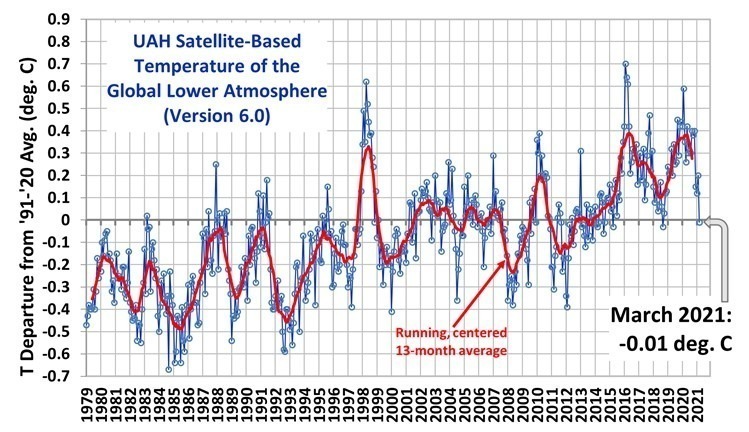
Look at the new satellite temperature measurement chart and notice that the March 2021 anomaly is similar to those in 2014-2015 time frame. March anomaly dropped 0.2C. And this is after two El Ninos that really boosted the temperature anomalies. Will April and following months continue a cooling phase? We can’t be sure, but odds are that it will. Latest Global Temps « Roy Spencer, PhD (drroyspencer.com)
These satellite measurements are not an outliner. And they are consistent with weather balloon temperature readings. Chart Courtsey of Dr.Roy Spencer
The National Oceanic and Atmospheric Administration (NOAA) is a scientific agency within the United States Department of Commerce that focuses on the conditions of the oceans, major waterways, and the atmosphere.
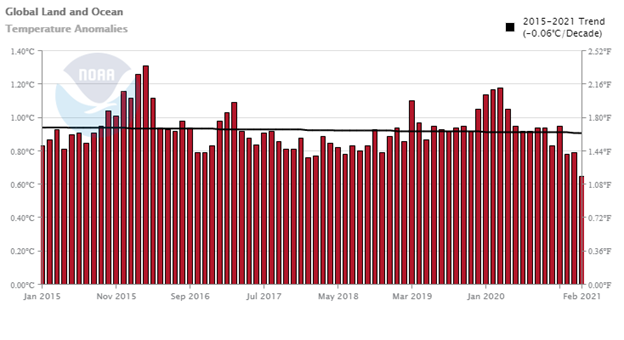
The following NOAA chart shows that the combined global land and ocean temperature has not been rising for the last 5 years, in fact it shows a slight decline. During this period, atmospheric CO2 has been rising. They confirm the cooling trend.
Then there is the global warming hiatus. From 1998 until 2013 there was almost no increase in global temperatures.
“It is believed that El Niño has occurred for thousands of years” and “There is no consensus whether climate change will have any influence on the occurrence, strength or duration of El Niño events, as research supports El Niño events becoming stronger, longer, shorter and weaker.”
So, the observed rise in global temperature following an El Nino-La Nina is as likely to be caused by natural causes as by man-made causes. And the trend in the period of the hiatus was only +0.09/Decade. At that rate, after 100 years, the global temperature rise would be less than 1C— hardly worth all the alarm.
Even at the +0.14c /decade rise of the satellite observed temperatures since 1979, it would take 70 years to raise it 1C.
The warmest ever and the most CO2 ever are claimed, seemingly, monthly by the alarmists. You are to believe that the current period is the” perfect” climate and any change is perilous.
The alarmists want all the scientific work establishing previous climate condition shoved down the memory hole, never to be seen again. The globe has seen higher CO2 concentrations in the atmosphere and higher temperatures than those being experienced today. The chart below illustrates this.
Berner RA, Kothavala Z (2001)GEOCARBlll: CO2 over Phanerozoic time.
And we know that the globe has also been much colder.
So now you know that the global temperature is not rising, in fact for the last 5 years the temperature has been falling. Further, you know that the Alarmists forecasts of rapidly increasing global warming are not happening. Their computer programs are biased to predict increasingly warming temperatures in order to scare people into going along with their bogus science. It is also clear that the rise in global temperatures might be just natural changes. Do not discount natural changes. What do you think began melting the glaciers that covered much of North America some 12 to 15 thousand years ago? It was not CO2 from SUV exhaust pipes.
I am going to use Dr. Roy Spencer’s comment in one of his recent blogs. It goes like this:
“Seldom is the public ever informed of these glaring discrepancies between basic science and what politicians and pop-scientists tell us.
Why does it matter?
It matters because there is no Climate Crisis. There is no Climate Emergency.
Yes, irregular warming is occurring. Yes, it is at least partly due to human greenhouse gas emissions. But seldom are the benefits of a somewhat warmer climate system mentioned, or the benefits of more CO2 in the atmosphere (which is required for life on Earth to exist).
But if we waste trillions of dollars (that’s just here in the U.S. — meanwhile, China will always do what is in the best interests of China) then that is trillions of dollars not available for the real necessities of life.
A dramatic global temperature rise has been forecasts by the alarmists for decades. Sea level is forecast to reach record heights as the globe’s ice melts. At every opportunity they tell us that any major storm or weather disruption is due to rising temperature. We are told that this rise in temperature must be stopped. A little more than degree C has the potential to be existential. How do they know this? Their climate computers tell them. These computers tell them that the atmospheric carbon dioxide (CO2) from the burning of fossil fuel will wreak this havoc.
The good news is that these computer forecasts of dramatic temperature rise are disproven by actual measurements of global temperature.
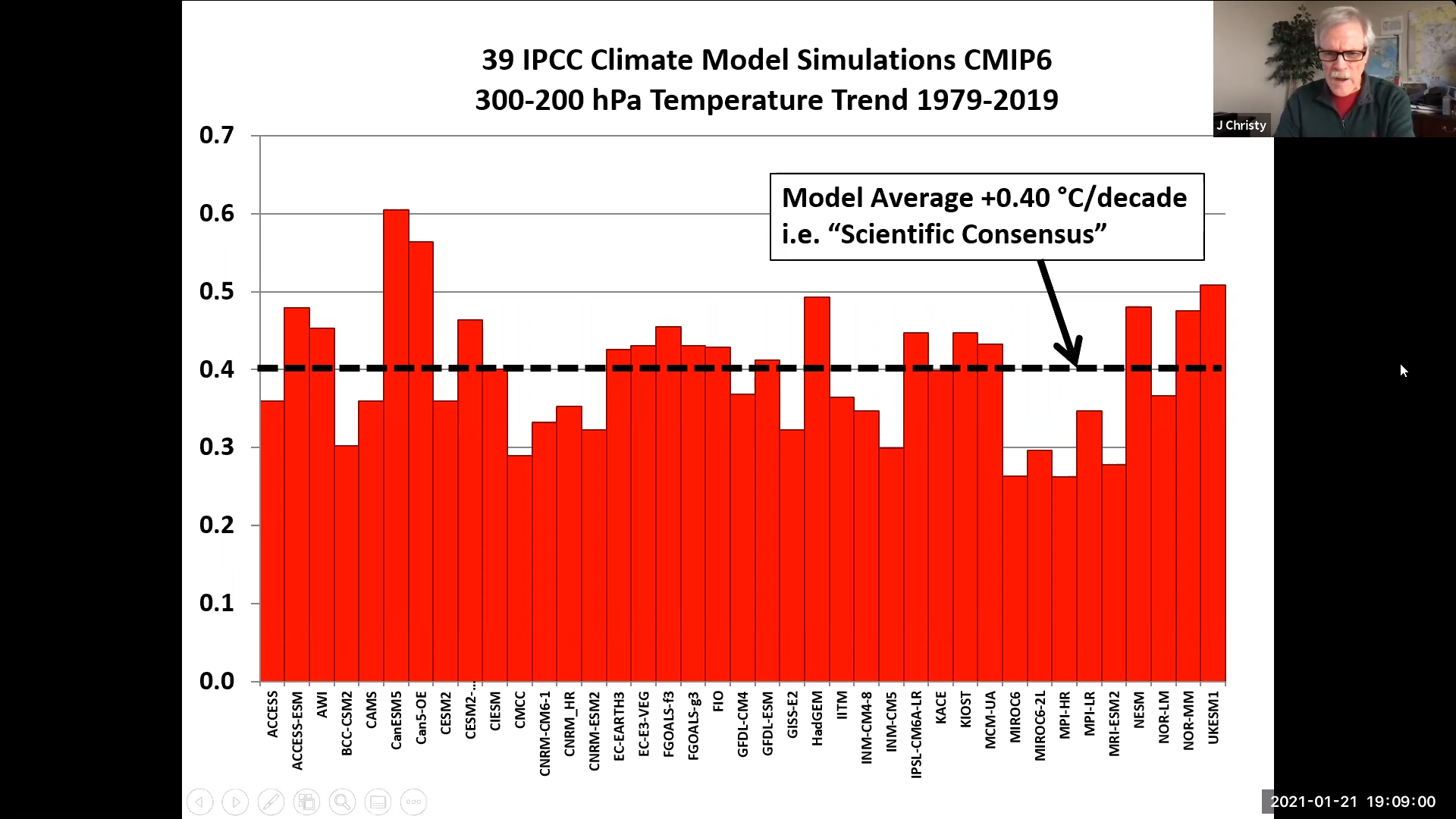
One of the recent examinations of the latest batch of climate computers (CMIP-6) was conducted by McKitrick and Christy.
The above is a screen capture is from a Zoom lecture given by John Christy. The upper straight line is the mean temperature forecast of the CMIP-6 and historical forecasts made by earlier computer models. The lower Green straight line is the mean of the actual measured temperature for this same period. The two lines , computer and observed global temperature trends, intersecting at zero in 1979 and based on 1979 to 2019 only.
The actual temperature measurements are a blend of satellite and radiosondes (weather balloons) . They confirm one another.
These are the predictions from which generate their alarming pronouncements. They are not reality.
Science News, for 2/29/20 carries an article titled “Earth’s hot future” and subtitled “As climate models improve, worst-case scenarios are hard to pin down.” The subtitle does not inspire confidence is the predictions. Then the article talks about how good these models are but they are missing an important piece of knowledge, that being the impact of clouds on climate.
Note the jumble the computer ensemble produce. The individual computers shoot up and then drive downward with a vengeance. If you could see it clearly, you would reject its output. Real temperatures do not swing that wildly. So they put all the computer’s output together to average out a mean. The one consistent feature of these computers is that they all show rising temperatures. Is that a “man-made” program bias having little to do with the science? (If the climate computers worked, they would only need one model, not dozens.)
Another way of visualizing this is the following chart:
The forecast from the computers is for warming to rise at +0.40C per decade. The observed (actual) warming has been +0.17C per decade.
Christy says about the performance of the Climate Models used by the warmers:
”You know in any other science, if you have a period of time you’re testing and you go through the first period and you’re already off by a factor of two and a half, on the rate of warming.
You say I better stop i’m going to go back and see if I can fix something that isn’t the way and climate moms they let it go, because the scary story is the one that seems to get the most attention.”
The charts are from an ICSF Zoom Meeting featuring John Christy as the main speaker. The link is ICSF Zoom Meeting – Zoom. You will need a password and it is S+R$j6N%.
The computers +0.40C per decade imply that the global temperature would increase by 1.2C by 2050’s. The alarmists target is to achieve net zero CO2 by that date.
“Seldom is the public ever informed of these glaring discrepancies between basic science and what politicians and pop-scientists tell us.
Why does it matter?
It matters because there is no Climate Crisis. There is no Climate Emergency.
Yes, irregular warming is occurring. Yes, it is at least partly due to human greenhouse gas emissions. But seldom are the benefits of a somewhat warmer climate system mentioned, or the benefits of more CO2 in the atmosphere (which is required for life on Earth to exist).
But if we waste trillions of dollars (that’s just here in the U.S. — meanwhile, China will always do what is in the best interests of China) then that is trillions of dollars not available for the real necessities of life.
Prosperity will suffer, and for no good reason.”
The climate predicting computers overstate the global temperatures by a wide margin as can be seen when compared to actual temperature measurements. Alarmists use them to put fear in to the pubic. Their predictions should never be used for making policy.
Rebloging a survey of public opinion regarding climate change commissioned by the Global Warming Policy Forum.
GWPF Survey: Perceptions of climate impacts at odds with scientific data
A new Savanta ComRes poll commissioned by the Global Warming Policy Forum (GWPF) has revealed low levels of public awareness of key trends relating to climate change and international development.
The survey of British adults suggests that the public perceive the impacts of climate change to be more negative than the academic research would suggest. However, there is also a significant minority of the public who say they are ‘not very’ or ‘not at all’ concerned by climate change.
In total, 28% of respondents said they were ‘very concerned’ about climate change, 42% said ‘fairly concerned’, 18% were ‘not very concerned’ and 6.4% described themselves as ‘not at all concerned’.
To see the entire posting click on the following link:









 Climate Change Sanity