Category Archives: United Nations

President-Elect Donald Trump–Part 1 US Out Of The Paris Agreement


The election of Donald Trump has the environmental industry in a panic.  The money and the  one or two  trips each year to exotic places all funded by the US and others, could be severely curtailed.   The scientist, ever eager to produce study results that indicts man—the only way to get study money—, may no longer  be able to afford their lifestyle if the Government slush funds dry up.  And the forecasts of doom in the far-off future proudly produced by some computer, could be ignored and there goes the forecasters claim to fame. 

un-building

Continue reading

Hillary Clinton Will Not Stop The UN Acting On The Bogus Theory Of Catastrophic Global Warming


We need to stop the UN and their IPCC from carrying out the Paris Accord.  The pact maybe unenforceable but a lot of damage will be done to the US economy and the rest of the world’s economy in its name.    The Chinese are lobbying against Donald Trump—where are those voices that say the Russians should not be poking their nose into the Presidential election.  Why are the Chinese lobbying?  Because they say we need to reduce our CO2 emissions.  This is the nation that President Obama negotiated a pact with where we reduce our emissions but the Chinese do not have to do that until 2030.  During which time we will be putting the brakes on our economy while they are rapidly expanding theirs.  If Trump ever had a target pact that the US  has been badly out foxed, this is it.    It will not be changed if, tomorrow Hilliary Clinton wins the Presidency, nor will the bad deal we got from the Paris Accord. 

Oh yes,  the Chinese CO2 emissions are already the largest in the world at about twice ours.  When 2030 arrives the Chinese emissions should be three times those of the US.

UPDATE   From Watts  UP With That is a posting that elaborates my point about China and their plans for coal burning.  Read this   “China Announces a Massive 20% Increase in Coal – by 2020”.


Read the NBC News posting  “Prospect of President Trump Casts Clouds Over COP22 Climate Conference”

cbdakota

Denying The Climate Catastrophe: 5A Argument For Attributing Past Warming To Man (Warren Meyers Essay)


This posting is a continuation of  the Warren Meyers Essay debunking the Climate Catastrophe theory.   Here he takes the reader though the warmerist’s reasoning of why CO2 emitted from fossil fuels will result in a climate catastrophe.

cbdakota

Having established that the Earth has warmed over the past century or so (though with some dispute over how much), we turn to the more interesting — and certainly more difficult — question of finding causes for past warming.  Specifically, for the global warming debate, we would like to know how much of the warming was due to natural variations and how much was man-made.   Obviously this is hard to do, because no one has two thermometers that show the temperature with and without man’s influence.

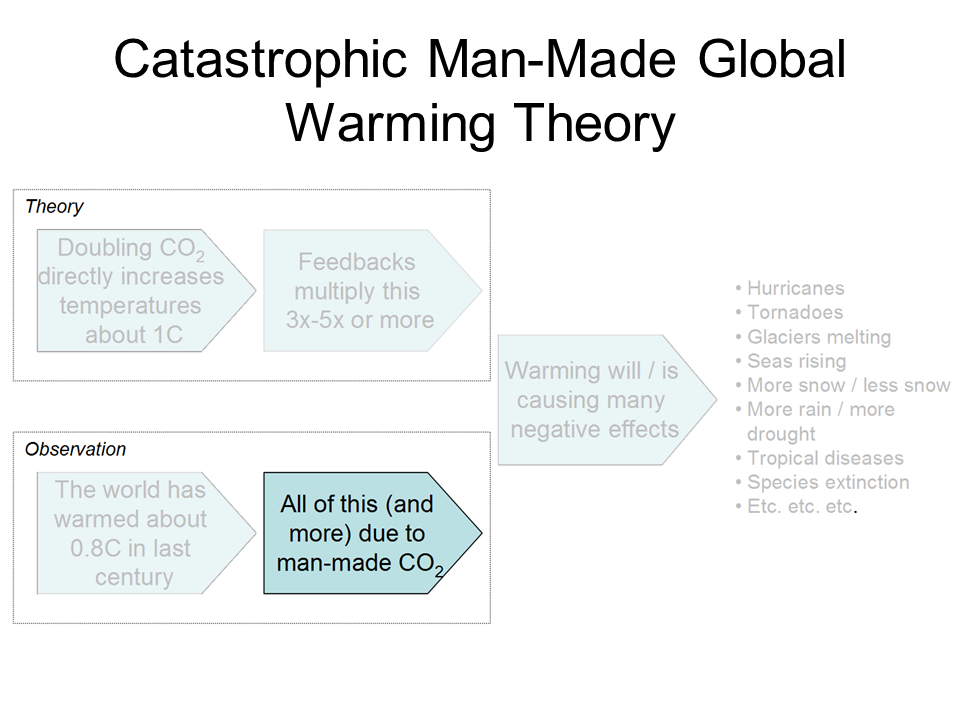
I like to begin each chapter with the IPCC’s official position, but this is a bit hard in this case because they use a lot of soft words rather than exact numbers.  They don’t say 0.5 of the 0.8C is due to man, or anything so specific.   They use phrases like “much of the warming” to describe man’s affect.  However, it is safe to say that most advocates of catastrophic man-made global warming theory will claim that most or all of the last century’s warming is due to man, and that is how we have put it in our framework below:


click to enlarge


By the way, the “and more” is not a typo — there are a number of folks who will argue that the world would have actually cooled without manmade CO2 and thus manmade CO2 has contributed more than the total measured warming.  This actually turns out to be an important argument, since the totality of past warming is not enough to be consistent with high sensitivity, high feedback warming forecasts.  But we will return to this in part C of this chapter

Past, Mostly Abandoned Arguments for Attribution to Man

There have been and still are many different approaches to the attributions problem.  In a moment, we will discuss the current preferred approach.  However, it is worth reviewing two other approaches that have mostly been abandoned but which had a lot of currency in the media for some time, in part because both were in Al Gore’s film An Inconvenient Truth.

Before we get into them, I want to take a step back and briefly discuss what is called paleo-climatology, which is essentially the study of past climate before the time when we had measurement instruments and systematic record-keeping for weather.   Because we don’t have direct measurements, say, of the temperature in the year 1352, scientists must look for some alternate measure, called a “proxy,”  that might be correlated with a certain climate variable and thus useful in estimating past climate metrics.   For example, one might look at the width of tree rings, and hypothesize that varying widths in different years might correlate to temperature or precipitation in those years.  Most proxies take advantage of such annual layering, as we have in tree rings.

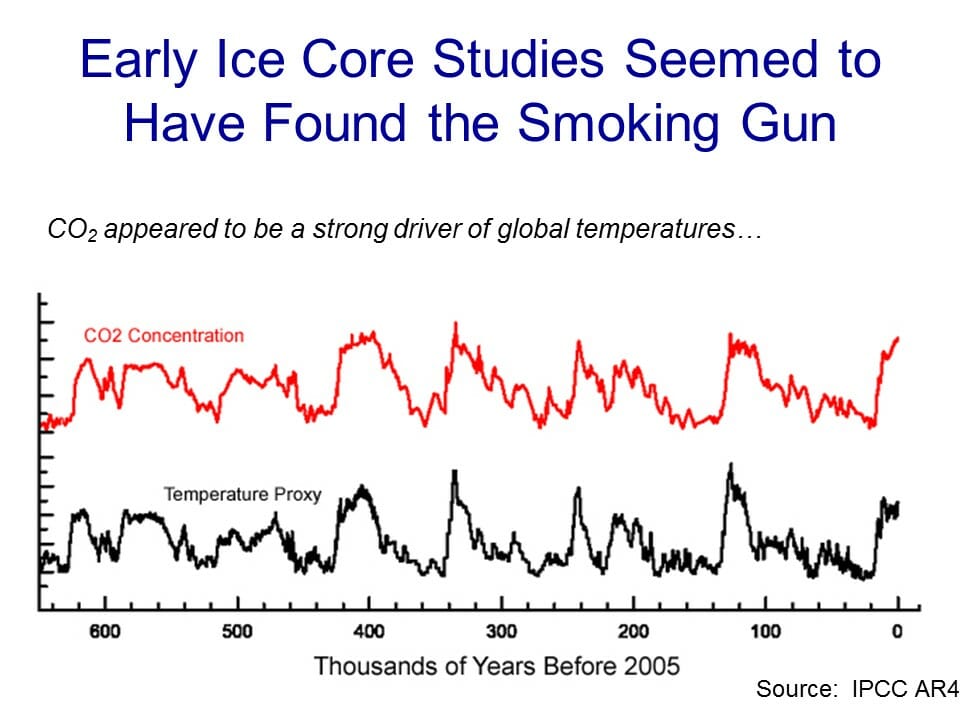
One such methodology uses ice cores.  Ice in certain places like Antarctica and Greenland is laid down in annual layers.  By taking a core sample, characteristics of the ice can be measured at different layers and matched to approximate years.  CO2 concentrations can actually be measured in air bubbles in the ice, and atmospheric temperatures at the time the ice was laid down can be estimated from certain oxygen isotope ratios in the ice.  The result is that one can plot a chart going back hundreds of thousands of years that estimates atmospheric CO2 and temperature.  Al Gore showed this chart in his movie, in a really cool presentation where the chart wrapped around three screens:

click to enlarge


As Gore points out, this looks to be a smoking gun for attribution of temperature changes to CO2.  From this chart, temperature and CO2 concentrations appear to be moving in lockstep.  From this, CO2 doesn’t seem to be a driver of temperatures, it seems to be THE driver, which is why Gore often called it the global thermostat.

But there turned out to be a problem, which is why this analysis no longer is treated as a smoking gun, at least for the attribution issue.  Over time, scientists got better at taking finer and finer cuts of the ice cores, and what they found is that when they looked on a tighter scale, the temperature was rising (in the black spikes of the chart) on average 800 years before the CO2 levels (in red) rose.

This obviously throws a monkey wrench in the causality argument.  Rising CO2 can hardly be the cause of rising temperatures if the CO2 levels are rising after temperatures.

It is now mostly thought that what this chart represents is the liberation of dissolved CO2 from oceans as temperatures rise.  Oceans have a lot of dissolved CO2, and as the oceans get hotter, they will give up some of this CO2 to the atmosphere.

The second outdated attribution analysis we will discuss is perhaps the most famous:  The Hockey Stick.  Based on a research paper by Michael Mann when he was still a grad student, it was made famous in Al Gore’s movie as well as numerous other press articles.  It became the poster child, for a few years, of the global warming movement.

So what is it?  Like the ice core chart, it is a proxy analysis attempting to reconstruct temperature history, in this case over the last 1000 years or so.  Mann originally used tree rings, though in later versions he has added other proxies, such as from organic matter laid down in sediment layers.

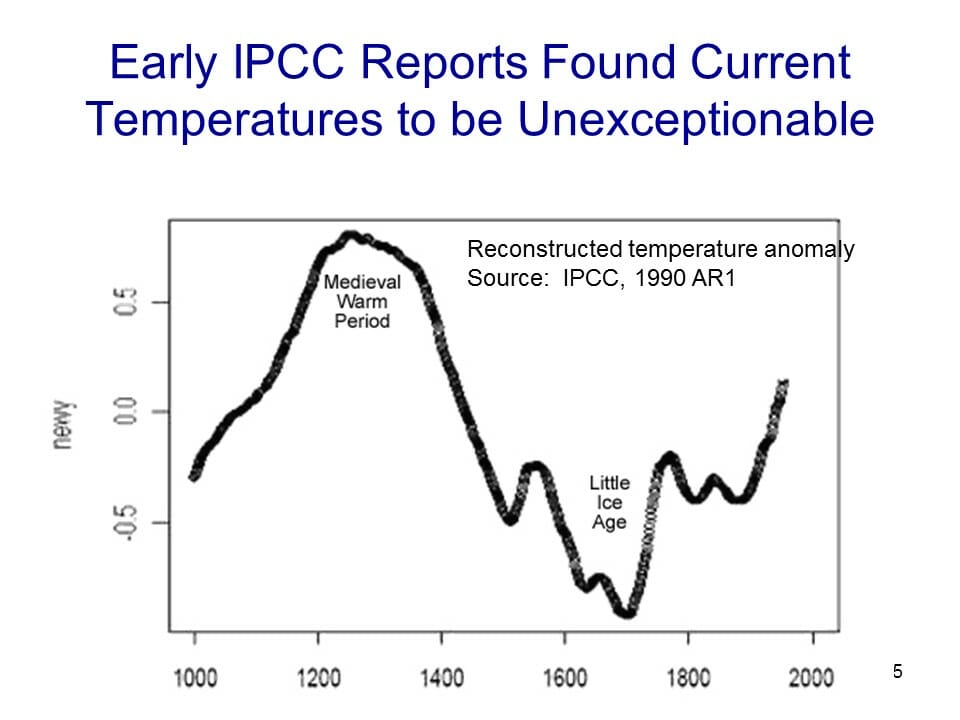
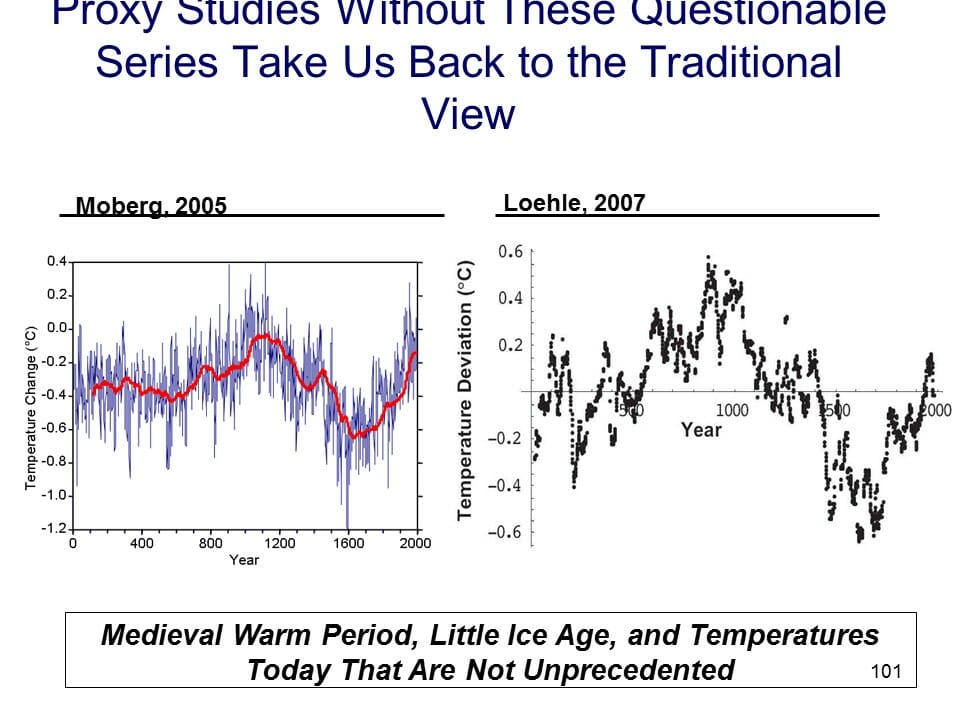
Before the Mann hockey stick, scientists (and the IPCC) believed the temperature history of the last 1000 years looked something like this


click to enlarge

Generally accepted history had a warm period from about 1100-1300 called the Medieval Warm Period which was warmer than it is today, with a cold period in the 17th and 18th centuries called the “Little Ice Age”.  Temperature increases since the little ice age could in part be thought of as a recovery from this colder period.  Strong anecdotal evidence existed from European sources supporting the existence of both the Medieval Warm Period and the Little Ice Age.  For example, I have taken several history courses on the high Middle Ages and every single professor has described the warm period from 1100-1300 as creating a demographic boom which defined the era (yes, warmth was a good thing back then).  In fact, many will point to the famines in the early 14th century that resulted from the end of this warm period as having weakened the population and set the stage for the Black Death.

However, this sort of natural variation before the age where man burned substantial amounts of fossil fuels created something of a problem for catastrophic man-made global warming theory.  How does one convince the population of catastrophe if current warming is within the limits of natural variation?  Doesn’t this push the default attribution of warming towards natural factors and away from man?

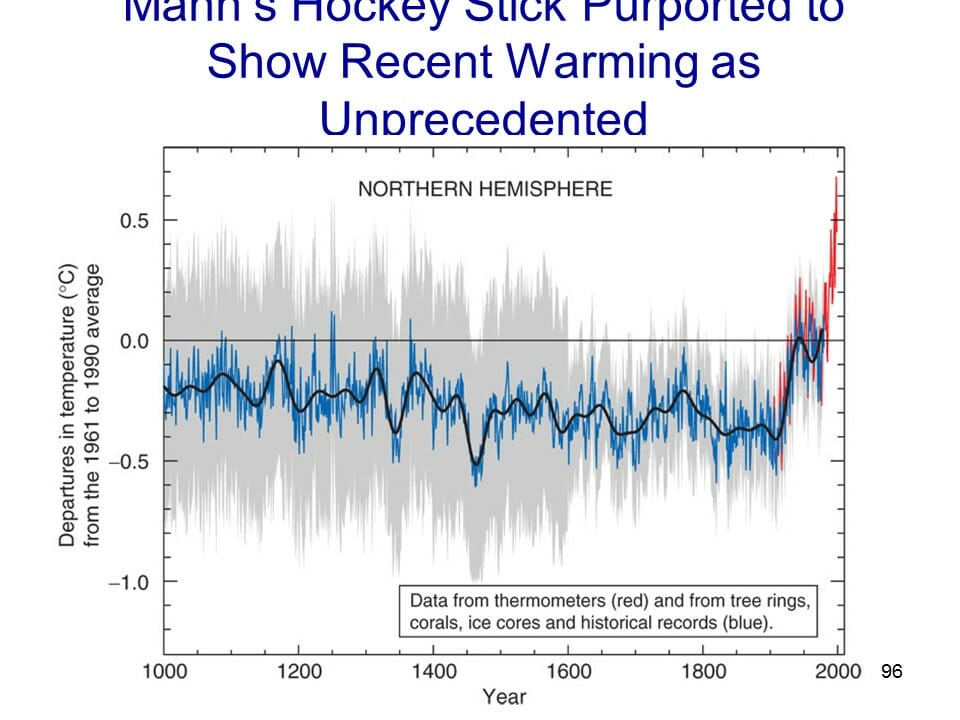
The answer came from Michael Mann (now Dr. Mann but actually produced originally before he finished grad school).  It has been dubbed the hockey stick for its shape:

click to enlarge

The reconstructed temperatures are shown in blue, and gone are the Medieval Warm Period and the Little Ice Age, which Mann argued were local to Europe and not global phenomena.  The story that emerged from this chart is that before industrialization, global temperatures were virtually flat, oscillating within a very narrow band of a few tenths of a degree.  However, since 1900, something entirely new seems to be happening, breaking the historical pattern.  From this chart, it looks like modern man has perhaps changed the climate.  This shape, with the long flat historical trend and the sharp uptick at the end, is why it gets the name “hockey stick.”

Oceans of ink and electrons have been spilled over the last 10+ years around the hockey stick, including a myriad of published books.  In general, except for a few hard core paleoclimatologists and perhaps Dr. Mann himself, most folks have moved on from the hockey stick as a useful argument in the attribution debate.  After all, even if the chart is correct, it provides only indirect evidence of the effect of man-made CO2.

Here are a few of the critiques:

  • Note that the real visual impact of the hockey stick comes from the orange data on the far right — the blue data alone doesn’t form much of a hockey stick.  But the orange data is from an entirely different source, in fact an entirely different measurement technology — the blue data is from tree rings, and the orange is form thermometers.  Dr. Mann bristles at the accusation that he “grafted” one data set onto the other, but by drawing the chart this way, that is exactly what he did, at least visually.  Why does this matter?  Well, we have to be very careful with inflections in data that occur exactly at the point that where we change measurement technologies — we are left with the suspicion that the change in slope is due to differences in the measurement technology, rather than in the underlying phenomenon being measured.
  • In fact, well after this chart was published, we discovered that Mann and other like Keith Briffa actually truncated the tree ring temperature reconstructions (the blue line) early.  Note that the blue data ends around 1950.  Why?  Well, it turns out that many tree ring reconstructions showed temperatures declining after 1950.  Does this mean that thermometers were wrong?  No, but it does provide good evidence that the trees are not accurately following current temperature increases, and so probably did not accurately portray temperatures in the past.
  • If one looks at the graphs of all of Mann’s individual proxy series that are averaged into this chart, astonishingly few actually look like hockey sticks.  So how do they average into one?  McIntyre and McKitrick in 2005 showed that Mann used some highly unusual and unprecedented-to-all-but-himself statistical methods that could create hockey sticks out of thin air.  The duo fed random data into Mann’s algorithm and got hockey sticks.
  • At the end of the day, most of the hockey stick (again due to Mann’s averaging methods) was due to samples from just a handful of bristle-cone pine trees in one spot in California, trees whose growth is likely driven by a number of non-temperature factors like precipitation levels and atmospheric CO2 fertilization.   Without these few trees, most of the hockey stick disappears.  In later years he added in non-tree-ring series, but the results still often relied on just a few series, including the Tiljander sediments where Mann essentially flipped the data upside down to get the results he wanted.  Taking out the bristlecone pines and the abused Tiljander series made the hockey stick go away again.There have been plenty of other efforts at proxy series that continue to show the Medieval Warm Period and Little Ice Age as we know them from the historical record:


click to enlarge

As an aside, Mann’s hockey stick was always problematic for supporters of catastrophic man-made global warming theory for another reason.  The hockey stick implies that the world’s temperatures are, in absence of man, almost dead-flat stable.   But this is hardly consistent with the basic hypothesis, discussed earlier, that the climate is dominated by strong positive feedbacks that take small temperature variations and multiply them many times.   If Mann’s hockey stick is correct, it could also be taken as evidence against high climate sensitivities that are demanded by the catastrophe theory.


The Current Lead Argument for Attribution of Past Warming to Man

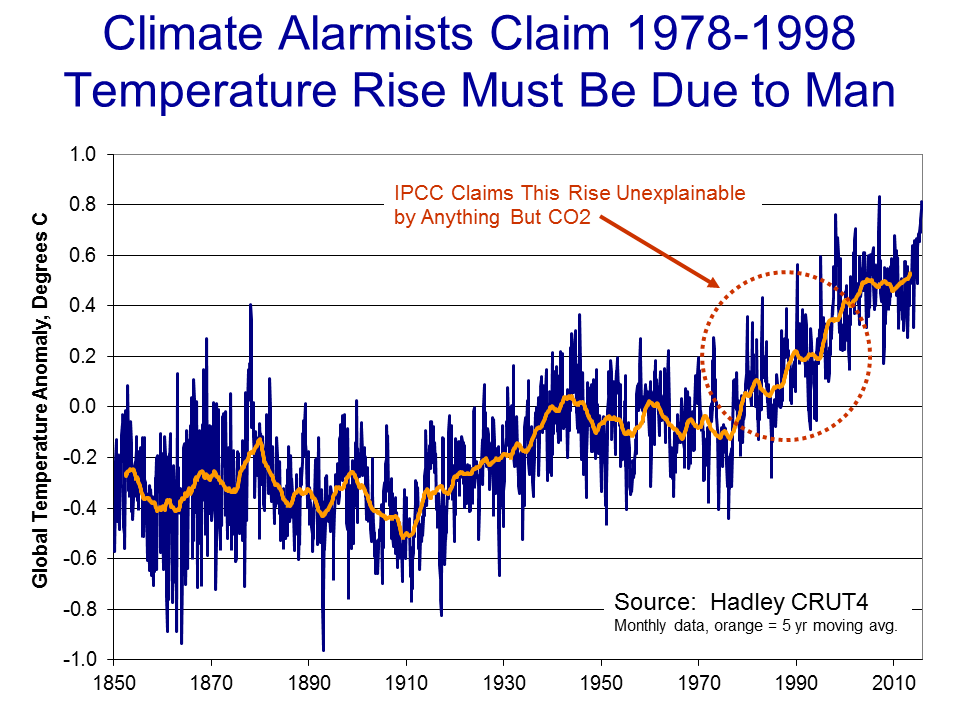
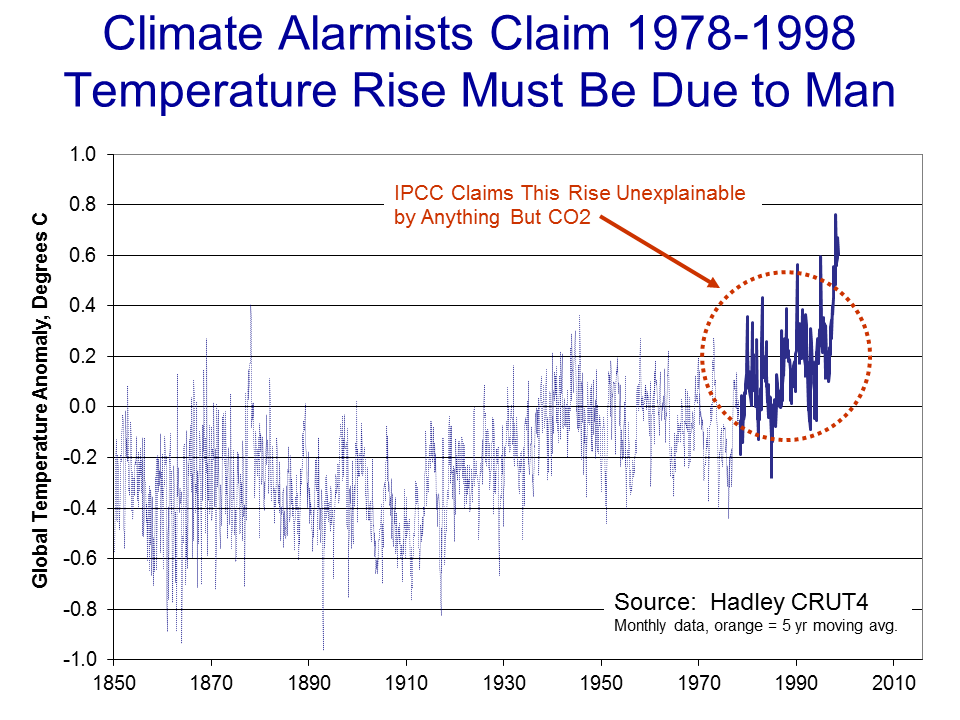
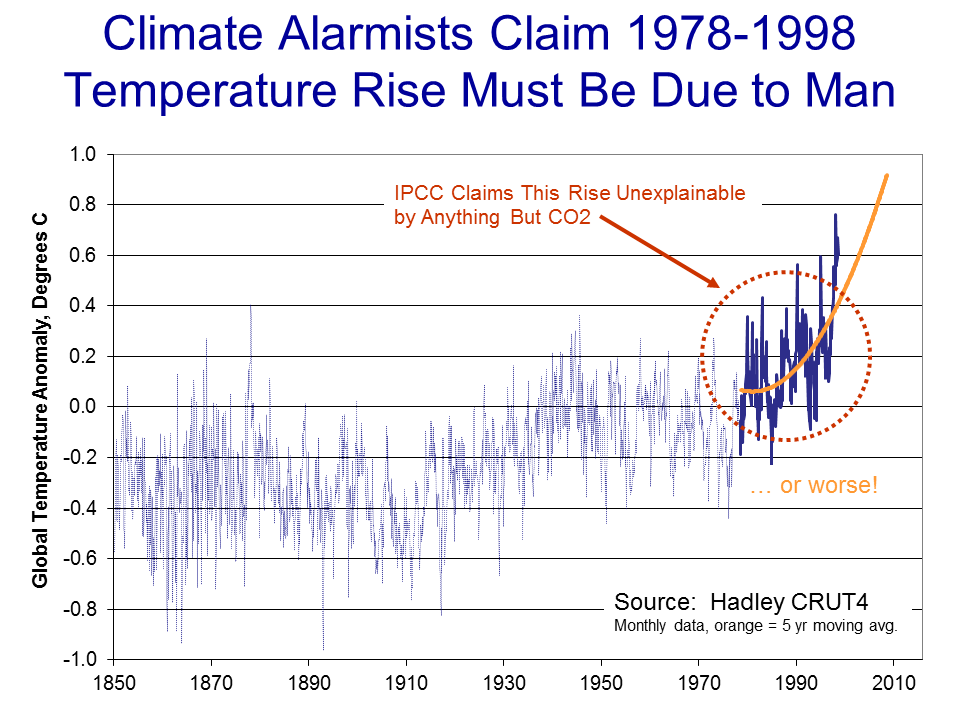
So we are still left wondering, how do climate scientists attribute past warming to man?  Well, to begin, in doing so they tend to focus on the period after 1940, when large-scale fossil fuel combustion really began in earnest.   Temperatures have risen since 1940, but in fact nearly all of this rise occurred in the 20 year period from 1978 to 1998:

click to enlarge

To be fair, and better understand the thinking at the time, let’s put ourselves in the shoes of scientists around the turn of the century and throw out what we know happened after that date.  Scientists then would have been looking at this picture:

click to enlarge

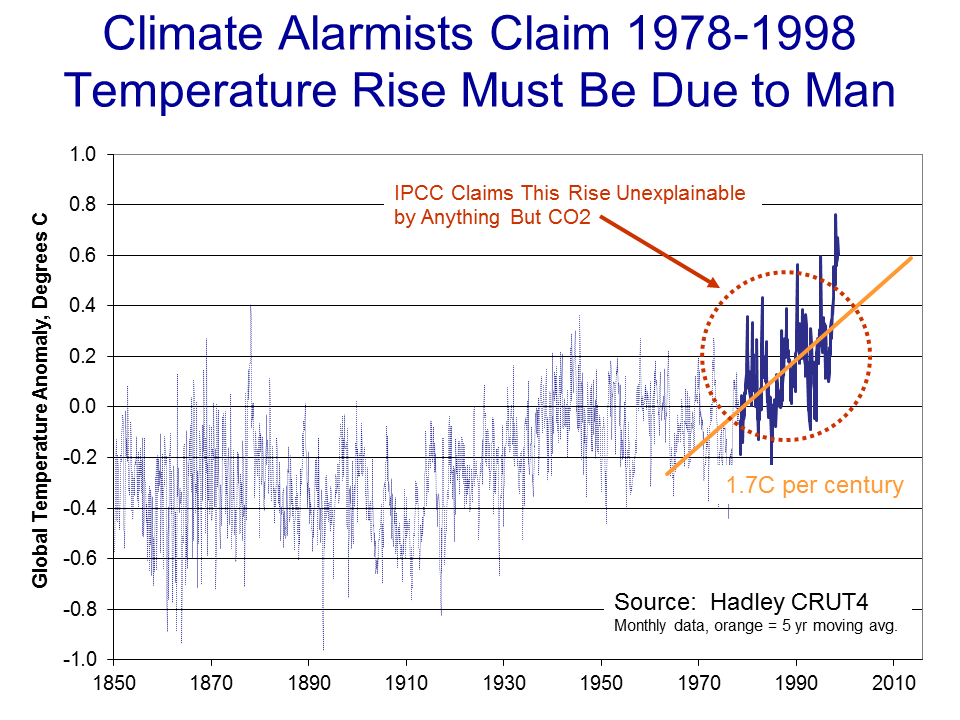
Sitting in the year 2000, the recent warming rate might have looked dire .. nearly 2C per century…

click to enlarge

Or possibly worse if we were on an accelerating course…

click to enlarge


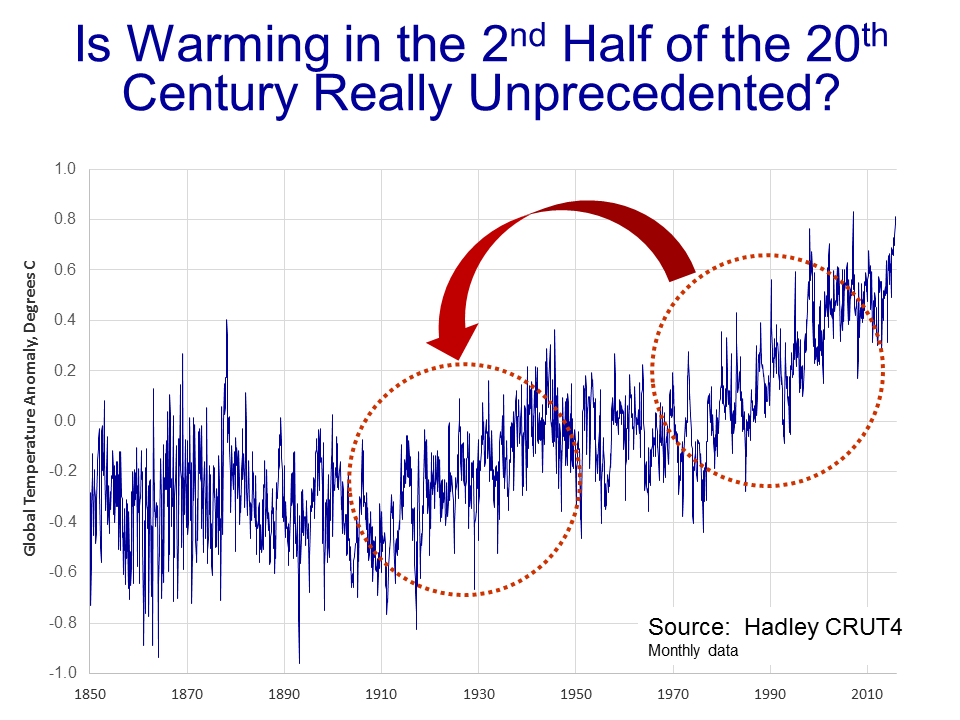
Scientists began to develop a hypothesis that this temperature rise was occurring too rapidly to be natural, that it had to be at least partially man-made.  I have always thought this a slightly odd conclusion, since the slope from this 20-year period looks almost identical to the slope centered around the 1930’s, which was very unlikely to have much human influence.

click to enlarge

But never-the-less, the hypothesis that the 1978-1998 temperature rise was too fast to be natural gained great currency.  But how does one prove it?

What scientists did was to build computer models to simulate the climate.  They then ran the computer models twice.  The first time they ran them with only natural factors, or at least only the natural factors they knew about or were able to model (they left a lot out, but we will get to that in time).  These models were not able to produce the 1978-1998 warming rates.  Then, they re-ran the models with manmade CO2, and particularly with a high climate sensitivity to CO2 based on the high feedback assumptions we discussed in an earlier chapter.   With these models, they were able to recreate the 1978-1998 temperature rise.   As Dr. Richard Lindzen of MIT described the process:

What was done, was to take a large number of models that could not reasonably simulate known patterns of natural behavior (such as ENSO, the Pacific Decadal Oscillation, the Atlantic Multidecadal Oscillation), claim that such models nonetheless accurately depicted natural internal climate variability, and use the fact that these models could not replicate the warming episode from the mid seventies through the mid nineties, to argue that forcing was necessary and that the forcing must have been due to man.

Another way to put this argument is “we can’t think of anything natural that could be causing this warming, so by default it must be man-made.  With various increases in sophistication, this remains the lead argument in favor of attribution of past warming to man.

In part B of this chapter, we will discuss what natural factors were left out of these models, and I will take my own shot at a simple attribution analysis.


Denying The Climate Catastrophe:Greenhouse GasTheory (Warren Meyers Essay)


Below is my reposting fr0m Coyotebog.com, the Warren Meyers essay on his take of the global climate change issue.

cbdakota

We continue our multi-part series on the theory of catastrophic man-made global warming by returning to our framework we introduced in the last chapter

Click to Enlarge

In the introduction, we discussed how catastrophic man-made global warming theory was actually made up of two independent parts.  In this section, we will discuss the first of these two parts, the greenhouse gas effect, which is the box in the upper left of our framework.

For those unfamiliar with exactly what the greenhouse effect is, I encourage you to check out this very short primer.  Essentially, certain gasses in the atmosphere can absorb some of the heat the Earth is radiating into space, and re-radiate some of this heat back to Earth.  These are called greenhouse gasses.  Water vapor is a relatively strong greenhouse gas, while CO2 is actually a relatively weak greenhouse gas.

It may come as a surprise to those who only know of skeptics’ arguments from reading their opponents (rather than the skeptics themselves), but most prominent skeptics accept the theory of greenhouse gas warming.  Of course there are exceptions, including a couple of trolls who like to get attention in the comments section of this and other blogs, and including a few prominent politicians and talk-show hosts.  But there are also environmental alarmists on the other side who have signed petitions to ban dihydrogen monoxide.  It is always tempting, but seldom intellectually rewarding, to judge a particular position by its least capable defenders.

There is simply too much evidence both from our and other planets (as well as simple experiments in a laboratory) to deny that greenhouse gasses in the atmosphere have a warming effect on planets, and that CO2 is such a greenhouse gas.   What follows in the rest of this section represents something of a consensus of people on both sides of the debate.

Continue reading

97% Claim Meant To Keep You From Looking At The Facts Of Climate Change


An editorial by the Washington Post has gotten wide spread coverage in the main stream media. The headline for the editorial is “Research shows there’s no debate” with a subtitle, “Study shows experts do agree on climate change”. The subject is a new paper by John Cook claiming the support for man-made global warming is indeed at 97.1%. Cook is no more than a spin doctor. One of my comments in a letter I wrote to a local newspaper was “The warmers need him, desperately, to direct the climate change discussion away from the facts. “

The facts I used were the global temperature and the global sea level to demonstrate how far off the mark the warmer’s science is when compared to the actual data.

David Legates has written an excellent, detailed rebuttal to the Cook paper.

From the website WUWT, Legates’ posting follows:

cbdakota

H/T Dick Waughtal

Deep-sixing another useless climate myth

Guest Blogger / April 10, 2016

The vaunted “97% consensus” on dangerous manmade global warming is just more malarkey

by Dr. David R. Legates

By now, virtually everyone has heard that “97% of scientists agree: Climate change is real, manmade and dangerous.” Even if you weren’t one of his 31 million followers who received this tweet from President Obama, you most assuredly have seen it repeated everywhere as scientific fact.

The correct representation is “yes,” “some,” and “no.” Yes, climate change is real. There has never been a period in Earth’s history when the climate has not changed somewhere, in one way or another.

People can and do have some influence on our climate. For example, downtown areas are warmer than the surrounding countryside, and large-scale human development can affect air and moisture flow. But humans are by no means the only source of climate change. The Pleistocene ice ages, Little Ice Age and monster hurricanes throughout history underscore our trivial influence compared to natural forces.

As for climate change being dangerous, this is pure hype based on little fact. Mile-high rivers of ice burying half of North America and Europe were disastrous for everything in their path, as they would be today. Likewise for the plummeting global temperatures that accompanied them. An era of more frequent and intense hurricanes would also be calamitous; but actual weather records do not show this.

It would be far more deadly to implement restrictive energy policies that condemn billions to continued life without affordable electricity – or to lower living standards in developed countries – in a vain attempt to control the world’s climate. In much of Europe, electricity prices have risen 50% or more over the past decade, leaving many unable to afford proper wintertime heat, and causing thousands to die.

Moreover, consensus and votes have no place in science. History is littered with theories that were long denied by “consensus” science and politics: plate tectonics, germ theory of disease, a geocentric universe. They all underscore how wrong consensus can be.

Science is driven by facts, evidence and observations – not by consensus, especially when it is asserted by deceitful or tyrannical advocates. As Einstein said, “A single experiment can prove me wrong.”

During this election season, Americans are buffeted by polls suggesting which candidate might become each party’s nominee or win the general election. Obviously, only the November “poll” counts.

Similarly, several “polls” have attempted to quantify the supposed climate change consensus, often by using simplistic bait-and-switch tactics. “Do you believe in climate change?” they may ask.

Answering yes, as I would, places you in the President’s 97% consensus and, by illogical extension, implies you agree it is caused by humans and will be dangerous. Of course, that serves their political goal of gaining more control over energy use.

The 97% statistic has specific origins. Naomi Oreskes is a Harvard professor and author of Merchants of Doubt, which claims those who disagree with the supposed consensus are paid by Big Oil to obscure the truth. In 2004, she claimed to have examined the abstracts of 928 scientific papers and found a 100% consensus with the claim that the “Earth’s climate is being affected by human activities.”

Of course, this is probably true, as it is unlikely that any competent scientist would say humans have no impact on climate. However, she then played the bait-and-switch game to perfection – asserting that this meant “most of the observed warming of the last 50 years is likely to have been due to the increase in greenhouse gas concentrations.”

However, one dissenter is enough to discredit the entire study, and what journalist would believe any claim of 100% agreement? In addition, anecdotal evidence suggested that 97% was a better figure. So 97% it was.

Then in 2010, William Anderegg and colleagues concluded that “97–98% of the climate researchers most actively publishing in the field support … [the view that] … anthropogenic greenhouse gases have been responsible for most of the unequivocal warming of the Earth’s average global temperature” over a recent but unspecified time period. (Emphasis in original.)

To make this extreme assertion, Anderegg et al. compiled a database of 908 climate researchers who published frequently on climate topics, and identified those who had “signed statements strongly dissenting from the views” of the UN’s Intergovernmental Panel on Climate Change. The 97–98% figure is achieved by counting those who had not signed such statements.

Silence, in Anderegg’s view, meant those scientists agreed with the extreme view that most warming was due to humans. However, nothing in their papers suggests that all those researchers believed humans had caused most of the planetary warming, or that it was dangerous.

The most recent 97% claim was posited by John Cook and colleagues in 2013. They evaluated abstracts from nearly 12,000 articles published over a 21-year period and sorted them into seven categories, ranging from “explicit, quantified endorsement” to “explicit, quantified rejection” of their alleged consensus: that recent warming was caused by human activity, not by natural variability. They concluded that “97.1% endorsed the consensus position.”

However, two-thirds of all those abstracts took no position on anthropogenic climate change. Of the remaining abstracts (not the papers or scientists), Cook and colleagues asserted that 97.1% endorsed their hypothesis that humans are the sole cause of recent global warming.

Again, the bait-and-switch was on full display. Any assertion that humans play a role was interpreted as meaning humans are the sole cause. But many of those scientists subsequently said publicly that Cook and colleagues had misclassified their papers – and Cook never tried to assess whether any of the scientists who wrote the papers actually thought the observed climate changes were dangerous.

My own colleagues and I did investigate their analysis more closely. We found that only 41 abstracts of the 11,944 papers Cook and colleagues reviewed – a whopping 0.3% – actually endorsed their supposed consensus. It turns out they had decided that any paper which did not provide an explicit, quantified rejection of their supposed consensus was in agreement with the consensus. Moreover, this decision was based solely on Cook and colleagues’ interpretation of just the abstracts, and not the articles themselves. In other words, the entire exercise was a clever sleight-of-hand trick.

What is the real figure? We may never know. Scientists who disagree with the supposed consensus – that climate change is manmade and dangerous – find themselves under constant attack.

Harassment by Greenpeace and other environmental pressure groups, the media, federal and state government officials, and even universities toward their employees (myself included) makes it difficult for many scientists to express honest opinions. Recent reports about Senator Whitehouse and Attorney-General Lynch using RICO laws to intimidate climate “deniers” further obscure meaningful discussion.

Numerous government employees have told me privately that they do not agree with the supposed consensus position – but cannot speak out for fear of losing their jobs. And just last week, a George Mason University survey found that nearly one-third of American Meteorological Society members were willing to admit that at least half of the climate change we have seen can be attributed to natural variability.

Climate change alarmism has become a $1.5-trillion-a-year industry – which guarantees it is far safer and more fashionable to pretend a 97% consensus exists, than to embrace honesty and have one’s global warming or renewable energy funding go dry.

The real danger is not climate change – it is energy policies imposed in the name of climate change. It’s time to consider something else Einstein said: “The important thing is not to stop questioning.” And then go see the important new documentary film, The Climate Hustle, coming soon to a theater near you.

Is There A Pause In Global Temperatures?


The “pause”, meaning the lack of global temperature rise in the 21st century, has gotten a lot of attention. The warmers want to deny that it is significant. The skeptics say that it is very significant in that atmospheric carbon dioxide (CO2) has been increasing during this period of time. According to the wamer’s theory, global temperatures should have been rising. Last year, some of the keepers of the global temperature records decided they had, had enough of this focus on the “pause”. So they made some bogus changes to the way the temperature was measured and when they were finished, they said—– see there really was no pause. Click here to see how they have tried to pull this off.

There are several global temperature amassing groups. These groups broadly are divided by being ground based or satellite based. The former are dependant on temperatures measured mostly from ground-based stations supplemented by some ocean surface temperature measurements. The ground-based stations are primarily in populated areas. Northern Hemisphere stations predominate. The vast areas of the oceans (75 % of the globe’s surface) are minimally covered. There are also enormous areas of land where population is very limited, or no one at all. In those areas, computers predict the missing temperatures.

The ground station leaders are: (1) (GISS), NASA Goddard Institute for Space Studies (2) (HadCRUT4) the Hadley Centre of the UK Met Office and the land surface air temperature records compiled by the Climatic Research Unit (CRU) of the University of East Anglia. (3) NCEI) NOAA’s National Centers for Environmental Information.

(For those of you with longer memories, yes, the University of East Anglia was the headquarters of the Climategate gang)

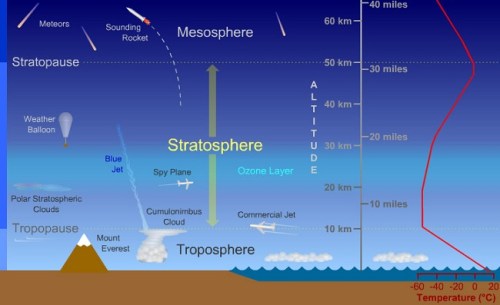
The latter group consists of two satellite based global temperature-measuring organizations. Satellites measure radiance in various wavelengths in troposphere. The troposphere extends about 7 miles above the Earth’s surface and the troposphere is where all of our weather occurs. The radiance measurements are translated into temperatures. In 1979, the University of Alabama at Huntsville (UAH) was the first satellite system to begin reading these temperatures. Start up problems are typical with any new breakthrough technology. For example early on there were problems with orbital decay and also with drift.   The UAH promptly made allowances for those problems as they have  with some smaller ones as time has past. The weather balloons (radiosondies) that have been used for many years, show agreement with the UAH satellite measurements. This is confirming proof of the satellite systems high accuracy and because it actually measures temperature across nearly the entire globe, that makes it the gold standard. The other satellite system is the Remote Sensing System (RSS). UAH and RSS have a few differences in how they make their tropospheric measurements, still the resulting temperatures are in close agreement. The satellites measurements cover about 95% of the Earth’s surface eliminating the use of computers to simulate actual measurements, as is the case with the ground based systems.

The illustration below shows the Earth’s atmosphere with the troposphere being the lowest part.

earth_stratosphere_diagram

The final player in this drama is the Intergovernmental Panel on Climate Change (IPCC). The IPCC is a branch of the UN. It was created to show how man was causing global warming and what the consequences of that would be. No, the IPCC was not created to examine the science of global warming; the founders had already decided man was the cause. The IPCC is programmed to report on the status of their work about every 5 years or so. The IPCC is often said to be the warmer’s equivalent of the “spoken word.” Most of the mainstream media accepts without question any pronouncement that is said to be from the IPCC—in their mind, it is the ultimate authority. Many major newspapers and science journals (and other media, too) do not allow, in their media, skeptical views, research, questions, letters to the editor, etc.

The IPCC produce temperature forecasts. These forecasts are the basis for catastrophic things that will happen—-flood, drought, snow, sea level, vast migrations of people, etc. —–if we do not quit using fossil fuels.

In the next posting, we will compare the IPCC temperature forecasts to the ground and satellite measured temperatures.

cbdakota


El Nino–Walker Circulation


The prior posting, “Some Background Regarding An El Nino began like this: “Currently, the weather is being strongly affected by an El Nino.  El Nino is but one part of a weather/climate system known as the El Nino Southern Oscillation (ENSO).  There are three phases of ENSO — El Nino, La Nina and Neutral.   ENSO is important because of its ability to change the global atmospheric circulation, which in turn, influences temperature and precipitation across the globe. The global atmospheric circulation is called the Walker Cycle   Circulation“.

This posting examines the Walker Circulation.(I have seen both cycle and circulation used but much of my sourcing for this posting uses Circulation.)

First lets talk about high and low pressure centers. Fair weather generally accompanies a high-pressure center while clouds and precipitation generally accompany a low-pressure center.  Low-pressure centers are formed by a hot surface. For example, the hot Pacific Ocean water that is driven to the Maritime Continent by the trade winds along the equator. The air is hot and moisture laden and as it rises, it cools and the moisture becomes rain. It reaches high-level winds that drive it to the west or east. This air is now dry and cool. It begins to fall forming a high-pressure center.   The air in the high-pressure center begins to flow toward the low pressure center residing above the hot seawater located in the Maritime Continent. Along the way it begins to warm and pick up moisture and then rise. This completes the circulation.

Continue reading

EPA Chief Provides Non-Answer To Reporter.


Environmental Protection Agency Administrator Gina McCarthy spoke at the Council on Foreign Relations in Washington, D.C., on Jan. 7, 2016. The event seerimageswas focused on the “threat” of climate change. A CNSnews.com posting “EPA Chief: Climate Change Is Certain But You Can’t Predict the Future” related the comments made by the Administrator at that meeting.

A CNS News reporter asked the Administrator the following question:

“According to the Energy Information Administration – although alternative and renewables are growing slightly – fossil fuels will still account for 80 percent of U.S. energy needs through 2040. Federal data also shows that U.S. carbon emissions are at almost a 20-year low right now. How do those facts fit into the picture the EPA is painting of the U.S. energy landscape?”

Continue reading

GISS Directors (Hansen and Schmidt) Are Marvelous Communicators?


NASA’s Goddard Institute for Space Studies(GISS) has had three directors since its founding in 1961. It’s first director was Robert Jastrow. From 1981 to 2013, GISS was directed by James E. Hansen. In June 2014, Gavin A. Schmidt was named the institute’s third director.

The last two are noted for their complete commitment to the theory of man- made catastrophic global warming (CGW). Hansen is considered by many as the godfather of this movement. His testimony in a Congressional hearing was the “alarm bell” for the liberal politician. He presented charts that were very alarming and have subsequently been shown to be very wrong.   He was (and still is ) an activist having been arrested many times for impeding coal trains and other tricks in an attempt to gain publicity for his cause. But it seems he has been wrong much more than he has been right. The following is one of his many scary predictions that have not been realized. Hansen is informing the newly elected President Obama in January 2009 that there were only 4 years left to save Earth.

From the January, 2009  Guardian posting “President ‘has four years to save Earth’” James Hansen said:”

Barack Obama has only four years to save the world. That is the stark assessment of Nasa scientist and leading climate expert Jim Hansen who last week warned only urgent action by the new president could halt the devastating climate change that now threatens Earth. Crucially, that action will have to be taken within Obama’s first administration, he added.

Soaring carbon emissions are already causing ice-cap melting and threaten to trigger global flooding, widespread species loss and major disruptions of weather patterns in the near future. “We cannot afford to put off change any longer,” said Hansen. “We have to get on a new path within this new administration. We have only four years left for Obama to set an example to the rest of the world. America must take the lead.”

Hansen said current carbon levels in the atmosphere were already too high to prevent runaway greenhouse warming. Yet the levels are still rising despite all the efforts of politicians and scientists.

Doesn’t Hansen contradict himself when he says that Obama can save the Earth but that “current carbon levels in the atmosphere were already too high to prevent runaway greenhouse warming”?  Sounds like a mixed message to me. And of course, those 4 years pass almost 8 years ago.

Can you trust the science that Hansen communicates?

Hansen’s successor, Gavin Schmidt, gained his notoriety as a climate modeler. Dr Schmidt does promote the theory of CGW but seems to have an aversion to actually debating the topic.   The last time he was to debate, he agreed to show up but not at the same time as his debate opponent. HUM, wonder what that means.

According to Wiki he has received recognition for his communicative skills: “In October 2011, the American Geophysical Union awarded Schmidt the Inaugural Climate Communications Prize, for his work on communicating climate-change issues to the public.”

Yet he doesn’t think he can communicate with Texans. Well,  let him explain as he does on the Youtube below:

So it is because a Jewish, atheist from New York cannot communicate with Texans. That explains it. He obviously is an open-minded person of the type that is needed to sort though the differences between warmers and skeptics, of course unless they are Texans.(sarc)

By the way, he was born, raised and educated in England.

cbdakota

Media Buried These Stories On “Global Warming”


The Investors Business Daily posted “Three More Global Warming Stories Media Don’t Want You To See”. The stories are about the so-called consensus, the loss of Greenland ice and climate model performance.

The Scientific Consensus on the theory of man-made global warming.

First is a peer-reviewed paper showing that only 36% of 1,077 geoscientists and engineers surveyed believe in the man-made global warming crisis as defined by the United Nations’ Kyoto model.

According to the paper, the Kyoto position expresses “the strong belief that climate change is happening, that it is not a normal cycle of nature, and humans are the main or central cause.”

Thirty-six percent is not insignificant. But it certainly is a long way from the oft-cited 97% “consensus” among scientists that man is causing temperatures to change.

Researchers behind “Science or Science Fiction? Professionals’ Discursive Construction of Climate Change,” which appeared in Organization Studies, also found “the proportion of papers” collected from a science database “that explicitly endorsed anthropogenic climate change has fallen from 75%” between 1993 and 2003 “to 45% from 2004 to 2008.”

The Heartland Institute’s James Taylor reminds us in Forbes that “survey results show geoscientists (also known as earth scientists) and engineers hold similar views as meteorologists. Two recent surveys of meteorologists revealed similar skepticism of alarmist global warming claims.”

Continue reading