Category Archives: sun and climate

Forecast US Winter Temperatures and Precipitation


Will the current El Nino be a record setter? Will it create bigger temperature and precipitation events than the current record holder that happened in 1997-98?

The National Oceanic and Atmospheric Administration (NOAA) say for the moment, they do not think so, but it still too early to rule out that possibility.

For the US, this probably means a warmer and drier period from December through mid-March in the North and Northeast and a cooler and wetter period in January through April in the South and Southwest.   The December’s temperatures in the Northeast are high enough to be record setters. NOAA says that there is typically about a month’s delay to see the effect in the South and Southwest.

NOAA forecasts of the US weather resulting from El Nino can be seen in the following two charts. NOAA hedges their bet by showing three possible forecast US weather bands. The highest percentage being the most likely.  First the forecast temperatures:

ELNINOtemp

The Northern part of the US has a 62% chance of a warm winter. And almost no chance of being cooler than normal. The midsection is a coin toss. The South will be cooler than normal.

Continue reading

Club du Soliel Posts Supportive Studies For Solar Forcing Climate Change


The warmers contend that no one studies the role the Sun plays in global warming any more. It is true that measurements of the Sun’s electromagnetic radiation received at the top of the Earth’s atmosphere, hardly changes. There are annual variations in the Sun’s energy received because the Earth’s orbit around the Sun is elliptical rather than circular. We are further away from the Sun in June than in January. However the distance effect averages out as it is essentially the same from year to year.

earths eliptical orbit600px-Seasons1

Continue reading

A Difference Of Opinions on Entering A Mauder Minimum


Forbes.com posting “Sun Flatlining Into Grand Minimum, Says Solar Physicist on JANUARY 20, 2014. Yes, the posting is nearly two years old. But the snowdriftsimagesdiscordance about the Sun’s influence in the Earth’s climate could not be more evident in the posting.

From the posting:

“My opinion is that we are heading into a Maunder Minimum,” said Mark Giampapa, a solar physicist at the National Solar Observatory (NSO) in Tucson, Arizona. “I’m seeing a continuation in the decline of the sunspots’ mean magnetic field strengths and a weakening of the polar magnetic fields and subsurface flows.”

Continue reading

November 2015 Solar Cycle 24 Update


Solar Cycle 24 activity has peaked and it is trending down to minimal Sunspot numbers. As most Solar Cycles are nominally 11 years in length, one might guess that December 2019 would be the end of Cycle 24 and the start of Solar Cycle 25. hotsunimagesBut don’t bet too much money on that date. Eleven years is 132 months. But Cycle 23 was not completed until 149 months after it began. The chart (courtesy of Solen.info) below shows the current state of Cycle 24:

solartressactive6dec15

Looking at the Solar Cycle 24 progress chart (courtesy of Solen.info) below one can see that the South Polar Field (green line) has been the source of most of the Sunspot activity the past year or so.   And it has really taken a tumble since midyear.

Continue reading

Little Ice Age By 2030?


Professor Valentian Zharkova of Northumbria University presented her results Cold-Weather-Cartoonfor a new model of the Sun’s interior dynamo to the Royal Astronomical Society. Zharkova and her team believe they have made a discovery that allows them to predict solar activity. From the Royal Astronomical Society’s National Astronomy Meeting 2015 – report 4” posting:

“We found magnetic wave components appearing in pairs; originating in two different layers in the Sun’s interior. They both have a frequency of approximately 11 years, although this frequency is slightly different [for both] and they are offset in time,” says Zharkova. The two magnetic waves either reinforce one another to produce high activity or cancel out to create lull periods.

The model predicts that the magnetic wave pairs will become increasingly offset during Cycle 25, which peaks in 2022. Then during Cycle 26, which covers the decade from 2030-2040, the two waves will become exactly out of synch, cancelling one another out. This will cause a significant reduction in solar activity. “In cycle 26, the two waves exactly mirror each other, peaking at the same time but in opposite hemispheres of the Sun. We predict that this will lead to the properties of a ‘Maunder minimum’,” says Zharkova”

Continue reading

Solar Cycle 24: June 2015 Update


How Cycle 24 June Sunspot plot will look when the new Sunspot numbering system is used is not yet clear. Using the “old Wolf system” that is the sun-womanInternational Smoothed Sunspot number basis, it would be expressed as 57.2 thirty day average versus last months number of 58.8.   The number for June 2015 is estimated to be 46.9 when the smoothing process is employed. What ever the measuring system, Cycle 24 is still heading downward to a minimum.

Continue reading

Sunspot Number History Change Is Underway


For those readers of this blog that follow the monthly update of Solar Cycle 24, things are about to change. For the better I think, but until the final report is 400yrsofsunspotcyclesUnknownreleased, we wont know for sure. Sunspot Index and Long-term Solar Observations (SILSO) a part of the World Data Center has issued a Sunspot Bulletin that says:”

                                           Warning of Major Data Change

Over the past 4 years a community effort has been carried out to revise entirely the historical sunspot number series. A good overview of the analyses and identified corrections is provided in the recent review paper: Clette, F., Svalgaard, L., Vaquero, J.M., Cliver, E. W.,”Revisiting the Sunspot Number. A 400-Year Perspective on the Solar Cycle”, Space Science Reviews, Volume 186, Issue 1-4, pp. 35-103.

Now that the new data series has been finalized, we are about to replace the original version of our sunspot data by an entirely new data set on July 1st. On this occasion, we decided to simultaneously introduce changes in several conventions in the data themselves and also in the distributed data files.

Continue reading

Solar Cycle 24 May 15 Update–Belated


Updating Solar Cycle 24 May 2015 status indicates that despite an uptick in Sunspots, the trend is still moving away from the maximum to quieter times.

sunspotIDimages

The May International Sunspot number was 58.8 versus April’s number of 54.4. (Click on charts to enlarge.)

solar-cycle-sunspot-numbermay15NOAA

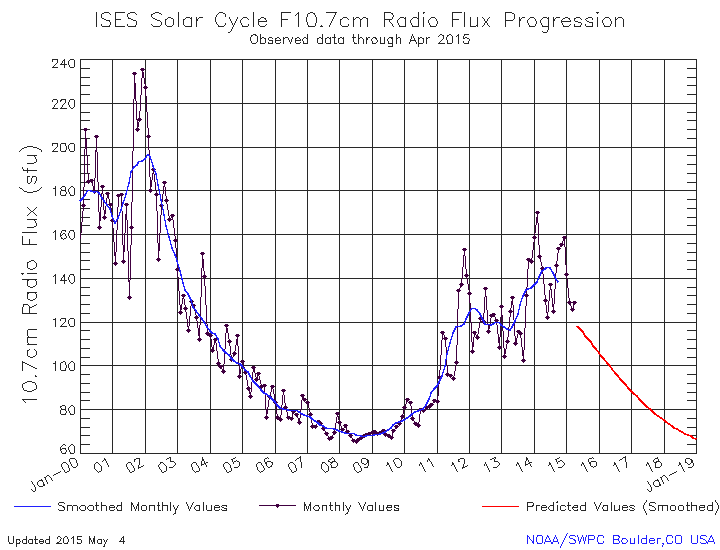
The F10.7cm solar flux number, perhaps the best indicator of solar activity, can be seen on this chart:

solar-cycle-10-cm-radio-fluxMAY15NOAAThe F10.7cm is comparable to the Sunspots chart in magnitude and direction.

The following chart shows data through the 14th of June.  Cycle 24 is still a long way from minimum (estimated to be in 2019 by NASA, although my guess is it will be at least a year more) and that can be seen by the NOAA Sunspot number that shot up about one week into the month of June.

solarterrestialchart14may15cbdakota

Skeptic Reference Sources—1350+ Peer-Reviewed Papers


This is the second posting of skeptic reference sources. This time it is “1350+ Peer- Reviewed Papers Supporting Skeptic Arguments Against ACC/AGW Alarmism”.   The papers have been sorted by categories to Cooling_is_the_New_Warmingmake the desired documents easily located. It is interesting that PopularTechnology.net supplied “Rebuttals to Criticisms” in the beginning. These are also a leg-up for you in discussions with warmers.

Click here to enter the PopularTechnology.net website.

cbdakota

Skeptic Reference Sources–Part 1


There are several excellent sources for Skeptics. This posting provides a the sunsource for Solar Research Papers.   The amount of Sun based research may surprise you, because the Warmers continue to tell us that the Sun is not important.

Some of the research is readily available and some is behind paywalls. But I suspect that just looking at the available research will occupy you for some long time.   The source is Club du Soleil  Click here to see  this source.

There are several additional resources that I will post soon.

cbdakota