Category Archives: Sea Ice

Chinese Academy Of Science Adopt Heartland’s “Climate Change Reconsidered”


The Nongovernmental International Panel on Climate Change (NIPCC) books, Climate Change Reconsidered and Climate Change Reconsidered: 2011 Interim Report published by the Heartland Institute has been translated from English to Chinese by the Chinese Academy of Sciences (CAS).  These books “..present a sweeping rebuttal of the findings of the United Nations’ controversial Intergovernmental Panel on Climate Change (IPCC), whose reports were widely cited as the basis for taking action to stop or slow the advance of climate change”.

According to the Heartland Institute:

“The Chinese Academy of Sciences is the world’s largest academy of sciences, employing some 50,000 people and hosting more than 350 international conferences a year. Membership in the Academy represents the highest level of national honor for Chinese scientists. The Nature Publishing Index in May ranked the Chinese Academy of Sciences No. 12 on its list of the “Global Top 100” scientific institutions – ahead of the University of Oxford (No. 14), Yale University (No. 16), and the California Institute of Technology (No. 25).

The first 856-page volume of Climate Change Reconsidered, published in 2009, and its follow-up, the 430-page Climate Change Reconsidered: 2011 Interim Report,were produced by a team of scientists originally convened by Dr. S. Fred Singer under the name of the Nongovernmental International Panel on Climate Change (NIPCC).

chinaccrcoverclimatechangereconsidered

                  Climate Change Reconsidered is translated into Chinese


Jim Lakely, director of communications at the Heartland Institute told Breitbart  News:

“Translating and publishing nearly 1,300 pages of peer-reviewed scientific literature from English to Chinese is no small task, and indicative of how important CAS considers Climate Change Reconsidered to the global climate change debate. That CAS has invited the authors and editors of Climate Change Reconsidered to a conference this Saturday in Beijing to introduce the studies is yet another indicator of how important it is to get this information out to a wider audience.”

Heartland Institute President Joseph Bast added:

“A December 2012 UN meeting designed to provide climate change regulations ended in failure after China refused to sign a global climate change treaty. China was joined by the United States, as well as Canada, India, Japan, Russia, and Brazil. “Opposition to a new climate treaty is justified based upon the real science presented in Climate Change Reconsidered.”

Hopefully,  the mainstream media will take note.

cbdakota

GLOBAL WARMING AND CLIMATE CHANGE: SCIENCE AND POLITICS


A referred paper in Quaestiones Geographicae* written by Cliff Ollier titled “Global Warming and Climate Change: Science and Politics “ maintains the idea that global warming will bring on devastation is a dangerous belief.  Ollier challenges the belief that CO2 is a major force in defining the globe’s climate.   He also takes on the corollary issues such as sea level, the Sun and climate.  The abstract to the paper follows:
The threat of dangerous climate change from anthropogenic global warming has decreased.
• Global temperature rose from 1975 to 1998, but since then has leveled off.
• Sea level is now rising at about 1.5mm per year based on tide gauges, and satellite data suggests it may even be falling.
o Coral islands once allegedly threatened by drowning have actually increased in area.
o Ice caps cannot possibly slide into the sea (the alarmist model) because they occupy kilometres-deep basins extending below sea level.
o Deep ice cores show a succession of annual layers of snow accumulation back to 760,000 years and in all that time never melted, despite times when the temperature was higher than it is today.
o Sea ice shows no change in 30 years in the Arctic.
• Emphasis on the greenhouse effect stresses radiation and usually leads to neglect of important factors like convection.
o Water is the main greenhouse gas.
o The CO2 in the ocean and the atmosphere are in equilibrium: if we could remove CO2 from the atmosphere the ocean would give out more to restore the balance. Increasing CO2 might make the ocean less alkaline but never acid.
• The sun is now seen as the major control of climate, but not through greenhouse gases.
o There is a very good correlation of sunspots and climate.
o Solar cycles provide a basis for prediction. Solar Cycle 24 has started and we can expect serious cooling.
• Many think that political decisions about climate are based on scientific predictions but what politicians get are projections based on computer models.
o The UN’s main adviser, the IPCC, uses adjusted data for the input, their models and codes remain secret, and they do not accept responsibility for their projections.
The issues listed in the Abstract are explored in some detail in the full paper that you can access by clicking here.
cbdakota

Scientists Baffled By The Stop In Global Warming


P.Gosselin of No Tricks Zone provides climate news from Germany in English. He has done this and incorporates his excellent insights, when he reviews Der Spiegel’s, (a major German newpaper) article titled “Klimawandel: Forscher rätseln über Stillstand bei Erderwärmung” (Trans…Climate change: scientists baffled by the stop in global warming).
Gosselin says that:
 “The big question now circulating through the stunned European media, governments and activist organisations is how could the warming stop have happened? Moreover, how do we now explain it to the public?”
My equally as stunned reaction is why aren’t the American media, etc also stunned? I guess perhaps it is because the US is the mother load of grant money.

Climate Model Forecasts Proven Wrong


Where would the theory of Anthropogenic Global Warming (AGW, aka: man-made global warming) be if it weren’t for the climate models that forecast devastatingly high temperatures, sea level change that will make hundreds of millions of people homeless, mass extinctions of all manner of creatures, etc? What if those forecasts consistently were in error?  You would have to conclude, that the warmers don’t have a viable theory and they would quickly fade away.  Well, the forecasts are consistently in error and warmers still have not faded away.  So what is going on?

Because it is Father’s Day, let’s look at James Hansen’s (father of the current man-made global warming cult) forecast presented to the US Congress in 1988:

Chart from: James Hansen et al. Global Climate Changes as Forecast by Goddard Institute for Space Studies Three-Dimensional Model journal of Geophysical Research.

The chart forecasts a global temperature increase that will be caused by different levels of CO2 emissions.  Scenarios “A” (blue) which postulated an increase in CO2 emissions by 1.5% per year
 and “B” (green): constant increase in CO2 emissions after 2000
 and “C” (red): no increase in CO2 emissions after 2000The black line is the actual global temperature.

Since 2000, the CO2 emissions have increased about 2.5% per year.  So one would expect the observed temperature to have exceeded the blue line “A”. Yet we see the actual temperature increase matching or perhaps coming in lower than that forecast by the red line “C” that was based upon a forecast of O% per year increase in CO2 after 2000. How many ways can you say FAIL!!!

Hansen’s influential presentation was widely broadcast and had a profound effect on Congress.  If you had been in the Capitol that day, you might have become concerned.   But with time, the Hansen forecast has been demonstrated to be very wrong.   The Chart above came from Wattsupwiththat (WUWT) blog and the comments by readers to the WUWT posting are quite interesting.  The warmers that commented essentially said—well, sure, it was wrong but some things happened; volcanoes, less fluorocarbons in the atmosphere, less methane in the atmosphere and the positive feedback he used is now imagined to be less than it was imagined to be at the time of the Hansen forecast.

Wow, that is a lot of things going wrong considering we are still being told that only CO2 really matters.  Isn’t it amazing that when the forecasts play out for a lot of years (in Hansen’s case, 24 years), only then can you find out if they are really any good.  Forecasting today what the world will look like in 2100 is an interesting exercise but only fools would believe that it was likely to be accurate.

We know that money and control drives the warmers and the politicians to continue this charade.  But the media has bought into this lock, stock and barrel.  What drives them?  I know that bad news (fear of global warming caused catastrophe) sells more papers than good news.  And the falling readership that the mainstream media is experiencing, makes them desperate to continue echoing everything the green alarmists say.  Why are there no latter-day Woodwards and Bernsteins that want to expose the lies after some 20 years of flat global temperatures and failed predictions?   Skeptics are gaining the upper hand with regard to public opinion, but if the media owned up to the facts and began questioning the AGW theory, this round of Lysenkoism could be ended.

cbdakota


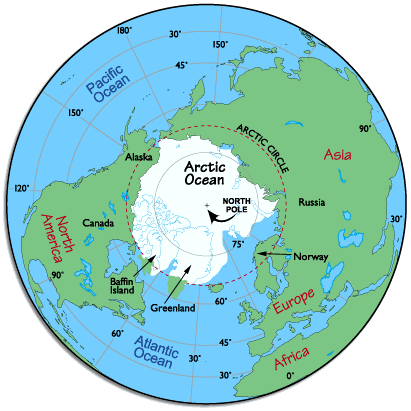
US Asserts Interest In Arctic


According to a story in Reuters, “Secretary of State Hillary Clinton will assert U.S. interest in the Arctic, where the prospects for abundant oil, gas and new trade routes has been likened to a modern-day gold rush, when she visits the region on Saturday.”  (1 June 12)

Interest is high with nations worldwide vying for access to the Arctic.  “Norway has moved its military operational headquarters into the Arctic Circle, China has development plans for Iceland and countries, including Russia, are laying claim to exploration rights in the once pristine Barents Sea.”

Map courtesy of WorldAtlas.com

It is all about energy.  While our politicians dilly-dally about the oil in ANWR, and fuss over any attempt to develop the resources in the Arctic area, the World’s nations are not waiting our approval.

More comments from the Reuters article:  “Even Russia, the largest provider of oil and gas to Europe is keen to accelerate gas production from its offshore gas fields as soon as possible, or as soon as economically viable.”

The U.S. Geological Survey estimates that the Arctic holds about 13 percent of the world’s undiscovered conventional oil and 30 percent of its undiscovered natural gas resources.

“All the major powers are positioning themselves for this development,” said Ole Arve Misund, director of the University Centre in Svalbard. “The resource has become more available and prospects have already been opened in Norway, Russia, Canada, the U.S. and Greenland.”

ExxonMobil is working with Rosneft to develop blocks in the Kara Sea, off Siberia, despite sea ice for up to 300 days a year.

Gazprom is also working with Total and Norway’s Statoil on the 4-trillion-cubic-metre Shtokman gas field 550 km offshore. Statoil has also established a strong Arctic record with its Skrugard and Havis finds, holding up to 600 million barrels of oil.   

Ole Arve Misund is quoted above saying that all major powers are positioning themselves for this development.  But one of the powers, the present US Administration may be deeply distressed by this major source of fossil fuels and who knows what game they will play to prevent exploitation of these resources.

cbdakota

Lubos Motl’s 104 Reasons To Be A Skeptic


Lubos Motl’s skeptical website, The Reference Frame, is widely read and cited.  Motl counters John Cook’s assertions about man-made global warming.  Motl provides background science that will serve skeptics in any discussion and/or debate.  Motl introduces his material as follows:

John Cook, a former student of physics in Australia, has constructed an interesting website trying to attack the opinions of climate skeptics.

It’s been in my climate bookmarks for quite some time but no one really cared about it so I didn’t want to respond. However, his talking counter-points were recently adopted by an iPhone application. Moreover, Andrew Revkin promoted the website, too. So let us look at his points and counter-points.

Motl matches the headings from Cook’s listing of “myths” and Motl adds his view illustrating what the real story is. Below are two of the 104 topics so you can get a flavor of what is included. To read to all of Motl’s work click here.

On his (Cook) website, you can currently see 102 observations by the skeptics (or some skeptics); 2 of them were added by March 29th and I can’t constantly update this web page so that he’s likely to surpass his 104 points sometime in the future. Each of the “slogans” is accompanied by a short attempted rebuttal by John Cook. And if you click it, you get to a long rebuttal. So let’s look at them:

1. It’s the sun: I agree with Richard Lindzen that it’s silly to try to find “one reason behind all climate change”, because the climate is pretty complex and clearly has lots of drivers, and this applies to the opinion that “everything is in the Sun”, too. Cook shows that the solar irradiance is too small and largely uncorrelated to the observed changes of temperatures. I agree with that: a typical 0.1% change of the output is enough for a 0.025% change of the temperature in Kelvins which is less than 0.1 °C and unlikely to matter much. But I find it embarrassing for a student of solar physics such as himself to be so narrow-minded. The Sun influences the Earth’s atmosphere not only directly by the output but also indirectly, by its magnetic field and its impact on the cosmic rays (via solar wind etc.) and other things. He has completely ignored all these things. Of course, I am actually not certain that these effects are very important for the climate but the evidence – including peer-reviewed articles – is as diverse as the evidence supporting CO2 as an important driver.

104. Southern sea ice is increasing: Cook agrees but says that it surely has nothing to do with warming or global climate change. It must be due to “complex phenomena” such as changes of the winds and circulation. Note that such comments would be unthinkable if he tried to discuss the Northern sea ice. As we have noticed, all “warming” observations are about the climate, important signals that you should appreciate, worship, extrapolate, and be afraid of. On the other hand, all “cooling” observations are just an irrelevant weather that you should dismiss, humiliate, and spit on. With such a biased attitude, it shouldn’t be shocking that Mr Cook ends up with an irrational orthodoxy based on 104 largely obscure misinterpretations, misunderstandings, and myths – and that his opinions about the most important questions are upside down.

Go through all of them, you will might learn something that you didn’t know.

cbdakota

The Warmers—-The Gang That Can’t Shoot Straight


Last year the Warmers were defending the IPCC’s Fourth Assessment Report’s conclusion that the Himalayan glaciers would disappear by 2035.   Oops, they then said, we meant 2350.  Even so, we are being told that the glaciers were melting and so quickly that the people in Asia would be in big trouble when there was no more melt water.  They believed that melting of Himalayan glacial ice was equivalent to 50 billion tons of water every year.  But now a study  ( lead scientist John Wahr and team) published in Nature tells that the Himalayan glaciers have lost no ice over the last decade. The measurements of global ice for this study were done using satellites.   According to the report:

The reason for the radical reappraisal of ice melting in Asia is the different ways in which the current and previous studies were conducted. Until now, estimates of melt water loss for all the world’s 200,000 glaciers were based on extrapolations of data from a few hundred monitored on the ground. Those glaciers at lower altitudes are much easier for scientists to get to and so were more frequently included, but they were also more prone to melting.

The bias was particularly strong in Asia, said Wahr:

“Their extrapolation is really tough as only a handful of lower-altitude glaciers are monitored and there are thousands there very high up.”

Satellite data for the rest of the world’s glaciers were also measured and the team reported no changes in the melt rate.

Glaciers have been melting for the last 10,000 years.   The question is really— is the present rate particularly unusual?  This study certainly puts into question the warmers previous assertion that it is.  Isn’t this just one more indication that there has been no statistically significant global warming over the past decade.

But whenever a study comes out like this, it is required to say—- nothing has changed, CO2 is still the problem.    Prof Jonathan Bamber, the director of the Bristol Glaciology Centre said:

“The new data does not mean that concerns about climate change are overblown in any way. It means there is a much larger uncertainty in high mountain Asia than we thought. Taken globally all the observations of the Earth’s ice – permafrost, Arctic sea ice, snow cover and glaciers – are going in the same direction.

NOT OVERBLOWN?????  (Just more uncertainty!!)

Professor Bamber also participated in an online Q and A session.  He responded to a question from “On Earth” as follows:

OnEarth. For Antarctica and Greenland the results from this study are in very good agreement with most recent previous estimates of mass loss from the ice sheets so it doesn’t change our view of what these are doing.

I have always had a lot of respect for “most recent previous estimates..” what ever they are.

Are we to assume that much stress is being felt in Asian lands where the Himalayan ice melt is so important according to the IPCC?  If there is no net change in total ice as the study tells us, does that mean there is a vastly reduced melt water flow?  By the way, there are many studies that say the monsoons are the principal source of the water these Asian countries rely upon.

To read more click here and here.

cbdakota

Weakness of AGW Theory- Part 6-A Legal Takedown


The University of Pennsylvania Law School has published Research Paper no. 10-08  titled  “Global Warming Advocacy Science: A Cross Examination” written by Jason Scott Johnston. His technique is a novel way of getting at the truth.  Johnson approaches the question of the validity of Anthropogenic Global Warming (AGW) as if it were in a court of law. While you may know a lot about this topic, my guess is that if you read it you will learn some new things.  I am familiar with the skeptic’s arguments but some of the AGW believer’s arguments were new to me.  Johnston takes a look at the arguments and treats them as if he were cross examining the two sides.

He does a nice job of exposing the weakness of “positive feedback” that is the basis for the computer projections of calamitous happenings if CO2 emissions are not checked. Further that computer projections of future climate are not science.  He highlights the rhetoric used by the alarmists that gets headlines and muddies the waters.

Johnston’s concludes his examination with these thoughts:  (ghg=green house gas)

Even if the reader is at this point persuaded to believe that there remain very important open questions about ghg emissions and global warming, and important areas of disagreement among climate scientists, she may well ask: So what? After all, such a reader might argue, CO2 is a ghg, and if we continue to increase CO2, then it seems clear that despite whatever uncertainty there may be about how much temperatures will increase as a consequence of increasing CO2 in the atmosphere, and about the impacts of such rising temperatures, there is no doubt that temperatures will increase with increasing CO2, and that at some point, such rising temperatures will cause harm, so that one way or another, at one time or another, we simply have to reduce our emissions of CO2.

However beguiling, such an argument not only oversimplifies the policy questions raised by human ghg emissions, it is also misunderstands the significance of the scientific questions revealed by my cross examination for the predictability of anthroprogenically-forced climate change. Consider first the scientific questions. If climate were a simple linear system – with increases in atmospheric CO2 directly and simply determining future warming – then while a detailed understanding of the earth’s climate system might still of scientific interest, there would be little policy justification for expending large amounts of public money to gain such an understanding. But if one thing is clear in climate science it is that the earth’s climate system is not linear, but is instead a highly complex, non-linear system made up of sub-systems – such as the ENSO, and the North Atlantic Oscillation, and the various circulating systems of the oceans – that are themselves highly non-linear. Among other things, such non-linearity means that it may be extremely difficult to separately identify the impact of an external shock to the system – such as what climate scientists call anthropogenic CO2 forcing – from changes that are simply due to natural cycles, or due to other external natural and anthropogenic forces, such as solar variation and human land use changes. Perhaps even more importantly, any given forcing may have impacts that are much larger – in the case of positive feedbacks – or much smaller – in the case of negative feedbacks – than a simple, linear vision of the climate system would suggest. Because of the system’s complexity and non-linearity, without a quite detailed understanding of the system, scientists cannot provide useful guidance regarding the impact on climate of increases in atmospheric ghg concentration.

As a large number of climate scientists have stressed, such an understanding will come about only if theoretical and model-driven predictions are tested against actual observational evidence. This is just to say that to really provide policymakers with the kind of information they need, climate scientists ought to follow the scientific method of developing theories and then testing those theories against the best available evidence. It is here that the cross examination conducted above yields its most valuable lesson, for it reveals what seem to be systematic patterns and practices that diverge from, and problems that impede, the application of basic scientific methods in establishment climate science. Among the most surprising and yet standard practices is a tendency in establishment climate science to simply ignore published studies that develop and/or present evidence tending to disconfirm various predictions or assumptions of the establishment view that increases in CO2 explain virtually all recent climate change.

Perhaps even more troubling, when establishment climate scientists do respond to studies supporting alternative hypotheses to the CO2 primacy view, they more often than not rely upon completely different observational datasets which they say confirm (or at least don’t disconfirm) climate model predictions. The point is important and worth further elucidation: while there are quite a large number of published papers reporting evidence that seems to disconfirm one or another climate model prediction, there is virtually no instance in which establishment climate scientists have taken such disconfirming evidence as an indication that the climate models may simply be wrong. Rather, in every important case, the establishment response is to question the reliability of the disconfirming evidence and then to find other evidence that is consistent with model predictions. Of course, the same point may be made of climate scientists who present the disconfirming studies: they tend to rely upon different datasets than do establishment climate scientists. From either point of view, there seems to be a real problem for climate science: With many crucial, testable predications – as for example the model prediction of differential tropical tropospheric versus surface warming – there is no indication that climate scientists are converging toward the use of standard observational datasets that they agree to be valid and reliable. Without such convergence, the predictions of climate models (and climate change theories more generally) cannot be subject to empirical testing, for it will always be possible for one side in any dispute to use one observational dataset and the other side to use some other observational dataset. Hence perhaps the central policy implication of the cross-examination conducted above is a very concrete and yet perhaps surprising one: public funding for climate science should be concentrated on the development of better, standardized observational datasets that achieve close to universal acceptance as valid and reliable. We should not be using public money to pay for faster and faster computers so that increasingly fine-grained climate models can be subjected to ever larger numbers of simulations until we have got the data to test whether the predictions of existing models are confirmed (or not disconfirmed) by the evidence.

This might seem like a more or less obvious policy recommendation, but if it were taken, it would represent not only a change in climate science funding practices, but also a reaffirmation of the role of basic scientific methodology in guiding publicly funded climate science. As things now stand, the advocates representing the establishment climate science story broadcast (usually with color diagrams) the predictions of climate models as if they were the results of experiments – actual evidence. Alongside these multi-colored multi-century model-simulated time series come stories, anecdotes, and photos – such as the iconic stranded polar bear — dramatically illustrating climate change today. On this rhetorical strategy, the models are to be taken on faith, and the stories and photos as evidence of the models’ truth. Policy carrying potential costs in the trillions of dollars ought not to be based on stories and photos confirming faith in models, but rather on precise and replicable testing of the models’ predictions against solid observational data.

This is a long paper,  some  80 pages, but I suggest that you read the entire document which you can do by clicking here.

Cbdakota

Oceans to Rise 1″ in 526 years. Man the Lifeboats.


Wattsupwiththat.com posts a blog about a University of Leeds press release titled “Melting Icebergs causing sea level rise”.  According to Professor Andrew Shepherd it would be unwise to discount this signal.  After he explains how melting icebergs cause this threat, he provides the punch line which is, “……the net effect is to increase sea level by 2.6% of its volume which is equivalent to 49 micrometers per year spread across the global oceans.”

Now you may already be laughing.  WUWT does the math (49 micrometers equals 0.0019 inches) and concludes, it will take 526 years to result in one inch of sea level rise because of this “threat.”  See the full story here.

The best laugh I got from this press release was a comment made on this story; as follows:

H.R. says:

April 30, 2010 at 12:10 pm

Note to self: in 526 years, send trousers to tailor and have them hemmed up.

Cbdakota

Boss and Galileo Discuss Cap and Trade


The Boss called in his science advisor, Galileo.  The Boss says “Galileo, I am being asked to limit carbon dioxide (CO2) atmospheric emissions resulting from the use of fossil fuels.   Should I do it; put in a plan to cutback fossil fuel use?  I know I can trust you because you, like your namesake think rationally not just go along with the crowd.”

Galileo responds “You have to decide based on (a) what we know or (b) what climate computers forecast the world will be like in 50 to 100 years if you don’t do something now.”

The Boss says “What’s the difference between what we know now and the computer forecasts?”

“Well Boss”  Galileo replied “you know that those who want you to cut back fossil fuel use say that the CO2 increase in the atmosphere will result in an unacceptable increase in global temperature, flooding resulting from ice melt, droughts in some parts of the world and excessive rains in others.  Plus famine, war, pestilence and death”

“How do they know these things will happen?” asked the Boss.

“It’s the computers, Boss.”

“OK, then tell me what you meant about what we know now.”

Galileo said “Well despite a continuing increase in atmospheric CO2, the global temperatures have not risen in over ten years and the ocean temperatures have declined since 2003 when the Argo Buoy system was put into service.  The Argo buoys are the only credible ocean temperature measurements.   Sea level rise has been steady for hundreds of years and in fact there has been a slight decrease in the rate of rise recently. Further more, the most recent studies have decoupled CO2 rise and violent weather.  Much of the 4 Horses of the Apocalypse talk is based on un-peer reviewed papers by  organizations like World Wildlife Fund that are advocates of the man-made global warming theory.”

Four Horsemen of the Apocalypse

“But surely the computers must have forecast this as I have heard of these  projections for 20 years,  even before I became Boss”

“ Boss, these climate computers are not skillful.”

“Skillful, what does that mean?”

“That is a way of saying they are unable to make accurate forecasts.  This is because the globe’s climate is so complex and the computer programmers and the scientist that provide technical data do not fully understanding its complexity.  So they backcast and add constants (fudge factors, speaking technically) to model the past.  But this is only of limited success when trying to predict the climate in the future.  It is my understanding they mostly fiddle with the output until it gives the desired outcome that matches their predisposition.”

“My, my  that doesn’t seem ligit.”

“Well Boss,  you can see why they do this.  The people are unlikely to agree to draconian laws that kill their economies.  But if you tell them that the computer says that in 50 to 100 years from now things will be pretty bad here on Earth if they don’t.  Even though these computers are woeful at making accurate predictions, the advocates of man-made global warming pretend they are believable else the whole man-made global warming industry would collapse.”

“So Galileo tell me what you think we should do.”

“First I want you to know that I believe the globe is warming and has been since the last Ice Age.  But the warming by and large is due to natural forces  and does not seem to present any danger of getting out of hand.  Right now, for example, the total global ice is increasing, ocean temperatures are on the decline,.  I don’t believe we know enough to potentially destroy our economy by restricting the use of fossil fuels.”

“Well said, but maybe the climate computers will be able to predict the future.”

“I have some thoughts on that , Boss.  Perhaps more powerful computers and increased knowledge of how the climate works will someday yield accurate forecasts.  But how can we know when that happens?   I believe climate forecasts must be accurate for 20 or more years into the future. I would have all the best computer programmers and climate scientists set up from 1 to 5 computers, let them make projections for climate in 20 years hence.  If any of them are found to make accurate projections after 20 years, then lets use that program to make decisions. It is likely that continuing development of this science will produce new candidates for this test.  Every 5 years new entries should be put into this program and we can wait for that computer program’s projection demonstration after 20 years.  With out demonstrated performance accuracy,  we never should  allow computer climate forecasts set policy.”

“In the meantime, we can work on improved  energy technologies.  We will  encourage this effort, but  we should not force unproven, unreliable and costly technologies on the public.”

“Thanks Galileo.”