Category Archives: Environment

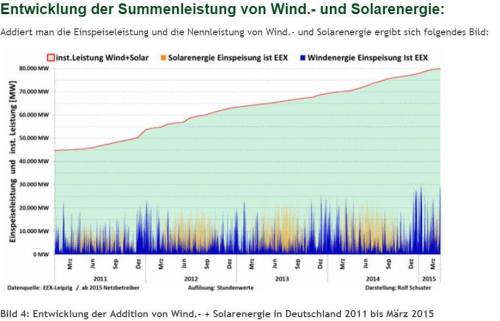
Germany’s Renewables Can Only Provide 11% Of Their Rated Capacity


Here is a look at the German renewable energy program. The NoTricksZone is a site that covers German media and reports it in English. The site is managed by Pierre Goselin and he recently posted “Two Great Destructive Lies German Leaders Refuse To Abandon”. The first of the two “lies” relates performance of wind and solar systems and it is that:

German renewable energies sun and wind are a success!”

germansolarwindcapvsactual

Continue reading

El Nino–Walker Circulation


The prior posting, “Some Background Regarding An El Nino began like this: “Currently, the weather is being strongly affected by an El Nino.  El Nino is but one part of a weather/climate system known as the El Nino Southern Oscillation (ENSO).  There are three phases of ENSO — El Nino, La Nina and Neutral.   ENSO is important because of its ability to change the global atmospheric circulation, which in turn, influences temperature and precipitation across the globe. The global atmospheric circulation is called the Walker Cycle   Circulation“.

This posting examines the Walker Circulation.(I have seen both cycle and circulation used but much of my sourcing for this posting uses Circulation.)

First lets talk about high and low pressure centers. Fair weather generally accompanies a high-pressure center while clouds and precipitation generally accompany a low-pressure center.  Low-pressure centers are formed by a hot surface. For example, the hot Pacific Ocean water that is driven to the Maritime Continent by the trade winds along the equator. The air is hot and moisture laden and as it rises, it cools and the moisture becomes rain. It reaches high-level winds that drive it to the west or east. This air is now dry and cool. It begins to fall forming a high-pressure center.   The air in the high-pressure center begins to flow toward the low pressure center residing above the hot seawater located in the Maritime Continent. Along the way it begins to warm and pick up moisture and then rise. This completes the circulation.

Continue reading

Some Background Regarding An El Nino


Currently the weather is being strongly affected by an El Nino. El Nino is but one part of a weather/climate system known as the El Nino Southern Oscillation (ENSO). There are three phases of ENSO — El Nino, La Nina and neutral.   ENSO is important because of its ability to change the global atmospheric circulation, which in turn, influences temperature and precipitation across the globe. The global atmospheric circulation is called the Walker Cycle and we will look  at that in the next posting.

Many of you already are fully informed about the ENSO but my guess is that some of you are not. I thought it might be helpful to provide some background information. (1)

First of all, we are talking about the Pacific Ocean. The Pacific Ocean from South America to the Maritime Continent(2), a distance of about 10k miles along the equator. Usually the trade winds blow along the equator toward the west. This moves the hot surface water to the Western Pacific. The sea surface is about ½ meter higher in Indonesian than it is in Ecuador. 
Usually, sea-surface temperatures off South America’s west coast range from the 60°s to 70°s F, while they exceed 80°F in the “warm pool.” This description is essentially that of the neutral phase.

On occasions the easterly winds weaken and the hot water begins to flow eastward toward South America. This is the beginning of an El Nino. It typically starts in the May-June timeframe as the water flows eastward. It reaches it peak strength about December. January through March/April typically are the months that the El Nino begins to lose it strength. Some El Ninos maintain strength longer such as the 1998/1999 El Nino, which is considered one of the strongest ever.

Continue reading

EPA Chief Provides Non-Answer To Reporter.


Environmental Protection Agency Administrator Gina McCarthy spoke at the Council on Foreign Relations in Washington, D.C., on Jan. 7, 2016. The event seerimageswas focused on the “threat” of climate change. A CNSnews.com posting “EPA Chief: Climate Change Is Certain But You Can’t Predict the Future” related the comments made by the Administrator at that meeting.

A CNS News reporter asked the Administrator the following question:

“According to the Energy Information Administration – although alternative and renewables are growing slightly – fossil fuels will still account for 80 percent of U.S. energy needs through 2040. Federal data also shows that U.S. carbon emissions are at almost a 20-year low right now. How do those facts fit into the picture the EPA is painting of the U.S. energy landscape?”

Continue reading

NIPCC Reference: Biological Impacts


A number of you have written telling me that you liked the Nongovernmental International Panel on Climate Change—Science. So I will add the NIPCC’s second reference book: Biological Impacts. Click here to link.

cbdakota

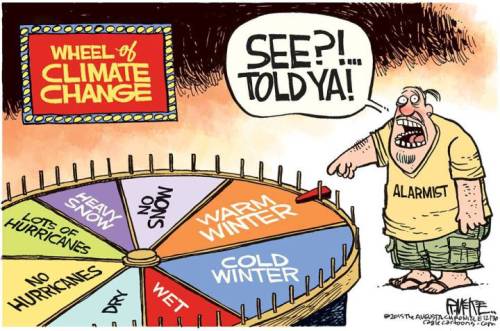
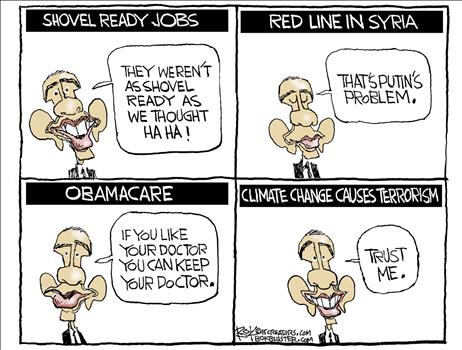
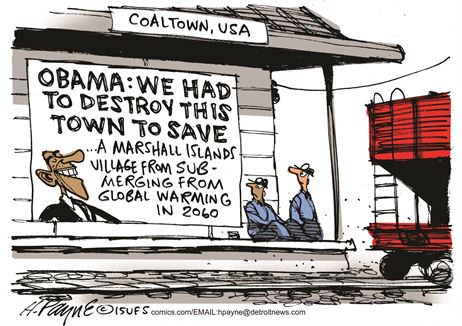
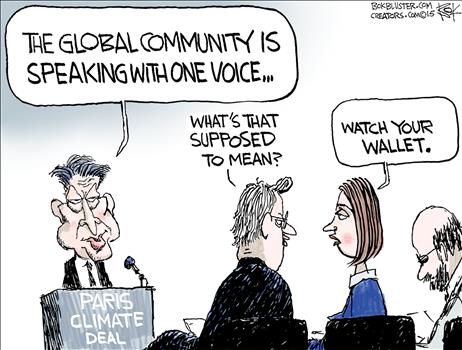
Year End Global Warming Cartoons


Year end cartoons  courtesy of TownHall.com

cartoonwheel-of-climatehttp://townhall.com/political-cartoons/2015/12/05/137270

cartoonbombintruckpayn_c13758220151220120100

cartoonstrustmecb120715dAPR20151204114706

cartoonworldpayn_c13727620151205120100

coaltowncartoonpayn_c13774320151229120100

cartoonwatchyourwalletcb121415dAPR20151214094510

Have a great 2016.  Happy New Year!!!

cbdakota


Climate Change Reconsidered II: Physical Science–An Unbiased Report


The International Panel on Climate Change (IPCC) issues a report every three or four years about global warming. This UN agency’s charter is not to examine the science of global warming but rather to show that man produced greenhouse gases will result in catastrophic damage to the globe.   IPCC does as directed by giving little consideration to data, science or reports that would contradict the charter.

A relatively new report, compiled by the Nongovernmental International Panel cover of part2FrontCover2on Climate Change (NIPCC) has been written to answer the IPCC’ reports. The first installment is Climate Change Reconsidered II: Physical Science (CCR-II). This installment is an independent, comprehensive, and authoritative report on the current state of climate science. It is the fourth in a series of scholarly reports produced by the (NIPCC), an international network of climate scientists sponsored by three nonprofit organizations: Center for the Study of Carbon Dioxide and Global Change, Science and Environmental Policy Project (SEPP), and The Heartland Institute. Real data and unbiased studies were used in the preparation of this installment.

You can link to Climate Change Reconsidered II: Physical Science (CCRII) by clicking here.

cbdakota


Forecast US Winter Temperatures and Precipitation


Will the current El Nino be a record setter? Will it create bigger temperature and precipitation events than the current record holder that happened in 1997-98?

The National Oceanic and Atmospheric Administration (NOAA) say for the moment, they do not think so, but it still too early to rule out that possibility.

For the US, this probably means a warmer and drier period from December through mid-March in the North and Northeast and a cooler and wetter period in January through April in the South and Southwest.   The December’s temperatures in the Northeast are high enough to be record setters. NOAA says that there is typically about a month’s delay to see the effect in the South and Southwest.

NOAA forecasts of the US weather resulting from El Nino can be seen in the following two charts. NOAA hedges their bet by showing three possible forecast US weather bands. The highest percentage being the most likely.  First the forecast temperatures:

ELNINOtemp

The Northern part of the US has a 62% chance of a warm winter. And almost no chance of being cooler than normal. The midsection is a coin toss. The South will be cooler than normal.

Continue reading

Wow, Do I Feel Betrayed–Massive Omnibus Spending Bill


Wow, do I feel betrayed. The promises by the Republicans on how they were going to handle the budget apparently were just used to fool the voters. They really did not mean what they said. The new budget deal doesn’t even address President Obama plans to send reparation money to the UN.  From the Daily Signal posting “What’s Wrong With The Massive Omnibus Spending Bill” one of the segments of the bill is “Energy”. I have on several occasions posted that US crude oil should be allowed to be sold outside the US. If the spending bill is enacted, that will happen. However, I would give that up for a reversal of the other provision such as extending tax credit for wind production. But my biggest regret is that the Republican promises to block the use of monies for the President’s climate change schemes did not happen . Read the following:

If you were to put a jelly bean for each energy provision on a two-sided scale, the side being good free-market provisions and the other being corrupt energy provisions, the bad side of the scale would be hitting the floor.

Continue reading

Fortunately, The Paris Climate Talks Appear To Have Failed


The bluster emanating from the Paris climate talks challenges the Potemkin Villages as the biggest attempted cover-up of the real facts on the ground in history. The agreement produced only voluntary caps on CO2 emissions; only voluntary transfers (reparations really) of money from the 1st world to the 3rd world); and reporting of emissions and international oversight do not exist. Further more, neither China or India will cut back their expected increase in CO2 emissions as they plan to serve their citizens first.
The Paris climate leadership acknowledged that even if the emission cuts would take place as promised, their arbitrary goal of holding the global temperature rise under 2C would not be achieved. President Obama flew a 500+ army to Paris. All they accomplished was to spend our money and a lot of CO2 emisssions.

The President, however, will claim he must have the money to pay reparations to the 3rd world countries and laws enacted to shut-down our industry to reduce CO2 emission. The science is not settled. Why wreck our economy and put our people out of work when there has been no significant rise in global temperatures for almost 19 years and polar ice is increasing.

cbdakota