Category Archives: CO2 positive feedback

Denying The Climate Catastrophe:Greenhouse GasTheory (Warren Meyers Essay)


Below is my reposting fr0m Coyotebog.com, the Warren Meyers essay on his take of the global climate change issue.

cbdakota

We continue our multi-part series on the theory of catastrophic man-made global warming by returning to our framework we introduced in the last chapter

Click to Enlarge

In the introduction, we discussed how catastrophic man-made global warming theory was actually made up of two independent parts.  In this section, we will discuss the first of these two parts, the greenhouse gas effect, which is the box in the upper left of our framework.

For those unfamiliar with exactly what the greenhouse effect is, I encourage you to check out this very short primer.  Essentially, certain gasses in the atmosphere can absorb some of the heat the Earth is radiating into space, and re-radiate some of this heat back to Earth.  These are called greenhouse gasses.  Water vapor is a relatively strong greenhouse gas, while CO2 is actually a relatively weak greenhouse gas.

It may come as a surprise to those who only know of skeptics’ arguments from reading their opponents (rather than the skeptics themselves), but most prominent skeptics accept the theory of greenhouse gas warming.  Of course there are exceptions, including a couple of trolls who like to get attention in the comments section of this and other blogs, and including a few prominent politicians and talk-show hosts.  But there are also environmental alarmists on the other side who have signed petitions to ban dihydrogen monoxide.  It is always tempting, but seldom intellectually rewarding, to judge a particular position by its least capable defenders.

There is simply too much evidence both from our and other planets (as well as simple experiments in a laboratory) to deny that greenhouse gasses in the atmosphere have a warming effect on planets, and that CO2 is such a greenhouse gas.   What follows in the rest of this section represents something of a consensus of people on both sides of the debate.

Continue reading

97% Claim Meant To Keep You From Looking At The Facts Of Climate Change


An editorial by the Washington Post has gotten wide spread coverage in the main stream media. The headline for the editorial is “Research shows there’s no debate” with a subtitle, “Study shows experts do agree on climate change”. The subject is a new paper by John Cook claiming the support for man-made global warming is indeed at 97.1%. Cook is no more than a spin doctor. One of my comments in a letter I wrote to a local newspaper was “The warmers need him, desperately, to direct the climate change discussion away from the facts. “

The facts I used were the global temperature and the global sea level to demonstrate how far off the mark the warmer’s science is when compared to the actual data.

David Legates has written an excellent, detailed rebuttal to the Cook paper.

From the website WUWT, Legates’ posting follows:

cbdakota

H/T Dick Waughtal

Deep-sixing another useless climate myth

Guest Blogger / April 10, 2016

The vaunted “97% consensus” on dangerous manmade global warming is just more malarkey

by Dr. David R. Legates

By now, virtually everyone has heard that “97% of scientists agree: Climate change is real, manmade and dangerous.” Even if you weren’t one of his 31 million followers who received this tweet from President Obama, you most assuredly have seen it repeated everywhere as scientific fact.

The correct representation is “yes,” “some,” and “no.” Yes, climate change is real. There has never been a period in Earth’s history when the climate has not changed somewhere, in one way or another.

People can and do have some influence on our climate. For example, downtown areas are warmer than the surrounding countryside, and large-scale human development can affect air and moisture flow. But humans are by no means the only source of climate change. The Pleistocene ice ages, Little Ice Age and monster hurricanes throughout history underscore our trivial influence compared to natural forces.

As for climate change being dangerous, this is pure hype based on little fact. Mile-high rivers of ice burying half of North America and Europe were disastrous for everything in their path, as they would be today. Likewise for the plummeting global temperatures that accompanied them. An era of more frequent and intense hurricanes would also be calamitous; but actual weather records do not show this.

It would be far more deadly to implement restrictive energy policies that condemn billions to continued life without affordable electricity – or to lower living standards in developed countries – in a vain attempt to control the world’s climate. In much of Europe, electricity prices have risen 50% or more over the past decade, leaving many unable to afford proper wintertime heat, and causing thousands to die.

Moreover, consensus and votes have no place in science. History is littered with theories that were long denied by “consensus” science and politics: plate tectonics, germ theory of disease, a geocentric universe. They all underscore how wrong consensus can be.

Science is driven by facts, evidence and observations – not by consensus, especially when it is asserted by deceitful or tyrannical advocates. As Einstein said, “A single experiment can prove me wrong.”

During this election season, Americans are buffeted by polls suggesting which candidate might become each party’s nominee or win the general election. Obviously, only the November “poll” counts.

Similarly, several “polls” have attempted to quantify the supposed climate change consensus, often by using simplistic bait-and-switch tactics. “Do you believe in climate change?” they may ask.

Answering yes, as I would, places you in the President’s 97% consensus and, by illogical extension, implies you agree it is caused by humans and will be dangerous. Of course, that serves their political goal of gaining more control over energy use.

The 97% statistic has specific origins. Naomi Oreskes is a Harvard professor and author of Merchants of Doubt, which claims those who disagree with the supposed consensus are paid by Big Oil to obscure the truth. In 2004, she claimed to have examined the abstracts of 928 scientific papers and found a 100% consensus with the claim that the “Earth’s climate is being affected by human activities.”

Of course, this is probably true, as it is unlikely that any competent scientist would say humans have no impact on climate. However, she then played the bait-and-switch game to perfection – asserting that this meant “most of the observed warming of the last 50 years is likely to have been due to the increase in greenhouse gas concentrations.”

However, one dissenter is enough to discredit the entire study, and what journalist would believe any claim of 100% agreement? In addition, anecdotal evidence suggested that 97% was a better figure. So 97% it was.

Then in 2010, William Anderegg and colleagues concluded that “97–98% of the climate researchers most actively publishing in the field support … [the view that] … anthropogenic greenhouse gases have been responsible for most of the unequivocal warming of the Earth’s average global temperature” over a recent but unspecified time period. (Emphasis in original.)

To make this extreme assertion, Anderegg et al. compiled a database of 908 climate researchers who published frequently on climate topics, and identified those who had “signed statements strongly dissenting from the views” of the UN’s Intergovernmental Panel on Climate Change. The 97–98% figure is achieved by counting those who had not signed such statements.

Silence, in Anderegg’s view, meant those scientists agreed with the extreme view that most warming was due to humans. However, nothing in their papers suggests that all those researchers believed humans had caused most of the planetary warming, or that it was dangerous.

The most recent 97% claim was posited by John Cook and colleagues in 2013. They evaluated abstracts from nearly 12,000 articles published over a 21-year period and sorted them into seven categories, ranging from “explicit, quantified endorsement” to “explicit, quantified rejection” of their alleged consensus: that recent warming was caused by human activity, not by natural variability. They concluded that “97.1% endorsed the consensus position.”

However, two-thirds of all those abstracts took no position on anthropogenic climate change. Of the remaining abstracts (not the papers or scientists), Cook and colleagues asserted that 97.1% endorsed their hypothesis that humans are the sole cause of recent global warming.

Again, the bait-and-switch was on full display. Any assertion that humans play a role was interpreted as meaning humans are the sole cause. But many of those scientists subsequently said publicly that Cook and colleagues had misclassified their papers – and Cook never tried to assess whether any of the scientists who wrote the papers actually thought the observed climate changes were dangerous.

My own colleagues and I did investigate their analysis more closely. We found that only 41 abstracts of the 11,944 papers Cook and colleagues reviewed – a whopping 0.3% – actually endorsed their supposed consensus. It turns out they had decided that any paper which did not provide an explicit, quantified rejection of their supposed consensus was in agreement with the consensus. Moreover, this decision was based solely on Cook and colleagues’ interpretation of just the abstracts, and not the articles themselves. In other words, the entire exercise was a clever sleight-of-hand trick.

What is the real figure? We may never know. Scientists who disagree with the supposed consensus – that climate change is manmade and dangerous – find themselves under constant attack.

Harassment by Greenpeace and other environmental pressure groups, the media, federal and state government officials, and even universities toward their employees (myself included) makes it difficult for many scientists to express honest opinions. Recent reports about Senator Whitehouse and Attorney-General Lynch using RICO laws to intimidate climate “deniers” further obscure meaningful discussion.

Numerous government employees have told me privately that they do not agree with the supposed consensus position – but cannot speak out for fear of losing their jobs. And just last week, a George Mason University survey found that nearly one-third of American Meteorological Society members were willing to admit that at least half of the climate change we have seen can be attributed to natural variability.

Climate change alarmism has become a $1.5-trillion-a-year industry – which guarantees it is far safer and more fashionable to pretend a 97% consensus exists, than to embrace honesty and have one’s global warming or renewable energy funding go dry.

The real danger is not climate change – it is energy policies imposed in the name of climate change. It’s time to consider something else Einstein said: “The important thing is not to stop questioning.” And then go see the important new documentary film, The Climate Hustle, coming soon to a theater near you.

Climate Change Reconsidered II: Physical Science–An Unbiased Report


The International Panel on Climate Change (IPCC) issues a report every three or four years about global warming. This UN agency’s charter is not to examine the science of global warming but rather to show that man produced greenhouse gases will result in catastrophic damage to the globe.   IPCC does as directed by giving little consideration to data, science or reports that would contradict the charter.

A relatively new report, compiled by the Nongovernmental International Panel cover of part2FrontCover2on Climate Change (NIPCC) has been written to answer the IPCC’ reports. The first installment is Climate Change Reconsidered II: Physical Science (CCR-II). This installment is an independent, comprehensive, and authoritative report on the current state of climate science. It is the fourth in a series of scholarly reports produced by the (NIPCC), an international network of climate scientists sponsored by three nonprofit organizations: Center for the Study of Carbon Dioxide and Global Change, Science and Environmental Policy Project (SEPP), and The Heartland Institute. Real data and unbiased studies were used in the preparation of this installment.

You can link to Climate Change Reconsidered II: Physical Science (CCRII) by clicking here.

cbdakota


COP 21: All Pain, No Gain


For the upcoming Paris COP 21, every nation was asked to make known an Intended Nationally Determined Contributions (INDC) of their reduction of CO2 emissions by the year 2030. The Paris meeting is intended to begin a process that will keep the global temperature rise less than 2C. It is also intended to provide 3rd world nations reparations for the “damage” done by the industrialized nations.

As of November 5, most of the nations having a significant level of CO2 emissions had submitted their INDC. The major sources of the CO2 emissions are from the US, China and the EU. Using  the forecast CO2 reduction commitments, computer runs find that the calculated global temperature reduction by 2100 as result of their INDCs will  only be 0.132C. Adding the temperature reduction from the other nations’ INDCs, the new total global temperature reduction change is 0.168C. These temperature reductions are probably too small to even be measured. And they are certainly nearly that of measurement error.

This minuscule effect on the global temperature will be accompanied by skyrocketing prices for energy, disruption of many nations economies and more hardships for the really poor peoples of this world. No gain but lots of Pain

Continue reading

“How Reliable Are The Climate Models” (Reblogged from WUWT)


I am reblogging a posting from WUWT by Mike Jonas titled: How reliable are the climate models?” The first chart in the WUWT posting illustrated the climate model unreliability.  The fact that climate models are not reliable has been covered on my blog, Climate Change Sanity, and many others. Often we talk about the fact that water vapor is the major “greenhouse” gas and not carbon dioxide (C02). Yet this issue is not the only reason these models have gone astray.   The WUWT blog discusses a number of other physical properties that have an effect on the “coupled nonlinear chaotic system” that is our atmosphere, that the models do not attempt to model.

The models are the basis for all the things that are forecast to happen —sea level rise, weather chaos, etc –  with their forecasts of very high global temperatures cause by CO2. Do we have a problem? Maybe but the climate models are unable to tell us anything.

cbdakota

WATTS UP WITH THAT

How reliable are the climate models?
Guest Blogger / 3 days ago September 17, 2015
Guest essay by Mike Jonas

michaels-102-ipcc-models-vs-reality

There are dozens of climate models. They have been run many times. The great majority of model runs, from the high-profile UK Met Office’s Barbecue Summer to Roy Spencer’s Epic Fail analysis of the tropical troposphere, have produced global temperature forecasts that later turned out to be too high. Why?

The answer is, mathematically speaking, very simple.

The fourth IPCC report [para 9.1.3] says : “Results from forward calculations are used for formal detection and attribution analyses. In such studies, a climate model is used to calculate response patterns (‘fingerprints’) for individual forcings or sets of forcings, which are then combined linearly to provide the best fit to the observations.”

To a mathematician that is a massive warning bell. You simply cannot do that. [To be more precise, because obviously they did actually do it, you cannot do that and retain any credibility]. Let me explain :


CLICK HERE TO READ THE REST OF THIS WUWT POSTING

Recent Research Papers Show That IPCC Climate Sensitivity Is Too High


The Intergovernmental Panel on Climate Change (IPCC) publishes, every 3 to 4 years, their version of the science supporting their theory of global warming. Laboratory tests would indicate that for every doubling of CO2 in the atmosphere, the Earth’s temperature should rise about 1C. That is not really very threatening. Their theory says that a doubling will bring about a 3C temperature increase.   The theory postulates that the temperature rise caused by CO2 would increase the amount of water vapor (H2O) in the atmosphere. This increase in water vapor, the major so called greenhouse gas, would result in an additional 2C rise— thus when added to the 1C from the CO2 effect would give the 3C rise for a doubling of atmospheric CO2. This is their view of climate sensitivity. The warmer’s climate models are programmed with this sensitivity. And if you follow this topic at all, you know that the models have predicted much higher temperatures than the real, measured temperatures. And the gap between actual temperature measurements and the climate model forecasts keeps growing.

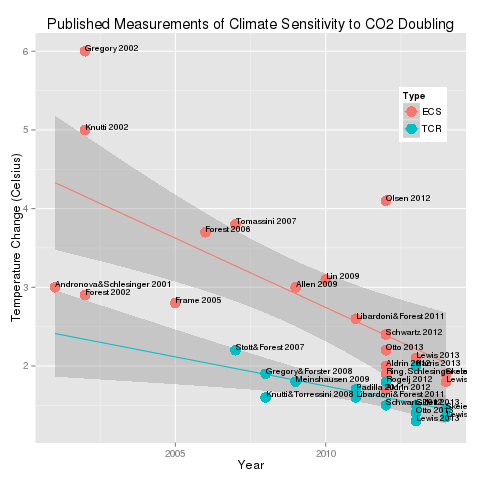
A 20 June 15 posting on Niche Modeling titled “Published measurements of climate sensitivity declining has a chart that compares the current research versus older research into  climate sensitivity. From that posting:

” Scientists made numerous estimates of climate sensitivity over the last few decades and have yet to determine the correct value.  The figure shows the change in published climate sensitivity measurements over the past 15 years (from here).  The ECS and TCR estimates have both declined in the last 15 years, with the ECS declining from 6C to less than 2C.  While one cannot extrapolate from past results, it is likely that the true figure is below 2C, and may continue to decline.  Based on this historic pattern we should reject the studies that falsely exaggerated the climate sensitivity in the past and remember that global warming is not the most serious issue facing the world today.

#2climatesensitivities

Frow Wiki, an expanded definition of ECS andTCR:

The equilibrium climate sensitivity (ECS) refers to the equilibrium change in global mean near-surface air temperature that would result from a sustained doubling of the atmospheric carbon dioxide concentration.  The transient climate response (TCR) is defined as the average temperature response over a twenty-year period centered at CO2 doubling in a transient simulation with CO2 increasing at 1% per year. The transient response is lower than the equilibrium sensitivity, due to the “inertia” of ocean heat uptake.

Over the 50–100 year timescale, the climate response to forcing is likely to follow the TCR.   With atmospheric CO2 now at a level of about 400 ppm and some experts claiming that the amount of CO2 will never rise to 800 because fossil fuels will be depleted by then.  I don’t know how to assess that but getting to 800ppm is a long way off into the future.

cbdakota


Climate Debate And Pope Francis’ Encyclical On The Environment


A debate about the theory of catastrophic man-made global warming (CAGW) took place recently between Carol Andress, of the Environmental Defense Fund (EDF) and Marc Morano of the Climate Depot Blog. The EDF website lists Ms Andress as having expertise in “Climate Change, U.S, Congress, air quality and U.S. climate policy”.

There are two themes during this debate; one is the credibility of the science supporting the CAGW and the other is Pope Francis’ expected papal encyclical on the environment.

The first theme was entirely won by Marano. This has been the consistent outcome of these debates between warmers and skeptics.   It is difficult for skeptics to get a warmer to debate anymore.  Because Ms Andress is considered an expert by the EDF, I am  further persuaded  that the EDF, as an organization, is weak on science as are most of the environmentally focused NGOs.  While nothing Ms Andress said with regard to the second theme was persuasive, the Pope appears to have been taken in. There is little likelihood at this point that he will change his mind.

Watch the debate on this YouTube video–it will initially open up with what looks to be another topic, but give it several seconds and it will switch to the debate.  The total time for the debate is about 15 minutes.

cbdakota


Skeptic Reference Sources—1350+ Peer-Reviewed Papers


This is the second posting of skeptic reference sources. This time it is “1350+ Peer- Reviewed Papers Supporting Skeptic Arguments Against ACC/AGW Alarmism”.   The papers have been sorted by categories to Cooling_is_the_New_Warmingmake the desired documents easily located. It is interesting that PopularTechnology.net supplied “Rebuttals to Criticisms” in the beginning. These are also a leg-up for you in discussions with warmers.

Click here to enter the PopularTechnology.net website.

cbdakota

5 IPCC Assessments Don’t Show Correlation Of Temperature And Severe Weather


Another Ronald Bailey of Reason.com posting is our feature today.   On 8 April, Bailey posted “Detection of Enhanced Greenhouse Warming:What The IPCC Said Back In 1990”.

si[imagesBailey’s previous posting listed reasons why he had switched from a skeptic to a warmer. He said there was a lot of pushback to that posting. People were challenging his assertions about climate models predictions of hurricanes, droughts, etc. He decided to review the 5 Assessment Reports (AR) produced by the Intergovernmental Pannel on Climate Change (IPCC), beginning with the first one issued in 1990. The results of the review in his words:

“As far as I can tell, all of the reports admit that the observational data do not definitively show any trends with regard to those particular aspects of climate. With regard to model outputs concerning those trends, the IPCC reports characterize them using tentative terminology such as “encouraging” back in 1990 and “medium evidence” and “medium agreement” in matching observational trends in the most recent report. In general, the models are not predicting a worsening trend in hurricanes, tornadoes, and droughts, at least in the short run.”

So the warmer’s bible cannot make the connection between “global warming” and severe weather.   But as that does not fit the narrative of the alarmist among the AGW crowd, they are ignoring this inconvenient fact.

Continue reading

Skeptic And Warmer Viewpoints On Global Warming


arguinginternetimagesRonald Bailey is the science correspondent for Reason.com. On 3 April he posted: “What Would Convince You That Man-Made Global Warming Is Real.” He was, at one time, a skeptic but several years ago, changed is mind and became a believer in the anthropogenic global warming (AGW) theory. His posting has examples of why he changed his mind and wonders if these examples might convince other skeptics to become a warmer.

The posting resulted in a number of responses, some of which I will cover in this posting. The responses essentially are refutations of Bailey’s reasons for his conversion

Continue reading