Category Archives: Climate Models

“ Average Global Temperature”? Do You Know What It Represents?


The warmers are saying that we cannot let the global temperature increase by more than 2ºC. According to them, really bad things will happen if we exceed that number. The 2ºC must be another of those “tipping points” that we have heard so much of in recent years. Most all of which have come and gone with out any noticeable effect.

What is the global temperature? You almost never hear it expressed like a typical temperature reading you get each day from the weather stations.   The only place I can find a description stated as a typical temperature reading is from the World Meteorological Organization saying that the average global temperature, between 1961 and 1990, was 14ºC (57.2ºF). But I find nothing more recent. One reason is that an agreement around a specific temperature is difficult to come by.

At the South Pole, the highest temperature ever recorded was 12.3º C (9.9ºF).  Singapore’s record low was 19.4ºC (66.9ºF). So where is the average?   An average global temperature does not exist in the real world.  I will discuss near the end of this posting.

Anomalies are used instead.  A long-term average is used for reference and the tempanomaliestemperature differences from that are termed anomalies.   Positive anomalies and negative anomalies are increases or decreases, respectively, from this long-term reference. Further these changes are very small. If you made a chart plotting a series of numbers of slowly warming normal temperature readings say:14.0ºC, 14. 01ºC, 14.01ºC, 14.02ºC, 14.02ºC, 14.03ºC,  you probably would not be able to visibly detect any change.   How frightening would that be?  Everything looks more dramatic when you plot the anomalies (0.01, 0.02, 0.o2, etc.).

Continue reading

“How Reliable Are The Climate Models” (Reblogged from WUWT)


I am reblogging a posting from WUWT by Mike Jonas titled: How reliable are the climate models?” The first chart in the WUWT posting illustrated the climate model unreliability.  The fact that climate models are not reliable has been covered on my blog, Climate Change Sanity, and many others. Often we talk about the fact that water vapor is the major “greenhouse” gas and not carbon dioxide (C02). Yet this issue is not the only reason these models have gone astray.   The WUWT blog discusses a number of other physical properties that have an effect on the “coupled nonlinear chaotic system” that is our atmosphere, that the models do not attempt to model.

The models are the basis for all the things that are forecast to happen —sea level rise, weather chaos, etc –  with their forecasts of very high global temperatures cause by CO2. Do we have a problem? Maybe but the climate models are unable to tell us anything.

cbdakota

WATTS UP WITH THAT

How reliable are the climate models?
Guest Blogger / 3 days ago September 17, 2015
Guest essay by Mike Jonas

michaels-102-ipcc-models-vs-reality

There are dozens of climate models. They have been run many times. The great majority of model runs, from the high-profile UK Met Office’s Barbecue Summer to Roy Spencer’s Epic Fail analysis of the tropical troposphere, have produced global temperature forecasts that later turned out to be too high. Why?

The answer is, mathematically speaking, very simple.

The fourth IPCC report [para 9.1.3] says : “Results from forward calculations are used for formal detection and attribution analyses. In such studies, a climate model is used to calculate response patterns (‘fingerprints’) for individual forcings or sets of forcings, which are then combined linearly to provide the best fit to the observations.”

To a mathematician that is a massive warning bell. You simply cannot do that. [To be more precise, because obviously they did actually do it, you cannot do that and retain any credibility]. Let me explain :


CLICK HERE TO READ THE REST OF THIS WUWT POSTING

No Category 3 Hurricanes Making US Landfall In Nearly 10 Years.


If by October 24 this year no category 3 or higher hurricane has made landfall in the USA, it will be ten years since the last major hurricane did so. Major hurricanes are those designated category 3 or higher.

Hurricane Wilma was the last major hurricane (category three) to make landfall in the United States on October 24, 2005. Wilma, carried winds of 120MPH, when it came ashore in the southwestern coast of Florida. Katrina, also a category 3 hurricane, preceded Wilma having come ashore in the Gulf Coast on August 29, 2005.

The US uses the Saffir-Simpson hurricane intensity scale to rate the potential damage/danger that the storm brings.

Cate Damage Windspeed, MPH Windspeed, M/S
1 Minimal 74-95 33-42
2 Moderate 96-110 43-49
3 Extensive 111-129 50-58
4 Extreme 130-156 59-69
5 Cata’rophic Greater than 156 Greater than 69

If conditions are just right, tropical storms like Sandy that came ashore in sandy-pier-rollerc_2384216kAtlantic City on October 29, 2005 can cause enormous damage. Sandy dropped over 11 inches of rain on Atlantic City.  Associated storm surges played havoc along the coastline and into the New York Harbor area where water flooded sections of New York City.   Some storms like Sandy, said to have caused damage estimated to be more than $36 billion, sometimes fight above their weight class.   This usually occurs where there are much building and settlement along the coast.

“Man-made global warming” is forecast to make hurricanes become more frequent and more dangerous.   Although it appears that the correlation between man-made global warming and hurricanes is some what tenuous, that has not stopped those who choose “alarm” over science to shout how bad it is and how bad it will be.

And now for some forecasts by the alarmists from a posting on Fabius Maximus.com. :   “Since Katrina, climate activists have beat a steady drumbeat warning of doom.

See ten even more outlandish predictions from the big 3 networks.

Some thoughts. Hurricanes seem to have a cycle of sorts, as shown in my previous posting. So, category 3 hurricanes may make a comeback at any time. But if increased global temperature is the reason for more hurricanes, perhaps the current pause and the lack of a lot of hurricanes or any major hurricanes prove the global temperatures have not been rising. One has to wonder if the real Man– made global temperature rise is the result of the manipulation of the raw temperature readings. Or at least a lot of it.

cbdakota


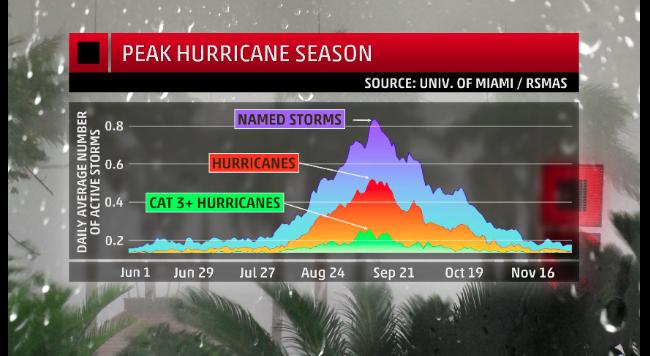
Hurricanes Typically Peak in Early September, But At The Moment, There Are No Active Hurricanes.


“As we reach the historical peak of the Atlantic hurricane season, there are no active hurricanes in the Atlantic or the Pacific basins. If fact, Wednesday afternoon marked the first time that we had no active hurricanes in the Atlantic or the Pacific since Aug. 26, according to Phil Klotzbach of Colorado State University and blogger for wunderground.com.“  The preceding quote is from a Weather.com posting on 10 September titled “There Are No Active Hurricanes in Atlantic or Pacific as Peak of the Season Arrives

The posting says that normally by this time, we would have had 3 hurricanes but so far we have had but one—Hurricane Danny that existed from 20-22 August.   The postings adds:” When looking at long-term averages of hurricanes and tropical storms in the Atlantic Basin, there is a broad maximum from late August through September. However, within this broader period is a peak that typically occurs around Sept. 10 or 11, depending on what data is used for the calculation.

The following chart illustrates the peak hurricane season.

peaks-by-typehuricame

Continue reading

What If America Can’t Stop Climate Change?


Dr Judith Curry is a top-notch researcher who is considered a lukewarmer by 140px-Curry_2006_200dpiAnthony Watts, owner of the WattsUpWithThat blog. Meaning she is not a hard-core believer in either the church of global warming or having a level of deep skepticism.   She was once believed that man was the cause of the global warming but more research convinced her that there are too many uncertainties in forecasting future climate. Whether she is a lukewarmer or a skeptic is an open question.  Her blog, Climate Etc. is reported to get about 12,000 hits per day, demonstrating that she is very influential.

Curry recently posted “Carly Fiorina hits the ‘sweet spot’ on Climate, Etc”. From that posting she says:


“In the political battles over climate change, there are three distinct and relevant questions:

  • First, does mankind have a material effect on the Earth’s climate?
  • Second, if mankind does impact the climate, is that impact harmful?
  • And third, if we assume that mankind is harming the environment, will any given American policy or collection of policies have a meaningful beneficial impact?

  Continue reading

Flashback To ABC 2009 Special On Climate Change–See Their 2015 Predictions.


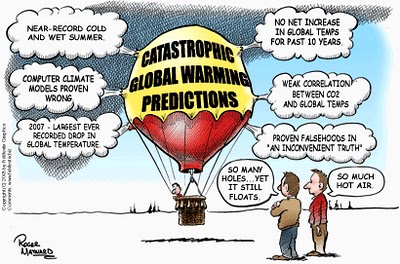
gwpredictions_cartoonThanks to the Daily Caller we can enter into the minds of the radical warmers and their surrogates, the national media. The Daily Caller posted “Flashback: ABC News Envisioned Apocalyptic 2015 Triggered By Climate Change”. Using the “best” minds on the planet to graphically display the terror that climate change will cause, ABC ran a special in 2009 called “Earth 2100 “. The special follows a baby girl born in 2009 through her life span with stops along the way to describe how the planet was suffering through the effects of climate change.   The first stop was 2015. You may wonder how you are missing all of these tragic happenings that the warmer scientist say would happen in 2015. But it is more likely that being a rational human, you will realize, once again, how far from the truth the great prognosticators are. These people have not changed since 2009. They just keep restarting their “end of the earth” smoke and mirrors” narratives, ignoring the need to apologize for how bad their last prediction was.

The Daily Caller quotes from the special:

“ABC News correspondent Bob Woodruff says the show “puts participants in the future and asks them to report back about what it is like to live in this future world. The first stop is the year 2015.”  A Harvard University professor says, “We’re going to see more floods, more droughts, more wildfires.”  Other voices can be heard saying that “Flames cover hundreds of square mile” and “We expect more intense hurricanes.” Another voice says, “Well, how warm is it going to get? How much will sea level rise? We don’t know really know where the end is.”


Continue reading

Global Temperature Pause Now At 18 Years, 7 Months.


A special posting at Climate Depot by Christopher Monckton titled “The Pause draws blood–A new record Pause length: no warming for 18 years 7 months”  theunisonoursideshows that the “pause” in global temperatures continues.

Monckton opens up with:

” For 223 months, since January 1997, there has been no global warming at all (Fig. 1). This month’s RSS temperature shows the Pause setting a new record at 18 years 7 months.

It is becoming ever more likely that the temperature increase that usually accompanies an el Niño will begin to shorten the Pause somewhat, just in time for the Paris climate summit, though a subsequent La Niña would be likely to bring about a resumption and perhaps even a lengthening of the Pause.”

Continue reading

Recent Research Papers Show That IPCC Climate Sensitivity Is Too High


The Intergovernmental Panel on Climate Change (IPCC) publishes, every 3 to 4 years, their version of the science supporting their theory of global warming. Laboratory tests would indicate that for every doubling of CO2 in the atmosphere, the Earth’s temperature should rise about 1C. That is not really very threatening. Their theory says that a doubling will bring about a 3C temperature increase.   The theory postulates that the temperature rise caused by CO2 would increase the amount of water vapor (H2O) in the atmosphere. This increase in water vapor, the major so called greenhouse gas, would result in an additional 2C rise— thus when added to the 1C from the CO2 effect would give the 3C rise for a doubling of atmospheric CO2. This is their view of climate sensitivity. The warmer’s climate models are programmed with this sensitivity. And if you follow this topic at all, you know that the models have predicted much higher temperatures than the real, measured temperatures. And the gap between actual temperature measurements and the climate model forecasts keeps growing.

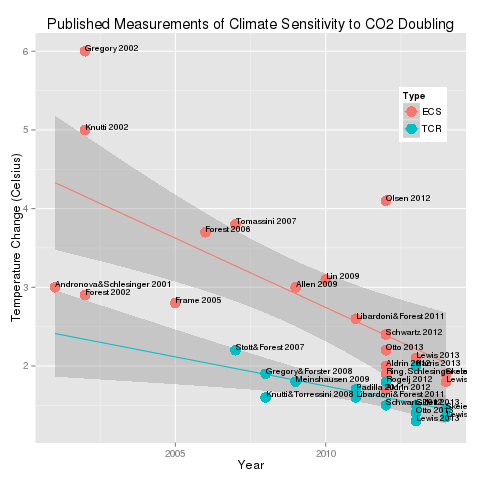
A 20 June 15 posting on Niche Modeling titled “Published measurements of climate sensitivity declining has a chart that compares the current research versus older research into  climate sensitivity. From that posting:

” Scientists made numerous estimates of climate sensitivity over the last few decades and have yet to determine the correct value.  The figure shows the change in published climate sensitivity measurements over the past 15 years (from here).  The ECS and TCR estimates have both declined in the last 15 years, with the ECS declining from 6C to less than 2C.  While one cannot extrapolate from past results, it is likely that the true figure is below 2C, and may continue to decline.  Based on this historic pattern we should reject the studies that falsely exaggerated the climate sensitivity in the past and remember that global warming is not the most serious issue facing the world today.

#2climatesensitivities

Frow Wiki, an expanded definition of ECS andTCR:

The equilibrium climate sensitivity (ECS) refers to the equilibrium change in global mean near-surface air temperature that would result from a sustained doubling of the atmospheric carbon dioxide concentration.  The transient climate response (TCR) is defined as the average temperature response over a twenty-year period centered at CO2 doubling in a transient simulation with CO2 increasing at 1% per year. The transient response is lower than the equilibrium sensitivity, due to the “inertia” of ocean heat uptake.

Over the 50–100 year timescale, the climate response to forcing is likely to follow the TCR.   With atmospheric CO2 now at a level of about 400 ppm and some experts claiming that the amount of CO2 will never rise to 800 because fossil fuels will be depleted by then.  I don’t know how to assess that but getting to 800ppm is a long way off into the future.

cbdakota


NOAA Alleges New Temperature Data Refutes The “Pause”–But Does It?


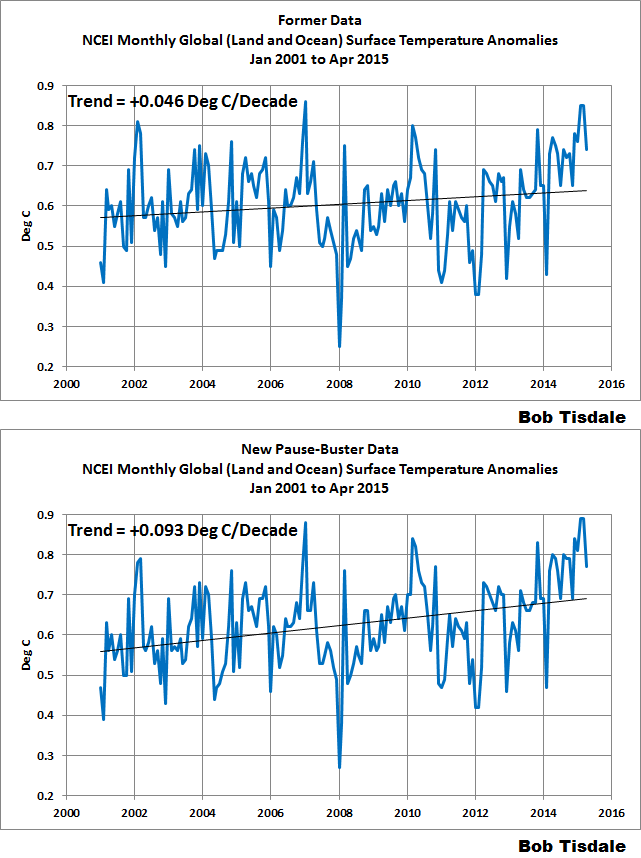
A New NOAA data set is being touted as having proved that the global temperature “pause” does not exist. Examination of the new data suggests that this is a desperate attempt to remove the “pause” before the December United Nations Climate Change Conference, COP21 meeting in Paris.   Bob Tisdale has posted a “before and after” chart for this century.  (click on chart for clarity).

pusebusteranimation-2How does this new temperature finding compare with the other measuring systems?   The magnitude of the change of the new data are incredible. A discussion of what was changed will follow after we look at how this new temperature finding compare with the other measuring systems.

Continue reading

Tenth International Conference on Climate Change


global-warming-south-carolina-political-cartoonI attended the “Tenth International Conference on Climate Change” held in Washington, DC on June 11-12, 2015.   It surpassed my expectations. The panel presentations were uniformly excellent. While I consider myself to be reasonably well informed regarding this topic, I realized that are certain important areas of which I knew little.     For example I learned many things about the way the EPA operates that makes me very angry. Several of the current Republican candidates for President have announced that if they are elected they plan to shut down the EPA and let the State’s environmental groups handle these issues.   I plan a future posting about this topic.

Mainly the Conference covered global warming science. However there were some tributes to contributors who have made an impact.   One interesting presentation was Christopher Monckton’s defense of Dr Willie Soon.

The entire conference is on video. It can be seen by clicking on this link

cbdakota