Category Archives: volcanoes

Natural Causes For Weather Changes


I post “Essay # 1 – Solar & Planetary Tidal Pumping – The Real Cause for Changes in Weather (Original Issue Dec. 18, 2023, Revised May 23, 2024 – Richard Cronin)” because I believe he has made interesting concepts regarding natural forces and weather.

An invisible force permeates the Universe. You don’t even think about it. Gravity and the ever-changing distances between major celestial bodies and Earth, causing Tidal Pumping which drives tectonics, volcanism, and changes to weather and climate.

It is very well known that Jupiter’s massive gravity field heats the moons Io, Ganymede, and Europa to drive extensive volcanism as they proceed through their elliptical orbits. Io is the most volcanic celestial body in the solar system. In fact, per recent NASA observations, these moons pump one another. This phenomenon is called Tidal Pumping or Tidal Heating. The Earth is affected in just such a manner by all major celestial bodies from the Sun out to Jupiter (Kent & Olsen, 2018).

Observe the animation of our Solar System with the gravity fields of the Sun and major planets flinging the Earth around in a helical or corkscrewing action. Neither Newton, Kepler, nor Einstein had any awareness of this motion and how it imposes stresses on the Earth’s crust, opening up Earth’s tectonic plates to spill immeasurable seismic heat into the South Pacific. This is the source of the El Nino Southern Oscillation (ENSO).  See video, Key word search: Helical Solar System.

).  See video, Key word search: Helical Solar System.

Gravitational effects within the Solar System drive Tidal Pumping for the short term El Nino Southern Oscillation (ENSO). Orbiting the Milky Way and passing close to other massive stellar systems drives much greater Tidal Pumping effects and Ice Ages.

Completely unappreciated in the energy balance of the Earth and gravitational force are at least five (5) phenomena. Perhaps just as important is that these effects are not uniformly distributed. There are about 40 to 50 “hot spots” globally. Hawaii, Iceland, Samoa, Yellowstone, Campi Flegrei (Naples), the Gulf of Guinea off Africa, and the Gulf of Maine. Due to the El Niño initiated in 2023 the Gulf Stream and the Gulf of Maine were quite warm and had the adherents of Anthropogenic Climate Change alarmed. In past epochs the Gulf of Maine was quite volcanic, like Yellowstone. In fact, Hawaii and Iceland “co-pulsate”. (Mjelde, Faleide 2009)

The variances in gravitational forces from the Sun and even out to Jupiter exert Tidal Pumping forces on Earth’s crust, which is quite thin and fragile, thus spilling seismic heat into the South Pacific and drive the El Niño Southern Oscillation (ENSO). Jupiter and Venus exaggerate the eccentricity of Earth’s orbit on a 405,000 year cycle (Kent, Olsen, et al 2018 Rutgers). Think of squeezing and re-squeezing a hard rubber ball and it heats up. This is what stirs seismic activity. The interior of the planet is not rigid and  unyielding. It is ductile and elastic with large reservoirs molten silicates and carbonates in the Upper Mantle as well as the molten Iron/Nickel Outer Core. The molten carbonates decompose by sulfur-based acids percolating up from the Lower Mantle. From penetrating radar observations it has been identified that lying 350 km below Yellowstone is a reservoir of molten carbonates measuring 25 km to 70 km thick and covers the area of Mexico. Researchers from the University of London estimate that if just 1 % of this reservoir were to decompose, it would be equivalent to burning 2.3 million barrels of oil.  The EPA now estimates that the Upper Mantle contains 100 trillion million metric tons of carbon in the Upper Mantle locked in carbonate minerals, which is decomposing under acidic attack. Moreover, it is now known that the core of the planet is not solid. It is the consistency of mushy butter, comprised of “superionic Iron” in constant motion. This is the real source of the Earth’s magnetic field (Butler & Tsuboi, 2021 / Sun & Kim, 2022 / He & Lin, 2023)

As the Solar System orbits the Milky Way, the Earth is flung about between the Sun and Jupiter the tail of a kite. The Earth is like a strip of cloth tied onto the tail. Tremendous stresses on Earth’s crust. Neither Newton, Kepler, nor Einstein were aware of this phenomenon.

The Sun’s gravity field pumps the Earth as we proceed through the Northern Hemisphere’s Winter Solstice (the Southern Hemisphere swings closest to the Sun) and, two weeks later, the Perihelion (the Earth’s closest approach to the Sun). These combined events rip and tear open the Trenches of the Ring of Fire to inject quantities immeasurable quantities of seismic heat into the waters of the South Pacific to drive the El Niño Southern Oscillation (ENSO). The key stress points are the two terminal points of the Ring of Fire, the Tonga Trench. In addition to the Tonga Trench, the New Hebrides Trench and New Britain Trench drive the La Niña and the Peru/Chile trench drives the El Niño.


The line of latitude of the deepest point of the Tonga Trench, the Horizon Deep, lies at 23.3 degrees South latitude. The deepest point of the Peru/Chile Trench, the Richards Deep, lies at approx. 23.2 degrees South latitude. Earth’s current Obliquity, the angle of inclination is about 23.4 degrees. The Osbourne Trough associated with the Tonga Trench lies at 25.5 degrees South latitude This is nominally the line of maximum, maximum Tidal Pumping stresses across the South Pacific.

From 1989 to 2018, the pattern of Richter 5+ earthquakes has migrated from the New Hebrides Trench towards the Tonga Trench and from the Central American Trench towards the Peru-Chile Trench. (Chen & Tang, 2022).

Focus on Mid-Oceanic Ridge (MOR) systems is inappropriate. Seismic heat injection from plate fractures and hydrothermal vents along ridge systems or on the abyssal plain is readily diluted and the heat is dissipated. Arising from the trenches the column of warm waters remains relatively intact and is carried east to west as it approaches the surface. There is a subsurface plume effect. This is observed in the elevated sea surface temperatures, with the Torres Strait and Bismarck Sea show the greatest warming. See records of maximum sea surface temperatures in these regions, Sept. 2022.

As opposed to Mid-Oceanic Ridge systems, Trench systems cutting through continental shelves are particularly noteworthy. The continental shelves were the beaches formed during the Ice Ages. They are nearly a uniform 140 meters below current sea level, relatively shallow. The Peru-Chile Trench cuts through the continental shelf of South America at depth of 145 meters below current sea level.

The onset of the El Niño is signaled by a cold water upwelling along the coast of Peru and Chile. This is due the melting of methane clathrates beneath the ocean floor from the opening of the Peru/Chile Trench (J. Kamis – “Plate Climatology”). Frozen methane clathrates exist between 100 to 1000 meters below the ocean floor. This cold upwelling brings up deep water fish from the Humboldt Current. Due to the east-to-west plume effect, the surface waters of the central Pacific warm first, then spread eastward as the clathrate melting diminishes.

In 2021/2022, the Winter Solstice was DE. 21,2021. The Perihelion was Jan.4 2022.


On Jan. 15, 2022 the Tidal Pumping stresses which had accumulated over a rather lengthy La Niña ripped loose in the Tonga Trench in the southwest Pacific. The largest submarine volcano ever observed spewed an estimated 50 to 150 million tons of water vapor into the atmosphere. The Pacific continued to warm throughout 2022, aided by Jupiter’s closest approach to the Earth in 59 years which occurred on Sept. 26, 2022.  A giant hand turned up the steam vaporizer to the maximum setting so 2023 was deemed to be the “Hottest Year on Record”.

With the stresses relieved in the southwest Pacific, the Tidal Pumping stresses shifted to the Eastern Pacific, opening up the Peru/Chile Trench and other seismically active regions off South America to drive the 2023 El Niño. Typical of an El Niño there were no hurricane landfalls on the U.S. East Coast in 2023 tropical storms were steered out into the North Atlantic, although Tropical Storm Ophelia flooded New York City in Sept. 2023. That moisture still affects us as we proceeded into early 2024, with ample rain and mudslides in California, record snows at ski resorts around the world during the winter of 2023/2024and a cool rainy spring in Delaware.

It is bewildering how Svente Arrhenius (1896), Gilbert Plass (1956), and continuing through today’s pseudo-scientists have ignored or misunderstood water in their analyses, especially phase change and the Second Law of Thermodynamics.  Doesn’t anybody understand the cooling effects of the water cycle ? Arrhenius held the global absolute humidity at a fixed 10 grams per cubic meter. Plass entirely ignored the radiative effects Long Wave Infrared Radiation (LWIR) from cloud tops due to phase change. Condensation to rain and freezing to snow. The Earth’s surface temperature is controlled by low clouds (Kauppinen & Malmi, 2019). The Earth is the Water Planet. If you heat up on the planet’s surface, for whatever reason, you evaporate more water to provide more cooling via the water cycle. Such is the case of the 50 to 150 million tons of water vapor spewed out of the largest submarine volcano ever observed in the Tonga Trench on January 15, 2022. The steam reached the stratosphere. These waters continued to warm through 2022, aided by Jupiter’s closest approach to Earth in 59 years on Sept, 26, 2022  followed by precipitation and cooling in the winter of 2023/2024

An entirely separate discussion is necessary regarding the heat producing (exothermic) geochemical reactions inside the planet which are entirely ignored in the current heat balance of the Earth. Logically, Tidal Pumping should impart mixing for multiple exothermic geochemical reactions, such as decomposition of carbonates, serpenization to generate Hydrogen, plus Fischer-Tropsh and Sabatier reactions to generate hydrocarbons. There are really only two (2) “fossil fuels” – lignite coal produced from peat bogs and wetlands plus Kerogens produced by algae and phytoplankton wedged into shales. Indeed, the internal heat of the Earth resolves the Faint Young Sun Paradox, wherein photosynthetic life emerged approx. 3.5 billion years ago when the Earth should have been frozen solid, with no liquid water on the surface. At that time, the Sun was only 70 % of its current luminosity.


Further reading: “The Chthonian Planet – Why Life Exists on Earth (Human Activity in No Way Affects the Weather nor Climate – Issue Date March 17, 2023)”
Key word search: Chthonian Planet Cronin SSRN

Richard F. Cronin, BChE, MBA, P.E. (retired), 30 years E.I. DuPont de Nemours

cbdakota


If


Will there be a solar minimum soon?


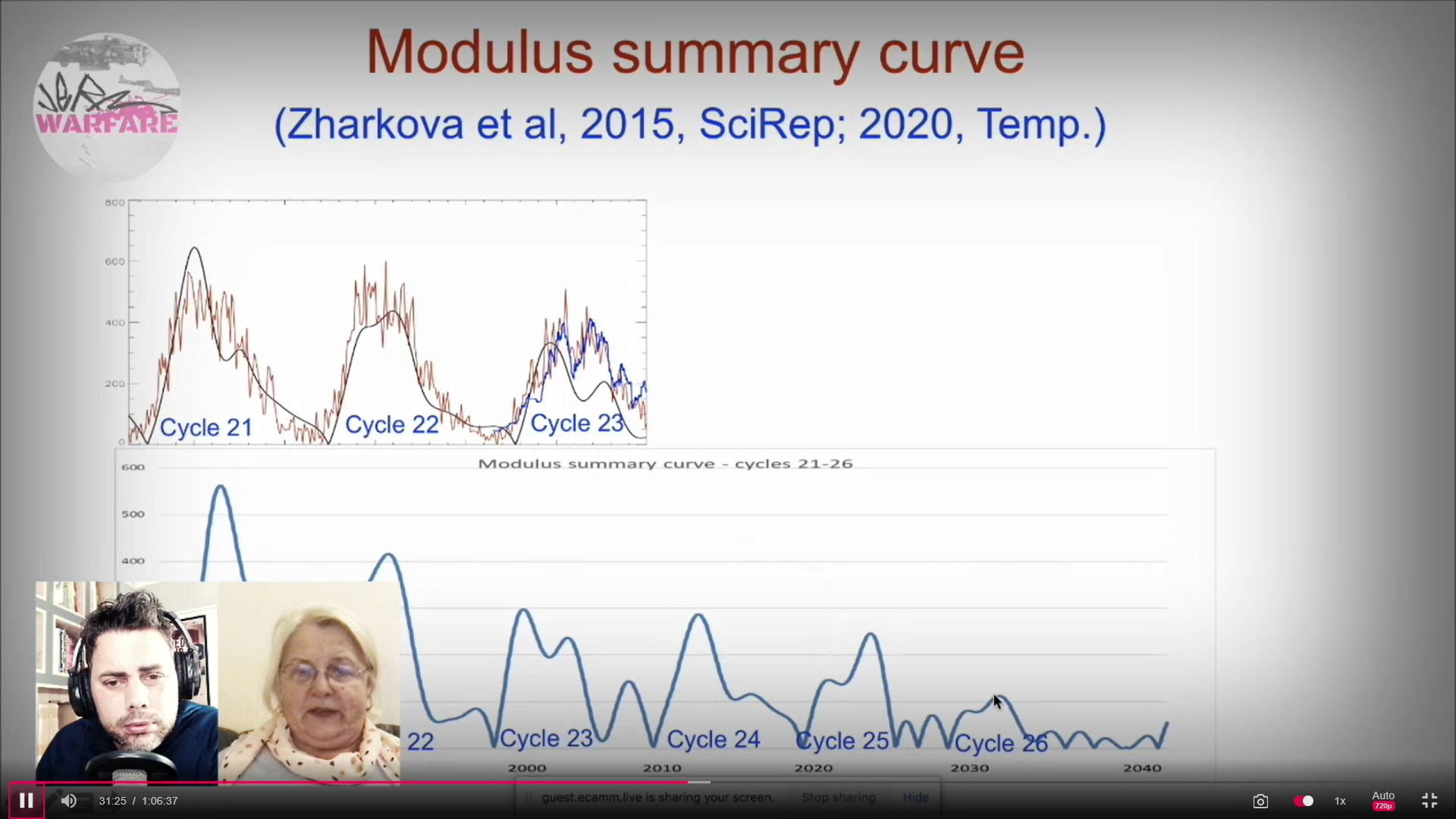
Chart from video of interview of Dr Zharkova Phd ** Click on charts to enlarge

The chart above shows the forecast for Solar Cycles 25, 26 and beyond by Valentina Zharkova.Phd. She believes that she and her team have determined how to forecast solar cycle activity. Solar Cycle 25 is underway and she predicts it will be less active than Solar Cycle 24 and Solar Cycle 26 will be much less active.

Madame Zharkova is much bolder than many other experts with respect to when or if there will be a solar minimum. Before we discuss Madame Zharkova, let’s look into some of the issues that surround the question of an upcoming Solar Minimum.

** The video begins at (2 minutes and 14 seconds.)

To begin with, look at the December 2022 Global temperature.  It dropped to an anomaly of 0.05C from November 2022’s 0.17C anomaly.  This measurement continues the decline of global temperatures since the last El Nino where the anomaly peaked at about 0.4 C. (Red line)

The chart above is from a Dr Roy Spencer posting.

This has resulted in a number of people saying we are on our way to another “little ice age”.   Let’s look at several predictions of serious global cooling

ENSO is the system name acronym for and the Southern Oscillation. It a major factor affecting global temperature.

The El Nino (ocean warming) and the La Nina (ocean cooling) are considered natural phenomena, meaning that they are not man-made actions.  A simplistic description of this phenomena is that over a period of time sun and or submerged volcanos, warm a body of western Pacific Ocean, lying along the equator and its temperature rises. This causes atmospheric changes and the hot water flows eastward to the coast of South America. This is called El Nino.  After several years the conditions change and the body of water flows westward and cool, deep ocean water along South America coast rises This is the La Nina.. This ebb and flow has a major effect on global weather.

The above chart illustrates the Nino and Nina occurrences from 1990 to the present.  Comparing the temperature chart and the Ninos charts show that when an El Nino occurs the global temperature rises. Conversely global temperature drops when a La Nina occurs. The charts seems to show that El Ninos are stronger that La Ninas.  (It would be interesting if someone had measured the chart area for the two.)

Now eyeballing the charts, it looks like the strong El Ninos, a natural occurrence, are the major mover of the global temperatures. 

Examining the global temperature chart, the period following the 1997 -1998 El Nino, stretching out to about 2015 shows that global temperature is flat, in other words, no significant change in global temperature was recorded. Something like 15/16 years.  This happened even though atmospheric C02 was increasing. Does this relegate CO2 to be only a minor forcing? Does this indicate that the sun (or volcanos) are causing global temperatures to rise?

Viewing Solar Cycles.

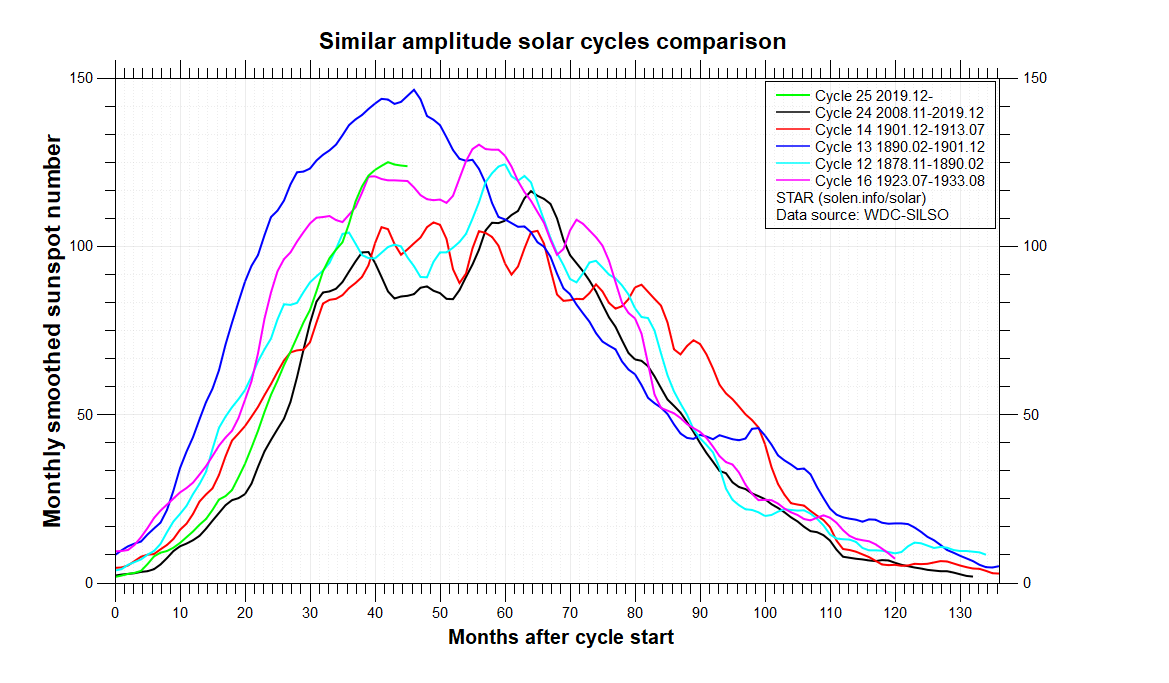
Solar Cycle 24 was much less active than its predecessors. The new Cycle 25 activity is almost identical to Solar Cycle 24 as can be seen in the following chart

The chart above is courtsey of Solan.Info.

Cycle 25 at 30 months after cycle start is the green line and that is where Cycle 24, the black line, was at thirty months. The other Cycles, from other years, that had unusually low activity are shown on this chart. Cycle 24 the black line was less activity than the others.

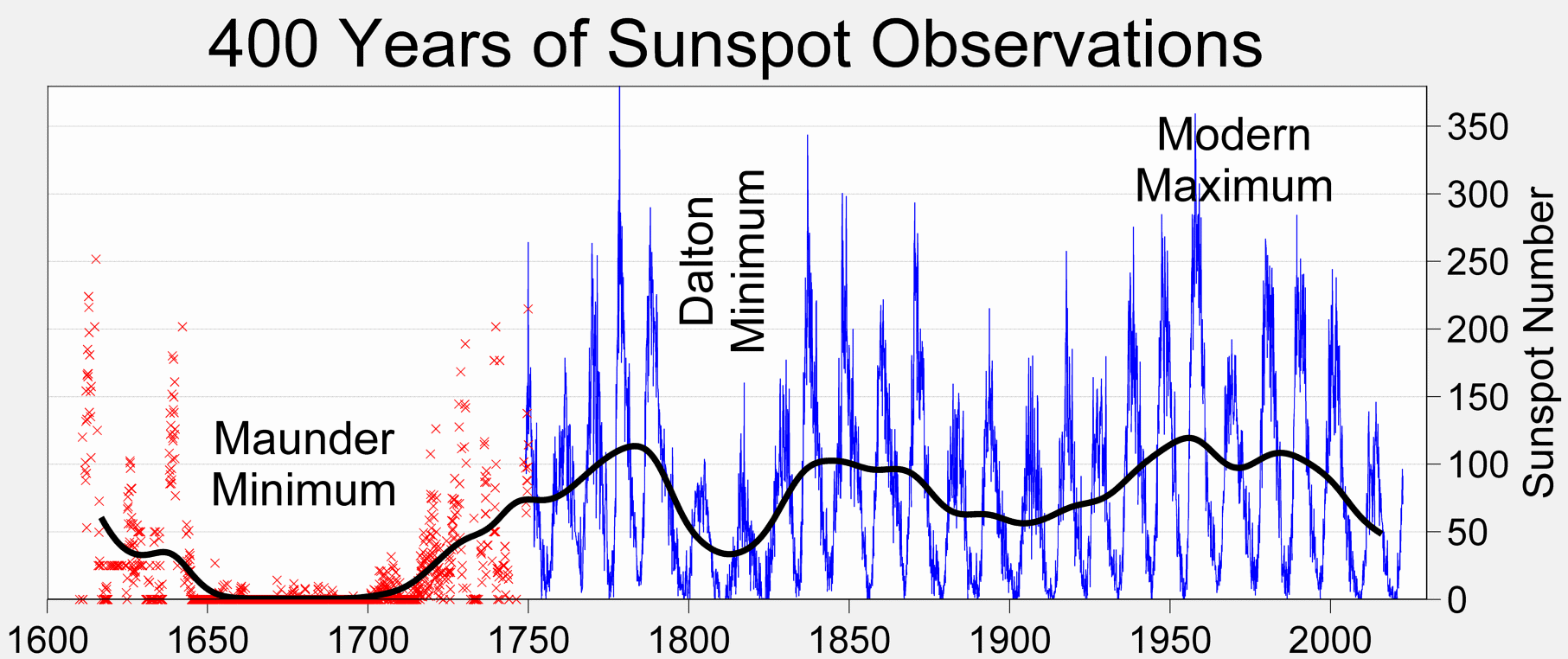
For contrast, the following chart shows the “Modern Maximum”, group of Cycles, meaning very active. The chart is a little dated as the last rising blue line is Solar Cycle 24.

The solar cycles 24 and 25 are substantially less active than their predecessors.  There is really no strong signal yet that the temperature is dropping due to low activity Solar Cycles. Perhaps there is a time delay built into the system.

Cloud Formation due to weak Solar Cycles

This allows us to examine three theories.  First comes the Svensmark theory: From the posting “comes this description of the theory:

“In 1995, Henrik Svensmark discovered a startling connection between the cosmic ray flux from space and cloud cover. He found that when the sun is more active–more sunspots, a stronger magnetic field, larger auroras, stronger solar winds, etc.–fewer cosmic rays strike the earth and cloud cover is reduced, resulting in warmer temperatures.”  When the sun is inactive, more of them penetrate the atmosphere. Upon reaching the lower atmosphere where more sulphur dioxide, water vapor, and ozone is present, the cosmic rays ionize the air, releasing electrons that aid in the formation of more CCN and form more dense clouds. This increase in low-cloud amount reflects more solar energy to space, cooling the planet.”

CERN set up chambers to test this theory. While there was some verification, they said that cosmic rays did form clouds, but the formation was much too small to have any effect.  It appears that there are many that still think Svensmark is correct.  We will have to wait to see future developments.

There are some new theories positing that Ultra Violet (UV) is a player.   

First some UV information from Wiki: “The Sun emits ultraviolet radiation at all wavelengths, including the extreme ultraviolet where it crosses into X-rays at 10 nm. Sunlight in space at the top of Earth’s atmosphere is composed of about 50% infrared light, 40% visible light, and 10% ultraviolet light, for a total intensity of about 1400 W/m2 in vacuum.[22]

The atmosphere blocks about 77% of the Sun’s UV, when the Sun is highest in the sky (at zenith), with absorption increasing at shorter UV wavelengths. At ground level with the sun at zenith, sunlight is 44% visible light, 3% ultraviolet, and the remainder infrared.[23][24] Of the ultraviolet radiation that reaches the Earth’s surface, more than 95% is the longer wavelengths of UVA, with the small remainder UVB. Almost no UVC reaches the Earth’s surface.[25] 

The shorter bands of UVC, as well as even more-energetic UV radiation produced by the Sun, are absorbed by oxygen and generate the ozone in the ozone layer when single oxygen atoms produced by UV photolysis of dioxygen react with more dioxygen. The ozone layer is especially important in blocking most UVB and the remaining part of UVC not already blocked by ordinary oxygen in air.”

Here is one of the UV theories It is called the Winter GateKeeper Hypothesis. I would like to say that I know enough to describe this hypothesis, but I can not. Dr Judith Curry has posted it on her site, which I think is a favorable appraisal of this hypothesis. She has also noted another researcher which seems to have a favorable opinion. So I will give you a summary:

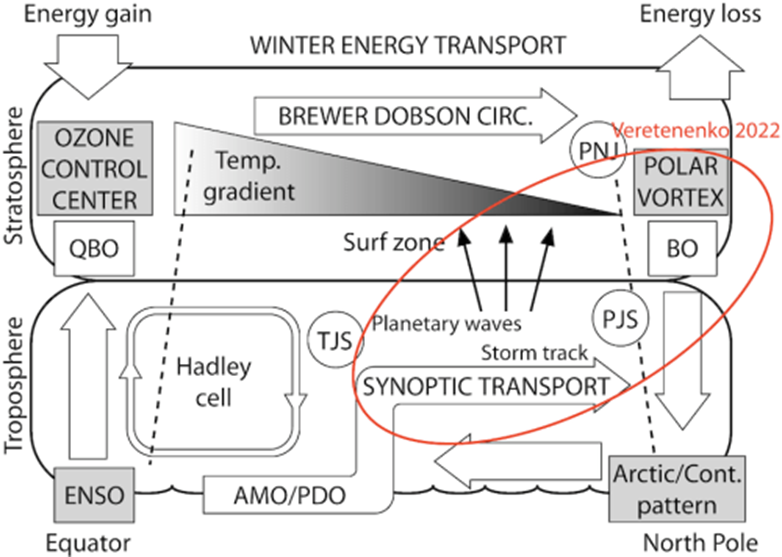
“The Winter Gatekeeper Hypothesis integrates different components of the transport system in the stratosphere, troposphere, and ocean. A schematic of the energy processes involved is presented in Fig. 8.1, with energy transport represented by white arrows. Solar modulation starting in the stratosphere affects all transport, and Vinós (2022) showed a solar effect on ENSO and the polar vortex. The mechanism by which solar activity modulates ENSO activity is still unknown, but this author proposes a solar modulation of the Brewer-Dobson tropical upwelling, known as the “tropical route” of the “top-down mechanism” (Maycock & Misios 2016; Vinós 2022).”

“Fig. 8.1. Northern Hemisphere winter meridional transport outline. The energy gain/loss ratio at the top of the atmosphere determines the maximal energy source in the tropical band and the maximal energy sink in the Arctic in winter. Incoming solar energy is distributed in the stratosphere and troposphere/surface where it is subjected to different transport modulations. Energy (white arrows) ascends from the surface to the stratosphere at the tropical pipe (left dashed line) and is transported towards the polar vortex (right dashed line) by the Brewer–Dobson circulation. Stratospheric transport is determined by UV heating at the tropical ozone layer, which establishes a temperature gradient affecting zonal wind strength through thermal wind balance, and by the quasi-biennial oscillation (QBO). This double control determines the behavior of planetary waves (black arrows) and determines if the polar vortex undergoes a biennial coupling with the QBO (BO). In the tropical ocean mixed-layer, ENSO is the main energy distribution modulator. While the Hadley cell participates in energy transport and responds to its intensity by expanding or contracting, most energy transport in the tropics is done by the ocean. Changes in transport intensity result in the main modes of variability, the AMO, and PDO. Outside the tropics, most of the energy is transferred to the troposphere, where synoptic transport by eddies along storm tracks is responsible for the bulk of the transport to high latitudes. The strength of the polar vortex determines the high latitudes winter climate regime. A weak vortex promotes a warm Arctic/ cold continents winter regime, where more energy enters the Arctic exchanged by cold air masses moving out. Jet streams (PJS, polar; TJS, tropical; PNJ, polar night) constitute the boundaries and limit transport. Red oval, the part of the Winter Gatekeeper Hypothesis studied in Veretenenko 2022. Figure from Vinós 2022”

Finally, a few notes about the Zharkova theory.

From the posting in Principia Scientific titled “The Woman Who Could Cancel Net Zero”comes another theory.   The woman in this case is  Professor Valentina Zharkova of the University of Northumbria. The professor’s fields are applied mathematics, plasma physics, pattern recognition, solar-terrestrial physics and solar activity. She forecasts that “in the next 30yrs, global warming problem will be last thing in our mind. Then the solar cycles return to being active.

With her team, she has studied the Sun’s many magnetic fields.   She says that sunspots are not a strong enough signal to base any predictions on.  So the team separated the magnetic fields in separate components with a principal component analysis using Eigen vectors and Eigen values. She used the output to create a method to predict solar cycle activity. She maintains that she demonstrated that the teams work can closely match the past solar cycles and they can use it to project the future solar cycle activity.

It would be enormous step in understanding the Sun if Dr Zharkova’s system proves out. It might well be a big hit on the man-made global warming theory, too.

cbdakota

The Myth of Man-made Ozone Depletion


Guest Post by Richard F. Cronin

August 3, 2017

After 31 years working for E.I. DuPont de Nemours here is my understanding about “ozone depletion” — the warm-up act for anthropogenic CO2-induced “global warming”.  Even the proponents of human-induced “ozone depletion” are starting to realize that the thinning of the ozone layer is a natural phenomenon that just waxes and wanes.

http://www.theozonehole.com/2017ozonehole.htm

Ozone (O3) is produced in the stratosphere by the intense solar radiation causing photo-dissociation of the di-atomic oxygen molecule (O2). The oxygen singlet (- O) is a powerful oxidizing agent and readily reacts with another O2 molecule to yield ozone.   Ozone is not produced during the dark polar winters and its lowest point is in the early spring. The ozone layer is renewed by the sunlit polar summers.

Molina and Rowland published in 1974 and their core premise is that heavier-than-air chloro-fluoro carbons (CFCs) convect upwards using a “one dimensional diffusion model”, where they photo-dissociate due to ultraviolet radiation in the band of 2000 Angstroms to yield ozone -destroying chlorine and bromine. Molina and Rowland also stated that CFCs do not dissolve in water, so they are not scrubbed out by rain at lower elevations. However, it is known that organo-halogens adsorb on dust particles and aerosols which are scrubbed out by rain in the troposphere.  Finally, volcanoes emit CFCs as well as copious amounts of hydrofluoric acid (HF), hydrochloric acid (HCl) and hydrodrobromic acid (HBr) which carry up to the stratosphere. (Ian Plimer, et al).  See “Heaven and Earth” by Ian Plimer, University of Adelaide.  There is always some equilibrium presence of these molecules, in trace quantities.

http://onlinelibrary.wiley.com/doi/10.1029/RG013i001p00001/full

Click here for Atmospheric aerosols in the Earth System

Continue reading

Study Says CO2 Not Statistically Significant In Global Temperature Change


This might be the most important report written in 2016 and perhaps in this century. In my simple understanding of things global warming, it seems that any honest scientist that reads this must be able to show this report to be wrong or, if not already, join us as a skeptic. By zeroing out natural causes, this report shows why man-made CO2 does not have a statistically significant impact on global warming. It validates other studies, especially ice cores,that show that CO2 is a lagging variable, not a leading variable.

A new report “ On the Existence of a “Tropical Hot Spot “& The Validity of EPA’s CO2 Endangerment Finding” demonstrates that CO2 has only minimal effect on the global warming. The authors of the report challenge critics of these finding by saying :

“Moreover, on an all-other-things-equal basis, there is no statistically valid proof that past increases in Atmospheric CO2 concentrations have caused the reported rising, even claimed record setting temperatures. To validate their claim will require mathematically credible, publically available, simultaneous equation parameter estimation work. Where is it?”

Some background. The damage to the US economy caused by the EPA claiming that CO2 emissions will eventually lead to catastrophic increases in Global temperatures was first permitted as a result of the US Supreme Court telling the EPA to determine if CO2 was hazardous. So if the EPA could make an endangerment  determination, then the Court would allow CO2 (and several other minor greenhouse gases) be added to the Clean Air Act (CAA). CO2 was considered in detail by Congress when they passed the CAA and Congress rejected its inclusion. Once again the Supreme Court, fully aware of Congress’ rejection, decided to legislate –not their prerogative– by including CO2 if the EPA said it was hazardous.

To no one’s surprise, the EPA did conclude it was hazardous and began sending out regulations of all kinds based upon their catastrophic global warming theory. The EPA in their CO2 Endangerment Finding said they had found 3 lines of evidence that demonstrates their Finding: They are:

“The assumption of the existence of a “Tropical Hot Spot (THS)” is critical to all Three Lines of Evidence in EPA’s GHG/CO2 Endangerment Finding. Stated simply, first, the THS is claimed to be a fingerprint or signature of atmospheric and Global Average Surface Temperatures (GAST) warming caused by increasing GHG/CO2 concentrations1. (The new report scientist are challenging this by saying that the proper test for the existence of the THS in the real world is very simple. Are the slopes of the three temperature trend lines [upper & lower troposphere and surface] all statistically significant and do they have the proper top down rank order?)

Second, higher atmospheric CO2 and other GHGs concentrations are claimed to have been the primary cause of the claimed record setting GAST over the past 50 plus years.

Third, the THS assumption is imbedded in all of the climate models that EPA still relies upon in its policy analysis supporting, for example, its Clean Power Plan–recently put on hold by a Supreme Court Stay. These climate models are also critical to EPA’s Social Cost of Carbon estimates used to justify a multitude of regulations across many U.S. Government agencies.

The scientists that issued the report: On the Existence of a “Tropical Hot Spot “& The Validity of EPA’s CO2 Endangerment Finding” have set out in detail their methodology and data used to arrive at their conclusions. These can be examined by clicking on the link above.

In summary, the scientists looked at natural causes for increases and decreases in global temperature as well as man-made causes. CO2 produced by burning of fossil fuels is a man-made source. There were three natural factors—an increase or decrease in Solar radiation, volcanic activity, and ENSO (El NINO Southern Oscillation) . Natural factors can not be the result of human actions.

ENSO is a three part phenomenon.. ElNino, LaNina and Neutral

make_enso_plot_v2-r-enso

El Ninos and La Ninas are irregular in their size and frequency. While this chart goes back to the fifties when ENSO was first recognized, Scripps Institute of Oceanography says:

There have been many El Niños observed in the past. Theres every reason to think that they have been happening for many thousands of years”

Obviously, fossil fuel produced CO2 is not a issue here.

These scientists removed from 13 temperature records the effect of natural causes of temperature changes leaving only the man-made causes. The temperature records were from balloons, satellite, ground and ocean temperature readings.

From the scientists report, here is what they did and found:

“These analysis results would appear to leave very, very little doubt that EPA’s claim of a Tropical Hot Spot, caused by rising atmospheric CO2 levels, simply does not exist in the real world. Also critically important, even on an all-other things-equal basis, this analysis failed to find that the steadily rising Atmospheric CO2 Concentrations have had a statistically significant impact on any of the 13 temperature time series analyzed.

Thus, the analysis results invalidate each of the Three Lines of Evidence in the EPA’s CO2 Endangerment Finding. Once EPA’s THS assumption is invalidated, it is obvious why the climate models they claim can be relied upon, are also invalid. And, these results clearly demonstrate–13 times in fact–that once just the ENSO impacts on temperature data are accounted for, there is no “record setting” warming to be concerned about. In fact, there is no ENSO-Adjusted Warming at all. These natural ENSO impacts involve both changes in solar activity and the 1977 Pacific Shift.

Moreover, on an all-other-things-equal basis, there is no statistically valid proof that past increases in Atmospheric CO2 Concentrations have caused the officially reported rising, even claimed record setting temperatures. To validate their (critic’s) claim will require mathematically credible, publically available, simultaneous equation parameter estimation work. Where is it?

I reviewed a website that had discussed these findings that there is no significant statistical evidence of CO2 causing global warming. Not a single challenge using data and facts. All of critics were saying that “97%” could not be wrong or using ad hominem attacks on the author.

So as the authors of the report say about having a factual disagreement, “Where is it?

cbdakota

Plate Climatology Theory


ClimateChangeDispatch posted “Global Warming and Plate Climatology Theory” on 7 October 2014.   The posting was written by James Edward Kamis, a Geologist who says he believes there is a probable connection between Geology and Climate. He begins this discussion of his theory by saying:

“The Sun, quite obviously, is the first order driver of Earth’s climate, but a much neglected second order driver can contribute significantly to short-term variations. The theory proposed herein is that periods of active Earth tectonism can be correlated to periods of active climate change and climate related events.

Increased global tectonic activity equates to more faulting and crustal plate movement, which leads to more global heat release from faults, fractures and volcanoes that are more active.

Altered heat input equates to climate change.

seafloorvolcano

Continue reading

Are Seafloor Volcanoes Altering The Climate?


I have received some interesting email of late that states that seafloor volcanoes are altering the Globe’s climate. So, I have been combing through the internet to see what I could find on this topic.

One theory is that seafloor volcanoes are more active in the time of glaciations than at time of the warming period in between. The thinking is that the increased weight of the ocean’s water, as it rises due to glaciers melting, reduces the activity of the many seafloor volcanoes.   The converse is true about the land-based volcanoes that would become more active as the weight of the glacial ice disappears. The ash emitted from land-based volcanoes can cause cooling of the atmosphere but seafloor ash does not get into the atmosphere.

Continue reading