Category Archives: Sun

Solar Cycle 24 October Update


The 30 day smoothed International Sunspot number for October 2013 was 78.9.  The Sun was more active as indicated by Sunspots and F10.7cm radio flux in October than any time since the middle of July this year.  The chart, by Solen, below shows this activity. (Click on chart to enlarge.)

sunspotoct13solar

The chart shows that the NOAA Sunspot number and the F10.7 cm flux are trending downward at month-end, indicating the likelihood that the 30-day smoothed Sunspot number will begin dropping.  A bit of prospective is that while the October solar activity was up, Cycle 24 is still much having much lower activity relative to the 3 preceding Solar Cycles.

cbdakota

Solar Cycle 24 October Sunspot Number Rising


It was beginning to look like the Sunspots were in freefall based on last month’s 30 day smoothed number of 36.9.  But the Sun continues to let us know that we don’t know a lot about it for certain.   It looks like the Cycle 24 Sunspot number may reach 70 for the month of October.  A jump in Sunspot activity began in second week of this month and has continued through the third week.  It will be interesting to see how high it will go.  This number is not the official smoothed 6 month lagging number* that will not move up a lot, unless this higher activity continues for several months.  See the Chart below that shows, in Green, the smoothed 30 day number at the last updating on 25 October 2013.   It is nearly 70 at this time. (Click on chart to enlarge.)

sunspotdatamidoct13

This chart is from http://www.solen.info/solar/.  This is an excellent site for monitoring solar data.

*The smoothed number is calculated by doing a 13 month average from the numbers that lag 6 months behind the current month.

cbdakota

Penn And Livingston Cycle 25 Sunspot Forecast


Penn and Livingston, in their September 2010 IAU publication “Long-Term Evolution Of Sunspot Magnetic Fields” predicted that Solar Cycle 24 would peak at an International Sunspot number of 66 and Solar Cycle 25 at 7!!

Sunspotdiagram

Considering that NASA believes that the peak for Cycle 24 will be 67, their prediction looks pretty good.   So would you bet against their Cycle 25 prediction of 7?

Continue reading

IPCC Errs When Concluding The Sun Is Not A Major Factor In Global Temperatures


While the IPCC doesn’t have an answer for why there has been no statistical increase in global temperatures for going on 17 years,  they don’t think the Sun has been a significant factor.  They  generalize that  volcanoes, deep ocean warming,  and particulate matter in the atmosphere may be the cause.

Duncan Q&A : on change of climate change : Earth and Sun

Copy of Woodcutting by TheGuardian.com by Duncan Clark

Continue reading

Solar Cycle 24 September 13 Update


The International Sunspot number for September dropped to 37 from 66 in August.    The F10.7cm solar flux moved downward as well from 115 in August to 103 in September.   Both are measures of Solar activity.  Again, Solar Cycle 24 is decidedly less active than recent Solar Cycles. (Click on the charts to improve clarity.  All charts are  by “Solar Terrestrial Activity Report”).

ssncycle24=0ct13

This chart, from Solen etc, is interesting.  The black line labled Ri is the International Sunspot number. The Rnorth indicates the number of Sunspots that were counted in the Sun’s northern hemisphere and Rsouth those formed in the southern hemisphere. Rnorth plus Rsouth equal Ri.  Rnorth peaked in late 2011 at about 97 Sunspots.  Rsouth peaked at about 50  in the middle of  last year.  The smoothed number is the official count.  The smoothed number is calculated by doing a 13 month average from the numbers that lag 6 months behind the current month.  The maximum smoothed number for Cycle 24 so far is 66.9 which occurred in early 2012.  Most of the solar cycle experts believe that will be the maximum for Cycle 24.

Below is the solar polar field strength chart updated for September showing the south and north poles have both crossed the  Sun’s equator.  It is suggested that you read the discussion regarding solar polar fields by clicking on this Forecasting Solar Cycle 25 Using The Solar Polar Field Strength”.

solarpolarfields-oct13

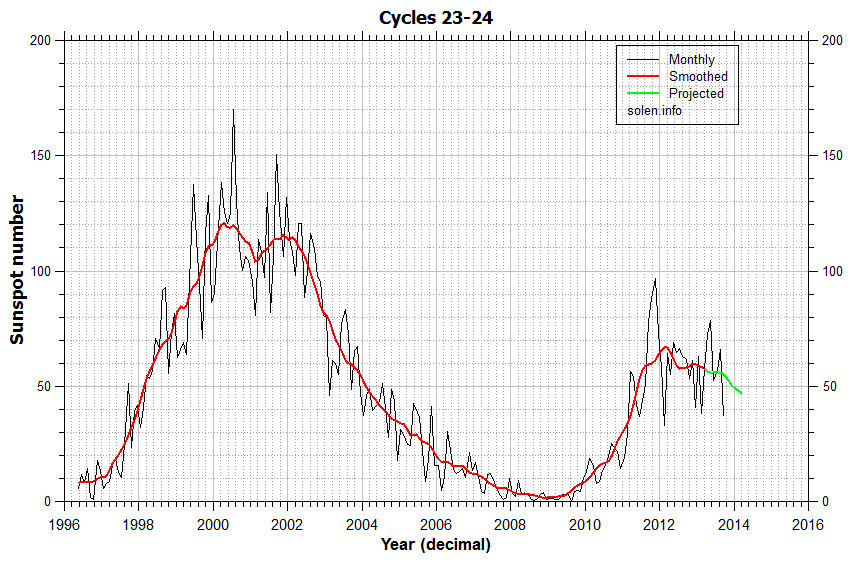
This chart puts Cycle 24 in perspective with Cycle 23.

ssncycles23_24-oct13

The projected Sunspot number, shown in green, is also a 13 month average but it has no six month delay built into the calculation.

cbdakota

Forecasting Solar Cycle 25 Using The Solar Polar Field Strength


Forecasting the strength of Solar Cycle 25 will not  be easy.  The expert’s track record for their Cycle 24 predictions show how hard it is.   For example, Doctor David Hathaway is quoted in December 2006 that cycle 24 would “be one of the most intense since record keeping began 400 years ago.”   He forecast 160+/- 25 as the peak Smoothed International Sunspot Number (SISN). His prediction as charted in 2006 below:

hathaway2billsunspot_med

Continue reading

Solar Cycle 24— August 2013 Update


Solar Cycle 24’s Sunspot number bounced up a little as did the F10.7cm radio flux.   However, Cycle 24 is still on track to be the least active Cycle since the first part of the last century.  The Sun’s North pole appears to have firmly switched its polarity but the South Pole may be months away from switching its polarity.  A cycle’s “maximum” is usually called when both poles have done the swap.

The August Sunspot and the F10.7cm radio flux are shown below (Click on Charts to enhance view):

Continue reading

Svensmark Theory—Cosmic Rays Contribute To Lower Global Temperatures


The previous posting closed with: Low Sunspot numbers and low F 10.7 indicate low solar activity.  How this activity translates to cooler weather is not clear.  The correlation between low activity and cooler weather has been know for several hundred year (or perhaps longer— recently read that the Chinese recorded Sunspot numbers many century’s ago and reported this correlation.)

One possible explanation is the Svensmark theory. This theory begins with high energy galactic cosmic rays (GCR) entering the Earth’s atmosphere where they collide with atmospheric molecules of oxygen. The collisions shatter the molecules and the resulting particles become nuclei for cloud droplets from which clouds are formed. Clouds reflect a significant amount of the Sun’s radiation back into space.  The weaker the Sun’s magnetic field (low solar activity),  the more GCR enter the atmosphere.  The more clouds, the more cooling.   This is opposed to the situation where the Sun’s activity is high, fewer GCR result in fewer clouds.

Continue reading

Solar Cycle 24 July Update


NASA predicts a solar magnetic field reversal in about 3 to 4 months.  When that happens, Solar Cycle 24 will have reached what is known as the cycle maximum.  After that the Sunspot numbers will decrease with time. There is a possibility that a  short period of none at all  will happen before Cycle 25 kicks in. NASA has produced a video that discusses the mechanism and the implications of the solar magnetic field reversal.  The video can be viewed by clicking here.

The July charts for Sunspots and F10.7 cm Radio flux are shown below.

sunspotjuly13

Continue reading

Climate Cycles-Part 1 Glacial Periods


Climate cycles are continuously happening on Earth since its beginning estimated to be some 4.5 billion years ago. Detailing the earliest climate cycles can only be done by painting with the broadest of brushes.  In more recent times, proxies, such as ice cores and oxygen isotope measurements are available for use in reconstructing these cycles. The globe has experienced glaciers in relatively recent times and in the not too distant future will surely experience glaciers again. The profound changes that take place resulting in glacial periods are of great interest.

greenlandglacierhelheim533

Greenland Glacier–NOAA

Continue reading