“Visual Capitalist” is an interesting site. It provides charts and some dialog on a broad range of topics. A partial list of the categories are Markets, Technology, Money, Health Care, Energy, etc. Often you get a new chart every weekday on some topic or other. It is easy to subscribe to the site.
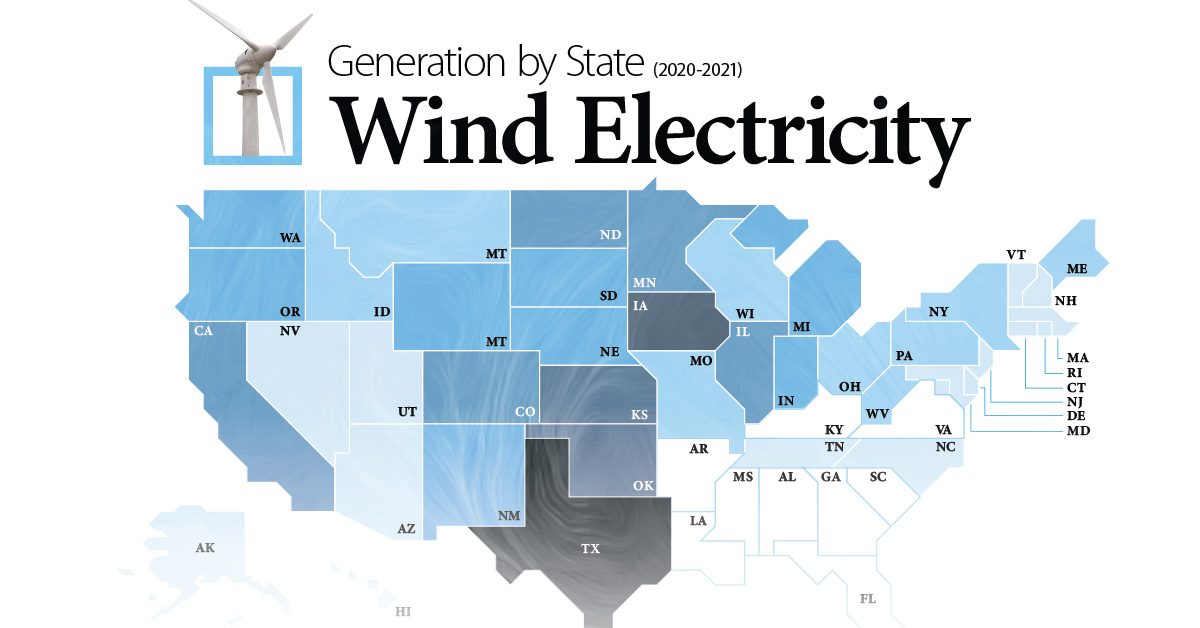
Even though it has a man-made global warming bias, its a useful site. I am providing a link to this site and it will come up with visualizations of Wind, Solar and Nuclear energy. These topics are covered often, and usually of interest. The site predicts that by the year 2026 wind and solar will produce more electricity than natural gas, coal and nuclear combined. This 8 June 2022 prediction will not be realized.
Renewable-energy producers have long touted the promise of cheap electricity, an assurance that’s helped them eat into the dominance of fossil fuels. But the pledge has gone too far, according to the world’s biggest wind-turbine maker.
From the Bloomberg’s posting:
“Soaring commodity costs and supply-chain bottlenecks have wiped out profits for much of the wind industry this year. Vestas expects its profit margin to be around -5% in 2022”.
“The output from the turbine has never been more valuable,” Andersen said. “But we are losing money in manufacturing a turbine.” Vestas has raised prices more than 30% in the past year to help stem losses.”
I have said this before—- the parasitic** cost of wind is never used in calculating the cost of wind turbine electricity. And the recently passed Inflation Reduction Act, that is really Green New Deal in disguise, expanded tax credits. If you use union labor, you probably can qualify for an expanded Investment Tax Credit (ITC) from 6% to 30%. The ITC is not used cost wise either.
One more time, if wind and solar energy is so cheap, why do they need any incentives? Do the taxpayers know this, especially the rate paying users of renewable energy that see the price of their electricity bill rise?
I have been trying to define wind and solar renewables in a way that conveys them at the core. I am looking for a definition that hits home. “Not dispatchable” provides a feature of those two renewables but it falls short. Some might not even know what that means.
“Free energy” is used by proponents, but it is not free. That is a misrepresentation. The cost of electricity rises as the use of the wind and solar component of the grid supply increases.
I think that they are PARASITES. Parasites are normally organisms that survive in or on another entity usually at the entity’s expense. The Criterion for electrical Grids is to provide electricity as demanded without interruption at the appropriate frequency 24/7. Natural gas, coal and nuclear can do that. Neither wind nor solar renewable energy can. There are no demonstrations that counter that statement. Not only that, if used, they make accomplishing the criteria difficult if not impossible. They are Parasites.
Parasites cannot live without a host. In the grid case, natural gas, coal and nuclear are the host. Why then, if they are parasites, are they part of the grid’s sources of electricity. As you know, Its political.
“Economist Jeff Currie of Goldman Sachs (Global Head of Commodities Research in the Global Investment Research Division): “Here’s a stat for you, as of January of this year. At the end of last year, overall, fossil fuels represented 81 percent of overall energy consumption. Ten years ago, they were at 82. So though, all of that investment in renewables, you’re talking about 3.8 trillion, let me repeat that $3.8 trillion of investment in renewables moved fossil fuel consumption from 82 to 81 percent, of the overall energy consumption. But you know, given the recent events and what’s happened with the loss of gas and replacing it with coal, that number is likely above 82.” … The net of it is clearly we haven’t made any progress.”
It is hard to get your head around the fact that $3.8 trillion has been spent with so little results. A lot of that money has been going to Crony Capitalists through subsidies and tax forgiveness.
That they have not made any progress replacing fossil fuels is understandable and that it is unlikely that wind and solar ever will. Their lack of dispatchability will forever prevent wind and solar from being the main source of power. Long term, nuclear power will have to be the main source of power with wind and solar playing second fiddle.
This is part two of Robert Bryce’s testimony to the House Select Committee on The Climate Crisis.
Our electric grid is fragile. Robert Bryce writes that the Department of Energy’s Office of Cybersecurity, Energy Security and Emergence Response illustrates the declining reliability of our grid. Bryce says:
“In 2002, there were 23 “major disturbances and unusual occurrences” on the domestic electric grid. Those outages were caused by things like ice storms, fires, vandalism, and severe weather. By 2016, the number of disturbances and unusual occurrences had increased six-fold to 141. In 2020, the number of events jumped to 383 – an increase of 270% in just four years. Even more alarming: through the first two months of 2021, there have been 122 of these outages.”
Bryce says:
“Electrifying everything is the opposite of anti-fragile. Attempting to halt the use of liquid motor fuels and replace them with electricity will make our transportation system more vulnerable to disruptions caused by extreme weather, saboteurs, equipment failure, accidents, or human error. Electrifying our transportation system will reduce societal resilience because it will put all our energy eggs in one basket. Electrifying transportation will reduce fuel diversity and concentrate our energy risks on a single grid, the electric grid, which will make it an even-more-appealing target for terrorists or bad actors.
Furthermore, and perhaps most important, attempting to electrify transportation makes little sense given the ongoing fragilization of our electric grid. The closures of our nuclear plants is reducing the reliability and resilience of the electric grid and making it more reliant on gasfired power plants and weather-dependent renewables.”
While skeptics have known for years that the alarmist’s forecasts of doom are not likely to be realized, the alarmists oddly want to shut down all nuke plants. Nuke plants that do not emit their enemy carbon dioxide (CO2). Bryce notes Congress inaction regarding this issue when he says:
“Instead, Congress is standing idly by as our nuclear plants – our most reliable, safest, and most power-dense form of electricity production – are being shuttered. Nuclear plants are, as writer Emmet Penney recently put it, our “industrial cathedrals.” If policymakers want to decarbonize our transportation system while enhancing the resilience of our society, the best option would be to have a grid that is heavily reliant on nuclear energy.”
Bryce discusses recent issues that demonstrate the gird’s declining reliability in his report. They can be reviewed by clicking here.
See part two about supply chains and mineral needs.
This is the sixth posting of a series listing things that the alarmists and the mainstream media do not want made public. At the top of this posting is a link to the preceding postings.
The Paris Agreement (PA) has been a flop, so far. The PA’s target is lowering CO2 emissions. Since the PA was signed in 2015 by some 180+ nations, the CO2 emissions have risen.
The chart below, from Rhodium, shows the percentage of the total global emissions of the so-called greenhouse gases made by the top 8 emitters in 2019. China is far and away the leading emitter and will be increasing the difference in the future. CO2 from fossil fuels is nominally 80+ % of the total emissions. The rest of the total is from cement manufacturing, methane, and fluorocarbons, etc. In 2020, the emissions dropped due to COVID but are forecast to be back up in 2021.
The International Energy Agency forecasts that 2021 will exceed the emissions in 2019. Their forecast is 33GtCO2 for the year 2021.
China and India as well as many nations in Africa and Asia are installing coal-based power plants at a breakneck speed. Because coal combustion produces more CO2 per Megawatt hour, than any other commonly used fossil fuel, it is the primary target of the alarmists. Bloomberg Green data reports on the primary users of coal int 2019:
COAL USER
% OF TOTAL COAL USED
CHINA
51.7
INDIA
11.8
US
7.2
REST OF THE WORLD
29.3
The US has been reducing the use of coal by using natural gas as a replacement.
The premise of the PA is to essentially eliminate all global manmade CO2 emissions to prevent the global temperature to have risen to 2C since 1900. Or else, awful things are going to happen the alarmists tell us.
If the US were able to totally reduce their emissions, would that prevent the global temperature to rise to 2C?
“Not when almost 90 percent of all of the planet’s global emissions come from outside of US borders. We could go to zero tomorrow and the problem isn’t solved,” Kerry conceded.
All the signers of the PA must submit their Nationally Determined Contribution (NDC), a plan to reduce CO2 emission. Then every 5 years they are to make a new set of NDCs more robust than the preceding submittal. There are no penalties for not meeting your NDC nor are there any for not making a sufficient effort. The burden for accomplishing this objective is laid on these 42 nations that signed the PA. This group consists of the 27nations within the EU, Australia, Canada, Chile, Iceland, Israel, Japan, Korea, Mexico, New Zealand, Norway, Switzerland, Turkey, the US, and the UK. These nation are accused of creating the problem because they have used fossil fuels to discontinue the use of horses, whale oil, backbreaking labor, inadequate living conditions, child labor, while at the same time providing affordable and available electricity— just to mention a few reasons.
The first submission of NDCs were underwhelming. And since then, the story is:
President Xi and the then President Obama met. Obama was going to bring China into the PA. The deal was that China could continue increasing their emission until 2030 without disapproval of the PA organization. From China’s perspective it was a perfect opportunity to build up their manufacturing/economy while the other nations were destroying theirs.
China has disappointed in every way, especially those who thought China was really into environmental stuff. China recently announced that wind and solar are too unreliable to depend upon. An added that they were reducing support to renewables. That was followed by the fact that they were going to build more coal plants. They offered to buy the UKs steel business. Does that sound like someone who worries about the global warming theory? Their new five-year plan that was expected to be based upon using less coal, turned out to be based on more coal.
“At a time when China is so obviously saying one thing and doing another, and clearly not fulfilling its share of the world’s commitments to reducing CO2 emissions — as the world’s second-largest economy– sends all the wrong signals. What China and others see is that no matter what it does — even if it deceives the world and continues its predatory behavior — the US is willing to reduce its own competitiveness, leaving China a thick red carpet to become the world’s dominant superpower, the very role to which it aspires. “
This same Gatestone posting also reminds that the Chinese government are not people of their word:
“It is extremely unlikely that China will deliver on its climate commitments and there are enough precedents to show that the CCP’s pledges cannot be trusted. In 1984, China pledged that Hong Kong’s autonomy, including its rights and freedoms, would remain unchanged for 50 years under the principle of “one country, two systems” after the 1997 return to Chinese sovereignty. By June 2020, however, when China introduced its iron-fisted national security law in Hong Kong, China had reneged on its pledge, and the CCP continues to crush Hong Kong.
China also broke its 2015 commitment not to militarize artificial islands that Beijing has been building in the Spratly Islands chain in the South China Sea and it has never honored at least nine of the commitments it made when it joined the World Trade Organization, to name just a few instances.
The list of broken pledges does not even include the lies that China told the world about the supposed non-transmissibility of the Coronavirus, which originated in Wuhan and has so far taken more than three million lives and ravaged countless economies.”
And another pact, the Montreal Protocol on Ozone is another example of a broken pledge. Jonathan Turley’s post titled China found in massive violation of the Montreal Protocol:
“A study in Nature shows a massive violation by China in the release of ozone-depleting gases like chlorofluorocarbons. China agreed to the Montreal Protocol to stop such CFC pollution. However, it now appears that the Chinese regime is violating the Protocol. A concentration of increased CFC pollution was traced to the northeastern provinces of Shandong and Hebei.”
“We find no evidence for a significant increase in CFC-11 emissions from any other eastern Asian countries or other regions of the world where there are available data for the detection of regional emissions. “
“Several considerations suggest that the increase in CFC-11 emissions from Eastern mainland China is likely to be the result of new production and use, which is inconsistent with the Montreal Protocol agreement to phase out global chlorofluorocarbon production by 2010.”
“If China cannot comply with the Montreal Protocol to control these most dangerous pollutants (particularly with the availability of alternatives for industry) the nation undermines its already low credibility on environmental compliance.”
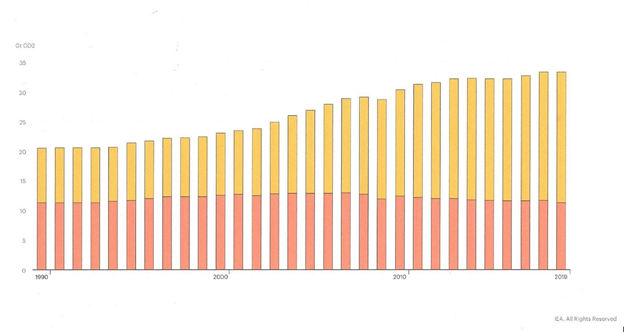
Look at what is already under way. This chart by IEA shows the Energy Related CO2 Emissions. The table that follows illustrates that the Advanced Economies have a diminishing role in controlling CO2 emissions.
Yellow is “Rest of the World” and rust is “Advanced Economies”.
IEA Chart
2010 2019
GtCO2
% of Total
GtCO2
% of Total
Advanced Economies
12.6
54.5
11.3
34
Rest of the World
10.5
45.5
22.0
66.0
Total
23.1
100
33.3
100
Energy Related C02 Emissions
IEA Data
In ten years, the advanced Economies reduced their energy related emissions by 1.3 GtCO2. The Rest of the World increased their emissions by 11.5 GtCO2. Neither China, nor India nor Brazil nor Russia nor the other Asian and African nations are going to stop installation of fossil fuel-based energy. Their reasons for this are many but they want their people to have electricity and other products of fossil fuels, too.
So, John Kerry nailed it, ““Not when almost 90 percent of all of the planet’s global emissions come from outside of US borders. We could go to zero tomorrow and the problem isn’t solved,”
If the West attempts to decarbonize, it will not succeed. I think that the further they get in this futile and misdirected attempt will be disastrous —not to the climate but to the viability of the West. The public will eventually wake up to the facts. Price rises for everything and sharp rises for electricity and gasoline, the new name for renewable will be unreliables, jobs will disappear as manufacturing leaves our shores for lower cost energy, and an unease about the US loss of stature and ability to protect its citizens. These things are likely to create public awareness that the government programs have had disappointing results.
If the West attempts to decarbonize, it will not succeed. I think that the further they get in this futile and misdirected attempt will be disastrous —not to the climate but to the viability of the West.
There is another party that wants to see the West fail. That is a movement titled the Great Reset. This blog will discuss the Great Reset in the next posting.
From a recent Dr. Roy Spencer blog: Seldom is the public ever informed of these glaring discrepancies between basic science and what politicians and pop-scientists tell us. Why does it matter? It matters because there is no Climate Crisis. There is no Climate Emergency. Yes, irregular warming is occurring. Yes, it is at least partly due to human greenhouse gas emissions. But seldom are the benefits of a somewhat warmer climate system mentioned, or the benefits of more CO2 in the atmosphere (which is required for life on Earth to exist). But if we waste trillions of dollars (that’s just here in the U.S. — meanwhile, China will always do what is in the best interests of China) then that is trillions of dollars not available for the real necessities of life. Prosperity will suffer, and for no good reason.“
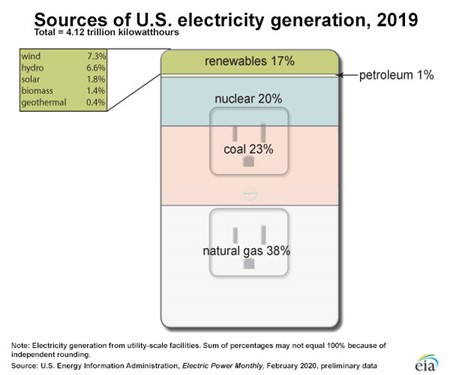
Our nation’s electricity is produced mainly by fossil fuels and nuclear energy. The role played by renewables is relatively small, even though the public seems to believe it is greater. This is probably because the media apparently wants the public to believe it is so. The Chart 1 below is from the Energy Information Administration (eia), an arm of the Department of Energy:
CHART 1
Wind and solar represent 9.1% of the sources of US electricity generation in 2019.
The sources noted in the picture above feed their power output into systems called the grids. These grids distribute the power to the users in their area. The grids do their utmost to be a source of uninterruptable electricity at a specific frequency. This they do reliably.
All of us have experienced a power loss at our home or business and you know how disruptive that is. But most power losses we have experienced are almost always local disruptions, e.g. wind, snow, lightning, power pole meets vehicle, transformer failure, etc. But not a grid failure.
The grids fine tunes their delivery of power, matching the increases and decreases of demand. The grid operators dictate to the suppliers what is needed. For example, the operators can use Nuclear and Coal based plants as a base load. These two sources are predictable and steady suppliers but may not be able to quickly react to changes in demand. The grid operator’s natural gas plants can adjust quickly to changes to prevent supply disruptions. Most businesses need electricity to be uninterrupted as downtime is costly.
Wind and solar are non-dispatchable because they are neither predictable nor steady suppliers of electricity. The wind driving the wind turbines can go from near gale force to calm very quickly. Solar can do the same as cloud banks appear overhead. The grid operator has no control over how much or how little the renewables are producing. If renewables are supplying the grid, the operator must have backup capacity to prevent shutdown of the grid. By the way, grids are not capable of storage of electricity.
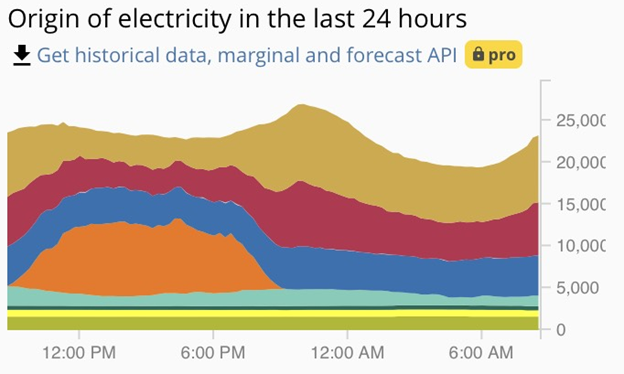
“The Chart 2 below is from Electricity Map, and it shows electricity generation by source on April 3, 2019 in California. The orange section represents solar, the blue hydroelectric, light blue, wind, green, nuclear, red natural gas, and the brown section is imported electricity.
Chart 2
As you can see, imports fall when it is sunny out, and increase again when the sun goes down. It just so happens that the sun was not shining when the demand for electricity in California was highest. California’s policies promoting renewables at the expense of dispatchable generation place it in an odd predicament, it must pay other states to take the excess electricity generated by renewables when their generation is high, and it must also pay other states for their power when renewable generation is low.”
From Chart 2, you can see solar cells negatives.
First it cannot function more than about a half a day. Meaning of course, some other power source is required.
When it is supplying electricity, it distorts the supply at the expense of dispatchable energy sources.
Solar cell production is not at its maximum at sunrise nor sunset. It peaks around noon when the sun is directly overhead. The eia Chart 3 below shows typical electricity production in Los Angeles. Using the gold curve, that assumes that the solar cell has tracking, at 3pm, the watts are about 550 Watts and at 7pm it is at zero. At the peak demand midpoint, say 5 pm, it can only produce about 250 watts. (This would be the output of a single solar cell. However, it represents the rest of the solar cells. The change in watts is equivalent to the percent reduction the entire solar cell farm would experience.)
Chart 3
The energy production Chart3 would suggest that a solar cell is not a major contributor during peak demand. That matches the illustrated Chart 2.
The greens imagine pairing solar cells and wind turbines producing energy for a grid. In this case, regardless of the capacity of the solar cells, the wind must be able to produce all the power to satisfy the capacity rating of the location. Every day, after the sun sets, the wind turbines would have to match demand. Solar cells can never support the daily capacity rating of the location. So why have them?
I am not a proponent of either wind turbines or solar cells. Earlier in this posting I outlined the fact that they are not dispatchable. Industry could not function with an unreliable energy supply. Nor would the public accept it. Brown outs and black outs are inevitable without a backup.
“We show that a 1 percent increase in the share of fast-reacting fossil generation capacity is associated with a 0.88% percent increase in renewable in the long run,” the NBER authors say in the report.
The man-made global warming eco-alarmists are composed of a cabal of scientists and bureaucrats that use scare tactics to frighten the public into supporting them. Their objective is to destroy capitalism and replace it with Marxism. This is fact, not opinion. Their leadership have repeatedly said that their movement is not about environmentalism. To accomplish their objective, for years they have been making predictions designed to frighten the general populace. The literature is filled with predictions of the apocalypse that have never happened. One of their most recent one is that the world is doomed in something like 12 years if we do not empower them to do the things they say need to be done. To these eco-alarmists, the cost of their plans is not an issue.
Why am I highlighting Shellenberger as he is not the only one that has challenged them? First, Shellenberger is a certified environmentalist. He was Time Magazine’s “Hero of the Environment”. He has testified before Congress as an expert and he was invited to be an expert reviewer of the Intergovernmental Panel on Climate Change (IPCC) next Assessment Report. A summary of his background can be found by clicking here.
Secondly, despite what you may have read, skeptics are not the recipients of large sums of money. The eco-alarmists are recipients almost all the money spent on global warming. Anyone that does not toe the line, endangers the alarmist’s incomes. There are few scientists that are willing to sacrifice their jobs by openly speaking out. Shellenberger insists that he believes in the man-made theory of global warming, but he cannot sit by and let the alarmist poison the scientific dialog. That is unacceptable.
I think that he represents many scientists that do not agree with the alarmists but are afraid to speak their mind. Perhaps Shellenberger’s example will encourage others to follow his lead. A Skeptic, on the other hand, might not be able to instill the needed courage.
I have purchased Shellenberger’s book. It is powerful. I recommend it. He has developed an outline of his book and the following are excerpts:
The “UN 2019 Revision of World Population Prospects” report says that by the end of this century the world’s population will be about 10.9 people. What does this mean with respect to the UN goals of having only renewable power—wind and solar –and the elimination of fossil fuels as an energy source?
The Pew Research Center analyzed the UN report and came up with some eye-opening observations. China will begin to lose population by the end of this century. India will have the world’s largest population, surpassing China. Africa will have 4.3 billion people at the turn of the century, substantially more that the 1.5 billion it has in 2020. And Africa’s average age will be 35. The World’s median age will be 42.
Look at this chart:
By 2100, Asia and Africa combined will be 9.0 billion of the forecast total world population of 10.9 billion. We can expect that the really undeveloped populations of the world will be demanding a standard of living approaching that of Europe and North America.
China and India have already launched programs to achieve a very much improved standard of living for their people. Africa will surely do the same and with a relatively young population they will be aggressive. That standard of living will only be realized through energy.
It will not come from renewables. It probably cannot be fully realized by fossil fuels. It will have to come from nuclear energy. Ultimately, nuclear will dominate the energy sector.
For the US, economics are causing some shutdowns of nuclear plants as natural gas generates energy at a lower cost. In the long run, nukes should be the lowest cost reliable energy.
However, there are several nukes that are being shutdown because a governing body does not like them. These are bad choices.
Germany seems to have an irrational fear of nukes that were prompted by the Japanese Fukushima nuke plants being flooded by a tsunami. When was the last time a tsunami hit Germany?
It is my opinion that the greens opposition to nukes is that the nukes have the potential to solve the energy problem. Many leaders of the green movement have publicly announced that their goal is a one-world socialist government based out of the UN. They would prefer an energy limited world where they would be in charge. Nukes could solve the energy problem, destroying their dream.
Ok, will these population estimates prove-out? Will Ebola wipe out millions of Africans? Will there be a war or wars that slash these estimates? Could the expectations for lower fertility be wrong and the world population grows even larger? Of course, I don’t know answers to any of those questions. But for the moment, I am assuming these estimates are going to be accurate.
Continuing serialization of Mark Mills’ report New Energy Economy: An Exercise in Magical Thinking. This is part 7 Moore’s Law Misapplied. Moore is well known for his prediction that the number of transistors in a dense integrated circuit would double every two years. But Mills points out this doesn’t work for renewable energy.
Faced with all the realities outlined above regarding green technologies, new energy economy enthusiasts nevertheless believe that true breakthroughs are yet to come and are even inevitable. That’s because, so it is claimed, energy tech will follow the same trajectory as that seen in recent decades with computing and communications. The world will yet see the equivalent of an Amazon or “Apple of clean energy.”70
This idea is seductive because of the astounding advances in silicon technologies that so few forecasters anticipated decades ago. It is an idea that renders moot any cautions that wind/solar/batteries are too expensive today—such caution is seen as foolish and shortsighted, analogous to asserting, circa 1980, that the average citizen would never be able to afford a computer. Or saying, in 1984 (the year that the world’s first cell phone was released), that a billion people would own a cell phone, when it cost $9,000 (in today’s dollars). It was a two-pound “brick” with a 30-minute talk time.
Today’s smartphones are not only far cheaper; they are far more powerful than a room-size IBM mainframe from 30 years ago. That transformation arose from engineers inexorably shrinking the size and energy appetite of transistors, and consequently increasing their number per chip roughly twofold every two years—the “Moore’s Law” trend, named for Intel cofounder Gordon Moore.
The compound effect of that kind of progress has indeed caused a revolution. Over the past 60 years, Moore’s Law has seen the efficiency of how logic engines use energy improve by over a billionfold.71 But a similar transformation in how energy is produced or stored isn’t just unlikely; it can’t happen with the physics we know today.
In the world of people, cars, planes, and large-scale industrial systems, increasing speed or carrying capacity causes hardware to expand, not shrink. The energy needed to move a ton of people, heat a ton of steel or silicon, or grow a ton of food is determined by properties of nature whose boundaries are set by laws of gravity, inertia, friction, mass, and thermodynamics.
If combustion engines, for example, could achieve the kind of scaling efficiency that computers have since 1971—the year the first widely used integrated circuit was introduced by Intel—a car engine would generate a thousandfold more horsepower and shrink to the size of an ant.72 With such an engine, a car could actually fly, very fast.
If photovoltaics scaled by Moore’s Law, a single postage-stamp-size solar array would power the Empire State Building. If batteries scaled by Moore’s Law, a battery the size of a book, costing three cents, could power an A380 to Asia.
But only in the world of comic books does the physics of propulsion or energy production work like that. In our universe, power scales the other way.
An ant-size engine—which has been built—produces roughly 100,000 times less power than a Prius. An antsize solar PV array (also feasible) produces a thousandfold less energy than an ant’s biological muscles. The energy equivalent of the aviation fuel actually used by an aircraft flying to Asia would take $60 million worth of Tesla-type batteries weighing five times more than that aircraft.73
The challenge in storing and processing information using the smallest possible amount of energy is distinct from the challenge of producing energy, or of moving or reshaping physical objects. The two domains entail different laws of physics.
The world of logic is rooted in simply knowing and storing the fact of the binary state of a switch—i.e., whether it is on or off. Logic engines don’t produce physical action but are designed to manipulate the idea of the numbers zero and one. Unlike engines that carry people, logic engines can use software to do things such as compress information through clever mathematics and thus reduce energy use. No comparable compression options exist in the world of humans and hardware.
Of course, wind turbines, solar cells, and batteries will continue to improve significantly in cost and performance; so will drilling rigs and combustion turbines (a subject taken up next). And, of course, Silicon Valley information technology will bring important, even dramatic, efficiency gains in the production and management of energy and physical goods (a prospect also taken up below). But the outcomes won’t be as miraculous as the invention of the integrated circuit, or the discovery of petroleum or nuclear fission








 Climate Change Sanity