The Alliance for Automotive Innovation says there are approximately 100,000 public charging ports in the US. The Federal Government is attempting to provide more. The Fed’s target is 500,000 charging ports. If there were more charging stations, there would be less range anxiety.
The rough number of gasoline/diesel filling stations is 145,000. Well, if it feels like there is a filling station almost anywhere, why would there need to have 500,000 charging ports? The answer is because it takes so long to recharge the battery.
The Biden Administration’s plan to put up 500,000 charging ports will probably take a while to accomplish. Currently, the plan is for each State to install a charging station along their major highways, 50 miles apart. Further, a charging station must be within a mile of an on and off Interstate intersection.
A private party that wants to operate a charging station picks a site for the station. The site is approved. The Feds will pay up to 80% of the cost and the private party must pay 20% or more. These stations can cost up to $1million. Each station must have a minimum of 4 charging ports.
The API says that the average fill-uptakes 2 minutes for an ICE vehicle. Then that vehicle could go 300 to 400 miles of highway driving.
Level 1 Minimum cost using house AC outlet. One hour provides 2.5 miles of range. So about 6 days to get charged to 350 miles range.
Level 2 Purchasing a charger/installation required. 240-volt system, a home installation. One hour provides 10 to 20 miles of range. Using the 20 miles per hour charge would need 17 hours to get 350 miles range.
Level 3 Fast DC. The public stations are mostly at this level. One hour charge provides about 180-to-240-mile range. Using 240 mile per hour charge would take about an hour and a half to get 350 miles range.
Tesla Supercharger. Dedicated Tesla charging points. One hour would give 1000 miles range. The 350-mile range would be done in about 20 minutes.
Some thoughts:
Anyone that buys an EV and uses a level1 must have more money than that sense. For certain, that person has an ICE car in the garage. The EV is for show.
If you buy an EV and you live in an apartment, where you only have street parking, you would have to go to public charging stations.
Level 2 requires a professional installation with costs that can be steep, often a thousand dollars or more. The charger itself isn’t free.
Level 3. If you use FastDC you will spend more money for charges than if you use a level 2 installed system using your cheaper home electricity.
Very important: routine charging with Superchargers and Fast DC degrades the batteries to the point they won’t be able to hold their charge as long. The fast chargers heat up the battery and that can cause loss of battery range. Tesla says that you should use these fast chargers sparingly.
Every charge degrades the battery’s capacity a little. From Wikipedia:
Capacity loss or capacity fading is a phenomenon observed in rechargeable battery usage where the amount of charge a battery can deliver at the rated voltage decreases with use.[1][2]
In 2003 it was reported the typical range of capacity loss in lithium-ion batteries after 500 charging and discharging cycles varied from 12.4% to 24.1%, giving an average capacity loss per cycle range of 0.025–0.048% per cycle.[3]
Public charging stations are often not close to an available place that you can retire to, while you wait for your battery to get charged. Think of sitting in your car in inclement weather, either hot or cold.
Public charging stations are not always reliable. The following is from
The cause may be lack of income the company gets from charging EVs. The US numbers of EVs on the road are not as many as was predicted.
Charging time is very long. Charging stations are inadequate for even the small number of EVs on the road. The fast chargers are desirable, but their use shortens the life of the battery.
The title is paraphrasing the Ragin Cajun, political adviser to the Clintons, James Carville. Carville said when asked about the biggest issue in an upcoming election, “it’s the economy, stupid” I contend that the biggest issue for the electric vehicle (EV) is the battery.
The battery represents the proposed transition from gasoline and diesel fuel to electricity. The transition will not be easy, if at all. Usually, major transitions have occurred because some new thing is better than the existing thing. That is not happening here. The EV is more costly, is less flexible, not as capable and is planned to be charged from an electrical grid that is sourced from wind turbines and solar cells. The latter, the so-called renewable energy, has not demonstrated that it is capable of keeping the grids supplying a reliable supply of electricity 24/7. Nowhere. Nada. see here But politicians keep throwing money at these schemes. You must wonder why they would do that. Well maybe not.
The EV sales are not displacing gasoline and diesel vehicles because they are better. No. It is replacing those fuel driven vehicles by Government fiat. Governments are giving EVs huge subsidies, and enacting regulatory systems making gasoline and diesel vehicles attain goals that are not reachable nor necessary. Six states have legislated that no gasoline or diesel-powered vehicle can be manufactured or sold after 2030 to 2035. And the Feds are considering that too.
The WSJ blog posted Car Dealers to Biden: EV’s Are Not Selling reporting that 3900 US car dealerships wrote a letter to President Biden saying his EV sales mandate is not working. They told him that:
“Dealers have a 103-day supply of EVs compared to 56 days for all cars. It takes them on average 65 days to sell an EV, about twice as long as for gas-powered cars. EV sales are slowing though manufacturers have slashed prices and increased discounts.
But most consumers aren’t “ready to make the change,” in part because EVs are still too expensive. Many apartment renters also don’t have garages for home charging, and public charging networks are spotty with one in four not functional, according to one study.
“Customers are also concerned about the loss of driving range in cold or hot weather,” the auto dealers say. “Some have long daily commutes and don’t have the extra time to charge the battery.
The dealers want the Administration to “tap the brakes” on its proposed tailpipe emissions rules that would effectively mandate that EVs comprise two-thirds of car sales by 2032
The dealers’ letter is an important political signal that progressive climate coercion isn’t as popular as Democrats think. Americans don’t like to be told what to do or what they must buy. As the dealers put it, “many people just want to make their own choice about what vehicle is right for them.” Imagine that.
The liabilities that are built in the EV battery are, to name a few:
The Range—how many miles can a charged battery propel a vehicle?
How long does it take to charge the battery?
What is the life of the battery?
How much is the cost of a replacement battery?
How safe are these batteries?
Will insurance rates be hiked up?
If most the materials needed to make a battery are suppled from China, is that worrisome?
Battery recycling?
Major electrical revisions to supply @ home charging?
New fees replacing gasoline tax such as miles driven tax or a tax for charger use.
Government overreach?
The future postings will address these liabilities.
Economically developed Nations around the world are pushing the idea that the global temperature is rising unabated to a point where it will become an existential threat to mankind. The problem, they say, is carbon dioxide (CO2) emissions from the use of fossil fuels. They think that CO2 emissions created by the use of gasoline, and diesel, along with natural gas and coal must be discontinued. I think that these Nations are planning to subjugate you under the guise of saying they are just following “science”.
A part of their plan is to accomplish this by using electricity produced from renewable energy sources—Wind Turbines and Solar Cells— and make people buy electric vehicles (EV). This plan will not work. But it will spend trillions of dollars before it is revealed as a failure. Their plan will not be accomplished because wind and solar are not dispatchable. Meaning, the Electric grids must provide, unfailingly, power 24/7. This is accomplished by the use of fossil fuel power that can be ramped up and down to meet requirements. The renewables are not dispatchable because grid operators cannot ramp them up and down. No wind, no sun, no renewable power. As they are today, EVs will continue to run on electricity made mostly by the combustion of fossil fuels.
Nevertheless, the government will try to force you into buying an electric vehicle (EV).
The EPA announced the new standards require a 49 mpg fleetwide average by 2026, a 33% increase over model year 2021 standards. The EPA said that these tough new tailpipe emission standards are designed to effectively force the auto industry to phase out the sale of gas-powered cars
The target cars are those powered by Internal Combustion Engines— aka ICE.
And then they are enacting laws that no gasoline or diesel car can be manufactured and sold after some certain date.
California, always the leader in penalizing the people living in that state, has a new law that it will be illegal to sell new gasoline-powered cars after 2035. Nothing from the Biden Administration yet but they are playing with a date to match California.
Washington Free Beacon carries this story:
“All CARS ARE BAD” Pete Buttigieg’s Equity Advisers Want You To Stop Driiving
Transportation Secretary Pete Buttigieg is appointing a group of “leading experts” to advise him on “transportation equity,” including several who argue that cars cause climate change and promote racism and therefore should be phased out.
And wouldn’t you know it, they make this issue, “racism”
So the Government is going to phase out all ICEs. Let’s see how that will work.
Hedges and Company say” Need to know how many cars there are on Earth in 2023? Here is how many cars there are in the world, including trucks, broken down by world region?
1). Asia: 543 million vehicles on the road 2). Europe: 413 million vehicles (288 million in EU plus 125 million in non-EU countries)1 3). North America: 358 million vehicles 4). South America: 84 million vehicles 5). Middle East: 50 million vehicles 6). Africa: 26 million vehicles 7). Antarctica: about 50 vehicles
That totals up to about 1.5Billion.
Basically only the North American and EU are making rules to get rid of gasoline and diesel vehicles. North American and EU vehicles are less than half of the world’s vehicles.
My guess is that the developing nations will not ban ICE vehicles as they will not have much available electricity to power EVs.
How effective will that be?
What does the vehicle situation in the US look like?
Statistica says: In the first quarter of 2023, there were around 286 million vehicles operating on roads throughout the United States.
From a Heartland posting we learn the following:
Historically, internal combustion engine (ICE) car sales in America are upwards of 55 million annually with about 15 million or 27 percent being new and 40 million or 73 percent being used car sales.
With a total of 50 to 55 million ICE vehicles being sold annually for new and used, it’s obvious that the auto industry and the economy has been benefiting and prospering in the used ICE car market.
The average life of an American vehicle is 13 years. For example, the California rule that no new ICE vehicle can be sold after 2035, would be mostly ineffective in that for years there will be grandfathered ICE vehicles on the road. Of course, California might get really draconian and try to make ICEs illegal own and drive.
The next blog will examine the new and used EV market.
First thing you should see is the following chart showing CO2 emissions by nations and by continent. It looks at major contributors.
The chart tells us that China is the primary source of CO2 emissions. The chart also shows what the two other major industrialized contributors, the North American continent and the European Union. The North American Continent is made up of Cananda, Mexico and America with the America being the biggest emitter.
The worldpopulationreview provided this list:
Top 10 Countries with the Highest CO₂ Emissions in the World (Unit: million tons CO₂) – 2020 EDGAR:*
These numbers are a little dated as the US emissions continue to decrease and the Chinese and Indian emissions are increasing.
Asia, consisting of China, India, Japan, Korea, Australia, etc. are already emitting twice as much as North America and Europe combined. Leading the Asian nations are China and India. They are not going to stop building coal based plants. Their rationale is that they need this to bring the living standards of their people up to our standards. China and India’s populations are each more than 1 billion. They are on their way to more than triple the emissions difference. Excluding Japan, Korea, and Australia , many of the other Asian nations are underway with plans to use fossil fuels to create wealth for their people.
China has said that in 2030, they will begin to reduce CO2 emissions. I doubt that they will, because for years they have announced they were through building coal based power plants. Rather they continually change their mind and announce they are building more of them. They are the world’s largest manufacturer of solar cells. So, it is not that they do not have renewable energy access, but rather they are enlightened enough to know that solar and wind will never replace fossil fuels.
And what are we doing? Why, we are spending trillions of dollars on wind and solar energy sources. The idea of replacing fossil fuels is an illusion. Certain factions are touting a future where wind and solar are the sole sources of energy. No North American or European nation have ever been able to supply their customers on a 24/7 basis and it is doubt full that they ever will. For example, Germany, with wind and solar nameplate capacity in place, that exceeds the nation’s electrical demand, have been unable to run without their fossil fuels plants.
And now, a couple of quotes:
“Even if the United States were to get rid of all fossil fuels, this would only make a difference of two-tenths of one degree Celsius in the year 2100, according to Heritage Foundation chief statistician Kevin Dayaratna.”
And a quote from President Biden’s Climate Tsar, John Kerry.
“The fact is that even if every American citizen biked to work, carpooled to school, used only solar panels to power their homes, if we each planted a dozen trees, if we somehow eliminated all of our domestic greenhouse gas emissions, guess what — that still wouldn’t be enough to offset the carbon pollution coming from the rest of the world,” Kerry said in 2015.
President Biden has called for 50% of all new car and light truck sales be Zero Emission Vehicles (ZEV) by 2030. Even more draconian laws from States like California say:
“…….. all new cars sold in the state by 2035 be free of greenhouse gas emissions like carbon dioxide”.
That means no gasoline vehicle sales can be made in California after 2035.
What is the outcome of these proposals that only allow ZEV to be made? The Fuels Institute, a proponent of the man-made global warming, posted “Reducing carbon emissions effectively-now and tomorrow” has the answer. The charts premise is that of California’s pathway, meaning 100% of new car sales are ZEVs and no new fossil fuel powered cars can be sold.
“As the chart shows, in a hypothetical scenario in which all U.S. light duty vehicle sales are required to be ZEV in 2035, the market would likely only convert 16.5% of vehicles in operation to ZEV by that time. This would leave 83.5% of vehicles in 2035 still operating primarily on liquid fuels used in combustion engines with a potential life expectancy of longer than 20 years. This means that BEVs and a cleaner electricity grid will not be able to significantly cut transportation-related CO2e emissions for many years to come, resulting in increased atmospheric concentrations that will linger for another 100-plus years
It might be possible for the manufacturers to make enough ZEVs, but it may not make any difference if the manufacturers can. The cost, the range anxiety, the charging time, fires, etc. have turned off the common man buying ZEVs so far.
The days of explosive growth in U.S. shale oil production are over. American oil production is rising, but at a much slower pace than it did before the 2020 crash, and at lower rates than expected a few months ago.
The new priorities of the shale patch – capital discipline and a focus on returns to shareholders and debt repayments – have coupled with supply chain constraints and cost inflation to drag down U.S. oil production growth.
The Biden Administration’s mixed signals to the American oil and gas industry, with frequent blaming of the sector for high gasoline prices and, most recently, a threat of more taxes, are not motivating U.S. producers, either. Many are reluctant to commit to spending more on drilling when there isn’t any medium-to-long-term vision of how the U.S. oil and gas resources could be used to boost America’s energy security and help Western allies who depend on imports.
This year, while U.S. oil and gas production continues to increase, the growth is capped by cost pressures and supply-chain delays, executives said in the Dallas Fed Energy Survey for the third quarter. The shale patch cites labor and equipment shortages, as well as the Biden Administration’s inconsistent policies, as the key hurdles to expanding drilling activity.
“The administration’s lack of understanding of the oil and gas investment cycle continues to result in inconsistent energy policies that contribute to rising energy costs. This continued inconsistency increases uncertainty and decreases investments in energy infrastructure,” an executive at an oilfield services firm said in comments to the survey.
“We are in an energy death spiral that will lead to higher highs and lower lows. Volatility will increase, and the public is in for a very difficult ride.”
From Politico’s bog: “New U.S. message on climate change: Make China pay.” Is our President out of his mind— wait, wait, I guess that is already answered. He says the US will pay reparations if China does.
First of all, why would he think the US taxpayer should pay reparations. Why not ask the underdeveloped nations to pay reparations for our medical discoveries, our thousands of inventions that have made their life easier, our pitching in to save starving people that routinely occur in Africa, etc.
Moreover, reparations are hard to get right. China and India, combined, are emitting more CO2 than the rest of the world. Every nation in the world has been using some level of fossil fuel. Would we get to reduce our reparations payments for that?
Secondly, China will not do reparations. And thank God for that because if they did, Biden then would have us hoisted by his own petard.
And the third reason is that there is no crisis. It is an invention by the alarmists and the Great Reset group. Is the world warming? Yes, because the UAH satellite global temperature measurements tell me that.
For at least the last million years, the globe cycles, roughly, every 100,000 years between cold and warm. Does that without any SUVs on the road, by the way.
But I do not believe the alarmist’s computer forecasts of future temperatures. Those forecasts have always exceeded the actual global temperatures. The alarmists recognize this. That is why they changed the narrative from “global warming” to “climate change”. But still, they use those faulty forecasts.
And how do they know that we are really, really going to be sorry if, since the year 1890 until now the global temperature will have increased more than 1.5C. Their ability to make accurate predictions has been non-existent. Why should we believe this one?
So, the answer is too back off global catastrophe predictions and focus on doing adaptation when and if necessary. In the meantime, the Earth will continue to green because of the CO2 in the atmosphere.
Rupert Darwall points his finger at President Biden and the Climate Alarmists as the creators of the current world energy crisis in his posting “Joe Biden’s Energy Crisis”. He says:
“…the energy crisis was not sparked by Saudi Arabia and its Gulf allies or by Iranian ayatollahs. It was self-inflicted, a foreseeable outcome of policy choices made by the West: Germany’s disastrous Energiewende that empowered Vladimir Putin to launch an energy war against Europe; Britain’s self-regarding and self-destructive policy of “powering past coal” and its decision to ban fracking; and, as Joseph Toomey shows in his powerful essay, President Biden’s war on the American oil and gas industry.”
“Hostilities were declared during Joe Biden’s campaign for the Democratic presidential nomination. “I guarantee you. We’re going to end fossil fuel,” candidate Biden told a climate activist in September 2019, words that the White House surely hopes get lost down a memory hole.”
The Biden Administration’s actions are all over the map. When US gasoline prices skyrocketed, and they found their policy on the wrong side they begged Venezuela, Iran and Russia to send their production to the US. Their campaign promises were abandoned by their fear of losing votes come November. How do you spell “hypocrites”?
“Although the price of oil has slipped back from recent highs, the factors behind high gasoline prices remain in place. Foremost among these is the steep decline in U.S. oil refinery capacity triggered when Covid lockdowns crushed demand but continued after the economy reopened. There has never been such a large fall in operable refinery capacity.
Just recently, the Biden Administration said that Big Oil was failing to keep the Northeastern states inventory of gasoline up to standard capacity. Darwall responds”
“Moreover, Gulf Coast refineries were operating at 97 percent of their operating capacity in June 2022. As Toomey remarks, “There isn’t any more blood to be squeezed out of this turnip.”
Darwall notes where climate alarmists are part of the problem. He says:
“Corporate and Wall Street ESG** policies are another factor driving refinery closures, especially of facilities owned by European oil companies to meet punishing decarbonization targets that will effectively end up sunsetting them as oil companies. If finalized as proposed, the Securities and Exchange Commission’s proposed climate disclosure rules, with the strong support of the Biden administration, will heighten the vulnerability of U.S. oil and gas companies to climate activists and woke investors to force them to progressively divest their carbon-intensive activities, such as refining crude oil, and eventually out of the oil and gas sector altogether. To these should be added aggressive federal policies aimed at phasing out gasoline-powered vehicles in favor of electric vehicles (EVs); an administration staffed from top to bottom by militants who believe that climate is the only thing that matters in politics; and an increasingly hostile political climate (“you know the deal,” Biden said of oil executives when campaigning for the presidency. “When they don’t deliver, put them in jail”).”
cbdakota
**ESG (Environmental, Social, Governance) has become a major issue of interest in the modern corporate world. Usually associated with things like climate change, pollution and resource scarcity, in reality, ESG covers a much wider spectrum of socio-economic issues like employability practices, diversity, social and cultural ethics, data security and sustainability.
SRI investors seek companies that promote ethical and socially conscious themes including diversity, inclusion, community-focus, social justice, and corporate ethics, in addition to fighting against racial, gender, and sexual discrimination.
This is the sixth posting of a series listing things that the alarmists and the mainstream media do not want made public. At the top of this posting is a link to the preceding postings.
The Paris Agreement (PA) has been a flop, so far. The PA’s target is lowering CO2 emissions. Since the PA was signed in 2015 by some 180+ nations, the CO2 emissions have risen.
The chart below, from Rhodium, shows the percentage of the total global emissions of the so-called greenhouse gases made by the top 8 emitters in 2019. China is far and away the leading emitter and will be increasing the difference in the future. CO2 from fossil fuels is nominally 80+ % of the total emissions. The rest of the total is from cement manufacturing, methane, and fluorocarbons, etc. In 2020, the emissions dropped due to COVID but are forecast to be back up in 2021.
The International Energy Agency forecasts that 2021 will exceed the emissions in 2019. Their forecast is 33GtCO2 for the year 2021.
China and India as well as many nations in Africa and Asia are installing coal-based power plants at a breakneck speed. Because coal combustion produces more CO2 per Megawatt hour, than any other commonly used fossil fuel, it is the primary target of the alarmists. Bloomberg Green data reports on the primary users of coal int 2019:
COAL USER
% OF TOTAL COAL USED
CHINA
51.7
INDIA
11.8
US
7.2
REST OF THE WORLD
29.3
The US has been reducing the use of coal by using natural gas as a replacement.
The premise of the PA is to essentially eliminate all global manmade CO2 emissions to prevent the global temperature to have risen to 2C since 1900. Or else, awful things are going to happen the alarmists tell us.
If the US were able to totally reduce their emissions, would that prevent the global temperature to rise to 2C?
“Not when almost 90 percent of all of the planet’s global emissions come from outside of US borders. We could go to zero tomorrow and the problem isn’t solved,” Kerry conceded.
All the signers of the PA must submit their Nationally Determined Contribution (NDC), a plan to reduce CO2 emission. Then every 5 years they are to make a new set of NDCs more robust than the preceding submittal. There are no penalties for not meeting your NDC nor are there any for not making a sufficient effort. The burden for accomplishing this objective is laid on these 42 nations that signed the PA. This group consists of the 27nations within the EU, Australia, Canada, Chile, Iceland, Israel, Japan, Korea, Mexico, New Zealand, Norway, Switzerland, Turkey, the US, and the UK. These nation are accused of creating the problem because they have used fossil fuels to discontinue the use of horses, whale oil, backbreaking labor, inadequate living conditions, child labor, while at the same time providing affordable and available electricity— just to mention a few reasons.
The first submission of NDCs were underwhelming. And since then, the story is:
President Xi and the then President Obama met. Obama was going to bring China into the PA. The deal was that China could continue increasing their emission until 2030 without disapproval of the PA organization. From China’s perspective it was a perfect opportunity to build up their manufacturing/economy while the other nations were destroying theirs.
China has disappointed in every way, especially those who thought China was really into environmental stuff. China recently announced that wind and solar are too unreliable to depend upon. An added that they were reducing support to renewables. That was followed by the fact that they were going to build more coal plants. They offered to buy the UKs steel business. Does that sound like someone who worries about the global warming theory? Their new five-year plan that was expected to be based upon using less coal, turned out to be based on more coal.
“At a time when China is so obviously saying one thing and doing another, and clearly not fulfilling its share of the world’s commitments to reducing CO2 emissions — as the world’s second-largest economy– sends all the wrong signals. What China and others see is that no matter what it does — even if it deceives the world and continues its predatory behavior — the US is willing to reduce its own competitiveness, leaving China a thick red carpet to become the world’s dominant superpower, the very role to which it aspires. “
This same Gatestone posting also reminds that the Chinese government are not people of their word:
“It is extremely unlikely that China will deliver on its climate commitments and there are enough precedents to show that the CCP’s pledges cannot be trusted. In 1984, China pledged that Hong Kong’s autonomy, including its rights and freedoms, would remain unchanged for 50 years under the principle of “one country, two systems” after the 1997 return to Chinese sovereignty. By June 2020, however, when China introduced its iron-fisted national security law in Hong Kong, China had reneged on its pledge, and the CCP continues to crush Hong Kong.
China also broke its 2015 commitment not to militarize artificial islands that Beijing has been building in the Spratly Islands chain in the South China Sea and it has never honored at least nine of the commitments it made when it joined the World Trade Organization, to name just a few instances.
The list of broken pledges does not even include the lies that China told the world about the supposed non-transmissibility of the Coronavirus, which originated in Wuhan and has so far taken more than three million lives and ravaged countless economies.”
And another pact, the Montreal Protocol on Ozone is another example of a broken pledge. Jonathan Turley’s post titled China found in massive violation of the Montreal Protocol:
“A study in Nature shows a massive violation by China in the release of ozone-depleting gases like chlorofluorocarbons. China agreed to the Montreal Protocol to stop such CFC pollution. However, it now appears that the Chinese regime is violating the Protocol. A concentration of increased CFC pollution was traced to the northeastern provinces of Shandong and Hebei.”
“We find no evidence for a significant increase in CFC-11 emissions from any other eastern Asian countries or other regions of the world where there are available data for the detection of regional emissions. “
“Several considerations suggest that the increase in CFC-11 emissions from Eastern mainland China is likely to be the result of new production and use, which is inconsistent with the Montreal Protocol agreement to phase out global chlorofluorocarbon production by 2010.”
“If China cannot comply with the Montreal Protocol to control these most dangerous pollutants (particularly with the availability of alternatives for industry) the nation undermines its already low credibility on environmental compliance.”
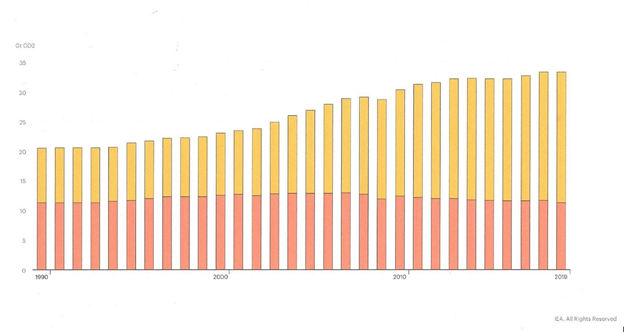
Look at what is already under way. This chart by IEA shows the Energy Related CO2 Emissions. The table that follows illustrates that the Advanced Economies have a diminishing role in controlling CO2 emissions.
Yellow is “Rest of the World” and rust is “Advanced Economies”.
IEA Chart
2010 2019
GtCO2
% of Total
GtCO2
% of Total
Advanced Economies
12.6
54.5
11.3
34
Rest of the World
10.5
45.5
22.0
66.0
Total
23.1
100
33.3
100
Energy Related C02 Emissions
IEA Data
In ten years, the advanced Economies reduced their energy related emissions by 1.3 GtCO2. The Rest of the World increased their emissions by 11.5 GtCO2. Neither China, nor India nor Brazil nor Russia nor the other Asian and African nations are going to stop installation of fossil fuel-based energy. Their reasons for this are many but they want their people to have electricity and other products of fossil fuels, too.
So, John Kerry nailed it, ““Not when almost 90 percent of all of the planet’s global emissions come from outside of US borders. We could go to zero tomorrow and the problem isn’t solved,”
If the West attempts to decarbonize, it will not succeed. I think that the further they get in this futile and misdirected attempt will be disastrous —not to the climate but to the viability of the West. The public will eventually wake up to the facts. Price rises for everything and sharp rises for electricity and gasoline, the new name for renewable will be unreliables, jobs will disappear as manufacturing leaves our shores for lower cost energy, and an unease about the US loss of stature and ability to protect its citizens. These things are likely to create public awareness that the government programs have had disappointing results.
If the West attempts to decarbonize, it will not succeed. I think that the further they get in this futile and misdirected attempt will be disastrous —not to the climate but to the viability of the West.
There is another party that wants to see the West fail. That is a movement titled the Great Reset. This blog will discuss the Great Reset in the next posting.
From a recent Dr. Roy Spencer blog: Seldom is the public ever informed of these glaring discrepancies between basic science and what politicians and pop-scientists tell us. Why does it matter? It matters because there is no Climate Crisis. There is no Climate Emergency. Yes, irregular warming is occurring. Yes, it is at least partly due to human greenhouse gas emissions. But seldom are the benefits of a somewhat warmer climate system mentioned, or the benefits of more CO2 in the atmosphere (which is required for life on Earth to exist). But if we waste trillions of dollars (that’s just here in the U.S. — meanwhile, China will always do what is in the best interests of China) then that is trillions of dollars not available for the real necessities of life. Prosperity will suffer, and for no good reason.“



 Climate Change Sanity