Category Archives: Global Temperatures

Neil deGrasse Tyson Is Wrong. Skeptics Know Science Better Than Warmers.


I want to respond to Astrophysicist Neil deGrasse Tyson’s video titled “Neil deGrasse Tyson explains the real problem with climate change deniers” so here goes. The problem according to Tyson is that “deniers” do not understand science. “They can not sort out what is true and what is not true,” says Tyson.

If you watch late night TV or mainstream TV news you probably know Tyson. He and Bill Nye “the science guy” are their favorites when the media want someone to talk about “deniers” and global warming. Tyson is reasonably informed about the theory of man-made global warming while Nye is an embarrassment. See Nye’s debate with Marc Morano of Climate Depot.

Back to Tyson.  Climate Depot has assembled a list of 700 or so prominent scientists that are skeptics. Most of them have as much or more understanding of climate science than does Tyson. Is Tyson overwhelmingly arrogant or living in a cocoon? I suspect the answer to that is probably both. With regard to the cocoon, he probably never looks at any of these Skeptics work or their reasons for being skeptical.

Continue reading

Ice Cores and Global Climate Part 2. Are Current Temperatures Highest Ever?


As discussed in the previous posting, examination of ice cores can provide high quality data about the Earth’s climate from thousands of years in the past.    Antarctica’s ice cores cannot be surpassed for the longest age records. Let us look once again at the Vostok ice core drilling. (Click on all the charts to enlarge.)

Vostok-400Kd

This illustration reverses the direction of time flow from that of the previous posting’s chart. It does expand the data from about 120,000 years ago to the present.

The chart blue line is the ice core temperature data referenced to the global temperature. The flat red line is the average of global annual temperature means for the period 1998 to 2008. This provides a reference with which to compare the past temperatures. And lastly, the green is the annual mean temperature for 2008.   Several things are obvious. First, recent temperatures are not as warm as previous temperatures at their peak. Second, the globe began to exit the last glacial period about 15,000 years ago, and the temperature increased fairly rapidly (of course rapidly on this chart may be several thousand of years). It is not possible to attribute this rise nor really any other rise shown on this chart to something that man has done.   The current period has been relatively stable.

Continue reading

Ice Cores And What They Tell Us About Global Climate


Ice cores provide information about the climate in the past and this allows us to compare it with the current climate to determine how it stacks up. While some of the readers may know a lot about ice cores, this posting provides general knowledge for those of you that are not so familiar with ice cores. The next posting will discuss the results of the information gather at two sites in the Antarctic.

The Vostok location, one of many places where ice cores are drilled, is part of the Antarctic ice cap. At this location the snow falls each year and the temperature doesn’t rise above freezing. In fact this location is called the coldest place on Earth.

This is how the ice sheets are formed. The surface layer of snow contains gaps between the snowflakes containing air. As subsequent season’s experience snow falls, the older snow begins to compress. The compression forms a grainy material (firn) said to resemble the texture of granulated sugar. As the snow above continues to accumulate, the firn eventually densifies and closes off the pores and the air is firmly trapped. The ice sheet now has inclusions which can be analyzed. When the ice is cored out of this ice sheet, large amounts of information can be obtained for analysis. Wiki has this to say about the ice core samples:

“Ice cores contain an abundance of information about climate. Inclusions in the snow of each year remain in the ice, such as wind-blown dust, ash, pollen, bubbles of atmospheric gas and radioactive substances. The variety of climatic proxies is greater than in any other natural recorder of climate, such as tree rings or sediment layers. These include (proxies for) temperature, ocean volume, precipitation, chemistry and gas composition of the lower atmosphere, volcanic eruptions, solar variability, sea-surface productivity, desert extent and forest fires.

Continue reading

Plate Climatology Theory


ClimateChangeDispatch posted “Global Warming and Plate Climatology Theory” on 7 October 2014.   The posting was written by James Edward Kamis, a Geologist who says he believes there is a probable connection between Geology and Climate. He begins this discussion of his theory by saying:

“The Sun, quite obviously, is the first order driver of Earth’s climate, but a much neglected second order driver can contribute significantly to short-term variations. The theory proposed herein is that periods of active Earth tectonism can be correlated to periods of active climate change and climate related events.

Increased global tectonic activity equates to more faulting and crustal plate movement, which leads to more global heat release from faults, fractures and volcanoes that are more active.

Altered heat input equates to climate change.

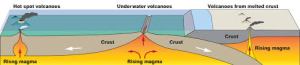
seafloorvolcano

Continue reading

Are Seafloor Volcanoes Altering The Climate?


I have received some interesting email of late that states that seafloor volcanoes are altering the Globe’s climate. So, I have been combing through the internet to see what I could find on this topic.

One theory is that seafloor volcanoes are more active in the time of glaciations than at time of the warming period in between. The thinking is that the increased weight of the ocean’s water, as it rises due to glaciers melting, reduces the activity of the many seafloor volcanoes.   The converse is true about the land-based volcanoes that would become more active as the weight of the glacial ice disappears. The ash emitted from land-based volcanoes can cause cooling of the atmosphere but seafloor ash does not get into the atmosphere.

Continue reading

2015 Was Not The Hottest Year


Seems like that every day some warmer announces that 2015 was the hottest year on record. One wants to ask, “what record” are you taking about? Reconstructed temperatures for thousands if not millions of years suggest that there are many periods that have had higher temperatures that those we are experiencing today. For those years which we have reasonably accurate temperature measuring devices they would suggest that 2015 was likely not the hottest although it might be among the hottest.   Of course there is the problem of “man-made” warming as discussed in this posting “ This Is “Man-Made” Global Warming Courtesy Of NASA”.

To give another perspective on this issue, let us use the recent posting by James Delingpole “No, 2015 Was Not The Hottest Year Evah…”. Delingpole has a really sharp wit. He uses it in this posting of his, and if you wish to experience it, click on the posting link above.   I plan on just using his 5 points that he believes clarify the issue and demonstrate that 2015 was not the hottest year. So here goes:

“Here is why they’re all talking rubbish and you needn’t worry about that “Hottest Year Evah” one bit.

  1. The satellite data show no warming

Compare the two trends (below): the upward one comes from the surface temperature dataset used by NASA GISS (and NOAA and the Met Office – they’re all pretty much interchangeable); the flat trend comes from the more accurate satellite data. Which one do you trust?

delingpolesatellite2016-01-20-13-31-07-300x222

  1. NASA has fiddled the raw temperature data on an ‘unbelievable scale’

From the publicly available data, Ewert made an unbelievable discovery: Between the years 2010 and 2012 the data measured since 1881 were altered so that they showed a significant warming, especially after 1950. […] A comparison of the data from 2010 with the data of 2012 shows that NASA-GISS had altered its own datasets so that especially after WWII a clear warming appears – although it never existed.

Continue reading

This Is “Man-Made” Global Warming Courtesy Of NASA


Tony Heller posting on RealClimateScience.com shows how the global temperature increase is indeed man-made.  Man-made as in “man”ipulating the data. Heller says NASA has changed the data over the past 15 years so that it now shows the year 2001 is about 0.2°C higher on the NASA 2016 chart than it was on NASA’s 2001 chart.

NASA_Fig._A_2001vs2016

And you can note that the 1880 temperature anomaly was made colder by 0.3°C between the 2001 and the 2016 charts.  Those two changes increase the amount of  “man-made” warming by about 0.5°C over those years.

The warmers have also been waring against the satellite temperature  measurements saying they are in error.  But the weather balloons temperature measurements confirm the satellite’s temperature measurements.   There are no independent checks on the NASA system (GISS) or other surface measuring systems.

The chart below show the temperatures by year for the period from 2000 to 2016 using RSS satellite and GISS temperatures and the temperature trends for those years.

woodfortrees2016-01-20-13-31-07

Note that while the surface measuring GISS shows warming, the RSS satellite system show a cooling trend.

Heller says “The fact that the US space agency is ignoring satellite data, is a pretty strong indication that the agency has collapsed into a hopelessly corrupt and decadent state”.

cbdakota

El Nino–Walker Circulation


The prior posting, “Some Background Regarding An El Nino began like this: “Currently, the weather is being strongly affected by an El Nino.  El Nino is but one part of a weather/climate system known as the El Nino Southern Oscillation (ENSO).  There are three phases of ENSO — El Nino, La Nina and Neutral.   ENSO is important because of its ability to change the global atmospheric circulation, which in turn, influences temperature and precipitation across the globe. The global atmospheric circulation is called the Walker Cycle   Circulation“.

This posting examines the Walker Circulation.(I have seen both cycle and circulation used but much of my sourcing for this posting uses Circulation.)

First lets talk about high and low pressure centers. Fair weather generally accompanies a high-pressure center while clouds and precipitation generally accompany a low-pressure center.  Low-pressure centers are formed by a hot surface. For example, the hot Pacific Ocean water that is driven to the Maritime Continent by the trade winds along the equator. The air is hot and moisture laden and as it rises, it cools and the moisture becomes rain. It reaches high-level winds that drive it to the west or east. This air is now dry and cool. It begins to fall forming a high-pressure center.   The air in the high-pressure center begins to flow toward the low pressure center residing above the hot seawater located in the Maritime Continent. Along the way it begins to warm and pick up moisture and then rise. This completes the circulation.

Continue reading

Some Background Regarding An El Nino


Currently the weather is being strongly affected by an El Nino. El Nino is but one part of a weather/climate system known as the El Nino Southern Oscillation (ENSO). There are three phases of ENSO — El Nino, La Nina and neutral.   ENSO is important because of its ability to change the global atmospheric circulation, which in turn, influences temperature and precipitation across the globe. The global atmospheric circulation is called the Walker Cycle and we will look  at that in the next posting.

Many of you already are fully informed about the ENSO but my guess is that some of you are not. I thought it might be helpful to provide some background information. (1)

First of all, we are talking about the Pacific Ocean. The Pacific Ocean from South America to the Maritime Continent(2), a distance of about 10k miles along the equator. Usually the trade winds blow along the equator toward the west. This moves the hot surface water to the Western Pacific. The sea surface is about ½ meter higher in Indonesian than it is in Ecuador. 
Usually, sea-surface temperatures off South America’s west coast range from the 60°s to 70°s F, while they exceed 80°F in the “warm pool.” This description is essentially that of the neutral phase.

On occasions the easterly winds weaken and the hot water begins to flow eastward toward South America. This is the beginning of an El Nino. It typically starts in the May-June timeframe as the water flows eastward. It reaches it peak strength about December. January through March/April typically are the months that the El Nino begins to lose it strength. Some El Ninos maintain strength longer such as the 1998/1999 El Nino, which is considered one of the strongest ever.

Continue reading

EPA Chief Provides Non-Answer To Reporter.


Environmental Protection Agency Administrator Gina McCarthy spoke at the Council on Foreign Relations in Washington, D.C., on Jan. 7, 2016. The event seerimageswas focused on the “threat” of climate change. A CNSnews.com posting “EPA Chief: Climate Change Is Certain But You Can’t Predict the Future” related the comments made by the Administrator at that meeting.

A CNS News reporter asked the Administrator the following question:

“According to the Energy Information Administration – although alternative and renewables are growing slightly – fossil fuels will still account for 80 percent of U.S. energy needs through 2040. Federal data also shows that U.S. carbon emissions are at almost a 20-year low right now. How do those facts fit into the picture the EPA is painting of the U.S. energy landscape?”

Continue reading