
(Revised Nov 13, 2022)
The following is a guest posting by Richard Cronin. He provides a well-documented discussion of how Tidal Pumping drives weather and Climate.
By Richard Cronin
There is no “climate crisis”. The internal heat of the Earth delivered to the ocean floor is grossly misunderstood.
An entirely unappreciated energy input onto the surface of our planet is Tidal Pumping. Not pumping water. Shifting our tectonic plates due to the Earth’s gyrations (Precession, Obliquity, Perihelion, and Orbital Eccentricity) in addition to our varying distance from the planetary gravity fields everywhere from the Sun out to Jupiter.
Milankovitch cycles have nothing to do with solar radiation. They have everything to do with tidal pumping. This information has been coming forward over the last decade by geologists, geophysicists, and astrophysicists. Unfortunately, these disciplines have been overlooked in the discussion about climate.
Tidal pumping by the Sun, Precession of the Equinoxes, Obliquity, Perihelion, Orbital Eccentricity, as well as planetary alignments (particularly Sun, Venus, & Jupiter) move Earth’s tectonic plates. Therefore, all of Earth’s internal heat is delivered to the surface, notably into the waters at the two (2) terminal points of the Pacific’s Ring of Fire. The seismic heat injection is Enormous. Per NASA, this energy input is approx. 99.5 % of all solar radiation but the flawed paradigm is that the internal heat of the Earth is dissipated in Mantle Convection. Mantle Convection and Subduction do not exist.
Per NASA’s very calculations: “The interior of the earth contributes more than 99.5 percent of the total heating of the surface compared with the sun!
This answer, of course is quite wrong because it assumes that 100% of the internal energy is radiated to the surface. In fact, the internal heat source drives powerful convective currents in the mantle so that nearly all of this thermal energy is lost.”
https://image.gsfc.nasa.gov/poetry/ask/a11779.html
The energy statement is true, but the dissipation of the internal heat into Mantle Convection is wrong. There is no Mantle Convection. The internal heat is delivered to the surface, specifically the ocean floor of our planet and greatly exceeds any causation from minuscule trace gases in our atmosphere.
At the Winter Solstice, the incrementally closer distance between the Sun and Southern Hemisphere induces greater plate movement across the Southern Hemisphere and greater seismicity in the Peru-Chile Trench to drive the El Niño. Alternately, these tidal stresses can find relief and induce greater seismicity in the Tonga-Kermadec Trenches to drive the La Niña. Elevated surface water temperatures near Papua-New Guinea are due to a heat plume emitted from the Tonga Trench, but the heating of these surface waters is also affected by the multi-plate, seismically active regions to the east of Papua-New Guinea, including the New Hebrides and New Britain Trenches. Ergo, sea surface temperatures are highest in these regions east of Papua New Guinea.
Current sea surface temperatures showing cooler waters in the central Pacific and elevated temperatures east of Papua New Guinea. Entirely typical of a strong La Niña:

In “Plate Climatology”, James Edward Kamis describes a single “Source Point” for the La Niña and El Niño as centered on the multi-plate, seismically active regions to the east of Papua-New Guinea. It seems doubtful to me that this region could drive the El Niño off the coast of Peru. I hold that the ENSO is a binodal condition, at either end of the Ring of Fire.
Via bathyscaphic ocean floor mapping, Hillier and Watt (2007) provided an estimate of 1.0 to 3.5 million oceanic seamounts which by definition are formed by submarine volcanoes. This estimate excludes estimates above latitudes 60 degrees North and South. See “Global distribution of seamounts from ship-track bathymetry data” in references.
The Dust Bowl years of the 1930s were caused by a strong, sustained La Niña. Drought across the plains states in summer months , punctuated by springtime flooding conditions further north.
The La Niña brings flooding monsoons across Bangladesh, while the Northern Hemisphere suffers extreme drought in the summer months. Extreme low water conditions across rivers of America’s interior as well as Europe. Yet earlier this spring the Yellowstone River flooded over its banks.
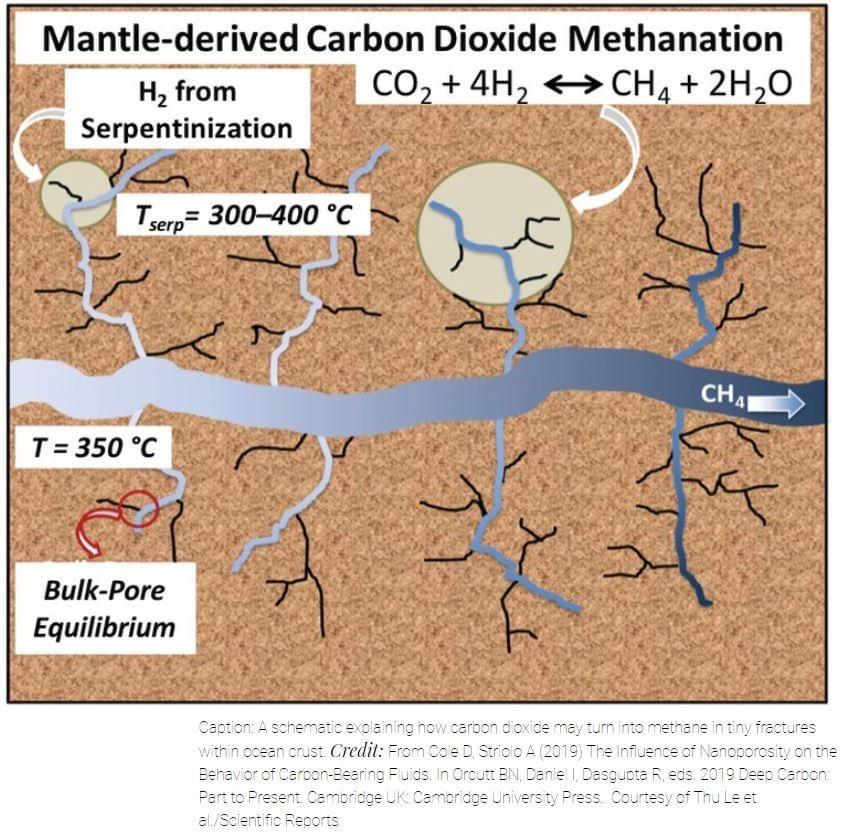
The geochemical reactions throughout the Upper and Lower Mantle are all exothermic (give off heat). Activation Energy is supplied by planetary Decompression. Fischer-Tropsch and Sabatier reactions produce methane and petroleum in unimaginable quantities. (See link). Most is diffused from the ocean floor. Land-based sources are minuscule.
Hydrothermal vents and plain old ocean floor seepage is immeasurable and these acidic discharges react with alkaline ocean waters to release the Heat of Neutralization and the Heat of Dilution.
We have been under pronounced La Niña conditions since autumn of 2020. Last year we went thru the alphabet in hurricane names. Entirely typical of La Niña.
An estimated 50 million tons of water vapor spewed from the Tonga Trench volcano on Jan. 15, 2022. This largest submarine volcano ever observed will produce a warm, wet planet for years. A Richter 7.3 submarine earthquake struck off Tonga on Nov. 11, 2022.
Areas of drought are also caused by an increase in katabatic winds. Moisture condenses on the southern face of the Himalayas, producing monsoons and floods across northern India and Bangladesh. Dry, hot winds flowing down from the Himalayas cause continuous dry conditions for Central Asia.
Significant tidal pumping stresses coincided with the Precession of the planet on Dec. 21, 2021 to tear open the Tonga Trench. Another stress-inducing event is the Perhelion, the closest approach between Earth and Sun, associated with the Earth’s elliptical orbit. The Perihelion occurs two (2) weeks after the Solstices. On April 30, 2022, there was a planetary alignment of Venus-Earth-Mars-Jupiter. On Sept. 26, Jupiter made its closest approach to Earth in 59 years. Tremendous tidal pumping stresses. Tremendous seismic energy release. Totally ignored.
References listed by date. Most of this information was issued in the last half decade. Copy and paste the titles into any web browser.
“Institute for Celestial Geodynamics” ( D. Zbikowski, et al )
“Continental Drift Theory – Unresolved Issues “
“Plate Climatology” by James Edward Kamis. Book published 2019.
“Topological inconsistency of continental drift on the present-sized Earth”
R Meservey. Science. 1969.
“Problem of Convection in the Earth’s Mantle”
E. N. Lyustikh, published in Geophysical Research Letters: 01 January 1969
“Pump-like Tidal Driving of Tectonic Plates – Plates 1” George W. Moore, AAPG Bulletin, GeoScience World, June 1, 1975
“The earth tides”
Judah Levine, December 1982 (NIST)
“Earth tides and the degassing of the Earth”
Khitarov, N. I. ; Voitov, G. I. , March 1982 (NIST)
“Global distribution of seamounts from ship-track bathymetry data”
J.K. Hillier, A.B. Watts, Geophysical Research Letters, July, 2007
—> By definition seamounts are formed by volcanic activity. Hillier and Watt estimate 1 to 3.5 million seamounts and this excludes allowance for regions higher than Latitude 60 degrees. Conservatively, active submarine volcanoes are in the tens of thousands.
“Can Earth’s rotation and tidal despinning drive plate tectonics?”
F. Riguzzi, et al, 2009
“Researchers discover new force driving Earth’s tectonic plates”
Cande & Stegman, Univ. of S. California, July 7, 2011
“On Ohmic heating in the Earth’s core II: Poloidal magnetic fields obeying Taylor’s constraint”. Jackson, Livermore & Ierley, Aug., 2011
“Earth Expansion Evidence: a Challenge for Geology, Geophysics and Astronomy”
G. Scalera, S. Cwojdzinski, National Institute of Geophysics & Vulcanology (Italy), 4-Oct-2011
“Spin-driven tidal pumping: Tidally driven changes in planetary spin coupled with secular interactions between planets.” R. Greenburg et al, Feb. 2013
“Tidal strain and tidal stress in the Earth’s interior” W. Kia, et al, Chinese Journal of Geophysics, November, 2013
“Tidal Stresses – How Gravity Heats Things Up”, Tim James, Dec. 2, 2013 ( author of ‘Astronomical: From Quarks to Quasars, the Science of Space at its Strangest’)
“Secular Increase in the Earth’s LOD (Length of Day) Strongly Implies that the Earth Might Be Expanding Radially on a Global Scale” G.G. Nyambuya ,
4-March-2014
“Asian monsoons in a late Eocene greenhouse world”
A. Licht, G. Dupont-Nivet, et al, Nature, 4-August 2014
—> “But monsoons are still poorly understood, and today’s climate models disagree about how increased carbon dioxide (CO2) in the atmosphere will alter them.”
—> “Asian monsoon began ….. recently several independent teams to around 40 million years ago.” (same duration as Central Asian drought)
“Jupiter’s effect on Earth’s climate”
O. G. Sorokhtin, et al Nov., 2014
“Stanford geologists refute coal development theory” Boyce, Nelson at Stanford 2-Feb. 2016
—> Coal, oil, and gas are NOT produced from squished trees. Fischer-Tropsch (F/T) and Sabatier reactions produce oil and gas on all planets. The only true “fossil fuel” is lignite (brown coal, soft coal, thermal coal) derived from peat bogs of the Tertiary Period. It has only 25 to 35% Carbon value.
—> Heavy crudes, petroleum tars, sub-bituminous coal, bituminous coal vent off volatiles to yield Anthracite (black coal, hard coal) which is 95% Carbon. These carbonaceous fuels all derive from F/T and Sabatier reactions.
“One Paradox of Plate Tectonics”
Laszlo Attila Horvath, July-2016
“Resilience of the Asian atmospheric circulation shown by Paleocene dust provenance”
A. Light, G. DuPont-Nivet et al
Nature Communications 4-August-2016
—> “Our results show that dust sources and near-surface atmospheric circulation have changed little since at least 42 Myr.” (same duration as India-Bangladesh monsoons)
—> “Neither Tibetan uplift nor the decrease in atmospheric carbon dioxide concentration since the Eocene seem to have changed the atmospheric pattern in central Asia,” Licht said. “Wind patterns are influenced by CHANGES IN THE EARTH’S ORBIT over tens or hundreds of thousands of years, but over millions of years these wind patterns are very resilient.”
“Pervasive upper mantle melting beneath the western US”
S. Hier-Majumber, B. Tauzin, et al Earth and Planetary Science Letters. April-2017
—> Just above Transition Region there are Carbonate melts, source of CO and CO2 by acidic attack from sulfur compounds (SO2, etc) produced in the Lower Mantle. CO and CO2 are reagents for Fischer-Tropsch and Sabatier reactions to produce methane and water. Just in the Western U.S. ALONE, centered on Yellowstone, this carbonate melt zone measures approx. 1.8 million sq. km with a thickness ranging from 25 to 70 km. Decomposing just 1 % of this Yellowstone carbonate layer would be equivalent to burning 2.3 trillion barrels of oil.
“The Very Deep Origin of the World’s Biggest Diamonds”
Gemological Institute of America, Winter 2017
—> “Culligan-like diamonds contain …. iron-rich metallic inclusions surrounded by a fluid jacket composed of methane and hydrogen.” This is a Fischer-Tropsch reaction. Iron is the catalyst.
—> Fischer-Tropsch reactions proceed as follows: CO + 3H2, under Reducing Conditions (O2 deficient) and in the presence of an Iron or Cobalt catalyst and starting at 350C, yields methane and water. Further dwell time in a geological “trap” will produce petroleum — in unimaginable quantities. Sabatier reactions perform in much the same way with with CO2 instead of CO catalysts of Vanadium and Silica. CO2 methanation.
“Spectral, spatial-statistical, and graphical evidence that gravitational interaction with the Moon assists in driving Earth’s tectonic plates Part 1”D.Zbikowski, Institute for Celestial Geodynamics, January 2018
“A global forecast for great earthquakes and large volcanic eruptions in the next decade” D. Zbikowski, Institute for Celestial Geodynamics, Sept. 2018
—> “Movement of Earth’s rotational axis with respect to the globe generates motion of the north and south rotational poles upon the surface. Motion of the north rotational pole with respect to the net surface consists of roughly circular wobbles with a quasi-annual period. The wobbles of polar motion are formed primarily from two components-the free Chandler wobble (433 days) and the forced annual wobble (seasonal, 365 days).”
“Empirical evidence for stability of the 405 kiloyear Jupiter-Venus eccentricity cycle over hundred of millions of years.
D.V. Kent, P.E. Olsen, C. Rasmussen, et al, Rutgers University , May 7, 2018
—> “Every 405,000 years, gravitational tugs from Jupiter and Venus slightly elongate Earth’s orbit, an amazingly consistent pattern that has influenced our planet’s climate for at least 215 million years and allows scientists to more precisely date geological events like the spread of dinosaurs, according to a Rutgers-led study.”
“The Ability of Significant Tidal Stress to Initiate Plate Tectonics” by Zanazzi & Triaud, Jan. 2019
“Seismic monitoring reveals tidal stresses in the Earth’s crust”, C. Sens-Schönfelder, et al, Physics World, 15-April-2019
“The phenomenon of subduction is incompatible with Earth’s surface geometry and geomorphology” Lazlo Attila Horvath, July 2019
“Milankovitch (Orbital) Cycles and Their Role in Earth’s Climate”
Alan Buis, NASA Jet Propulsion Laboratory, February 27, 2020
“Tidal modulation of plate motions”
D. Zaccagnino, C. Doglioni, Earth-Science Reviews, June 2020
—> “While mantle convection is fundamental ingredient of geodynamics the driving mechanism of plate tectonics remains elusive. ….. GPS measurements are now accurate enough that, on long baselines, both secular plate motions and periodic tidal displacements are visible.”
—> “Tidal oscillations also correlate with the seismic release.”
“Solar system planetary alignment triggers tides and earthquakes”
S. Awadh, 2021
“Beyond Plate Tectonics”by James Maxlow. Book published 1-Dec.-2021
“Links of planetary energetics to moon size, orbit, and planet spin: A new mechanism for plate tectonics”
A. Hofmeister, Univ. of Washington (St. Louis), January 2022
—> “Tug of sun, moon could be driving plate motions on ‘imbalanced’ Earth”
“The hot zones of global Mw ≥ 5 earthquakes and their decadal migration during 1989–2019”
Jin Chen & Hong Tang, Journal of Geosciences, March 2022
“Precession helped drive glacial cycles in the Pleistocene.”
S. Barker, A. Starr, Geophysical Research Letters. 26-May-2022
GLOBAL-SCALE TIDAL FORCING AND PLATE TECTONICS HAVE BOTH SHAPED THE TECTONIC EVOLUTION OF EUROPA. C. E. Detelich, et al, 53rd Lunar and Planetary Science Conference (2022)
Richard F. Cronin – BChE, MBA, P.E. (retired)


 Climate Change Sanity