Category Archives: fossil fuels

The Paris Agreement Augments China’s Global Ambitions.


I am forwarding a posting by RealClear Energy titled “China’s Green NGO Climate Propaganda Enablers” with the following subtitle:
“Climate change is a national security threat – but not in the way the national security elite assumes.”

A quote from with in this posting sums up China’s objectives.
“China is a great power using global warming to advance its geopolitical interests. Unlike the Soviet Union’s sclerotic economy, China’s is far from a state of collapse. Indeed, China is likely to be the only major economy to emerge larger at the end of 2020 than at the beginning. For China, climate change offers a strategic opportunity. Decarbonizing the rest of the world makes China’s economy stronger – it weakens its rivals’ economies, reduces the cost of energy for its hydrocarbon-hungry economy, and sinks energy-poor India as a potential Indo-Pacific rival.”

By Rupert Darwall
December 21, 2020

Shortly before the Soviet Union collapsed, Greenpeace opened an office in Moscow. It enjoyed the patronage of a leading member of the Soviet Academy of Sciences and enjoyed Kremlin funding, laundered through a state-owned record company. The green activist group made clear that it would have nothing to do with environmental groups in the Baltic republics. Recycling standard Soviet propaganda, Greenpeace denounced them as little more than separatist organizations.

This was by no means a one-off. The inconvenient truth: the environmental movement fought on the wrong side of the Cold War. In the early 1980s, it used the “nuclear winter” scare to try to stop Ronald Reagan’s nuclear build-up and undermine the West’s ability to negotiate the arms agreement that effectively ended the Cold War. It turns out that nuclear winter had been concocted by the KGB and transmitted to America by executives of the Rockefeller Family Fund. A nuclear winter conference held in 1983 was supported by 31 environmental groups, including the Environmental Defense Fund, Friends of the Earth, and the Natural Resources Defense Council (NRDC).

This pattern, wherein the West’s enemies use the environmental movement – whether NGOs like Greenpeace, foundations, or “concerned scientists,” to undermine Western interests – is now being repeated, this time in respect to China. A report by Patricia Adams for the London-based Global Warming Policy Foundation released earlier this month lays bare the role of the green movement in acting as China’s propagandists.
Solar Cells Are Not Able to Supply Daily Power Demand Alone


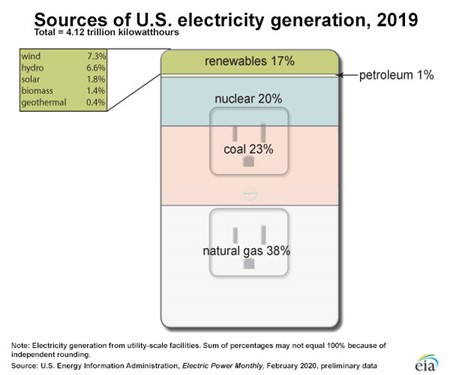
Our nation’s electricity is produced mainly by fossil fuels and nuclear energy.  The role played by renewables is relatively small, even though the public seems to believe it is greater.  This is probably because the media apparently wants the public to believe it is so.  The Chart 1 below is from the Energy Information Administration (eia), an arm of the Department of Energy:

                                                   CHART 1 

Wind and solar represent 9.1% of the sources of US electricity generation in 2019. 

The sources noted in the picture above feed their power output into systems called the grids.  These grids distribute the power to the users in their area. The grids do their utmost to be a source of uninterruptable electricity at a specific frequency.  This they do reliably. 

All of us have experienced a power loss at our home or business and you know how disruptive that is.  But most power losses we have experienced are almost always local disruptions, e.g.  wind, snow, lightning, power pole meets vehicle, transformer failure, etc. But not a grid failure.

The grids fine tunes their delivery of power, matching the increases and decreases of demand.  The grid operators dictate to the suppliers what is needed.  For example, the operators can use Nuclear and Coal based plants as a base load.  These two sources are predictable and steady suppliers but may not be able to quickly react to changes in demand.  The grid operator’s natural gas plants can adjust quickly to changes to prevent supply disruptions. Most businesses need electricity to be uninterrupted as downtime is costly.

Wind and solar are non-dispatchable because they are neither predictable nor steady suppliers of electricity. The wind driving the wind turbines can go from near gale force to calm very quickly.   Solar can do the same as cloud banks appear overhead.  The grid operator has no control over how much or how little the renewables are producing.  If renewables are supplying the grid, the operator must have backup capacity to prevent shutdown of the grid. By the way, grids are not capable of storage of electricity.

The following is from a posting by American Experiment titled “No State Imports More Electricity Than California” by Isaac Orr:

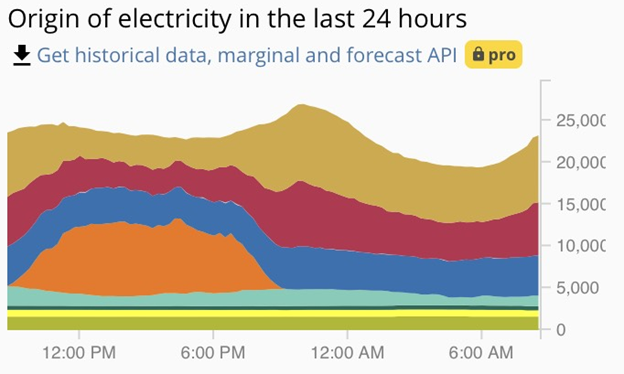
“The Chart 2 below is from Electricity Map, and it shows electricity generation by source on April 3, 2019 in California. The orange section represents solar, the blue hydroelectric, light blue, wind, green, nuclear, red natural gas, and the brown section is imported electricity.

                                                   Chart 2

As you can see, imports fall when it is sunny out, and increase again when the sun goes down. It just so happens that the sun was not shining when the demand for electricity in California was highest. California’s policies promoting renewables at the expense of dispatchable generation place it in an odd predicament, it must pay other states to take the excess electricity generated by renewables when their generation is high, and it must also pay other states for their power when renewable generation is low.”

From Chart 2, you can see solar cells negatives. 

 Solar cell production is not at its maximum at sunrise nor sunset.  It peaks around noon when the sun is directly overhead. The eia Chart 3 below shows typical electricity production in Los Angeles.   Using the gold curve, that assumes that the solar cell has tracking, at 3pm, the watts are about 550 Watts and at 7pm it is at zero.  At the peak demand midpoint, say 5 pm, it can only produce about 250 watts.  (This would be the output of a single solar cell.  However, it represents the rest of the solar cells.  The change in watts is equivalent to the percent reduction the entire solar cell farm would experience.)

                                             Chart 3

The energy production Chart3 would suggest that a solar cell is not a major contributor during peak demand.  That matches the illustrated Chart 2.

  • The greens imagine pairing solar cells and wind turbines producing energy for a grid.  In this case, regardless of the capacity of the solar cells, the wind must be able to produce all the power to satisfy the capacity rating of the location. Every day, after the sun sets, the wind turbines would have to match demand.  Solar cells can never support the daily capacity rating of the location. So why have them?

I am not a proponent of either wind turbines or solar cells.  Earlier in this posting I outlined the fact that they are not dispatchable.   Industry could not function with an unreliable energy supply.  Nor would the public accept it.  Brown outs and black outs are inevitable without a backup. 

Power Engineering posted “Study Says Renewable Power Still Reliant on Backup from Natural Gas” by Wayne Barber.   In this posting he covers a study by the Massachusetts-based National Bureau of Economic Research that stated:

“We show that a 1 percent increase in the share of fast-reacting fossil generation capacity is associated with a 0.88% percent increase in renewable in the long run,” the NBER authors say in the report.

cbdakota

Are Our Political Leadership Ignorant Of Global Warming Science?


Is the inherent ignorance of global warming science in our political leadership leading us over the cliff?  A posting on WattsUpWithThat by Dr Tim Ball tells us that, with the exception of President Trump, these leaders are weak, ignorant, and pandering  .  Ball’s views are as follows:

World Leaders’ Ignorance About Climate Change Continues Despite Simple, Obvious Evidence.

 Guest Blogger / May 18, 2019 Guest opinion Dr. Tim Ball “

To be able to fill leisure intelligently is the last product of civilization.” Arnold Toynbee

Until Trump, and very obviously with his exception, weak, ignorant, pandering, people lead the western nations. They want leadership positions but with no intention of doing the job, or, for that matter, any talent to do it. We are a long way from Toynbee’s “last product of civilization.” Worse, we are moving further away every day. What can you say about America, supposedly the most advanced civilization in the world, with a regular TV program about 600-pound people in prime time? Is that filling leisure intelligently? What can you conclude about western leaders listening to and, worse, heeding Swedish teenager, Greta Thuneberg about climate change who claims she can see carbon dioxide in the air? This skill may be because she is a 16- year old child who, regrettably, has Obsessive Compulsive Disorder (OCD) and Asperger’s Syndrome. We know this because her mother, who needs for child abuse, told us so in the family book ‘Scenes from the heart. Our life for the climate.’ Historically, it was a child who pointed out that the emperor had no clothes. Now the ill-informed, used and abused, children are pointing out the emperor is wearing a cloak of green.

None of this is surprising as the world moves past madness into insanity. A US Senator, Elizabeth Warren, is running for President. This after admitting she claimed a nonexistent native heritage to jump the line at Harvard Law School and to get called to the Bar. There is another Senator also a lawyer, Richard Blumenthal, sitting on the Judiciary Committee where he cynically sits in judgment of other people’s truth and credibility. He claimed involvement in live combat in Vietnam when he was never even in the country. How can such exposed and admitted liars continue to retain positions of power?

Sadly, it is easy, have you watched debates and proceedings in any legislative body from the US Congress, through the British Parliament and beyond. It is a zoo of childish one-upmanship and petty name-calling, but what makes it worse is they think it is clever. No wonder the ratings of all such bodies are so low.

The major reason for the problem of poor leadership is that natural leaders, who are born, not nurtured, know the populace is not ready to be led. They also know that anybody who steps forward to lead immediately becomes the target of a media who believes its divine function is to destroy anybody and everybody. Understandably, they are not prepared to put their heads on the media chopping block. The impact on society is more than the loss leadership. This creates a vacuum that is almost immediately filled by people who want to lead but have nothing but ambition. These people want the job but lack the skills. They say whatever you want to hear or what they think you want to hear. The sincerity is as thin as the ability. Most of these are the people that Daniel Boorstin identified as being famous for being famous. They are so shallow that they are more vulnerable than most to misinformation and false stories that can become the basis of a political campaign. The biggest of these is the human-caused climate change issue. They, along with everybody else, didn’t understand it, but they deliberately exploited it. Everybody thought climate change was a problem, they didn’t care because it was a superb political opportunity.

A Yale University test on climate titled “American’s Knowledge of Climate Change” proved it. The test was designed to find out

from a national study of what Americans understand about how the climate system works, and the causes, impacts, and potential solutions to global warming.

The test given to 2030 American adults resulted in catastrophic results. A full 77% of them achieved a grade of only D or F (52%). I know from 50 years of talking to and dealing with politicians at all levels that their knowledge is as bad. In one way it is worse because politicians take stronger, more definitive positions that preclude an open mind.

Continue reading

Michael Shellenberger Exposes Global Warming Alarmists


The man-made global warming eco-alarmists are composed of a cabal of scientists and bureaucrats that use scare tactics to frighten the public into supporting them.  Their objective is to destroy capitalism and replace it with Marxism.  This is fact, not opinion. Their leadership have repeatedly said that their movement is not about environmentalism. To accomplish their objective, for years they have been making predictions designed to frighten the general populace.  The literature is filled with predictions of the apocalypse that have never happened.  One of their most recent one is that the world is doomed in something like 12 years if we do not empower them to do the things they say need to be done.  To these eco-alarmists, the cost of their plans is not an issue.

Why am I highlighting Shellenberger as he is not the only one that has challenged them? First, Shellenberger is a certified environmentalist. He was Time Magazine’s “Hero of the Environment”. He has testified before Congress as an expert and he was invited to be an expert reviewer of the Intergovernmental Panel on Climate Change (IPCC) next Assessment Report.  A summary of his background can be found by clicking here.

Secondly, despite what you may have read, skeptics are not the recipients of large sums of money.  The eco-alarmists are recipients almost all the money spent on global warming.  Anyone that does not toe the line, endangers the alarmist’s incomes.  There are few scientists that are willing to sacrifice their jobs by openly speaking out. Shellenberger insists that he believes in the man-made theory of global warming, but he cannot sit by and let the alarmist poison the scientific dialog. That is unacceptable.

I think that he represents many scientists that do not agree with the alarmists but are afraid to speak their mind.  Perhaps Shellenberger’s example will encourage others to follow his lead.   A Skeptic, on the other hand, might not be able to instill the needed courage.

I have purchased Shellenberger’s book. It is powerful.  I recommend it.  He has developed an outline of his book and the following are excerpts:

Continue reading

Can Global Warming Be Used To Bring Down Capitalism –Part 3 Failed Predictions of the Apocalypse


The previous two posting show that the real purpose of the leaders is to take down Capitalism using man-made global warming as the cover.  They concluded that global warming probably would not likely be dramatic enough if they just reported their scientific findings.  So, let’s see what a spokesperson of this movement decided would have to be done:

“On one hand, as scientists we are ethically bound to the scientific method, in effect promising to tell the truth, the whole truth, and nothing but—which means that we must include all the doubts, the caveats, the ifs, ands, and buts.”

“On the other hand, we are not just scientists but human beings as well. And like most people we’d like to see the world a better place, which in this context translates into our working to reduce the risk of potentially disastrous climatic change. To do that we need to get some broad-based support, to capture the public’s imagination.”

“That, of course, entails getting loads of media coverage. So, we have to offer up scary scenarios, make simplified, dramatic statements, and make little mention of any doubts we might have. This ‘double ethical bind’ we frequently find ourselves in cannot be solved by any formula.”

Each of us has to decide what is the right balance between being effective and being honest. I hope that means being both.” Dr. Stephen Schneider, former IPCC Coordinating Lead Author, APS Online, Aug./Sep. 1996

Schneider knows that to be honest will not work.  He is obviously endorsing the scary scenarios.    And it worked.

Along the way, some of the scientists challenged Schneider’s plan.  For example, emeritus professor Daniel Botkin related this story:

Some colleagues who share some of my doubts argue that the only way to get our society to change is to frighten people with the possibility of a catastrophe, and that therefore it is all right and even necessary for scientists to exaggerate. They tell me that my belief in open and honest assessment is naïve.”

” Wolves deceive their prey, don’t they?’ one said to me recently. Therefore, biologically, he said, we are justified in exaggerating to get society to change.”
emeritus professor Daniel Botkin, president of the Center for the Study of the Environment and professor emeritus in the Department of Ecology, Evolution and Marine Biology at the University of California, Wall St Journal 17 Oct 2007

 Obviously, they disregarded Botkin’s opinion.   But those scientists have left a body of exaggerated predictions that demonstrate how poorly their technique has been. Yet, however poorly their predictions have been, the media has fulfilled Schneider fondest wish without thinking twice.  For example, they not only do not care how many bad predictions Al Gore has made, and often they find the most alarming part of his prediction and exaggerate it even more.  There is a problem with the reporters.  Do you remember what Ben Rhodes said about the reporters that covered his press releases promoting the then President Obama’s pact with Iran regarding Iran’s plan to make nuclear weapons?: Rhodes braggingly said that he could get them to write anything he wanted because:

 “The average reporter we talk to is 27 years old, and their only reporting experience consists of being around political campaigns. That’s a sea change. They literally know nothing.”

Ok, so what about these predictions?  You are going to have to work a little to see them.  The work will be to click on links to these predictions.  There are many lists of failed prediction available, but alas, if I included them all, this would not be a posting, it might be more like a tome.

Continue reading

Can Global Warming Be Used To Bring Down Capitalism?


My first reaction to the title question is NO.  A new poll of what are the major issues that American citizens are concerned about, found global warming as the next to last of the list’s 12 issues. A previous poll shows almost no interest in any program to “fix” global warming that would cost the individual more than $5 per month. Considering the trillions of dollars that are estimated to do the “fix”, that hardly seems enough to get any program even started.

But when I see what “our betters” are scheming, I am worried.  Back in the 60tys, elites got together looking for a way to bring capitalism down and they choose the idea of using the global warming issues as their vehicle to give their program wheels.   Even today, the authors of the green new deal have said that the objective is to bring down capitalism, not fix the environment.

They promote fear.  The Media, their ally, are willing to assist these alarmists.  Youngsters have been led to believe that they will be dead in 10 or so years because of global warming.   The education system, both elementary and college, plays a role expanding this fear.

The progressive wing of the Democrat party is promoting the Green New Deal. And unfortunately, the leadership of the Democrats are supporters of this scheme.

Even this dismaying Marxism trend of many in the Democrat Party, ultimately, they probably would not find “fixing” the climate appealing.  Those people are thinking the government will be giving them lots of free stuff, but not thinking that the government would be using the free stuff money to try to “fix” global warming.

The Most Serious Threat is the “Great Reset”

Continue reading

UN Forecast Year 2100 World Population At 10.9Billion. Only Nuclear Can Provide Needed Energy


The “UN 2019 Revision of World Population Prospects” report says that by the end of this century the world’s population will be about 10.9 people. What does this mean with respect to the UN goals of having only renewable power—wind and solar –and the elimination of fossil fuels as an energy source? 

The Pew Research Center analyzed the UN report and came up with some eye-opening observations.   China will begin to lose population by the end of this century.  India will have the world’s largest population, surpassing China.   Africa will have 4.3 billion people at the turn of the century, substantially more that the 1.5 billion it has in 2020.  And Africa’s average age will be 35. The World’s median age will be 42.

Look at this chart:

By 2100, Asia and Africa combined will be 9.0 billion of the forecast total world population of 10.9 billion. We can expect that the really undeveloped populations of the world will be demanding a standard of living approaching that of Europe and North America. 

China and India have already launched programs to achieve a very much improved standard of living for their people.  Africa will surely do the same and with a relatively young population they will be aggressive.  That standard of living will only be realized through energy.

It will not come from renewables.  It probably cannot be fully realized by fossil fuels.   It will have to come from nuclear energy.  Ultimately, nuclear will dominate the energy sector.  

For the US, economics are causing some shutdowns of nuclear plants as natural gas generates energy at a lower cost.  In the long run, nukes should be the lowest cost reliable energy.

However, there are several nukes that are being shutdown because a governing body does not like them.  These are bad choices.

Germany seems to have an irrational fear of nukes that were prompted by the Japanese Fukushima nuke plants being flooded by a tsunami.  When was the last time a tsunami hit Germany?

It is my opinion that the greens opposition to nukes is that the nukes have the potential to solve the energy problem. Many leaders of the green movement have publicly announced that their goal is a one-world socialist government based out of the UN. They would prefer an energy limited world where they would be in charge.   Nukes could solve the energy problem, destroying their dream.  

Ok, will these population estimates prove-out?  Will Ebola wipe out millions of Africans?   Will there be a war or wars that slash these estimates?   Could the expectations for lower fertility be wrong and the world population grows even larger?   Of course, I don’t know answers to any of those questions.  But for the moment, I am assuming these estimates are going to be accurate.

cbdakota

The Paris Agreement is Failing


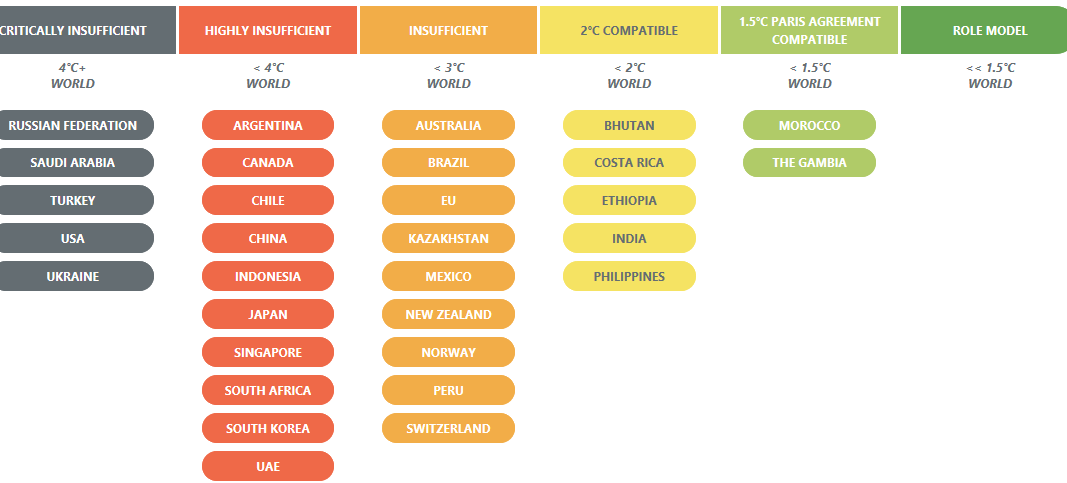
Germany, Poland, etc., for example, are not meeting their self-imposed commitments regarding CO2 emissions reductions. In fact, the Paris Agreement bookkeepers show that almost no one is meeting their commitments. Let’s look at the graphic they have developed to show the status:


The chart shows how the key nations or national groups are performing with respect to meeting the self-imposed commitments for CO2 emission reductions.  The Paris Agreement objective is to hold Global Temperature rise to 1.5C by 2050.   These initial commitments are not enough to do that but were planned to be a start with the nations and national groups accomplishing further reductions as time passes.  That may be problematic if they can not even make the “easy to accomplish” initial commitments.

I hope you can read the chart, but just in case you can’t it is constructed as follows:

Across the top are 6 performance categories—   

·         Role Model

·         1.5C Paris Agreement compatible

·         2C Compatible

·         Insufficient

·         Highly insufficient

·         Critically Insufficient

No one has made the Role Model category

Morocco and The Gambia are 1.5cº Paris Agreement Compatible.   Are you beginning to see why I say the Agreement is failing if only these two inconsequential nations (with respect to emissions) make the grade.

The 2cº compatible  category has Bhutan, Costa Rica, Ethiopia, India and the Philippines. Well, India is a major emitter but what they tell the Paris Group and where the Indian leaders appear to be taking the country are very different.

Insufficient category nations are Australia, Brazil, the EU, Kazakhstan, Mexico, New Zealand, Norway, Peru and Switzerland. The EU is a major emitter, but the others are not.  

Highly insufficient nations are Argentina, Canada, Chile, China, Indonesia, Japan, Singapore, South Africa, South Korea and the UAE.   China is already the world’s No.1 CO2 emitter and they don’t plan to stop increasing their emissions until 2030.

And now for the Critically Insufficient we have Russian Federation, Saudi Arabia, Turkey, the USA, and Ukraine.

The US has reduced its emissions as a result of the ongoing change over from coal to natural gas.  That change over is driven by economics, and not by government edict.

There is another surprise waiting for those that think the all is well with the Paris Agreement.  Starting next year, a $100billion fund is to be created by the “developed nations”.  The money is then available to the less developed nations to accomplish CO2 reductions in their nation.  Each year a new $100billion are to be deposited into this fund by those same developed nations, perhaps forever.

 $10billion was to be deposited into this fund over the past 5 years.  Then President Obama, chipped in $2billion.   Last I looked, the fund has not reached the expected $10billion.  These countries can’t come up with $8billion in 5 years.  Make a guess if they are going to contribute another $100billion into that fund next year.  And the year after that, and the year after that, etc.

You might think that the writers of the Paris Agreement wanted to make a joke to see if anyone would catch it by making this arrangement—China, the world’s largest emitter of CO2 and the 2nd largest economy in the world, is part of the group that can draw on that fund, not contribute to it.     Unfortunately, it is not a joke.

Cbdakota

Renewables Are Better At Creating Jobs Than At Creating Energy


Anericanexperiment blog posted”Energy Industry There to Produce Energy, not Jobs” written by John Phelan..The author begins by quoting Gregg Mast of Clean Energy Economy Minnesota who is boasting about clean energy jobs growth.  Mast says:

 “The fact is,the number of clean-energy jobs has grown every year since the release of the first Clean Jobs Midwest-Minnesota report in 2016, and these good-paying jobs have been added at a faster pace than the statewide average.”


Countering Gregg Mast’s boast,  Phelan responds by saying:

“This might sound like great news, but there is something missing from this celebration. It is something vital. Indeed, from an economic point of view, it is the most vital thing of all: How much energy are these workers actually producing?  Increasing productivity — the ratio of outputs produced to inputs used — is key to economic growth and raising living standards”.

So, how productive are these new clean-energy workers? How much energy does each produce?  Sadly, the answer seems to be “not much.” According to data on electric-power generation by primary energy sources from the Energy Information Administration and figures for employment in each sector from the U.S. Energy and Employment Report, we can see that, in 2017,   the 412 workers employed in Minnesota’s natural-gas sector produced an average of 16,281 megawatt hours of electricity each. For coal, the figure was 13,230 megawatt hours produced for each of the 1,722 workers employed in the state.

But for renewable wind and solar, the numbers are far less encouraging. In terms of megawatt hours produced per worker, Minnesota’s wind sector came in a somewhat distant third. Each of the 1,966 workers here generated an average of just 5,665 megawatt hours in 2017. This was just 43 percent of the amount of electricity a Minnesota coal worker produced annually and 35 percent of that produced by a natural-gas worker.

For solar, the numbers are even worse. In 2017, each of Minnesota’s 3,800 solar-energy workers produced an average of just 157 megawatt hours. This was just 1.2 percent of the energy produced by a coal worker and only 1 percent of that which a natural-gas worker produced.

The chart below illustrates the above:


In terms of that vital ratio of outputs (energy generated) to inputs (number of workers), wind energy is a low-productivity sector compared to natural gas and coal. Solar is even worse. Piling more inputs into these sectors when they could be more productive in other sectors lowers productivity and economic welfare. This is certainly not something to be celebrated — from an economic point of view, at least.

Mast and Clean Energy Economy Minnesota need to remember that the point of an energy industry is to generate energy, not to generate jobs.

A response by supporters of wind and solar is that there are workers out there insulating homes.  How many of solar’s 3800 jobs are insulating homes?

cbdakota

New Energy Economy” An Exercise in Magical Thinking Part 10 Energy Revolutions Are Still Beyond The Horizon


This is the final part of the serialization of Mark Mills’ report New Energy Economy: An Exercise in Magic Thinking.

=======================================================================

Energy Revolutions Are Still Beyond the Horizon

 When the world’s poorest 4 billion people increase their energy use to just 15% of the per-capita level of developed economies, global energy consumption will rise by the equivalent of adding an entire United States’ worth of demand.92 In the face of such projections, there are proposals that governments should constrain demand, and even ban certain energy-consuming behaviors. One academic article proposed that the “sale of energy-hungry versions of a device or an application could be forbidden on the market, and the limitations could become gradually stricter from year to year, to stimulate energy-saving product lines.”93 Others have offered proposals to “reduce dependency on energy” by restricting the sizes of infrastructures or requiring the use of mass transit or car pools.94

The issue here is not only that poorer people will inevitably want to—and will be able to—live more like wealthier people but that new inventions continually create new demands for energy. The invention of the aircraft means that every $1 billion in new jets produced leads to some $5 billion in aviation fuel consumed over two decades to operate them. Similarly, every $1 billion in data centers built will consume $7 billion in electricity over the same period.95 The world is buying both at the rate of about $100 billion a year.96

The inexorable march of technology progress for things that use energy creates the seductive idea that something radically new is also inevitable in ways to produce energy. But sometimes, the old or established technology is the optimal solution and nearly immune to disruption. We still use stone, bricks, and concrete, all of which date to antiquity. We do so because they’re optimal, not “old.” So are the wheel, water pipes, electric wires … the list is long. Hydrocarbons are, so far, optimal ways to power most of what society needs and wants.

More than a decade ago, Google focused its vaunted engineering talent on a project called “RE<C,” seeking to develop renewable energy cheaper than coal. After the project was canceled in 2014, Google’s lead engineers wrote: “Incremental improvements to existing [energy] technologies aren’t enough; we need something truly disruptive. … We don’t have the answers.”97 Those engineers rediscovered the kinds of physics and scale realities highlighted in this paper.

An energy revolution will come only from the pursuit of basic sciences. Or, as Bill Gates has phrased it, the challenge calls for scientific “miracles.”98 These will emerge from basic research, not from subsidies for yesterday’s technologies. The Internet didn’t emerge from subsidizing the dial-up phone, or the transistor from subsidizing vacuum tubes, or the automobile from subsidizing railroads.

However, 95% of private-sector R&D spending and the majority of government R&D is directed at “development” and not basic research.99 If policymakers want a revolution in energy tech, the single most important action would be to radically refocus and expand support for basic scientific research.

Hydrocarbons—oil, natural gas, and coal—are the world’s principal energy resource today and will continue to be so in the foreseeable future. Wind turbines, solar arrays, and batteries, meanwhile, constitute a small source of energy, and physics dictates that they will remain so. Meanwhile, there is simply no possibility that the world is undergoing—or can undergo—a near-term transition to a “new energy economy.”

================================================================

 I know it was a lot of reading, but Mills does a marvelous job of making his thoughts easily understandable and convincing.

Mills’ entire report can be downloaded by clicking here. 

The pages of numbered references are found by clicking “to read more”.

cbdakota

Continue reading