Category Archives: fossil fuels

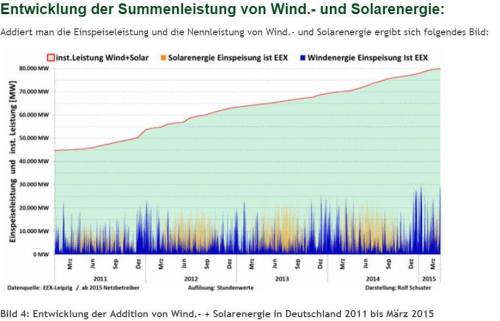
Germany’s Renewables Can Only Provide 11% Of Their Rated Capacity


Here is a look at the German renewable energy program. The NoTricksZone is a site that covers German media and reports it in English. The site is managed by Pierre Goselin and he recently posted “Two Great Destructive Lies German Leaders Refuse To Abandon”. The first of the two “lies” relates performance of wind and solar systems and it is that:

German renewable energies sun and wind are a success!”

germansolarwindcapvsactual

Continue reading

Why Not Make North America, the New Middle East?


Several years ago, a study done by the Manhattan Institute titled “ Unleashing the North American Energy Colossus: Hydrocarbons Can Fuel Growth and Prosperity”, by Mark P Mills pointed out that we have the capability to replace the Middle East as the major source of crude oil.  This, he says, would be of shaleoilhuge economic benefit to the US, Canada and Mexico. Something like $7 trillion dollars of value over the next 15 or 20 years.

Mills argues that the problems with becoming the New Middle East are political, not geological nor technological. One of the political roadblocks was resolved when the latest Federal budget bill was enacted. The bill included the removal of the prohibition against selling US crude oil on the world market. That prohibition had stood since the Nixon Administration.

While the Executive Summary that follows is probably enough for most readers,  Mill’s full report, some twenty pages in length, can be read by clicking here.

EXECUTIVE SUMMARY

The United States, Canada, and Mexico are awash in hydrocarbon resources: oil, natural gas, and coal. The total North American hydrocarbon resource base is more than four times greater than all the resources extant in the Middle East. And the United States alone is now the fastest-growing producer of oil and natural gas in the world.

The recent growth in hydrocarbons production has already generated hundreds of thousands of jobs and billions in local tax receipts by unlocking billions of barrels of oil and natural gas in the hydrocarbon-dense shales of North Dakota, Ohio, Pennsylvania, Texas, and several other states, as well as the vast resources of Canada’s oil sands.

It is time to appreciate the staggering potential economic and geopolitical benefits that facilitating the development of these resources can bring to the United States. It is no overstatement to say that jobs related to extraction, transport, and trade of hydrocarbons can awaken the United States from its economic doldrums and produce revenue such that key national needs can be met—including renewal of infrastructure and investment in scientific research.

An affirmative policy to expand extraction and export capabilities for all hydrocarbons over the next two decades could yield as much as $7 trillion of value to the North American economy, with $5 trillion of that accruing to the United States, including generating $1–$2 trillion in tax receipts to federal and local governments. Such a policy would also create millions of jobs rippling throughout the economy. While it would require substantial capital investment, essentially all of that would come from the private sector.

The underlying paradigms embedded in American energy policy and regulatory structures are anchored in the idea of shortages and import dependence. A complete reversal in thinking is needed to orient North America around hydrocarbon abundance—and exports.

In collaboration with Canada and Mexico, the United States could—and should—forge a broad pro-development, pro-export policy to realize the benefits of our hydrocarbon resources. Such a policy could lead to North America becoming the largest supplier of fuel to the world by 2030. For the U.S., the single most effective policy change would be to emulate Canada’s solution for permitting major energy projects: create a one-portal, one-permit federal policy for all permits.

The recent preoccupation with technologies directed at creating alternatives to hydrocarbons misses how technology also unleashes alternative sources of hydrocarbons themselves. A number of detailed analyses of the new hydro- carbon realities have emerged, not least of which are excellent ones from Citi, Wood Mackenzie, IHS, and the U.S. Chamber of Commerce.

The authors of Citi’s detailed report “Energy 2020: North America, the New Middle East?” note that “[t]he main obstacles to developing a North American oil surplus are political rather than geological or technological.”

The projected growth in total world energy demand through 2030 is equal to an additional two Americas’ worth of consumption. Every credible forecast shows hydrocarbons fueling the major share of that growth, as they have in the past. While alternative energy has grown rapidly, the overall contribution to U.S. and world supply remains de minimus and stays that way in every credible future scenario.

There will doubtless be objections to the idea of a radical shift in policies and attitudes toward hydrocarbons. But the benefits to the U.S., to the rest of North America, and to the rest of the world are so dramatic and important that abandoning them without serious policy deliberations would be unconscionable.

cbdakota


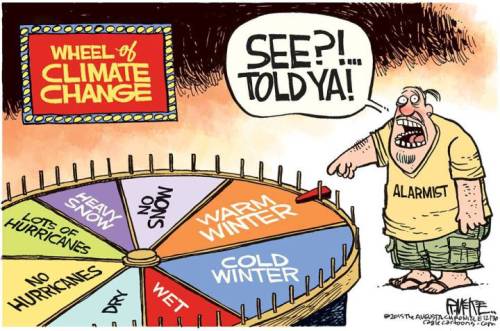
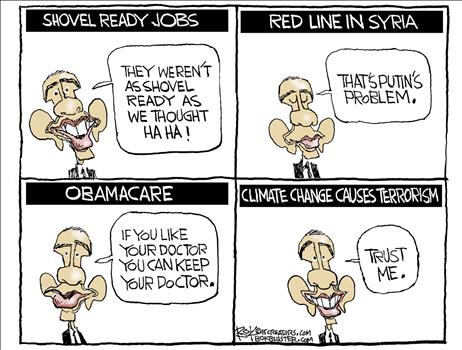
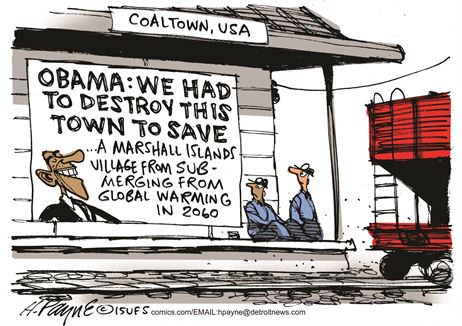
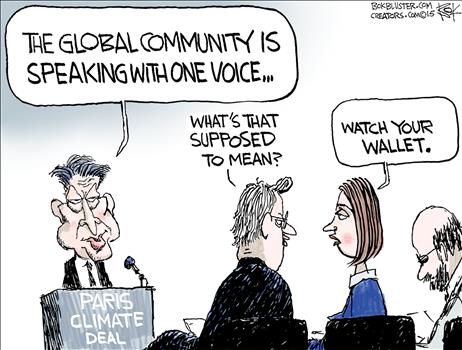
Year End Global Warming Cartoons


Year end cartoons  courtesy of TownHall.com

cartoonwheel-of-climatehttp://townhall.com/political-cartoons/2015/12/05/137270

cartoonbombintruckpayn_c13758220151220120100

cartoonstrustmecb120715dAPR20151204114706

cartoonworldpayn_c13727620151205120100

coaltowncartoonpayn_c13774320151229120100

cartoonwatchyourwalletcb121415dAPR20151214094510

Have a great 2016.  Happy New Year!!!

cbdakota


The Perilous Business Of Predicting The Future


The National Review.com posted “Why Climate Change Won’t Matter in 20 Years”. They subtitled the posting “The perilous business of predicting the future.” The subtitle accurately depicts what happens when politicians or anyone for that matter, think they can safely make the future an extension of the present.

First of all, the warmers should be willing to take seriously the abject failure of their vaunted climate models to make prediction on any time frame. Yet they insist that the Earth in 2100 will be x degrees hotter and the sea level will be y meters higher than today because the climate models told them so. The odds are that they might do just as well talking to Madame Charmaine, the village palm reader.

The author of this posting, Josh Gelernter, put in a lot of effort into showing why projecting the present as a representation of the future is very unlikely to be successful. So I will let him speak:

“Michael Crichton — the brilliant novelist and thinker — posed this horsespulling streetcarquestion in a speech at Caltech in 2003, re climate predictions for 2100. What environmental problems would men in 1900 have predicted for 2000? Where to get enough horses, and what to do with all the manure. “Horse pollution was bad in 1900,” said Crichton. How much worse would someone in 1900 expect it to “be a century later, with so many more people riding horses?”

Continue reading

Wow, Do I Feel Betrayed–Massive Omnibus Spending Bill


Wow, do I feel betrayed. The promises by the Republicans on how they were going to handle the budget apparently were just used to fool the voters. They really did not mean what they said. The new budget deal doesn’t even address President Obama plans to send reparation money to the UN.  From the Daily Signal posting “What’s Wrong With The Massive Omnibus Spending Bill” one of the segments of the bill is “Energy”. I have on several occasions posted that US crude oil should be allowed to be sold outside the US. If the spending bill is enacted, that will happen. However, I would give that up for a reversal of the other provision such as extending tax credit for wind production. But my biggest regret is that the Republican promises to block the use of monies for the President’s climate change schemes did not happen . Read the following:

If you were to put a jelly bean for each energy provision on a two-sided scale, the side being good free-market provisions and the other being corrupt energy provisions, the bad side of the scale would be hitting the floor.

Continue reading

Producing More Greenhouse Gases Than Climate Agreements Block


The American Interest posting of “A Manufactured ‘Success’ in Paris” reviews the fact that the Paris meeting agreement fails to accomplish what the greens had hoped for and in fact may even set back the movement. For example, the money fund part of the agreement does not mention the number $100billion and as we know, there are no mechanisms to make the developed countries actually produce this kind of money. The authors of the posting, Walter Russell Mead and Jamie Horgan suggest that could produce a set back:

Developing countries can and will excuse their inaction by pointing to the absence of that $100 billion slush fund, and, in any case, the governments of many developing country are surprisingly indifferent to the views of first-world NGO scolds.”

 Read the complete posting because it lays out the Paris agreement ‘s lack of real success and some thought on the future of their effort.

 I really liked the authors’ views when they said this:

There will no doubt be many follow-ups, jet-setting conferences in many more attractive destinations, and climate diplomacy will continue to produce more greenhouse gasses than climate agreements block.”

 We have been saying that for some long time. There were, by some estimates, around 40,000 people attending this conference.   When they begin to do their meetings using Skype, I will take them more seriously.

 cbdakota


Secretary Kerry Says Climate Agreement Is Unenforceable


Secretary of State John Kerry hailed the Paris climate agreement as “a victory for all of the planet and for future generationsaccording to the Washington Examiner posting “Kerry says Paris agreement crafted to avoid Congress”.

How did he avoid the US Congress?  

Secretary of State John Kerry said Sunday the climate agreement reached this week in Paris did not contain any enforcement provisions because Congress would not have approved them.

“It doesn’t have mandatory targets for reduction and it doesn’t have an enforcement, compliance mechanism,” Kerry said during an interview on “Fox News Sunday.”

“Binding legal requirements would have made the Paris agreement a treaty, requiring approval from two-thirds of the Senate. Because no climate change measure could close to the high bar in the chamber, the Paris deal was written to avoid it.”

Nice work Secretary Kerry. An unenforceable climate agreement is going to save the planet.  Actually being unenforceable is probably a victory for the planet, but not in the same sense that Kerry is claiming.   Unenforceable provides hope for the poor.  Fossil fuel electrical power plants may now be in their future.

The Secretary has crafted another unenforceable agreement regarding Iran’s nuclear program.   In just one year, the Secretary has crafted two unenforceable victories for the planet. Certainly this is some kind of distinction.

cbdakota

Fortunately, The Paris Climate Talks Appear To Have Failed


The bluster emanating from the Paris climate talks challenges the Potemkin Villages as the biggest attempted cover-up of the real facts on the ground in history. The agreement produced only voluntary caps on CO2 emissions; only voluntary transfers (reparations really) of money from the 1st world to the 3rd world); and reporting of emissions and international oversight do not exist. Further more, neither China or India will cut back their expected increase in CO2 emissions as they plan to serve their citizens first.
The Paris climate leadership acknowledged that even if the emission cuts would take place as promised, their arbitrary goal of holding the global temperature rise under 2C would not be achieved. President Obama flew a 500+ army to Paris. All they accomplished was to spend our money and a lot of CO2 emisssions.

The President, however, will claim he must have the money to pay reparations to the 3rd world countries and laws enacted to shut-down our industry to reduce CO2 emission. The science is not settled. Why wreck our economy and put our people out of work when there has been no significant rise in global temperatures for almost 19 years and polar ice is increasing.

cbdakota

Dr Judith Curry Is No Longer A Member Of the Warmer Tribe.


Dr Judith Curry believes that CO2 is warming the Earth. But she thinks that the forecasts of temperature rise by the IPCC and other warmers are vastly curryUnknownoverstated. Thus she is labeled a lukewarmer. Because most skeptics are in some sense lukewarmers, she is readily accepted by the Skeptics. But warmers do not tolerate those who don’t strictly follow their religious like beliefs that allow no deviation from their catastrophic views.   She says she has been tossed out of the warmer tribe of which she was once a welcome member.

Her credentials are solid gold. Wikipedia cites her publications as follows:

Curry is the co-author of Thermodynamics of Atmospheres and Oceans (1999), and co-editor of Encyclopedia of Atmospheric Sciences (2002). Curry has published over 130 scientific peer reviewed papers. Among her awards is the Henry G. Houghton Research Award from the American Meteorological Society in 1992.

She (Curry) wrote: “I have a total of 12,000 citations of my publications (since my first publication in 1983).

The new.spectator.com.uk posted “I was tossed out of the tribe’: climate scientist Judith Curry interviewed”. This is how it happened:

“Curry’s independence has cost her dear. She began to be reviled after the 2009 ‘Climategate’ scandal, when leaked emails revealed that some scientists were fighting to suppress sceptical views. ‘I started saying that scientists should be more accountable, and I began to engage with sceptic bloggers. I thought that would calm the waters. Instead I was tossed out of the tribe. There’s no way I would have done this if I hadn’t been a tenured professor, fairly near the end of my career. If I were seeking a new job in the US academy, I’d be pretty much unemployable. I can still publish in the peer-reviewed journals. But there’s no way I could get a government research grant to do the research I want to do. Since then, I’ve stopped judging my career by these metrics. I’m doing what I do to stand up for science and to do the right thing.’”

Curry says that the COP 21 will be driven by the warmer’s belief that global temperature rise is a direct function of the atmospheric CO2 concentration.   She says there is no such relationship:

“This debate will be conducted on the basis that there is a known, mechanistic relationship between the concentration of carbon dioxide in the atmosphere and how world average temperatures will rise. Any such projection is meaningless, unless it accounts for natural variability and gives a value for ‘climate sensitivity’ —i.e., how much hotter the world will get if the level of CO2 doubles. Until 2007, the UN Intergovernmental Panel on Climate Change (IPCC) gave a ‘best estimate’ of 3°C. But in its latest, 2013 report, the IPCC abandoned this, because the uncertainties are so great. Its ‘likely’ range is now vast — 1.5°C to 4.5°C.

Curry says that reaching 2°C is likely much farther away than the warmers think because the recent research shows a climate sensitivity of around 2°C rise per doubling of the CO2 in the atmosphere versus the 3°C rise.  See Recent “Research Papers Show That IPCC Climate Sensitivity Is Too High”

 Curry also believes the warmers need to look at natural sources that cause the climate to change. She says:

“Meanwhile, the obsessive focus on CO2 as the driver of climate change means other research on natural climate variability is being neglected. For example, solar experts believe we could be heading towards a ‘grand solar minimum’ — a reduction in solar output (and, ergo, a period of global cooling) similar to that which once saw ice fairs on the Thames. ‘The work to establish the solar-climate connection is lagging.’”

Curry closes her interview by the David Rose of the New Spectator UK with this:

She remains optimistic that science will recover its equilibrium, and that the quasi-McCarthyite tide will recede: ‘I think that by 2030, temperatures will not have increased all that much. Maybe then there will be the funding to do the kind of research on natural variability that we need, to get the climate community motivated to look at things like the solar-climate connection.’ She even hopes that rational argument will find a place in the UN: ‘Maybe, too, there will be a closer interaction between the scientists, the economists and policymakers. Wouldn’t that be great?’

cbdakota

(I previously post the Spectator interview on my Facebook sans my comments.)


COP 21 President Obama Wants Money To Pay Reparations


What will come from the COP21?   An agreement? Perhaps,  but what will it amount to?   President Obama wants to commit the US to a combination of gwbiggestthreatCartoon54reduced CO2 emissions and billions of dollars for reparation (wealth redistribution plan) payments. The US Congress has said they wont approve any money expenditure for reparations unless they have a treaty to vote on. A treaty would require approval of 67 members of the Senate voting in favor of the treaty, so this probably means there wont be any money. Congress has signaled both the President and the rest of the world that will not be spending any money. Obama and his crew know a treaty would not make it through the Senate so they have been trying to come up with some other scheme that will not require the Senate’s approval. Obama has promised to make a $3billion down payment to the UN’s Green Climate Fund at the COP21 meeting.

He and the Congressional Democrats could try to force Congress to give the money to the UN by threatening a Government Shutdown. This has worked in the past, but I doubt that global warming is a winning issue with the voters. The most recent poll by Fox News shows that only 3% believe that global warming is something they need to worry about. This result is consistent would other news organizations polling.

Continue reading