Category Archives: Alternative Energy

New Energy Economy: An Exercise in Magic Thinking: Part 4 Ensuring Energy Availability and Grid Parity


This part is a little longer than the previous posting but I think believe it conveys the message.


Continuing the serialization of Mark Mills’ report New Energy Economy: An Exercise in Magic Thinking. 

====================================================

The high cost of ensuring  energy availability

Availability is the single most critical feature of any energy infrastructure, followed by price, followed by the eternal search for decreasing costs without affecting availability. Until the modern energy era, economic and social progress had been hobbled by the episodic nature of energy availability. That’s why, so far, more than 90% of America’s electricity, and 99% of the power used in transportation, comes from sources that can easily supply energy any time on demand.18

 In our data-centric, increasingly electrified, society, always-available power is vital. But, as with all things, physics constrains the technologies and the costs for supplying availability.19 For hydrocarbon-based systems, availability is dominated by the cost of equipment that can convert fuel-to-power continuously for at least 8,000 hours a year, for decades. Meanwhile, it’s inherently easy to store the associated fuel to meet expected or unexpected surges in demand, or delivery failures in the supply chain caused by weather or accidents.

It costs less than $1 a barrel to store oil or natural gas (in oil-energy equivalent terms) for a couple of months.20 Storing coal is even cheaper. Thus, unsurprisingly, the U.S., on average, has about one to two months’ worth of national demand in storage for each kind of hydrocarbon at any given time.21

Meanwhile, with batteries, it costs roughly $200 to store the energy equivalent to one barrel of oil.22 Thus, instead of months, barely two hours of national electricity demand can be stored in the combined total of all the utility-scale batteries on the grid plus all the batteries in the 1 million electric cars that exist today in America.23

For wind/solar, the features that dominate cost of availability are inverted, compared with hydrocarbons. While solar arrays and wind turbines do wear out and require maintenance as well, the physics and thus additional costs of that wear-and-tear are less challenging than with combustion turbines. But the complex and comparatively unstable electrochemistry of batteries makes for an inherently more expensive and less efficient way to store energy and ensure its availability.

Since hydrocarbons are so easily stored, idle conventional power plants can be dispatched—ramped up and down—to follow cyclical demand for electricity. Wind turbines and solar arrays cannot be dispatched when there’s no wind or sun. As a matter of geophysics, both wind-powered and sunlight-energized machines produce energy, averaged over a year, about 25%–30% of the time, often less.24 Conventional power plants, however, have very high “availability,” in the 80%–95% range, and often higher.25

 A wind/solar grid would need to be sized to meet both peak demand and to have enough extra capacity beyond peak needs in order to produce and store additional electricity when sun and wind are available. This means, on average, that a pure wind/solar system would necessarily have to be about threefold the capacity of a hydrocarbon grid: i.e., one needs to build 3 kW of wind/solar equipment for every 1 kW of combustion equipment eliminated. That directly translates into a threefold cost disadvantage, even if the per-kW costs were all the same.26

Even this necessary extra capacity would not suffice. Meteorological and operating data show that average monthly wind and solar electricity output can drop as much as twofold during each source’s respective “low” season.27

The myth of grid parity  

How do these capacity and cost disadvantages square with claims that wind and solar are already at or near “grid parity” with conventional sources of electricity? The U.S. Energy Information Agency (EIA) and other similar analyses report a “levelized cost of energy” (LCOE) for all types of electric power technologies. In the EIA’s LCOE calculations, electricity from a wind turbine or solar array is calculated as 36% and 46%, respectively, more expensive than from a natural-gas turbine—i.e., approaching parity.28 But in a critical and rarely noted caveat, EIA states: “The LCOE values for dispatchable and non-dispatchable technologies are listed separately in the tables because comparing them must be done carefully”29 (emphasis added). Put differently, the LCOE calculations do not take into account the array of real, if hidden, costs needed to operate a reliable 24/7 and 365-day-per-year energy infrastructure—or, in particular, a grid that used only wind/solar.

 The LCOE considers the hardware in isolation while ignoring real-world system costs essential to supply 24/7 power. Equally misleading, an LCOE calculation, despite its illusion of precision, relies on a variety of assumptions and guesses subject to dispute, if not bias.

 For example, an LCOE assumes that the future cost of competing fuels—notably, natural gas—will rise significantly. But that means that the LCOE is more of a forecast than a calculation. This is important because a “levelized cost” uses such a forecast to calculate a purported average cost over a long period. The assumption that gas prices will go up is at variance with the fact that they have decreased over the past decade and the evidence that low prices are the new normal for the foreseeable future.30 Adjusting the LCOE calculation to reflect a future where gas prices don’t rise radically increases the LCOE cost advantage of natural gas over wind/solar.

 An LCOE incorporates an even more subjective feature, called the “discount rate,” which is a way of comparing the value of money today versus the future. A low discount rate has the effect of tilting an outcome to make it more appealing to spend precious capital today to solve a future (theoretical) problem. Advocates of using low discount rates are essentially assuming slow economic growth.31

A high discount rate effectively assumes that a future society will be far richer than today (not to mention have better technology).32 Economist William Nordhaus’s work in this field, wherein he advocates using a high discount rate, earned him a 2018 Nobel Prize.

An LCOE also requires an assumption about average multi-decade capacity factors, the share of time the equipment actually operates (i.e., the real, not theoretical, amount of time the sun shines and wind blows). EIA assumes, for example, 41% and 29% capacity factors, respectively, for wind and solar. But data collected from operating wind and solar farms reveal actual median capacity factors of 33% and 22%.33 The difference between assuming a 40% but experiencing a 30% capacity factor means that, over the 20-year life of a 2-MW wind turbine, $3 million of energy production assumed in the financial models won’t exist—and that’s for a turbine with an initial capital cost of about $3 million.

U.S. wind-farm capacity factors have been getting better but at a slow rate of about 0.7% per year over the past two decades.34 Notably, this gain was achieved mainly by reducing the number of turbines per acre trying to scavenge moving air—resulting in average land used per unit of wind energy increasing by some 50%.

 LCOE calculations do reasonably include costs for such things as taxes, the cost of borrowing, and maintenance. But here, too, mathematical outcomes give the appearance of precision while hiding assumptions. For example, assumptions about maintenance costs and performance of wind turbines over the long term may be overly optimistic. Data from the U.K., which is further down the wind-favored path than the U.S., point to far faster degradation (less electricity per turbine) than originally forecast.35

 To address at least one issue with using LCOE as a tool, the International Energy Agency (IEA) recently proposed the idea of a “value-adjusted” LCOE, or VALCOE, to include the elements of flexibility and incorporate the economic implications of dispatchability. IEA calculations using a VALCOE method yielded coal power, for example, far cheaper than solar, with a cost penalty widening as a grid’s share of solar generation rises.36

One would expect that, long before a grid is 100% wind/solar, the kinds of real costs outlined above should already be visible. As it happens, regardless of putative LCOEs, we do have evidence of the economic impact that arises from increasing the use of wind and solar energy.

===================================================

Part 5 will be The Hidden Costs of a “Green” Grid.

cbdakota

New Energy Economy:An Exercise in Magic Thinking–Part 3 The Physics-Driven Cost Realities of Wind and Solar


Continuing with the serialization of Mark Mills report titled New Energy Economy: An Exercise in Magic Thinking.

================================================

The Physics-Driven Cost Realities of Wind and Solar   Part 3

The technologies that frame the new energy economy vision distill to just three things: windmills, solar panels, and batteries.10 While batteries don’t produce energy, they are crucial for ensuring that episodic wind and solar power is available for use in homes, businesses, and transportation.

Yet windmills and solar power are themselves not “new” sources of energy. The modern wind turbine appeared 50 years ago and was made possible by new materials, especially hydrocarbon-based fiberglass. The first commercially viable solar tech also dates back a half-century, as did the invention of the lithium battery (by an Exxon researcher).11

Over the decades, all three technologies have greatly improved and become roughly 10-fold cheaper.12 Subsidies aside, that fact explains why, in recent decades, the use of wind/solar has expanded so much from a base of essentially zero.

Nonetheless, wind, solar, and battery tech will continue to become better, within limits. Those limits matter a great deal—about which, more later—because of the overwhelming demand for power in the modern world and the realities of energy sources on offer from Mother Nature.

With today’s technology, $1 million worth of utility-scale solar panels will produce about 40 million kilowatt-hours (kWh) over a 30-year operating period (Figure 2). A similar metric is true for wind: $1 million worth of a modern wind turbine produces 55 million kWh over the same 30 years.13 Meanwhile, $1 million worth of hardware for a shale rig will produce enough natural gas over 30 years to generate over 300 million kWh.14    That constitutes about 600% more electricity for the same capital spent on primary energy-producing hardware.15

The fundamental differences between these energy resources can also be illustrated in terms of individual equipment. For the cost to drill a single shale well, one can build two 500-foot-high, 2-megawatt (MW) wind turbines. Those two wind turbines produce a combined output averaging over the years to the energy equivalent of 0.7 barrels of oil per hour. The same money spent on a single shale rig produces 10 barrels of oil, per hour, or its energy equivalent in natural gas, averaged over the decades.16

The huge disparity in output arises from the inherent differences in energy densities that are features of nature immune to public aspiration or government subsidy. The high energy density of the physical chemistry of hydrocarbons is unique and well understood, as is the science underlying the low energy density inherent in surface sunlight, wind volumes, and velocity.17 Regardless of what governments dictate that utilities pay for that output, the quantity of energy produced is determined by how much sunlight or wind is available over any period of time and the physics of the conversion efficiencies of photovoltaic cells or wind turbines.

These kinds of comparisons between wind, solar, and natural gas illustrate the starting point in making a raw energy resource useful. But for any form of energy to become a primary source of power, additional technology is required. For gas, one necessarily spends money on a turbo-generator to convert the fuel into grid electricity. For wind/solar, spending is required for some form of storage to convert episodic electricity into utility-grade, 24/7 power.

===================================================

Coming up next is  Part 4   The High Cost of Ensuring Energy Availability

cbdakota

New Energy Economy: An Exercise in Magical Thinking—Part 2 Moonshot Policies and the Challenge of Scale


Continuing the serialization of the Mark Mills report, “New Energy Economy: An Exercise in Magical Thinking.

=======================================================

Moonshot Policies and the Challenge of Scale

The universe is awash in energy. For humanity, the challenge has always been to deliver energy in a useful way that is both tolerable and available when it is needed, not when nature or luck offers it. Whether it be wind or water on the surface, sunlight from above, or hydrocarbons buried deep in the earth, converting an energy source into useful power always requires capital-intensive hardware.

Considering the world’s population and the size of modern economies, scale matters. In physics, when attempting to change any system, one has to deal with inertia and various forces of resistance; it’s far harder to turn or stop a Boeing than it is a bumblebee. In a social system, it’s far more difficult to change the direction of a country than it is a local community.

Today’s reality: hydrocarbons—oil, natural gas, and coal—supply 84% of global energy, a share that has decreased only modestly from 87% two decades ago (Figure 1).[3] Over those two decades, total world energy use rose by 50%, an amount equal to adding two entire United States’ worth of demand.[4]

The small percentage-point decline in the hydrocarbon share of world energy use required over $2 trillion in cumulative global spending on alternatives over that period.[5] Popular visuals of fields festooned with windmills and rooftops laden with solar cells don’t change the fact that these two energy sources today provide less than 2% of the global energy supply and 3% of the U.S. energy supply.

The scale challenge for any energy resource transformation begins with a description. Today, the world’s economies require an annual production of 35 billion barrels of petroleum, plus the energy equivalent of another 30 billion barrels of oil from natural gas, plus the energy equivalent of yet another 28 billion barrels of oil from coal. In visual terms: if all that fuel were in the form of oil, the barrels would form a line from Washington, D.C., to Los Angeles, and that entire line would increase in height by one Washington Monument every week.

To completely replace hydrocarbons over the next 20 years, global renewable energy production would have to increase by at least 90-fold.[6] For context: it took a half-century for global oil and gas production to expand by 10-fold.[7] It is a fantasy to think, costs aside, that any new form of energy infrastructure could now expand nine times more than that in under half the time.

If the initial goal were more modest—say, to replace hydrocarbons only in the U.S. and only those used in electricity generation—the project would require an industrial effort greater than a World War II–level of mobilization.[8] A transition to 100% non-hydrocarbon electricity by 2050 would require a U.S. grid construction program 14-fold bigger than the grid build-out rate that has taken place over the past half-century.[9] Then, to finish the transformation, this Promethean effort would need to be more than doubled to tackle nonelectric sectors, where 70% of U.S. hydrocarbons are consumed. And all that would affect a mere 16% of world energy use, America’s share.

This daunting challenge elicits a common response: “If we can put a man on the moon, surely we can [fill in the blank with any aspirational goal].” But transforming the energy economy is not like putting a few people on the moon a few times. It is like putting all of humanity on the moon—permanently.

===================================================

I like that last paragraph.    Next up is The Physics-Driven Cost Realities of Wind and Solar.  Part 3.

cbdakota

New Energy Economy: An Exercise in Magical Thinking–Part 1— Introduction


INTRO  MAGIC

This posting will provide the Introduction to Mark Mills report titled “New Energy Economy: An Exercise in Magical Thinking”.

Mills is a scientist.  Most of the reports that say it is possible to eliminate fossil fuel’s use and replace them with wind and solar, seem to be written by economists.  I have nothing against economists as my daughter and son are economists.  It is just that I fear that the authors accept the alarmists visions then hang some economic words on that skeleton.  Let’s look at Mills’ VC:

Mark P. Mills is a senior fellow at the Manhattan Institute and a faculty fellow at Northwestern University’s McCormick School of Engineering and Applied Science, where he co-directs an Institute on Manufacturing Science and Innovation. He is also a strategic partner with Cottonwood Venture Partners (an energy-tech venture fund). Previously, Mills cofounded Digital Power Capital, a boutique venture fund, and was chairman and CTO of ICx Technologies, helping take it public in 2007. Mills is a regular contributor to Forbes.com and is author of Work in the Age of Robots (2018). He is also coauthor of The Bottomless Well: The Twilight of Fuel, the Virtue of Waste, and Why We Will Never Run Out of Energy (2005). His articles have been published in the Wall Street Journal, USA Today, and Real Clear. Mills has appeared as a guest on CNN, Fox, NBC, PBS, and The Daily Show with Jon Stewart. In 2016, Mills was named “Energy Writer of the Year” by the American Energy Society.

Earlier, Mills was a technology advisor for Bank of America Securities and coauthor of the Huber-Mills Digital Power Report, a tech investment newsletter. He has testified before Congress and briefed numerous state public-service commissions and legislators. Mills served in the White House Science Office under President Reagan and subsequently provided science and technology policy counsel to numerous private-sector firms, the Department of Energy, and U.S. research laboratories.

Early in his career, Mills was an experimental physicist and development engineer at Bell Northern Research (Canada’s Bell Labs) and at the RCA David Sarnoff Research Center on microprocessors, fiber optics, missile guidance, earning several patents for his work. He holds a degree in physics from Queen’s University in Ontario, Canada.

=======================================================

INTRODUCTION

A growing chorus of voices is exhorting the public, as well as government policymakers, to embrace the necessity— indeed, the inevitability—of society’s transition to a “new energy economy.” Advocates claim that rapid technological changes are becoming so disruptive and renewable energy is becoming so cheap and so fast that there is no economic risk in accelerating the move to—or even mandating—a post-hydrocarbon world that no longer needs to use much, if any, oil, natural gas,  or coal. Central to that worldview is the proposition that the energy sector is undergoing the same kind of technology disruptions that Silicon Valley tech has brought to so many other markets. Indeed, “old economy” energy companies are a poor choice for investors, according to proponents of the new energy economy, because the assets of hydrocarbon companies will soon become worthless, or “stranded.”1 Betting on hydrocarbon companies today is like betting on Sears instead of Amazon a decade ago. “Mission Possible,” a 2018 report by an international Energy Transitions Commission, crystallized this growing body of opinion on both sides of the Atlantic.2 To “decarbonize” energy use, the report calls for the world to engage in three “complementary” actions: aggressively deploy renewables or so-called clean tech, improve energy efficiency, and limit energy demand. This prescription should sound familiar, as it is identical to a nearly universal energy-policy consensus that coalesced following the 1973–74 Arab oil embargo that shocked the world. But while the past half-century’s energy policies were animated by fears of resource depletion, the fear now is that burning the world’s abundant hydrocarbons releases dangerous amounts of carbon dioxide into the atmosphere. To be sure, history shows that grand energy transitions are possible. The key question today is whether the world is on the cusp of another. The short answer is no. There are two core flaws with the thesis that the world can soon abandon hydrocarbons. The first: physics realities do not allow energy domains to undergo the kind of revolutionary change experienced on the digital frontiers. The second: no fundamentally new energy technology has been discovered or invented in nearly a century—certainly, nothing analogous to the invention of the transistor or the Internet. Before these flaws are explained, it is best to understand the contours of today’s hydrocarbon-based energy economy and why replacing it would be a monumental, if not an impossible, undertaking.

===================================================

The next installment of Mills’ report will be “Moonshot Policies and the Challenge of Scale”. That will be followed by “The Physics—Driven Cost Realities of Wind and Solar.

The numbers that appear at the end of some sentences  are references.  I will publish all those at the end of serialized report.

cbdakota

Can Wind and Solar Sources Replace Fossil Fuels by 2050?


Can wind and solar sources replace fossil fuels by 2050?   Beginning with today’s positing, I will let Mark Mills answer that question.  I plan a series of posting on this topic beginning with  a summary of Mills’ views. The summary is a condensation of his report titled “THE “NEW ENERGY ECONOMY”: AN EXERCISE IN MAGICAL THINKING “.  I plan to serialized the report as a follow-up for those who want to dig deeper.  I bet you will find the serialized posting to be enlightening and what little math is used is  limited to multiplication, addition and subtraction.

cbdakota

=====================================================

Want an Energy Revolution?

by Mark Mills

Throughout history, some 60 percent to 90 percent of every nation’s economy has been consumed by food and fuel costs. Hydrocarbons changed the way that humans organize their productive capacity. The coal age, followed by the oil age, and now by the ascendant age of natural gas, has (at least for developed nations) driven the share of GDP devoted to acquiring food and fuel down to around 10 percent. That transformation constitutes one of the great pivots for civilization.

Many analysts claim that yet another such consequential energy revolution is upon us: “clean energy,” in the form of wind turbines, solar arrays, and batteries, they say, is about to become incredibly cheap, making it possible to create a “new energy economy.” Polls show that nearly 80 percent of voters believe that America is “capable of creating a new electricity system.”

We can thank Silicon Valley for popularizing “exponential change” and “disruptive innovations.” The computing and communications revolutions that have transformed many industries have also shaped both expectations and rhetoric about how other technologies evolve. We hear claims, as one Stanford professor put it, that clean tech will follow digital technology in a “10x exponential process which will wipe fossil fuels off the market in about a decade.” Or, as the International Monetary Fund recently summarized, “smartphone substitution seemed no more imminent in the early 2000s than large-scale energy substitution seems today.” The mavens at Singularity University tell us that with clean tech, we’re “on the verge of a new, radically different point in history.” Solar, wind, and batteries are “on a path to disrupt” the old order dominated by fossil fuels.

Never mind that wind and solar—the focus of all “new energy economy” aspirations, including its latest incarnation in the Green New Deal—supply just 2 percent of global energy, despite hundreds of billions of dollars in subsidies. After all, it wasn’t long ago that only 2 percent of the world owned a pocket-sized computer. “New energy economy” visionaries believe that a digital-like energy disruption is not just possible, but imminent. One professor predicts that we will see an “Apple of clean energy.”

As it happens, energy does have something to do with the fact that today’s smartphones are much cheaper and more powerful than a room-size IBM mainframe from the 1980s. The essential feature of that transformation is that engineers collapsed the energy appetite and size of transistors, consequently increasing their number per chip roughly twofold every two years. In other words, computing power per energy unit doubled five times per decade. The compound effect of that kind of progress—formally dubbed Moore’s Law, after Intel cofounder Gordon Moore—has indeed caused a “disruptive” revolution. A single iPhone at 1980 energy efficiency would require as much power as a Manhattan office building. Similarly, a single data center at 1980 efficiency would require as much power as the entire U.S. grid. But because of efficiency gains, the world today has billions of smartphones and thousands of datacenters.

A similar transformation in how energy is produced or stored isn’t just unlikely: it’s impossible. Drawing an analogy between information production and energy production is a fundamental category error. They entail different laws of physics. Logic engines don’t produce physical action or energy; they manipulate the idea of the numbers one and zero. Silicon logic is rooted in simply knowing and storing the position of a binary switch—on or off.

But the energy needed to move a ton of people, heat a ton of steel or silicon, or grow a ton of food is determined by properties of nature, whose boundaries are set by laws of gravity, inertia, friction, and thermodynamics—not clever software or marketing. Indeed, the differences between the physical and virtual are best illustrated by the fact that, using mathematical magic, one can do things like “compress” information to reduce the energy needed to transport that information. But in the world of humans and objects with mass, comparable “compression” options exist only in Star Trek.

If, in some alternative universe, the performance of silicon solar cells followed Moore’s Law, a single postage-stamp-size solar cell could fuel the Empire State Building. Similarly, a single battery the size of a book would cost 3 cents and power a jumbo jet to Asia. Such things happen only in comic books because, ultimately, physics, not policies, dictates the possibilities—and thus the economics—for energy technologies, regardless of subsidies and mandates.

Spending $1 million on wind or solar hardware in order to capture nature’s diffuse wind and sunlight will yield about 50 million kilowatt-hours of electricity over a 30-year period. Meantime, the same money spent on a shale well yields enough natural gas over 30 years to produce 300 million kilowatt-hours. That difference is anchored in the far higher, physics-based energy density of hydrocarbons. Subsidies can’t change that fact.

And then batteries are needed, and widely promoted, as the way to convert wind or solar into useable on-demand power. While the physical chemistry of batteries is indeed nearly magical in storing tiny quantities of energy, it doesn’t scale up efficiently. When it comes to storing energy at country scales, or for cargo ships, cars and aircraft, engineers start with a simple fact: the maximum potential energy contained in hydrocarbon molecules is about 1,500 percent greater, pound for pound, than the maximum theoretical lithium chemistries. That’s why the cost to store a unit of energy in a battery is 200 times more than storing the same amount of energy as natural gas. And why, today, it would take $60 million worth of Tesla batteries—weighing five times as much as the entire aircraft—to hold the same energy as is held in a transatlantic plane’s onboard fuel tanks.

For a practical example of the physics-anchored gap between aspiration and reality, consider Florida Power & Light’s (FPL) recently announced plan to replace an old gas-fired power station with the world’s biggest battery project—promised to be four times bigger than the current number one, a system Tesla installed, to much fanfare, last year in South Australia. The monster FPL battery “farm” will be able to store just two minutes of Florida’s electricity needs. That’s not going to change the world, or even Florida.

Moreover, it takes the energy equivalent of about 100 barrels of oil to manufacture a battery that can store the energy equal to one oil barrel. That means that batteries fabricated in China (most already are) by its predominantly coal-powered grid result in more carbon-dioxide emissions than those batteries, coupled with wind/solar, can eliminate. It’s true that wind turbines, solar cells, and batteries will get better, but so, too, will drilling rigs and combustion engines. The idea that “old” hydrocarbon technologies are about to be displaced wholesale by a digital-like, clean-tech energy revolution is a fantasy.

If we want a disruption to the energy status quo, we will need new, foundational discoveries in the sciences. As Bill Gates has put it, the challenge calls for scientific “miracles.” Any hoped-for technological breakthroughs won’t emerge from subsidizing yesterday’s technologies, including wind and solar. The Internet didn’t emerge from subsidizing the dial-up phone, or the transistor from subsidizing vacuum tubes, or the automobile from subsidizing railroads. If policymakers were serious about the pursuit of the next energy revolution, they’d be talking a lot more about reinvigorating support for basic science.

It bears noting that over the past decade, U.S. production of oil and natural gas has increased by 2,000 percent more than the combined growth of (subsidized) wind and solar. Shale technology has utterly transformed the global energy landscape. After a half-century of hand-wringing about import dependencies, America is now a major exporter. Now that’s a revolution.

Want an Energy Revolution?


Can Ocean Going Ships Be Battery Equipped?


Wind and Solar energy assumptions by the warmers greatly exceeds these sources actual capability.  Let’s look at how renewable energy plays out as a possible replacement of diesel fuel for container ships.  This is discussed in a 27 Feburary 19  IEEE Spectrum  posting by Vaclav Smil  titled “Electric Container Ships Are Stuck on the Horizon”.   It opens up with the following:

Just about everything you wear or use around the house once sat in steel boxes on ships whose diesel engines propel them from Asia, emitting particulates and carbon dioxide. Surely, you would think, we can do better.

Why not get electric container ships? Actually, the first one should begin to operate this year: the Yara Birkeland, built by Marin Teknikk, in Norway, is not only the world’s first electric-powered, zero-emissions container ship but also the first autonomous commercial vessel.

When warmers quote emissions from battery powered engines, they always tell us that such engine is “Zero-emissions”.  Most batteries charges are provided by fossil fuel power plants.  So the real emissions are never zero but rather those emissions from the fossil fuel plant that created the energy to charge the batteries.  And more from the posting:

Containers come in different sizes, but most are the standard twenty-foot equivalent units (TEU)—rectangular prisms 6.1 meters (20 feet) long and 2.4 meters wide..  Maersk’s Triple-E class ships load 18,000 TEUs.   At the “super slow steaming,” fuel-saving speed of 16 knots, these ships can make the journey from Hong Kong to Hamburg in 31 days.

Now look at the Yara Birkeland. It will carry just 120 TEU, its service speed will be 6 knots, its longest intended operation will be 30 nautical miles—between Herøya and Larvik, in Norway—and its batteries will deliver 7 to 9 megawatt hours. Today’s state-of-the-art diesel container vessels thus carry 150 times as many boxes over distances 400 times as long at speeds three to four times as fast as the pioneering electric ship can handle.

 The author makes a comparison with a hypothetical battery powered container ship and an actual diesel-powered container ship:

Load the ship with today’s best commercial Li-ion batteries (300 Wh/kg) and still it would have to carry about 100,000 metric tons of them to go nonstop from Asia to Europe in 31 days. Those batteries alone would take up about 40 percent of maximum cargo capacity, an economically ruinous proposition, never mind the difficulties involved in charging and operating the ship. And even if we push batteries to an energy density of 500 Wh/kg sooner than might be expected, an 18,000-TEU vessel would still need nearly 60,000 metric tons of them for a long intercontinental voyage at a relatively slow speed.

The conclusion is obvious. To have an electric ship whose batteries and motors weighed no more than the fuel (about 5,000 metric tons) and the diesel engine (about 2,000 metric tons) in today’s large container vessels, we would need batteries with an energy density more than 10 times as high as today’s best Li-ion units. 

That’s a tall order indeed: In the past 70 years the energy density of the best commercial batteries hasn’t even quadrupled.

I have read accounts of “fuel anxiety” that electric car drivers get as they wonder if they can make the next recharging station before the batteries are totally discharged.  Can you imagine the anxiety the ship’s captain might have knowing there are no recharging stations in mid ocean.

If the container ships were equipped with a nuclear reactor as in our navy’s submarines, we could probably match the performance of the diesel container ships and actually have a no carbon emissions ship.

cbdakota


Fisking Of The Posting “If Trump And GOP Don’t Understand Climate Change, The Don’t Deserve Public Office.”


The following fisking is of an article posted on CNN Opinion, by Jill Flipovic  on August 21 2018 titled “If Trump and GOP don’t understand climate change, they don’t deserve public office:.

I have added comments to Ms Filipovic essay in red.

The Trump administration’s latest efforts to undo more of Barack Obama’s efforts to slow climate change come as no surprise. Nothing gets this President more excited than trying to undo his predecessor’s legacy.

But his proposed new EPA rules — tagged with the laughable misnomer the “Affordable Clean Energy” rule — are not just vindictive, they are dangerous. The administration wants to allow coal-burning power plants to emit more deadly carbon and to give states greater leeway to allow big-money companies to pollute. The new rules would replace the Obama-era Clean Power Plan, which is aimed at reducing carbon emissions.  

Several things wrong here. First “deadly carbon” is an ignorant thing to say.  Does she not know that virtually every living thing is composed of carbon?   The globe is greening due to the increased levels of carbon dioxide (CO2).  Wheat and corn fields are becoming more productive as atmospheric  CO2 increases.   Secondly, her ignorance shows.  She is wrong if she thinks shutting down US coal plants will have any effect on the planet.  Using the warmers own formula for calculating the effect of reduced CO2 emissions by a shutdown US coal plants,  shows that any temperature decrease will be too small to be  measurable.
Thirdly the emission of CO2 from US coal plants is pretty small compared to China.  Her rant is  missdirected.  China is  adding a new coal plant every week. And guess who gave the Chinese  permission to continue doing this until 2030 —none other than forward looking savior Barak O.   Obama thinks we should close our coal plants down but its ok for the Chinese to keep building them.  Not just China , world-wide construction of coal based plants is on the rise.  Coal sales are on the rise.

The proposal reflects a longstanding and fundamentally damaging idea in right-wing politics: That climate change is a matter of opinion, not fact, and that people who have no interest in the facts still deserve to hold political office. 

It is obvious, she belongs to the church of unending climate catastrophes.  If she would look at actual recorded temperatures versus the computer PREDICTION, she might come down off her high horse. Paraphrasing the last sentence, Those who hold catastrophic climate change based upon religious beliefs  do not deserve to write ignorant opinion pieces.

The deluded perspective is not confined to America’s Republican Party. Conservatives in Australia have also latched on to the theory that climate change is debatable, and that efforts to fight it are a liberal conspiracy against big business.

 Well, Germany, and other European countries are increasing their CO2 emissions.  The third world is increasing their CO2 emissions. The Paris Agreement is a scam.  This is evading Ms. Filipovic.  She lives in a world of make believe.  Perhaps that shows that only the US and Australia are not hiding under the covers.

The GOP has long been in the pocket of polluters, who have who have made clear that they are quite comfortable destroying the planet for our children and grandchildren in return for getting rich now. The party has helped to make this denialism politically feasible by systematically undermining the public. 

Once again Ms Pilipovic seems to be ill informed.  What President Trump is doing is to make electricity affordable.   Go look at the reports from England and Germany, two nations that have gone head over heals in renewable energy, about the poor people that are dying because they can no longer afford electricity.  Every intelligent person knows that the people that will suffer the most as energy prices go skyrocketing are the poorest people among us. 

That the new Trump rules will cost thousands of lives — 1,400 every year by the EPA’s own admission — doesn’t seem to matter to this President and his GOP enablers, who put corporate profits first, ahead of citizens’ health. In this, they are joined by a base that seems willing to accept any lie, indignity or even undermining of health and life.

When you read about the deaths of 1400 every year, you may wonder where that came from.   Ms Pilipovic may know but my guess is that she doesn’t.  The Obama EPA knew that the coal plant CO2 emissions were insufficient to justify the “Clean Power Plant” plan.  They needed something else. So, they settled on 2.5-micron particles.  Too small for you to see, but they postulated that people are breathing them in and dying.  They had a problem.  All the test they had run as well as other groups outside of the EPA never found that the 2.5-micron particles were killing people.  So, they got a group of “scientist” to run these tests again.  Guess what.  They found out that it was a serious situation.  Two things are fishy here.  The first that they would not publish their test data.  Of course, no one could disprove their results without access to their data.   BUT the EPA accepted the results.  A new bill has been passed saying that the EPA can no longer use “secrete science”.  And the group of scientists that did this secrete science have amassed over $20, 000,000 doing studies for the EPA.  They know who is buttering their bread.

It’s a sad state of affairs — but also a real and growing threat to a country experiencing wild weather mood swings, the largest wildfires in recorded history, floods, droughts and on and on.

The bible of the warmers is the IPCC reports.  These reports have consistently said that the “wild weather “is not a function of climate change.

In any reasonable universe, those who deny basic scientific facts that connect this grim reality to humans’ role in global warming would be deemed unfit to hold office.

Here we go again. Who is unfit to hold office is the catastrophic global warmers. Get this, James Hansen, the god father of the catastrophic global warming movement says their theory is all wrong.   Click here to read.

Imagine a congressman who questioned whether gravity was real, or a senator who insisted the earth was flat. We would rightly say that they’re intellectually deficient, and that their bizarre theories mean they probably shouldn’t be making vital decisions that affect millions of Americans (not to mention billions more people around the world).

Is this a mistake on her part?  Normally people would say Representatives and Senators not congressmen and senators.

But somehow climate change falls in a different category (along with, among a majority of evangelical protestants, for example, a disbelief in evolution).

This seems to be religious bias.  I was told that liberals never sank that low.

It’s one thing to be ignorant — and, to be sure, many non-climate-change-denying Americans don’t understand the basics of climate change either. But most Americans also don’t understand the details of how a bill becomes law, how our court system works, or how the national budget gets set — all things we expect of our nationally elected officials.

I think we have shown who are the Ignorant ones.

Politicians should similarly be expected to understand the basic science of climate change, and to listen to the scientific experts instead of seeking out the few outliers who confirm their own half-baked beliefs.

Oh yes, such people as Al Gore and Bill Nye are the biggest half baked, maybe only unbaked catastrophic global warmer educators.

Of course, Trump has appointed a series of cronies and amateurs to his cabinet, and he himself holds the highest office in the land, with zero previous experience for the job, zero intellectual curiosity, and zero ability to train his attention on just about anything other than Twitter and Fox News.

Gosh he only amassed several billions of dollars in his business career.  Of course  Barak Obama’s experience as a community organizer made him much more qualified than Donald Trump. (sarc)

Again, showning who the ignorant one is.

His presidency makes full mockery of the theory that those in charge should know anything at all. And with this latest green light to polluters and contaminators, all of us are again paying the price for that unapologetic greed and ignorance.

Repeat.

cbdakota

“EPA Endangerment Finding Endangers The USA”


My previous posting discussed the need to eliminate the endangerment finding (EF) and to do it quickly.   This posting will be a reposting of an essay by Dennis Avery from WattsUpWithThat, titled “The EPA CO2 endangerment finding endangers the USA”.   Avery  really captures the danger that the ER imposes and an overview of how wrong it is. 

My next posting will look at the “lines of evidence” upon which the EPA based the ER and how these “lines” have been invalidated.

cbdakota

======================================================

WATTS UP WITH THAT

The EPA CO2 endangerment finding endangers the USA

By Dennis T Avery with a foreword by Paul Driessen

October 2 2017

President Trump must reverse EPA’s climate change “Endangerment Finding”

Foreword by Paul Driessen:

The Obama EPA’s infamous “Endangerment Finding” declared that carbon dioxide and methane from fossil fuel operations cause global warming and climate change that pose imminent dangers to the health and wellbeing of every American. In this insightful article, climate history author Dennis Avery explains why this finding is based on bad science and should not be the basis for bureaucratic regulations or court decisions.

As Avery notes, computer climate models have predicted far more warming than has actually occurred in the Real World. Contrary to EPA claims, hurricanes, tornadoes, floods and droughts have not become more frequent or severe. Natural forces and phenomena explain the various climate and weather fluctuations we have observed over the centuries – and demonstrate that CO2 is only a “bit player” in determining these changes. Moreover, new research convincingly shows that solar activity determines the number of cosmic rays hitting the Earth, and thus the extent of low-lying clouds that periodically cool the planet … and at the other end of the cycle bring sunnier skies that warm it.


Guest opinion by Dennis T. Avery

Nine years ago, the Obama Environmental Protection Agency issued an “Endangerment Finding.” It claimed that methane leaks from natural gas production and pipelines, and manmade carbon dioxide emissions from burning fossil fuels, cause dangerous global warming that poses an imminent danger to the health and wellbeing of Americans. However, the Finding was based on computerized climate models that couldn’t even successfully hind-cast the weather we’d had over the past century – much less forecast Earth’s climate 100 years into the future. In fact, Earth’s climate has changed frequently, often abruptly.

EPA essentially asserted that the 80% of our energy that comes from coal, oil and natural gas caused all our planet’s recent warming and any more warming is a long-term threat. Obama’s team thus bet in 2009 that Earth’s warming from 1976–98 would continue. But it didn’t. Never mind all those recent NOAA and NASA claims that 2016 was our “hottest year” ever. Satellites are our most honest indicator, and they say our planet’s temperature has risen an insignificant 0.02 degrees C (0.04 degrees F) since 1998.

That 20-year non-warming clearly shows that the models are worthless for prediction. But the Federal Appeals Court in Washington nevertheless recently cited methane emissions to block regulatory approval for a new natural gas pipeline. The ruling will encourage radical greens to keep thinking they can regulate gas and oil production and transport into oblivion. Alarmists across the country are already citing the new precedent in other cases, in effect demanding re-hearings on Trump’s entire energy plan. Continue reading

Paris Agreement and Paris Agreement Hollow Echos


Virginia goes Don Quixote 

State will defy Trump, double down on renewables and CO2 reductions – and hurt poor families.  By Paul Driessen

Democrat Ralph Northam had barely won the Virginia governor’s race when his party announced it would impose a price on greenhouse gases emissions, require a 3% per year reduction in GHG emissions, and develop a cap-and-trade scheme requiring polluters to buy credits for emitting carbon dioxide.

Meanwhile, liberal governors from California, Oregon and Washington showed up at the COP23 climate confab in Bonn, Germany to pledge that their states will remain obligated to the Paris climate treaty, and push ahead with even more stringent emission, electric vehicle, wind, solar and other programs.  Leaving aside the unconstitutional character of states signing onto an international agreement that has been repudiated by President Trump (and the absurdity of trying to blame every slight temperature change and extreme weather event on fossil fuels), there are major practical problems with all of this.

To read the complete posting click here

———————————————————————————————-

Germany-to-miss-co2-reduction-targets  By P Gosselin on 6. December 2017

The latest forecast shows snow and cold moving across much Germany this weekend, again. Despite Germany ‘s ruddy CO2 emissions, winter keeps coming.

German public broadcasting, here for example, reports today that despite all the green, climate-preaching, Germany will miss its 2020 CO2 reductions by a mile. More embarrassingly, the country has not reduced its CO2 equivalent emissions in 9 years when 2017 is counted in the statistics.

To read the complete posting click here

——————————————————————————————–

From the New York Time: “What Happened (and Didn’t) at the Bonn Climate Talks

The New York Times puts a happy face on the Bonn meeting on the Paris agreement,  it is clear that virtually none of the parties are meeting their commitments:

Click here to read the complete posting.

——————————————————————————————–

Even Without Paris Agreement, U.S. Leads World in Declining Carbon Dioxide Emissions: “While the decision to pull out of the deal had diplomatic consequences, the U.S. has dramatically lowered its carbon emissions in the last year, largely without government mandates. These emissions reductions came as the result of price drops for both natural gas and solar panels. How significant this reduction is, however, demonstrates the challenges of gauging emissions on a global scale.

Click here to read the complete posting  

Green Energy Train To Energy Poverty


The Claim: Europe and Australia are benefiting from their green energy policies. We should follow their example.

The Facts: The Ice Cap blog refutes that claim in a posting titled:“Green Energy Train To Energy  Poverty”.

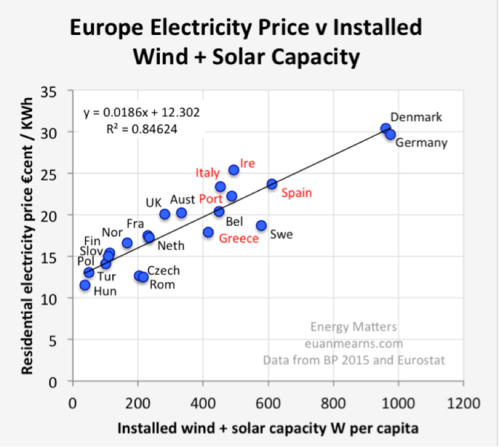
Joseph D’Aleo shows that green energy is pricing the Europeans out of a number of markets and is wreaking real damage on their poorer citizens.

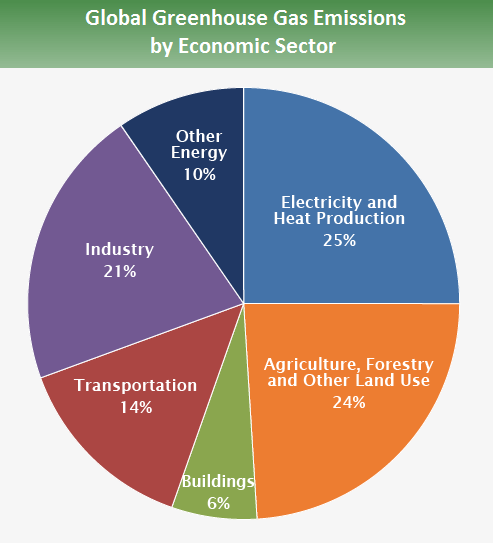
Two of the many  charts that  D”Aleo uses to make his case are as follows:


And the following chart equates the amount of installed wind and solar renewable energy with the cost of electricity:


Read D’Aleo’s full posting by clicking here:

cbdakota