Climate Change Impacts In The USA are Already (NOT) Happening


This posting’s title, “Climate Change Impacts In the USA Are Already (Not) Happening” is a direct lift of a Craig Loehle, Ph.D. essay that was posted on the WattsUpWithThat website.   Loehle says that the US Government reports by such groups as “NASA, NOAA, EPA, USFWS, USFS, USDA and other agencies mention that climate change impacts are already observable in the USA.” Loehle adds: “This is discussed in the context of endangered species conservation, forest resource assessment, future water availability, disaster planning, agriculture policy, etc. I have read many of these reports, which often refer back to the IPCC or the US Global Change Research Program. But they are usually vague on details of what bad things are expected to happen, generally referring to increases in extreme events. Nevertheless, these vague bad things are being used to guide policy.

The USA has some of the best data and is a large country. Are bad effects of climate change really visible already? In what follows, I address the evidence often put forward to support these claims and compare these to the literature. The true story is far from alarming.”

Loehle discusses what the facts support about these observable climate impacts versus the vague bad things that the Government is spinning. The main topics he weighs in on are:

  • Ocean Acidification
  • Sea Level Rise
  • Temperature Increases
  • Floods
  • Regional Drought Frequency
  • Extreme Storm Events
  • Hurricanes
  • Fires
  • Algal Blooms
  • Changes in Ecosystems

That is a comprehensive list.  He includes references for your examination.  Click here to see the complete essay.

Loehle concludes saying: “Within the United States, the claim that bad climate effects can “already” be detected is a totally subjective and unsupported hypothetical.”

Read Loehle discussion of each of these topics.  Then spread the word.  You have to do it via the Internet and/or conversations with family, co-workers, and friends.   We cannot depend on the media as they just regurgitate whatever the alarmist say.  Partly because the media loves doom, gloom and blood to try to catch their reader’s interest.

cbdakota
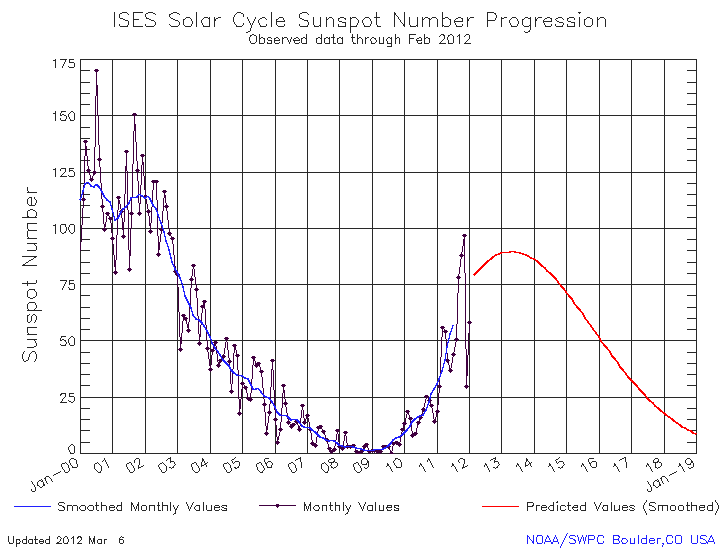
Cycle 24—February Update


Cycle 24 activity took another drop in February.  The Sunspot number for February was about 30 versus the 60+ in January. (Click on Charts to expand.)

That’s a major drop in the sunspot number.  Cycle 24 certainly looks like it will be the least active cycle in the last hundred years.

Dr Hathaway of NASA has again revised his forecast of Cycle 24 Sunspots.  He now says that  the Cycle 24 sunspot number will peak (maximum) at 59. Below is his March 2012 sunspot number forecast:


F10.7 cm radio flux is down as well.  First shown on the NOAA chart followed by Dr Hathaways revised chart:

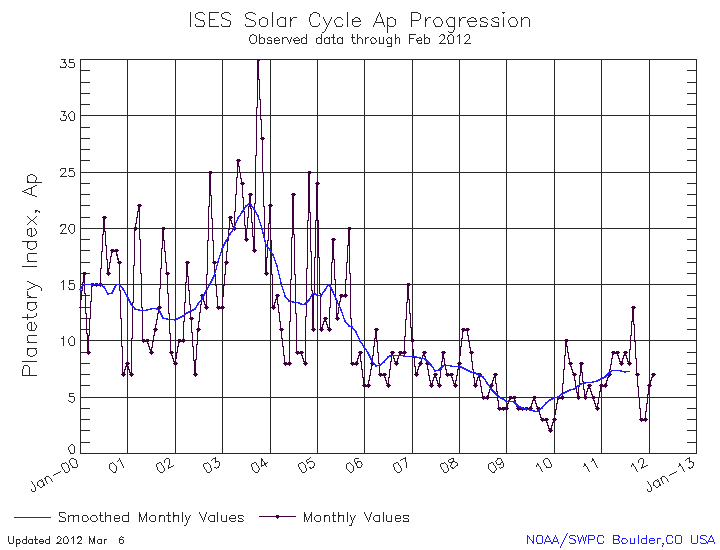
And the magnetic activity as indicated by the Ap index remains low:

cbdakota

GM Shuts Down The Volt Line. Temporary Layoff For 1300 Employees.


GM will lay off  some 1300 employees that make Volts for 5 weeks. General Motors sold 1023 Chevrolet Volts this past February , but made  2,347 Volts.

Where is GE, a company that has promised to by a boatload of Volts?

See this link for more on the story.

cbdakota

Global Temperature Update—February 2012


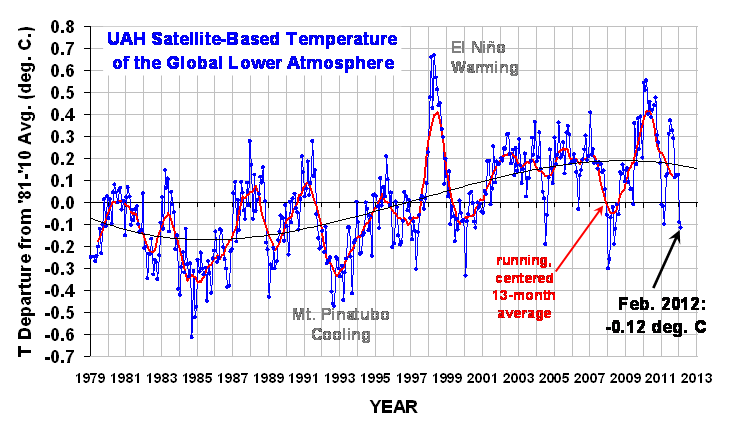
The UAH satellite global temperatures have been posted by Dr Roy Spencer on his website.  The February temperature anomaly is -0.12 C.   That is just slightly down from the January number of -0.09C.

Above is Dr Spencer’s chart (click on it to enlarge) of the global temperature anomalies since the start of the satellite temperature-measuring program in the late seventies.  The average global temperature departure is about 0.16C warmer that the average temperature for the period 1981-2010.  Dr Spencer might not approve of this calculation but 0.16 C over that 30-year period might indicate a warming of about 0.6C per century.  Further, if solar Cycle 24 and the next Cycle 25 perform as many are now forecasting, we may see the anomaly go negative for many years.

cbdakota

Lubos Motl’s 104 Reasons To Be A Skeptic


Lubos Motl’s skeptical website, The Reference Frame, is widely read and cited.  Motl counters John Cook’s assertions about man-made global warming.  Motl provides background science that will serve skeptics in any discussion and/or debate.  Motl introduces his material as follows:

John Cook, a former student of physics in Australia, has constructed an interesting website trying to attack the opinions of climate skeptics.

It’s been in my climate bookmarks for quite some time but no one really cared about it so I didn’t want to respond. However, his talking counter-points were recently adopted by an iPhone application. Moreover, Andrew Revkin promoted the website, too. So let us look at his points and counter-points.

Motl matches the headings from Cook’s listing of “myths” and Motl adds his view illustrating what the real story is. Below are two of the 104 topics so you can get a flavor of what is included. To read to all of Motl’s work click here.

On his (Cook) website, you can currently see 102 observations by the skeptics (or some skeptics); 2 of them were added by March 29th and I can’t constantly update this web page so that he’s likely to surpass his 104 points sometime in the future. Each of the “slogans” is accompanied by a short attempted rebuttal by John Cook. And if you click it, you get to a long rebuttal. So let’s look at them:

1. It’s the sun: I agree with Richard Lindzen that it’s silly to try to find “one reason behind all climate change”, because the climate is pretty complex and clearly has lots of drivers, and this applies to the opinion that “everything is in the Sun”, too. Cook shows that the solar irradiance is too small and largely uncorrelated to the observed changes of temperatures. I agree with that: a typical 0.1% change of the output is enough for a 0.025% change of the temperature in Kelvins which is less than 0.1 °C and unlikely to matter much. But I find it embarrassing for a student of solar physics such as himself to be so narrow-minded. The Sun influences the Earth’s atmosphere not only directly by the output but also indirectly, by its magnetic field and its impact on the cosmic rays (via solar wind etc.) and other things. He has completely ignored all these things. Of course, I am actually not certain that these effects are very important for the climate but the evidence – including peer-reviewed articles – is as diverse as the evidence supporting CO2 as an important driver.

104. Southern sea ice is increasing: Cook agrees but says that it surely has nothing to do with warming or global climate change. It must be due to “complex phenomena” such as changes of the winds and circulation. Note that such comments would be unthinkable if he tried to discuss the Northern sea ice. As we have noticed, all “warming” observations are about the climate, important signals that you should appreciate, worship, extrapolate, and be afraid of. On the other hand, all “cooling” observations are just an irrelevant weather that you should dismiss, humiliate, and spit on. With such a biased attitude, it shouldn’t be shocking that Mr Cook ends up with an irrational orthodoxy based on 104 largely obscure misinterpretations, misunderstandings, and myths – and that his opinions about the most important questions are upside down.

Go through all of them, you will might learn something that you didn’t know.

cbdakota

Volt and Leaf February sales


The February sales numbers for Volt and Leaf are in.   Volt numbers were 1023 which bettered January sales of 603.    Leaf numbers were 478 which trailed January sales of 679.   Y-T-D  sales for Volt are 1,626 and Leaf 1,157.  Chevy’s 4 cylinder ICE sales were up 46 percent.  The Cruze, one of the GM 4cylinder line,  put up big numbers at 18,556 units in February.   The public is obviously moving to more fuel-efficient vehicles with gasoline prices skyrocketing.   But their choice continues to be the more affordable ICEs than the all-electrics or hybrids.

cbdakota

Germany Surrenders on Solar Power


The title of this blog is a direct lift from an American Thinker posting of the same name.   Bjorn Lomborg, the Skeptical Environmentalist reports that Germany once was proud to call themselves “photovoltaic world champion”.  But nation has found the solar-power subsidies are expensive and inefficient.  Accordingly Lomborg:’ Using solar, Germany is paying about $1,000 per ton of CO2 reduced. The current CO2price in Europe is $8. Germany could have cut 131 times as much CO2 for the same price. Instead, the Germans are wasting more than 99 cents of every euro that they plow into solar panels.”

The Germans are phasing out these subsidies over a 5 year period.

In the US, we need to get serious about stopping the handouts to the Friends of Obama too.

cbdakota

Fisker Appoints New CEO- Can He Save This Company?


Fisker has appointed Tom LaSorda CEO replacing Henrik Fisker.  Fisker, founder and co-owner of Fisker Motors, will assume the role of executive chairman.  LaSorda’s skill is said to be manufacturing.

The first model from Fisker is the Karma.  A terrific looking automobile but beauty may only be skin deep as the vehicle interior is rated a sub-compact by the EPA.  The Karma’s range is 32 miles on the battery.  It is a hybrid so the gasoline driven generator comes on when the battery is exhausted, at which point the EPA rating becomes 20 mpg.

According to a Bloomberg posting, Jeremy Anwyl, vice chairman of Edmunds.com, an automotive data and pricing company had this to say about the Karma: “The odds are stacked against Fisker.  The car may be an interesting toy for people who have $100,000 to spend on such a thing, but Fisker will run out of those people quickly, and how tolerant of glitches will those people be?”  He probably was referring to the recent recall to fix the battery cooling system.

The current issue for Fisker is the DOE $529 million in loans granted to Fisker in June 2009.   The first part, $169 million was for engineering of the Karma and the second part of$360 million for the development of the NINA, a mid-sized hybrid to built in the old GM plant in Wilmington, DE.  Fisker, according to Bloomberg, has used $193 million of the loans.  But Fisker stopped work at the old GM plant when the DOE blocked further access to the loan saying that Fisker had not met the required milestones.

The battery supplier for Fisker is A123.   It has had to lay off workers due to the Fisker delays.  A123 is also an investor in Fisker.  A share of A123 stock closed on the 28 Feb at $1.91.  The 52-week range is $1.51 to $9.60.  Earnings per share are   $-1.88.

A posting late last year by Discovery asked: IS FISKER A ‘GREEN CAR’ SOLYNDRA SCANDAl? The author, John Voelker, GreenCarReports.com said:   “We’d like to see three specific questions answered.

— Since Fisker backers have contributed to Democratic party causes, is there any hard evidence of improper influence over the DoE loan process by the White House?

— How did Fisker come to select a closed assembly plant located in Vice President Joe Biden’s home state, since Delaware is no longer an obvious place to build cars?

— What steps does the DoE take to monitor compliance with the loan terms–and why won’t it release the revised terms of the Fisker loans?”

Good questions.

cbdakota

Reliable Solar Cycle Forecasting Requirements


Dr David Hathaway is NASA’s solar cycle guru.  In 2010, he published in Solar Physics a review of the methods used to forecast solar cycle activity.   The review, titled TheSolar Cycle” is worth reading.  He discusses many of the techniques currently in use that purport to be the method for solar cycle forecasting. 

This post will only look at the key features that Hathaway says must be explained by any viable theory or model in order to provide a reliable forecast. 

The Abstract for “The Solar Cycle”  follows:

The Solar Cycle is reviewed. The 11-year cycle of solar activity is characterized by the rise and fall in the numbers and surface area of sunspots. We examine a number of other solar activity indicators including the 10.7 cm radio flux, the total solar irradiance, the magnetic field, flares and coronal mass ejections, geomagnetic activity, galactic cosmic ray fluxes, and radioisotopes in tree rings and ice cores that vary in association with the sunspots. We examine the characteristics of individual solar cycles including their maxima and minima, cycle periods and amplitudes, cycle shape, and the nature of active latitudes, hemispheres, and longitudes. We examine long-term variability including the Maunder Minimum, the Gleissberg Cycle, and the Gnevyshev–Ohl Rule. Short-term variability includes the 154-day periodicity, quasi-biennial variations, and double peaked maxima. We conclude with an examination of prediction techniques for the solar cycle.

Hathaway lists the critical features for making an accurate forecast:  

Understanding the solar cycle remains as one of the biggest problems in solar physics. It is also one of the oldest. Several key features of the solar cycle have been reviewed here and must be explained by any viable theory or model.  (I am adding several charts to aid in visualize his thinking.)

  • The solar cycle has a period of about 11 years but varies in length with a standard deviation of about 14 months.
  • Each cycle appears as an outburst of activity that overlaps with both the preceding and following cycles by about 18 months.
  • Solar cycles are asymmetric with respect to their maxima – the rise to maximum is shorter than the decline to minimum and the rise time is shorter for larger amplitude cycles.
  • Big cycles usually start early and leave behind a short preceding cycle and a high minimum of activity.
  • The activity bands widen during the rise to maximum and narrow during the decline to minimum.
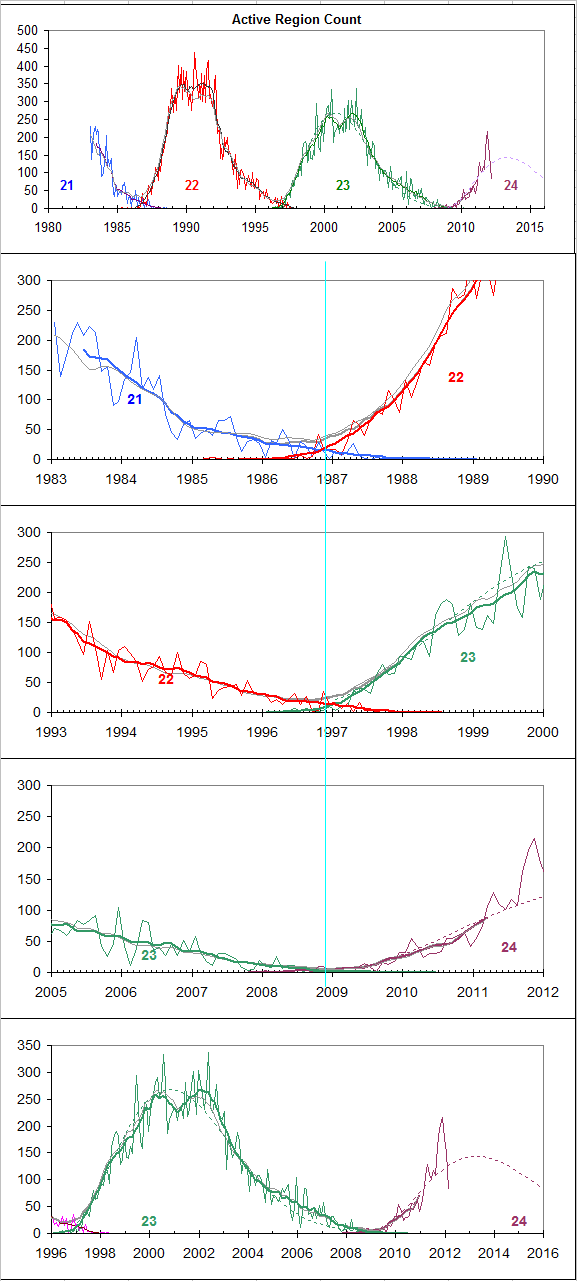
These  sunspot charts show the last stages of cycle 21, cycles 23 and 23 fully and the current status of cycle 24.  The overlapping between the end of one cycle and the start of the other is apparent.   The relatively steep rise in the sunspot count at the begining of a new cycle and the more gradual decent.  Cycle 24’s rise is not nearly as steep as its predecessors.  Charts by Leif Svalgaard.
  • Sunspots erupt in low latitude bands on either side of the equator and these bands drift toward the equator as each cycle progresses.
  • At any time one hemisphere may dominate over the other but the northern and southern hemispheres never get completely out of phase.
  • Sunspots erupt in groups extended in longitude but more constrained in latitude with one magnetic polarity associated with the leading (in the direction of rotation) spots and the opposite polarity associated with the following spots.
  • The leading spots in a group are positioned slightly equatorward of the following spots and this tilt increases with latitude.

Butterfly Diagram: All the sunspots in a give cycle are plotted on the charts above. The initial sunspots appear at about 30° North and South lattitude. As new spots appear they tend to get closer to the equator. Each solar cycle ends, nominally, when the spots reach the equator. Charts by Solar Physics Group @ NASA

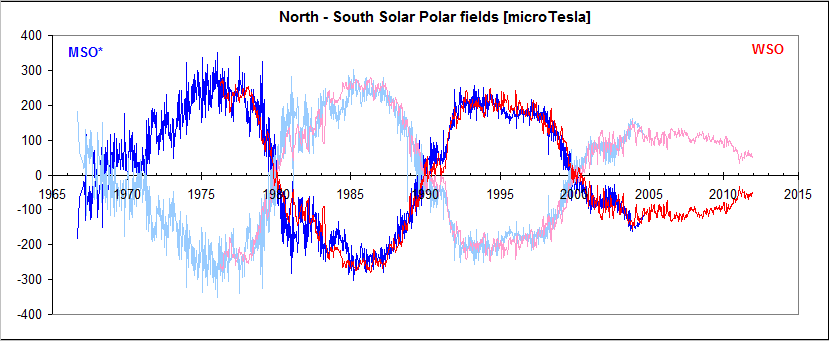
  • The polar fields reverse polarity during each cycle at about the time of cycle maximum.

Solar Magnetic Fields: This chart shows the North and South magnetic fields reversing at the end of a solar cycle. Note how weak the magnetic fields are for the start of the current cycle 24. Chart by Leif Svalgaard.

  • Cycle amplitudes exhibit weak quasi-periodicities like the 7 to 8-cycle Gleissberg Cycle.

The Gleissberg Cycle is a period of about 80 to 90 years that overlays the well established 11 year cycle.  The theory is that solar maxima and solar minima are forced by the gravitational pull of the major planets.  The specific alignment, particularily Jupiter and also Saturn Neptune and Uranus have a major effect on the Sun’s activity.  To see graphics of the alignment of these major planets, click here.

  • Cycle amplitudes exhibit extended periods of inactivity like the Maunder Minimum.
  • Solar activity exhibits quasi-periodicities at time scales shorter than 11 years.
  • Predicting the level of solar activity for the remainder of a cycle is reliable 2 – 3 years after cycle minimum.

Hathaway tells us that theory must be able to predict the preceding.  Until then,  people will continue to predict the features of the next solar cycle but it may be just luck if they get it right.

cbdakota

Dr Evans Explains Why Climate Models Overstate Potential Global Warming


Last September, I posted:  Dr Evans:”Climate Models Are Violently At Odds With Reality”.   This posting is a Dr Evans up-date of the September information.  This time he adds a simple explanation of the central issue regarding CO2 caused global warming—will feedbacks from a doubling of atmospheric CO2 be positive or negative?  The Warmers claim that a 1C increase due to doubling of atmospheric CO2 will really become a 3.3C  increase because of positive feedback.  We skeptics believe that the feedback will be negative and the warming will probably be in the range of 0.6C.

For those of you more inquisitive types, Dr Evans in his footnotes, gives more information and references to help you do some research of your own.

Click here to read Dr Evans full posting

cbdakota