Is there a question about Solar Cycle activity and the climate?


We can see that Solar Cycle (SC) activity is pretty closely reflected in Global Temperature.  Look at the chart below. The Y axis indicates the number of sunspots. Sunspots are a proxy for solar activity. The more spots the more active the SC is. The blue peaks shown on the chart are representative of the 25 SCs that have been well charted over the years. Charting began when Galileo looked at the Sun through his telescope on 1610. Sunspots were observed and counted. But scientific counting was instituted about 1755.
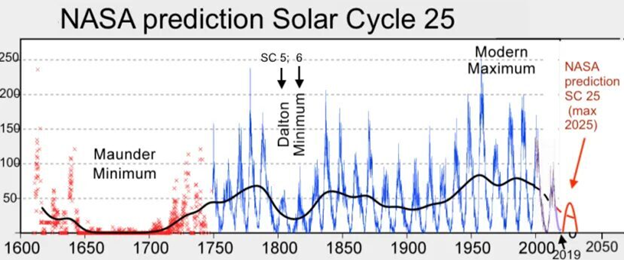
Here is what the NASA Earth Observatory had to say about SCs and global temperature:

 “From 1650 to 1710, temperatures across much of the Northern Hemisphere plunged when the Sun entered a quiet phase now called the Maunder Minimum. During this period, very few sunspots appeared on the surface of the Sun, and the overall brightness of the Sun decreased slightly. Already in the midst of a colder-than-average period called the Little Ice Age, Europe and North America went into a deep freeze: alpine glaciers extended over valley farmland; sea ice crept south from the Arctic; and the famous canals in the Netherlands froze regularly—an event that is rare today:”

The Dalton Minimum is also shown on this chart. Some solar scientists believe that the period containing the Maunder and Dalton Minimums continued on until the 1940s and they call it the “little ice age. Solar activity was waning. Temperatures followed.

Then came the Modern Maximum. Global temperatures began rising from roughly 1940-1950s until 2000.                                                                                                                                  

The path from cooling to warming is shown on this NOAA chart below. The warming is closely related to the Modern Maximum.  
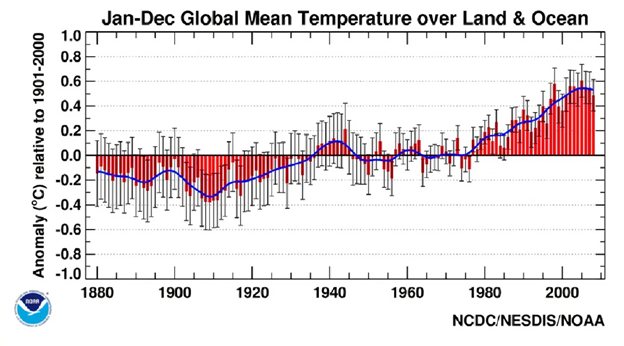
Then for a period of about 20 years, the global temperatures plateaued. The two very powerful El Ninos occurred, one right after another. That is shown on the chart below.

Carbon Dioxide was still rising during this period of hardly any growth in the global temperature. The solar cycles were becoming less active.

What is to say about El Ninos? This is what Wikipedia says:

It is believed that El Niño has occurred for thousands of years.[11] For example, it is thought that El Niño affected the Moche in modern-day Peru. Scientists have also found chemical signatures of warmer sea surface temperatures and increased rainfall caused by El Niño in coral specimens that are around 13,000 years old.[12] Around 1525, when Francisco Pizarro made landfall in Peru, he noted rainfall in the deserts, the first written record of the impacts of El Niño.[12] Modern day research and reanalysis techniques have managed to find at least 26 El Niño events since 1900, with the 1982–831997–98 and 2014–16 events among the strongest on record.[13][14][15]

I have highlighted two sentences in bold.

First, El Ninos have been going on for thousands of years before the industrial use of fossil fuels. They are natural occurrences.

Second, the strongest El Ninos on record have occurred during and following the Modern Maximum.

I have been warned that correlation does not necessarily mean causation. But it does not mean that correlation can’t mean causation

I have quoted NASA saying that the Maunder minimum was caused by exceptionally low solar activity.  NASA’s chart expects SC 25 activity to drop.

Examination of the charts seem to correlate SC activity to global temperatures. Rising when the Modern Maximum occurs and falling when low activity SC occur.

The plateau in the early part of this century suggests that Solar activity is more likely to be controlling the global temperature than is CO2. The fact that El Ninos are natural rather that caused by CO2 accumulation is important information. Further, the most powerful El Ninos have come at a time of very active SCs.

Different theories are being proposed as to why global temperature fall when SC activity is low. Cosmic rays, change in solar UV emission, solar irradiance variation etc. While the warmers are quick to tell you that the irradiance only changes about 0.15% so that it has no effect. When you learn that accurate measurement of irradiance was first accomplished in 1979 you realize that is a small sample.

I am certain that someone will precisely show that the peaks and valleys do not exactly coincide with my assertions. But they are close enough to tell the story. And NASA seems to be on board. We do not know a lot about the sun. Lags and leads may result from the activity changes of the sun. The oceans are a key factor. They make their effects in slow motion.

This blog’s charter is that solar activity is what controls global temperatures, and I am sticking to it.

cbdakota  

For your information, I have a Wikipedia chart detailing SCs for you, below.

Solar CycleStart (Minimum)Smoothed minimum ISN (start of cycle)MaximumSmoothed maximum ISNAverage spots per dayTime of Rise (years)Duration (years)Spotless days[10][11]
Solar cycle 11755-0214.01761-061446.311.3
Solar cycle 21766-0618.61769-091933.39.0
Solar cycle 31775-0612.01778-052642.99.3
Solar cycle 41784-0915.91788-022353.413.6
Solar cycle 51798-045.31805-02826.812.3
Solar cycle 61810-080.01816-05815.812.8
Solar cycle 71823-050.21829-111196.510.5
Solar cycle 81833-1112.21837-032453.39.7
Solar cycle 91843-0717.61848-022204.612.4
Solar cycle 101855-126.01860-02186924.211.3561
Solar cycle 111867-039.91870-08234893.411.8942
Solar cycle 121878-123.71883-12124575.011.3872
Solar cycle 131890-038.31894-01147653.811.8782
Solar cycle 141902-014.51906-02107544.111.51007
Solar cycle 151913-072.51917-08176734.110.1640
Solar cycle 161923-089.41928-04130684.710.1514
Solar cycle 171933-095.81937-04199963.610.4384
Solar cycle 181944-0212.91947-052191093.310.2382
Solar cycle 191954-045.11958-032851293.910.5337
Solar cycle 201964-1014.31968-11157864.111.4285
Solar cycle 211976-0317.81979-122331113.810.5283
Solar cycle 221986-0913.51989-112141063.29.9257
Solar cycle 231996-0811.22001-11180825.312.3619
Solar cycle 242008-122.22014-04116495.311.0914
Solar cycle 252019-121.8Progressive: 25 (Apr 2021) [Same point last cycle: 21]267 (Nov 9, 2021) (Same point last cycle: 331)
Average9.0178.74.411.04

EU Is Said to Be Planning to Allow Financing of New Nuclear and Natural Gas Plants.


A posting by EURACTIV claims that they have obtained  a document  that  would allow financing nuclear power generating plants; and for the time being, natural gas  (NG) based plants.   New NG facilities would have some  restriction on CO2 emissions.  

It is being opposed by the Alarmists. The EURACTIV posting says: “

This proposal is a scientific disgrace that would deal a fatal blow to the taxonomy,” said Henry Eviston, spokesman on sustainable finance at WWF European Policy Office.

“It would severely damage the EU’s sustainable finance agenda and the EU Green Deal. It must be firmly rejected by the Commission and opposed by all member states,” he added in a statement.

However, it does look like this is going to be done.  The EURACTIV  posting adds:

“It comes in the wake of declarations by European Commission President Ursula von der Leyen, who said the EU executive would soon table proposals on gas and nuclear as part of the bloc’s green finance rulebook.

“We need more renewables. They are cheaper, carbon-free and homegrown,” von der Leyen wrote on Twitter after an EU summit meeting two weeks ago where leaders debated the bloc’s response to rising energy prices.

“We also need a stable source, nuclear, and during the transition, gas. This is why we will come forward with our taxonomy proposal,” she added.”

It is becoming more apparent to the Europeans that wind and solar are unreliable sources. This winter is forecast to be quite cold and the recent months have been less windy and sunlight reducing renewables power generation.  More coal and natural gas use has been required to keep the lights on.

cbdakota

The Hypocrites Arrive at COP 26 in Glasgow


The Dalily Mail covers the arrival of the participants to the COP 26.  The Mail leads with:

Hypocrite airways? Jeff Bezos’s £48m Gulf Stream leads parade of 400 private jets into COP26 including Prince Albert of Monaco, scores of royals and dozens of ‘green’ CEOs – as huge traffic jam forces empty planes to fly 30 miles to park

  • MailOnline watched as plane after plane of dignitaries landed in Glasgow and Edinburgh for COP26 meeting
  • Prince Albert of Monaco was among those choosing to fly private – according to an analysis of flight records
  • Bank of America, which in PR documents boasts of its ‘commitment to sustainability’, owned one of the jets 
  • Prince Charles is among those travelling by non-commercial plane from G20 in Rome, MailOnline can reveal””

Follows with:

“President Joe Biden will generate an estimated 2.2 million pounds of carbon during his trip to Europe to speak on the perils of climate change.  

The gigantic carbon footprint is comprised of 2.16 million pounds of carbon dioxide generated by the four large planes that comprise his airborne entourage on the trip to Italy and Scotland, where the president will speak at the COP26 summit on change in Glasgow, with the remainder emitted by Biden’s cars. 

His fleet is comprised of the heavily modified Boeing 747 he travels on, known as Air Force One when the president is on board, an identical decoy, and two huge C-17 Globemaster planes to carry his battalion of cars and helicopters.

Those jets each belch out an average of 54 pounds of carbon per mile flown. An average American would generate 0.365 pounds of carbon for if they flew a similar distance – just under 10,000 miles – on a regular scheduled flight.” 

It is said that the Biden’s Party is some 800 people. 

The Mail covers Boris Johnson’s greetings to the participants.  He compares the COP with James Bond out to save the world.  And he uses “facts” that are made-up hysterical rantings of the Alarmists and the Great Reset People who have stated that their objective is to kill capitalism.

The coverage is extensive. Full of photos and sideline stories about the $2 million Bill Gates Birthday party given to him by Jeff Bezos. 

The link to the Daily Mail article is  here.

cbdakota

COP 26 Will Be Another Failure. Self-Inflicted At That


It is already clear, before Cop26 has begun, that the gap between climate ambition and action won’t be closed in Glasgow.”

That comment comes from the posting by Climate Home News a committed alarmist supporter. The posting continues:

“If countries meet their 2030 emission targets in full, global heating could be limited to 2.6-2.7C this century, according to the UN Emissions Gap report. Collective ambition needs to be seven times higher to align with the most ambitious 1.5C goal of the Paris Agreement.

So the UK Cop26 presidency is considering a proposal for the final Glasgow outcome to demand another round of updated nationally determined contributions (NDCs) by 2023.”

Pakistan’s climate minster voices the emerging economies resistance to the new round of nationally determined contributions, when he says:

“This talk of another round of [climate plans] will just feed into the hot air which is already plenty in the Cop process,” 

“The huge gap between what is already in the NDCs and what is actually being implemented needs to be plugged instead of another round of updating NDCs. Let’s talk climate action and not bureaucratic and endless updating of meaningless NDCs.”

What the emerging nations want is the money that the Paris Agreement committed the developed nations to supply. This is the response from those wealthy nations:

“On Monday wealthy nations announced that they won’t meet a long-overdue commitment to mobilise $100bn a year between 2020 and 2025 before 2023 –providing developing countries with no means or incentives to up their targets.”

And Indonesia echoes the other developing nations:

“But for Esther Tamara, a researcher at the Foreign Policy Community of Indonesia, the lack of finance for developing countries will be “a huge stumbling block” to agree to more climate efforts”

“Like Pakistan and Indonesia, India is a member of a group of “like-minded” developing countries that emphasises the historic responsibility of rich countries to cut emissions deeper and faster. In a statement last week, the group accused the Cop26 host of going “against climate justice” by calling on all to set mid century net zero targets.

The Alarmists are fully responsible for this squabble. For years now, it has been clear that the climate models used to predict the future global temperatures are rigged to give “alarmingly high” and erroneous temperatures. Their objective has been to scare the general population. Unfortunately, with the help of the mainstream media, they have been very successful.

Rational scientists, also including formerly alarmist know that the temperatures will not rise to those levels and if they do get to 2C it will probably be a non-event.

The alarmists are putting the developed nations in peril. These nations will be weakened by turning their industry and populations power sources to wind and solar, so-called renewables. These sources should be labeled “unreliables” rather than renewables. Politicians are up for this transition to wind and solar because they want political power. The money people–banks, investment firms, etc –see crony capitalism profits, at least for a while before our nation collapses. Examine the goals of The Great Reset to see what I am talking about.

China is cheering this fantasy. They pretend they are going to stop using fossil fuel, but don’t let them fool you. The Western nations collapse, and China achieves its plan of becoming Masters to the world.

The problems that have been created by the alarmists are way beyond most people’s imagination.

cbdakota

Videos of the Heartland Conference on Climate Change Held in Las Vegas


I attended “The Heartland 14th International Conference on Climate Change” held in Las Vegas on 15, 16 and 17 October 2021.  It is the third Heartland meeting on climate change I have attended.  And while the other two were excellent, this one was better.

I had been waiting for the videos of the sessions to be published before making comments. They are now available.

On Friday night, 15 October, the conference began.  The link that follows was a recording of the presentations that night.

The Frederick Seitz Memorial Award was presented to David Legates, Ph.D.  David, a friend of mine, has made enormous contributions to the science of climate change.  Some years ago, the new Governor of Delaware learned that David, a skeptic, was the State Climatologist, so she fired him.  Hardly anyone will remember the former Governor, but David has distinguished himself and he will be the Delawarean that people will remember.

His acceptance of the Seitz award and his speech begins at 15 minutes on the video.

Videos – Friday Opening Keynote, 10/15/21 – Heartland’s 14th International Conference on Climate Change. | Heartland Institute

This video contains two more presentations.  One by Anthony Watts regarding a teacher’s manual that provides our side of the theory.  Some 300,000 have been sent out to teachers.  His presentation begins at 49minutes of the video.

Following that at about 59 minutes on the video is a presentation by Justin Haskins “Climate and the Great Reset”.  THIS CONTAINS AN IMPORTANT MESSAGE.  Please listen.

You can find all the other sessions by working away from this link. 

I will have comments on some of the sessions in upcoming blogs.

cbdakota

HEARTLAND CONFERENCE ON CLIMATE CHANGE


I leave tomorrow for Las Vegas to participate in the Heartland Conference on Climate Change. This is my 3rd Heartland conference. They are really very good. Looking forward to seeing most of the big time skeptics.

cbdakota

Policy Maker Need Schooling In Science.


One of my sources of information comes from the Yahoo financial app. My conviction that most political figures do not understand science was justified by Janet Yellen by a posting in the blog.  Yellen, the former chairperson of the FED, now the Treasury Secretary said the following regarding the UK’s current power problem caused by over reliance on unreliable wind and solar energy sources:

“She added that “in the case of the UK, there’s a question of what to do if the sun isn’t out and the wind doesn’t blow, and I believe there is storage technologies that can be deployed and, you know, other means to address that, and of course that has to be part of a plan to switch to renewables and address climate change.”

First of all, it does not trouble her that wind and solar can just stop producing electricity.  Second, she believes there are “storage technologies”.  She obviously has no idea how big such storage technologies would have to be to resolve anything but a minute or less loss of power for the customers being served.  Nor the extreme costs for suitable storage. Here, Here and Here. Thirdly, she does not seem to know what those “….other means to address that..” are.   I wonder if the fact that on average the sun is only available for something less than 12 hours a day has ever occurred to her.

I would have thought, because of her financial education and occupation, she would have understood why the UK and the much of Europe are facing skyrocketing prices, but she fails this one too.

“I don’t believe that the president’s program is going to lead to increases in the cost of energy,” Yellen said, referring to the fuel shortage and high gas prices in the UK and Europe more broadly.” 

I truly believe that anyone in this Administration, including her addled leader, should be required to understand the science when they are making policy of this magnitude. Congress belongs in school too.

cbdakota 

Net Zero is a Pipe Dream


A posting  titled “Renewable Power Fuels Europe’s Energy Crisis: by the Las Vegas Review-Journal stated:

 “Europe is in the midst of a full-scale energy crisis. Unusually calm weather this year reduced wind power production in countries, including Germany and Denmark. SSE, an energy company in the United Kingdom, saw its renewable energy assets produce 32 percent less electricity than expected since April. Along with less wind, a dry summer reduced hydropower production.

The prices have skyrocketed:

“ In January 2019, the European price of a megawatt hour of electricity from natural gas was around 20 euros. That dropped to under 5 euros in May 2020 as the pandemic reduced demand. Today, it’s more than 70 euros.”

“Things are so bad that Britain recently increased output from coal plants to boost supply. But coal prices have soared, too — they have nearly quadrupled from a year ago.”

“In France, energy bills have gone up 57 percent since January

“The coming winter months threaten to make this worse. Shortages of gas, which is used for heat, can have deadly consequences.”

When are the public going to realize that wind and solar are unreliable and a nation will not survive if it banks everything on renewables?

 Lost in the discussion of Net Zero campaign, (the plan to cease use of fossil fuels) is that today many power sources are supplying energy. Natural gas, coal, oil, nuclear, and hydro are the backbone of a robust power supply system. Coal plants maintain a large supply of coal on their property. This supply can withstand transportation interruptions for example. Hydro usually has a large supply back up. Nuclear changes out about a ¼ or one-third of the fuel rods every 18 to 24 months so they should be able to withstand extended interruptions. Natural gas does not have a significant storage option, but the reliability of the supply pipelines is high. Solar and wind have no control over the sun or the wind; hence they cannot replace fossil fuels.

cbdakota

Part 2: The Fragile Electric Grid


See the source image

This is part two of Robert Bryce’s testimony to the House Select Committee on The Climate Crisis.

Our electric grid is fragile.  Robert Bryce writes that the Department of Energy’s Office of Cybersecurity, Energy Security and Emergence Response illustrates the declining reliability of our grid.  Bryce says:

“In 2002, there were 23 “major disturbances and unusual occurrences” on the domestic electric grid. Those outages were caused by things like ice storms, fires, vandalism, and severe weather. By 2016, the number of disturbances and unusual occurrences had increased six-fold to 141. In 2020, the number of events jumped to 383 – an increase of 270% in just four years.  Even more alarming: through the first two months of 2021, there have been 122 of these outages.”

Bryce says:

Electrifying everything is the opposite of anti-fragile.  Attempting to halt the use of liquid motor fuels and replace them with electricity will make our transportation system more vulnerable to disruptions caused by extreme weather, saboteurs, equipment failure, accidents, or human error. Electrifying our transportation system will reduce societal resilience because it will put all our energy eggs in one basket. Electrifying transportation will reduce fuel diversity and concentrate our energy risks on a single grid, the electric grid, which will make it an even-more-appealing target for terrorists or bad actors.

Furthermore, and perhaps most important, attempting to electrify transportation makes little sense given the ongoing fragilization of our electric grid. The closures of our nuclear plants is reducing the reliability and resilience of the electric grid and making it more reliant on gasfired power plants and weather-dependent renewables.”

While skeptics have known for years that the alarmist’s forecasts of doom are not likely to be realized, the alarmists oddly want to shut down all nuke plants. Nuke plants that do not emit their enemy carbon dioxide (CO2).  Bryce notes Congress inaction regarding this issue when he says:

“Instead, Congress is standing idly by as our nuclear plants – our most reliable, safest, and most power-dense form of electricity production – are being shuttered. Nuclear plants are, as writer Emmet Penney recently put it, our “industrial cathedrals.” If policymakers want to decarbonize our transportation system while enhancing the resilience of our society, the best option would be to have a grid that is heavily reliant on nuclear energy.”

Bryce discusses recent issues that demonstrate the gird’s declining reliability in his report.  They can be reviewed by clicking here.

See part two about supply chains and mineral needs.

Governmental Dictates To Force Shutdown Of Gasoline/Diesel Fuel Vehicles And Force Use Of Electric Vehicles (EV) Is Misguided.


 On June 30, 2021, Robert Bryce provided testimony before the House Select Committee on the “climate crisis”.   Bryce points out that our electrical grid has become fragile in recent years, largely because of the actions by our state and local governments. 

Forcing the grid to accept wind and solar energy, energy that is renewable but not reliable, is taking its toll.   Bryce summarizes his view of the current policies as follows: 

Electrifying parts of our transportation system may result in incremental reductions in greenhouse gas emissions. But a look at history, as well as an analysis of the supply-chain issues involved in manufacturing EVs, the resource intensity of batteries, and the increasingly fragile state of our electric grid – which is being destabilized by bad policy at the state and national levels – shows that a headlong drive to convert our transportation systems to run on “green” electricity could cost taxpayers untold billions of dollars, increase greenhouse gas emissions, be bad for societal resilience, make the U.S. more dependent on commodity markets dominated by China, make us less able to respond to extreme weather events or attacks on our infrastructure, and impose regressive taxes on low and middle-income Americans in the form of higher electricity prices.”


Bryce’s testimony dealt with Affordability, Grid Fragility and Supply Chains.   This posting will only deal with Affordability.  The next posting will grapple with other two.  His testimony is some 14 pages long, all worth reading.  In the interest of your time however, I will attempt to abbreviate the testimony citing key points.

Affordability  

Bryce notes that while EV sales are increasing, they are only a fraction of the US vehicle population.    He says:

“But policymakers must be cautious. While that growth in EV sales is notable, EVs still account for less than 1% of the 276 million registered vehicles in the U.S. Of all the EVs on U.S. roads, about 42% of them are in California. By contrast, states like South Dakota, North Dakota, Montana, and Wyoming each have less than 1,000 registered EVs. Furthermore, in 2020, fewer than 300,000 EVs were sold in the U.S.  For comparison, Ford Motor Company sold nearly 800,000 F-series pickup trucks last year”.

Bryce notes that 42% of the EVs are in California making it the best place to sample the experiences and expectations.

“The history of EVs in California provides context for the rest of the country. In 1990, the California Air Resources Board passed a measure that required 10% of all auto sales in the state be zero-emission vehicles by 2003. But today, 31 years after California implemented the ZEV mandate, the state has nearly 15 million automobiles, and of that number, less than 900,000, or about 6%, have an electric plug. Over the past century, the history of the EV sector in California and the rest of the country can be summarized as lots of government push, but not enough consumer pull.”

Bryce examines current and future prices of EVs.  With respect to future prices, he turns to an expert:

“Policymakers must also be aware that future EV adoption rates depend heavily on the ability of automakers to continue cutting costs and improving the utility of EVs. Earlier this month, Jeremy Michalek of the Vehicle Electrification Group at Carnegie Mellon University, questioned the ability of the industry to continue slashing costs. In an article titled, “I’m an EV expert, and I’m skeptical about how quickly electric cars will go mainstream in the U.S.”

Michalek explained that: economies of scale drove early reductions in battery costs, but now they are all but exhausted, and we shouldn’t expect big factories or growing demand alone to make EV batteries much cheaper. Second, production process improvements have also driven cost reductions, but even a utopian production process can’t push battery prices below material costs. Third, prices can temporarily dip below costs when firms leverage subsidies, take temporary hits to establish a foothold in the market, or crosssubsidize to comply with regulation, but prices can’t stay below costs for long.

He concluded that we should, “remain skeptical about predictions of exactly how fast battery costs will drop and how quickly EVs will be adopted in the future.”  Michalek’s conclusion brings me to my first point: affordability.”

Bryce expands on EV affordability:

“In 2019, the National Bureau of Economic Research published a study that found the average household income of EV buyers was about $140,000. That’s twice the median household income in the U.S., which was nearly $69,000 in 2019. The average owner of a Tesla Model S has a household income of about $153,000”

“Wealthy EV buyers are being subsidized by low and middle-income consumers. In 2016, two academics at the University of California at Berkeley, Severin Borenstein and Lucas W. Davis published a paper that concluded the majority of the money being collected under federal programs aimed at promoting energy efficiency and alternative transportation was going to wealthy Americans. They found “the most extreme disparity is in the program aimed at electric vehicles, where we find that the top income quintile has received about 90% of all credits.” They continued saying that taxpayers who had adjusted gross incomes “in excess of $75,000 have received…about 90% of all credit dollars aimed at electric cars.”

Bryce used the June 9 report by the California Energy Commission (CEC) for the following comments:

“Low and middle-income ratepayers will also be forced to pay for the generation capacity and grid upgrades needed to accommodate electrification of transportation. The same CEC report found that by 2030, “electricity consumption from passenger EV charging could reach about 5,500 megawatts (MW) around midnight and 4,600 MW around 10 a.m. on a typical weekday, increasing electricity demand by up to 20–25 percent at those times.” To put that 5,000 MW or so of new generation capacity in perspective, it is roughly equal to the rated output of all of California’s existing geothermal and nuclear plants, combined. It must be noted here that the state is slated to close its last remaining nuclear plant, the Diablo Canyon Power Plant, by 2025. “The California grid will have difficulty providing electricity from midnight until the early morning hours because it is heavily dependent on solar energy to meet demand. Thus, it is highly likely that to meet the power demand needed to charge EVs, the state will have to deploy more natural gas-fired capacity. The timing of EV charging will have a big effect on greenhouse gas emissions. If the state has to rely on gas-fired generators to charge EVs at night, the climate benefits of widespread EV adoption may be negated.”

Bryce notes this about California energy prices:

In 2020, California’s electricity prices jumped by 7.5%, making it the biggest price increase of any state in the country last year and nearly seven times the increase that was seen in the United States as a whole. According to data from the Energy Information Administration, the all-sector price of electricity in California last year increased to 18.15 cents per kilowatt-hour, which means that Californians are now paying about 70% more for their electricity than the U.S. average all-sector rate of 10.66 cents per kWh.

Bryce paints a realistic picture of the future if we continue down the path set out by the Biden Administration and progressive States.  The lower- and middle-income families will be paying regressive taxes in the form of higher electricity prices. if we do not resist going down the progressives’ path that might be the least of our problems.

cbdakota