Category Archives: Sunspots

A Difference Of Opinions on Entering A Mauder Minimum


Forbes.com posting “Sun Flatlining Into Grand Minimum, Says Solar Physicist on JANUARY 20, 2014. Yes, the posting is nearly two years old. But the snowdriftsimagesdiscordance about the Sun’s influence in the Earth’s climate could not be more evident in the posting.

From the posting:

“My opinion is that we are heading into a Maunder Minimum,” said Mark Giampapa, a solar physicist at the National Solar Observatory (NSO) in Tucson, Arizona. “I’m seeing a continuation in the decline of the sunspots’ mean magnetic field strengths and a weakening of the polar magnetic fields and subsurface flows.”

Continue reading

Little Ice Age By 2030?


Professor Valentian Zharkova of Northumbria University presented her results Cold-Weather-Cartoonfor a new model of the Sun’s interior dynamo to the Royal Astronomical Society. Zharkova and her team believe they have made a discovery that allows them to predict solar activity. From the Royal Astronomical Society’s National Astronomy Meeting 2015 – report 4” posting:

“We found magnetic wave components appearing in pairs; originating in two different layers in the Sun’s interior. They both have a frequency of approximately 11 years, although this frequency is slightly different [for both] and they are offset in time,” says Zharkova. The two magnetic waves either reinforce one another to produce high activity or cancel out to create lull periods.

The model predicts that the magnetic wave pairs will become increasingly offset during Cycle 25, which peaks in 2022. Then during Cycle 26, which covers the decade from 2030-2040, the two waves will become exactly out of synch, cancelling one another out. This will cause a significant reduction in solar activity. “In cycle 26, the two waves exactly mirror each other, peaking at the same time but in opposite hemispheres of the Sun. We predict that this will lead to the properties of a ‘Maunder minimum’,” says Zharkova”

Continue reading

New Solar Cycle Charts Now Reflect The Revised Sunspot Counting System.


bigspotfd_thumbRevised Sunspot number as discussed in previous posting of July 2015 numbers can be seen below:new #solarterrestialjuly

Below is the Sunspot number posted before the numbering was changed to match the new criteria discussed in the “Sunspot Number History Change Is Underway“.

solarterrestrialjuly1-2015

The only thing different is the green line the “30 day Wolf Number. The new number is greater than the old one.

Quoting SILSO: “In the values themselves, the most prominent change will result from the elimination of the 0.6 factor formerly used by the Zürich Observatory to scale the modern numbers down to the scale of the initial Wolf observations. This factor has always led to some confusion and now has lost its sense more than 130 years after Wolf’s observations. This change will thus raise the scale of the entire sunspot number time series by a factor 1/O.6, which may significantly affect software using the sunspot number as input.”

cbdakota


Sunspot Number History Change Is Underway


For those readers of this blog that follow the monthly update of Solar Cycle 24, things are about to change. For the better I think, but until the final report is 400yrsofsunspotcyclesUnknownreleased, we wont know for sure. Sunspot Index and Long-term Solar Observations (SILSO) a part of the World Data Center has issued a Sunspot Bulletin that says:”

                                           Warning of Major Data Change

Over the past 4 years a community effort has been carried out to revise entirely the historical sunspot number series. A good overview of the analyses and identified corrections is provided in the recent review paper: Clette, F., Svalgaard, L., Vaquero, J.M., Cliver, E. W.,”Revisiting the Sunspot Number. A 400-Year Perspective on the Solar Cycle”, Space Science Reviews, Volume 186, Issue 1-4, pp. 35-103.

Now that the new data series has been finalized, we are about to replace the original version of our sunspot data by an entirely new data set on July 1st. On this occasion, we decided to simultaneously introduce changes in several conventions in the data themselves and also in the distributed data files.

Continue reading

Solar Cycle 24 May 15 Update–Belated


Updating Solar Cycle 24 May 2015 status indicates that despite an uptick in Sunspots, the trend is still moving away from the maximum to quieter times.

sunspotIDimages

The May International Sunspot number was 58.8 versus April’s number of 54.4. (Click on charts to enlarge.)

solar-cycle-sunspot-numbermay15NOAA

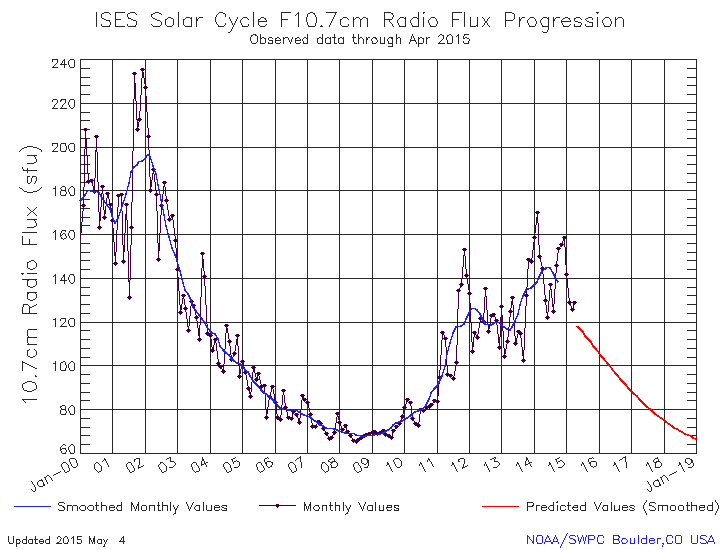
The F10.7cm solar flux number, perhaps the best indicator of solar activity, can be seen on this chart:

solar-cycle-10-cm-radio-fluxMAY15NOAAThe F10.7cm is comparable to the Sunspots chart in magnitude and direction.

The following chart shows data through the 14th of June.  Cycle 24 is still a long way from minimum (estimated to be in 2019 by NASA, although my guess is it will be at least a year more) and that can be seen by the NOAA Sunspot number that shot up about one week into the month of June.

solarterrestialchart14may15cbdakota

Skeptic Reference Sources–Part 1


There are several excellent sources for Skeptics. This posting provides a the sunsource for Solar Research Papers.   The amount of Sun based research may surprise you, because the Warmers continue to tell us that the Sun is not important.

Some of the research is readily available and some is behind paywalls. But I suspect that just looking at the available research will occupy you for some long time.   The source is Club du Soleil  Click here to see  this source.

There are several additional resources that I will post soon.

cbdakota

Solar Cycle 24 Activity Continues To Decline


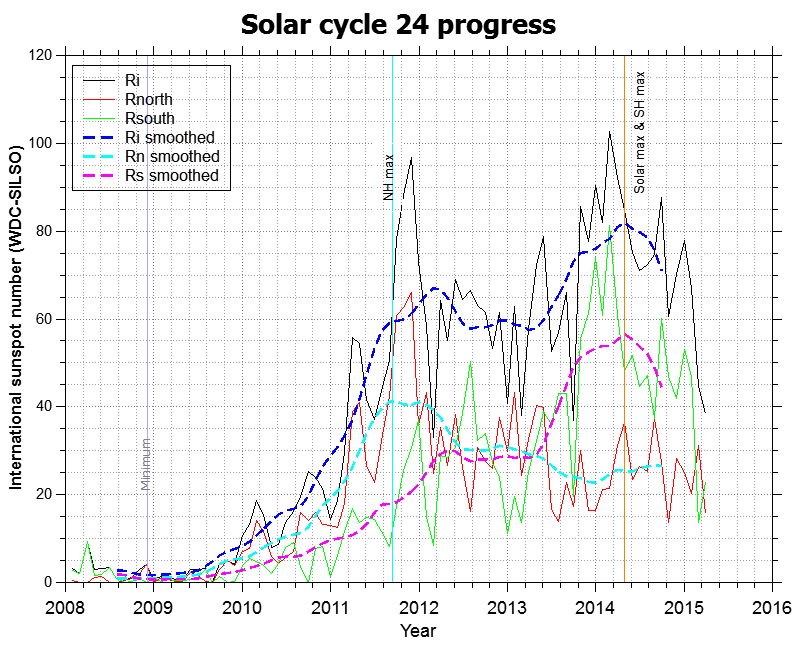
The April 2015 Solar Cycle 24 Sunspot number rose somewhat in April, but the forecast is for a continued decline in activity.   The 2015 monthly Sunspot counts were: January = 67.0, February=44.8, March=38.4 and April=54.4.   The daily Sunspot counts seesawed, but definitely with a downward trend, Ri(black).  This can be seen be examining Rsouth (green). While Rnorth has been reasonably quiet for a year or so, Rsouth has been the major contributor to the total number since late 2013.

Continue reading

Bosse And Vahrenholt: Solar Cycle 24 Observations


German scientist Frank Bosse and Fritz Vahrenholt, on 12 March,  bluesunUnknownprovided another way to look at Solar Cycle 24. It is worth sharing. They posted “The Sun In March 2015” on the Notrickszone.com website. They begin by saying:

“Last month our sun gave a really sluggish impression. The sunspot number (SSN) was only 38.4: only 46% of what is normal at this time into a cycle for all the cycles observed since 1750.

The following chart illustrates their assertion:

solarcycle24sspotsgermanmaerz1Fig. 1: The current solar cycle 24 compared to the mean of all previous cycles (blue) and to solar cycle no. 1, 1755-1766, (black).

solarcycle24ssanomalygerman Figure 2 Comparing the individual cycles to each other further confirms that the current cycle is a quiet one compared to those we saw in the second half of the last century.

(March was the 76th month since the start of Cycle 24. These numbers will change as the Cycle 24 progresses, but the low activity will likely to continue to result in under performing almost all of the previous Cycles. )

The posting discusses the Sun’s polar fields.  Click on the link above to see the entire posting.

{Vahrenholt is co-publiser of the highly regarded book “Die kalte Sonne: warum die Klimakatastrophe nicht stattfindet[6] (The Cold Sun: Why the Climate Crisis Isn’t Happening).}

cbdakota


Solar Cycle 24 And Solar Wind Storm


Solar Cycle 24 activity, using Sunspots as the proxy, is slowing down considerably. The International number for March was 38.4. The smoothed International Sunspot number is estimated at 56.1. The March number will not be official for another 6 months. The chart below, the black line, labeled Ri is the International number which is the sum of the Rnorth (red) and Rsouth (green) Sunspot numbers.

march15cycle24

Continue reading

Solar Cycle 24—Ending February At Low Activity


Solar Cycle 24 activity is relatively low as the month of February comes to a close. On February 27, only three visible Sunspot clusters could be seen. Solar Cycle 24 International Sunspot smoothed number for February 2015 looks like it will be about 65.

regions_feb27

Continue reading