Category Archives: Sun

Solar Cycle 24 Update-June 2013


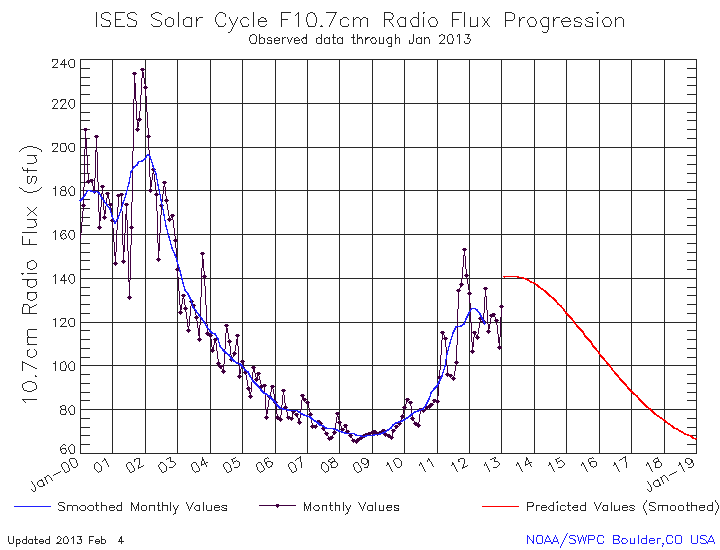
Solar Cycle 24 activity was low in June.  Sunspots took a sizable drop from about 77 in May to 52 in June.  Solar flux dropped as well.  (Click on charts to enhance clarity.)

sunspotjune13

solar24fluxjune13

The experts believe that Cycle 24 will match Cycle 14.  NASA is predicting Cycle 24 Sunspot peak at 67 whereas Cycle 14’s peak was 64.   Cycle 14 began February, 1902 and ended August, 1913.  Temperatures during that time were much colder than the average since that time.  My March 8, 2013 posting has some interesting statistics to make comparisons of Cycle 24 and other Solar Cycles.  There is a plot of temperature anomalies from 1880 to 2010 that you can compare to Solar Cycle size. You can access that data by clicking here.

cbdakota

SOLAR CYCLE 24 APRIL UPDATE// RUSSIAN TEAM SAYS COOLING MAY LAST FOR MORE THAN 200 YEARS.


There was an uptick in Sunspot numbers and F10.7cm radio flux.   Sunspots monthly average went up to 72  versus  55 in March.   Cycle 24’s  pattern seems somewhat reminiscent of Cycle 23 during its time at or near maximum. (Click on charts to enlarge.)
cycles23_24APRIL13Chart curtsey of Solen.com
Sunspots appear to be in sync with the predicted path shown as the green line in the chart.

International Nuclear Fusion Project Underway


The UK Independent reports that the Iter fusion project gained final approval “ for the design of the most technically challenging component – the fusion reactor’s “blanket” that will handle the super-heated nuclear fuel.”
The Iter project is designed to produce  at a rate of  500 megawatts of energy using an input of 50 megawatts  during a 1000 seconds run. The Iter fusion project is forecast to cost £ 13billion (US $20 billion) .  The project team is an international combine of 46 nations that are contributing  science and money.  The facility is based in Cadarache, France.
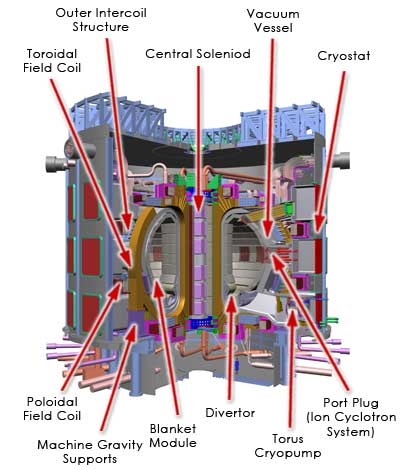
Below is a cut-away of the Iter reactor design and brief description of the elements of the reactor from Howstuffworks.com
fusion-reactor-5

Solar Cycle 24 March Update


There was a small upward spike in Sunspot numbers in March.   Dean Pesnell of NASA’s Goddard Space Flight Center thinks this will make Cycle 24 a double peak “maximum” event.  He says that the second peak may even last into 2014.
(Click on the Charts for more Clarity)
March13sunspots

Solar Cycle 24 Activity Compared To Previous Solar Cycles


Solar Cycle 24 activity dropped off in February.  Charts for sunspots and F10.7 cm radio flux follow:
sunspotmarch13

Solar Cycle 24 Update-January 2013


Solar Cycle 24 experienced a small uptick in the number of Sunspots and F 10.7cm solar flux in the month of January.  First the Sunspot chart:
solarcycle24sunspot4feb13
And the F 10.7cm solar flux chart:
solarcycle24f10.7cm4feb13

NASA Revises Cycle 24 Sunspot Prediction.


David Hathaway, NASA solar cycle expert, has a revised forecast for Solar Cycle 24 Sunspot number and Maximum timing.  In May 2012, he forecast the smoothed sunspot number maximum at 60 and the timing of the maximum as the spring of 2013.  His January 2013 Cycle 24  revised forecast is for 69 spots and maximum in the Fall of 2013.  He adds:
“ We are currently over four years into Cycle 24. The current predicted and observed size makes this the smallest sunspot cycle since Cycle 14 which had a maximum of 64.2 in February of 1906.”  
 jan13hathawayssn_predict
       Hathaway’s  NASA Revised January 2013 Sunspot Number Prediction

Two Mile Wide Comet Passing By Earth In 2013.


NASA confirms that a 2 mile wide comet, discovered by amateur Russian Astronomers,  is coming our way.  The comet is know as ISON.  According to NASA:
“Comet ISON appears on course to achieve sungrazer status as it passes within a solar diameter of Sun’s surface in late 2013 November. Whatever survives will then pass nearest the Earth in late 2013 December,” NASA astronomers explained in a posting. ‘Astronomers around the world will be tracking this large dirty snowball closely to better understand its nature and how it might evolve during the next 15 months’  “The comet, which is estimated to be nearly two miles wide, will likely be one of the largest comets to ever pass Earth. While there is a chance that ISON will disintegrate when it approaches the sun, some astronomers say heat from the sun will vaporize ices in its body, creating what could be a spectacular tail.”
To read more click here.
I think that a bright object in the sky at the end of December may remind some of      another bright object in the sky several thousand years ago.
Just saying.
cbdakota