Category Archives: solar cells

The Weakness of the Wind Turbine Operability is Exposed. Stop The Transition to Renewables


Backgound

Many believe that Germany is the leading, major nation regarding transitioning energy sources from thermal and nuclear to renewable. Germany’s major renewables are wind turbines, solar cells, hydro and biomass.  The thermal resources are lignite, hard coal and natural gas.  At the beginning of 2023, nuclear energy was a sources but it was abandoned on15 April after generating 7TWhs .  The electricity demand for the year 2023, was 457 TWh.  In 2023 the wind turbines produced 140 TWh and Solar produced 60 TWh of that supply.    The remaining 247 TWh were produced by natural gas, coal, lignite, hydro, and biomass energy sources. The wind turbines rated capacity is 613TWh and solar rated capacity is 707 TWh.  That adds up to 1320TWh rated capacity versus demand of 457 TWh.     Why weren’t wind and solar producing all the electricity?  Together their rated capacity is 3-fold more than the demand. It is alleged that electricity from these renewable is dirt cheap, so, they should be making the electricity.   But that is not the case. The German wind turbines had a rated capacity of 60 GWs that should provide 525 TWh per year, yet they  only made 140 TWh.  That makes the capacity factor only  22.8%. The thermal fuel electricity production was greater than the wind turbine production , with lignite, hard coal and natural gas producing 176TWh opposite the 140TWh that the turbines produced. That level of thermal production capacity allowed  the weather dependence  of the non-dispatchable wind turbines.   

The Source

The data for this posting are mostly from  this excellent  German  document :  “Fraunhofer Public Net Electricity Generation 2023 in Germany: Renewables Cover the Majority of the Electricity Consumption for the First Time”      https://www.ise.fraunhofer.de/en.html

I chose the year 2023  because a full year’s data is tabulated

Can wind turbines supply a grid without out back up?

The question is could renewables without thermal sources make a reliable 24/7 grid?  Looking at it from that perspective of capacity factor of 22.8% , one answer to that question would be at least 4 times the current numbers of  wind turbines would be needed to meet the 457 TWh  with some extra to cover peak demands.   Yet using average year data may not tell the score.  Lets look at monthly performance. This is needed as weather has seasons.   Wind is the main propellant  for these turbines and it is changeable.

Deeper dive into the question.

In 2023 the record maximum output from these 60GW wind turbines was 53 GW  for a short time. Simply stated is that these beasts only respond to weather.  Wind speed can be so fast that the turbines must be shutdown to protect them from serious damage. The wind speed can also be slow, all the way to calm.  .  

Examining how German wind turbines function, gives us some insight why it is doubtful that renewables  alone could supply a gird without thermal sources backup.  The Germans collect the energy being produced by the turbines and all the other resources every 15 minutes. This data collection allows an excellent opportunity to examine how things are operating, far surpassing yearly averages. For instance, the wind turbine production is not running steady  at the capacity factor of 22.3%, as you would inherently know. But it allows us a deeper understanding of the make-up of the 22.3% capacity factor. The Germans employ both onshore and offshore wind turbines.  Combining the two for each month will provide a monthly capacity factor versus the 2023 demand.    

Using an average GWh     457TWh/12 months=38.1TWh per month.

MONTH         TURBINES PRODUCTION   CAPACITY FACTOR(versus demand)

                                     TWh                                                           %

Jan                            17,039                                                         44.6

Feb                           11,832                                                         31.0

Mar                           13,901                                                         36.5

Apr                            9,967                                                           26.2

May                          8,147                                                           21.4

Jun                            5,895                                                            15.5

Jul                              9,537                                                            25.0

Aug                           6,877                                                            18.0

Sep                           6,627                                                            17.4

Oct                            14,240                                                         37.4

Nov                           17,240                                                         45.2

Dec                          19,080                                                         50.1

In this we see that weather conditions are not always favorable for maximizing  production with wind turbines.   December suggests that increasing the number of turbines would only require a little more that 2 times plus a  little more for peak demands.   But going solo (nothing but wind turbines), June would require 7 times the number of wind turbines would be needed to meet average demand. If the wind turbines were the only source of electricity , June sets the target for the number of wind turbines required.   The summer month’s weather was not favorable to maximizing wind turbine electricity production

The turbines need to be able to match demand and that means June.

Taking an even deeper dive.

Looking deeper,   the data proves that wind turbines alone are not feasible. The data shows the turbines can fail to even produce 1GW at times.  Just a sample is tabled as follows:

Date             ONSHORE GW   OFF SHORE GW    TOTAL GW

04/05                       0.334                        0.021                        0.355

04/05                       0.727                        0.238                        0.955

05/28                       0.675                        0.119                        0.794  

06/05                       0.893                        0.001                        0.894

06/15                       0.765                        0.049                        0.814

06/17                       0.647                        0.079                        0.726

06/17                       0.947                        0.040                        0.987

06/18                       0.371                        0.150                        0.521

06/18                       0.216                        0.074                        0.290

06/25                       0.444                        0.173                        0.617

07/19                       0.664                        0.167                        0.831

09/02                       0.364                        0.199                        0.563

09/09                       0.469                        0.261                        0.730

09/10                       0.166                        0.010                        0.176

09/14                       0.469                        0.523                        0.992

09/27                       0.667                        0.205                        0.875

These  less than 1.GW  performances  have to be considered a “complete collapse of power”. 

Why does it have a “complete collapse?”

When the speed of the wind dies it can cause a very sharp loss of production of electricity .

Penn State description of wind speed vs power follows: (revised to shorten the narrative.)

The power in the wind is given by the following equation:

Power (W) = 1/2 x ρ x A x v3

Thus, the power available to a wind turbine is based on the density of the air (usually about 1.2 kg/m3), the swept area of the turbine blades (picture a big circle being made by the spinning blades), and the velocity of the wind. Of these, clearly, the most variable input is wind speed. However, wind speed is also the most impactful variable because it is cubed, whereas the other inputs are not.

The following are calculations for power available in the wind at  different velocities for a Northwind 100C turbine.  The calculations will show what happens when you double the wind speed. Take a moment to think about how much available power will increase if you double the velocity:

  • The standard(link is external) density of air is 1.225 kg/m3
  • The turbine has a 24 m diameter, which means the radius is 12 m. Thus, the swept area of the turbine is: (pi)r2 = 3.14159(122) = 452.4 m2
  • We’ll start with a 6 m/s wind.
  • The power in the wind at 6 m/s is: 1/2 x ρ x A x v3 = 0.5 x 1.225 kg/m3 x 452.4 m2 x (6 m/s)3 = 59,851 W = 59.85 kW
  • At 12 m/s: 1/2 x ρ x A x v3 = 0.5 x 1.225 kg/m3 x 452.4 m2 x (12 m/s)3 = 478,808 W = 478.8 kW (8 times as large)
  • Returning to 6m/s, the power generated falls to 59.85kW.   

Wind is always changing.  It’s irregularity is demonstrated in the German data.  Sometimes the change is large and the turbine production of electricity goes low.  The data shows that the thermal sources have to act to manage the output to the gird. Remember, thermal sources produced more electricity than the wind turbines in 2023.

German solar data

The solar capacity factor is 8.5%.  Solar should not be brought into a discussion about keeping a grid operating. The solar cells do not run at night.  So they can’t back up the wind turbines.  Maybe, there will be a miracle battery that could be charged by solar cells.   If a capable and affordable  battery is ever available it might be used as backup. Only then solar can be brought into the discussion

If the only statement  of operability of wind turbines is the annual data point, power factor, it can be  misleading.  Thanks to the German 15 minute data, the weakness of the wind turbine operability is exposed.

In my next blog, two cases of complete loss of power in 2024, one it Canada and one in Australia  due to weather conditions.    And it will review the high cost of renewable energy.  

cbdakota

Data Centers and Artificial Intelligence-Stop Energy Transition Part 3


ENERGY

The United States of America is built on energy. Primarily produced by fossil fuels.  The transportation area, cars, trucks, airplane, ships, etc. are propelled by gasoline, jet fuel, diesel oil, bunker fuel, propane, etc., all fossil fuels.  Transportation is 90% reliant on fossil fuels. About 60% of the Electricity is produced by fossil fuels.  Quoting Denny Ervin:   “Economies and standards of living hinge on having an adequate, economic, and reliable energy source—attributes that are non-negotiable for an optimal energy infrastructure. Our current trajectory risks creating inadequate, unaffordable, and unreliable energy supplies, which would devastate the U.S. economy and standard of living”.

Mr. Ervin has hit the nail on the head

Electricity Generation

The US generated 4.18Trillion Kilowatt hours in 2023.  A trillion Kilowatt-hour are called Petawatt hour.  That means that it is 4.18 followed by 15 zeros.  Because billing is usually done in kilo watts hours-,  it would be 4.18 Tera kilowatt-hours or as it is expressed in the  graph, 4.18 trillion kilowatt hours.   These vast numbers are here to stay.    Primer: Kilo is a thousand; Mega is a million; Giga is a billion; Tera is trillion and Peta is a quadrillion.

The primary source was thermals (natural gas, coal  and petroleum) at 60%, Nuclear added 18.6 %.   The renewables came in at 21.4 %.   Within that renewables list is Wind and solar and they are the rising sources.  They came sourced at 14.1%   They are non-dispatchable, meaning that their generation is a  wild card function of the weather.

Artificial Intelligence Creates Demand For Electricity

Power generation in 2023 was slightly lower than the 2022 generation.  Why? Due to higher price of electricity and use of power saving devices like LED bulbs.  But the demand is forecasted to increase soon and require a lot of additional generating sources, and transmission lines to carry the increase.   This increase is attributed to data center growth.  There are an estimated 2700 data centers in the US.  Data centers are the backbone of the digital world.  They host the internet from not only the US but a big share of the World’s internet.  It is in data centers where the Clouds store data for businesses and websites are housed. A large new power demand is forecasted for the Artificial Intelligence (AI).   DataCenterDynamics says that data center power consumption in the US is set to reach 35GW by the end of the decade, almost double its 2022 level.

Goldman Sachs posted on 13 May 2024, “AI is showing ‘very positive’ signs of eventually boosting GDP and productivity”.   That feeling seems to be universal.  The posting says: “Some of the academic literature and economic studies that have looked at the increase in productivity that we’ve seen following AI adoption, in a few specific cases, supports our view that large productivity gains are possible. The average increase in productivity is about 25%. Case studies of companies that have adopted AI imply similarly large efficiency gains. And so, you know, there’s a lot of reasons to be optimistic. It will just take a little bit more time to see these productivity gains realized.”

That is an incredible gain.  The nation must do what it takes to accomplish that goal. 

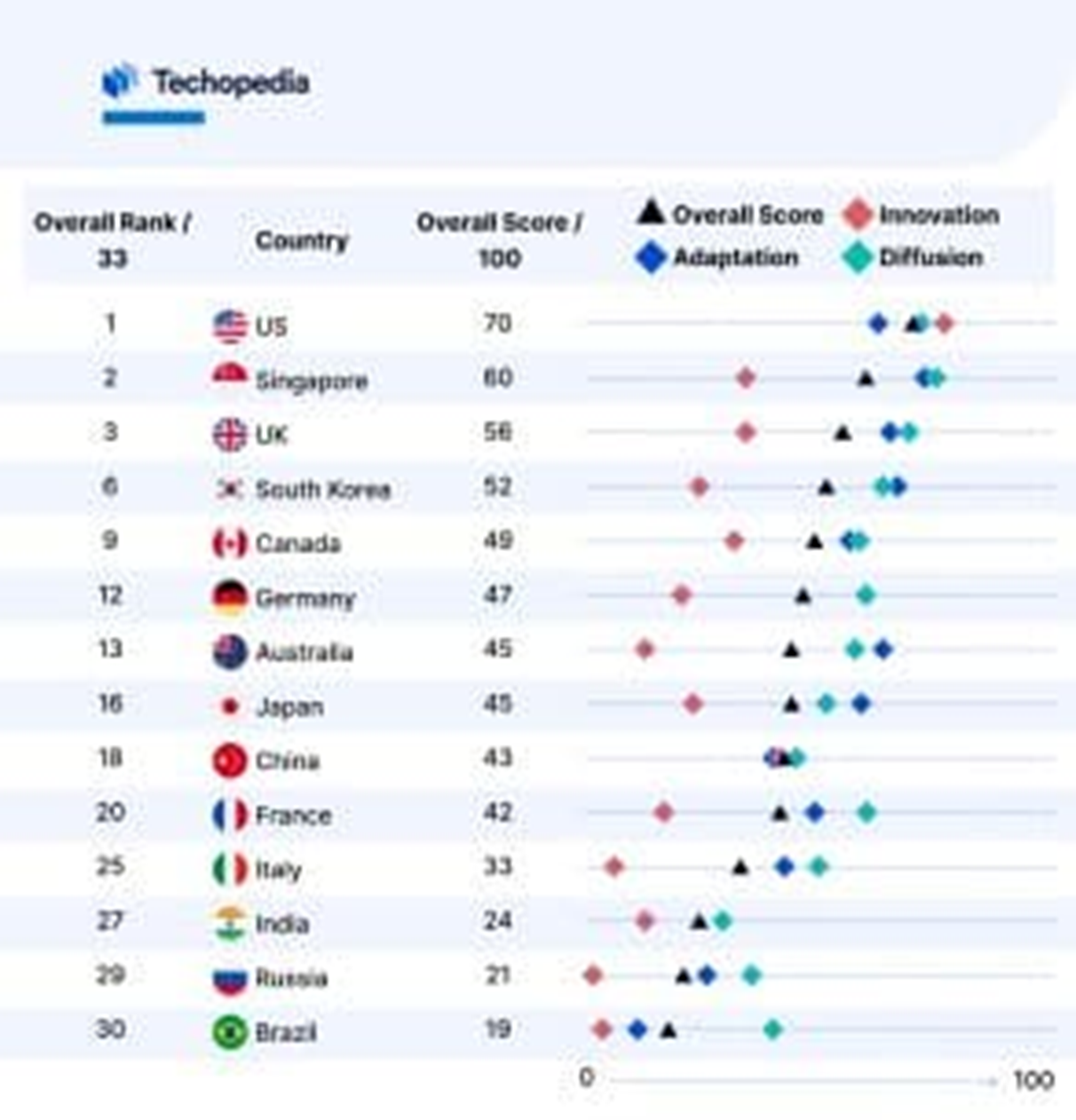
Techopedia predicts that the US gain the most:

Techopedia offers why the US will dominate.

The US leads the way, reflecting its size, private and public investment in research and development, and the talent nurtured by its higher education system”.

Techopedia offers why the US will dominate.

There are impediments to AI success.

The major impediment is the Energy Transition from thermal sources to renewable sources. 

There are 3 major actors in this transition.  First is the Administration putting up big subsidies to make solar cells and wind turbines installations to assure Crony Capitalist will make money.   Second is the EPA that writes regulations that force the demise of reliable thermal sources, particularly coal based.  And lastly are the States that write laws, that are ill thought-out, declarations of what sources are allowed, what percentage and the time line.  See here and here. This triple bogey is not escaping notice.  The grid operators have been telling everyone that their systems are headed for collapse.   FERC has been telling the same story.  But the Governmental bodies believe themselves to know more about the grids than the grid operators. The companies that are planning to spend vast sums of money to bring AI online seem to be aware of this huge pothole in the road to delivery.  They need electricity that is reliable, and they need it now.  That can only come from thermal sources. The WSJ front page on October 1, 2024 posted “AI fever abates in stocks’ latest quarter.” The stock market sees that AI is not unfolding as was forecast.  You can bet that China is going to provide the power to their AI plans.

The Daily Caller posts: “‘Inevitable And Foreseeable’: Grid Operators Beg Court To Nix EPA Rules To Save Electricity System From Collapse”:

“The Biden-Harris administration says that its stringent power plant rules won’t harm long-term power reliability, but four grid operators stated the exact opposite in a legal brief filed Friday.

The Environmental Protection Agency (EPA) finalized its aggressive emissions rules for America’s power plants in April, saying at the time that the regulations would “improve public health without disrupting the delivery of reliable electricity.” However, four major regional grid operators argued the exact opposite in an amicus brief filed in support of red states’ legal challenge against the rule, stating explicitly that the rules will jeopardize Americans’ ability to reliably secure sufficient amounts of power if they are enforced as is”

Specifically, the EPA’s rules will mandate existing coal plants to harness 90% of their emissions by 2032 if they want to stay open past 2039, and they will also require new natural gas-fired plants to do the same in order to stay open past 2039, according to the agency. The EPA is essentially requiring power plants to meet those emissions cuts using carbon capture and sequestration (CCS) technology, which the four grid operators contend is too expensive and unproven to be mandated on such a tight timeline.”  

The EPA is setting up rules that require the operators to use unproven systems (CCS). Coal plants in operation now provide low cost energy. They provide dispatchable electricity.  They have a distinct advantage in that they usually have several months of coal stored at their site.  Gas units normally do not have a storage that could be used if there is an interruption in the supply line. Nuclear sourced electricity has many months, perhaps as long as a year on plant fuel

The Energy Bad Boys posted:” PJM, MISO, SPP, and ERCOT Join the Legal Fight Against EPA’s Carbon Rules”

The four— PJM, the Midcontinent Independent Systems Operator (MISO), Southwest Power Pool (SPP), and the Electric Reliability Council of Texas (ERCOT)— stretch from New Jersey to parts of New Mexico and serve more than 156 million Americans in their respective service territories.

“The rules on carbon dioxide emissions are not the only regulations threatening the viability of the existing thermal fleet.  Under the Biden-Harris administration, the EPA has written or updated regulations like the Ozone Transport Rule, the Coal Combustion and Residual Rule, and the Mercury and Air Toxics Standards, all of which are designed to place enough straws on the backs of reliable coal-fired power plants to compel their owners to shut them down”.


AI builders Must Have Reliable Energy Sources

Here are some appeals for reliability:

Larry Fink, Chairman and CEO of Black Rock Investment Management Corporation said no to renewables. Fink spoke at the World Economic Forman that AI will be big and profitable.  He wants the suppliers for his operations to use only dispatchable energy sources because they are reliable sources of power 24/7. 

Dominion CEO Robert Blue said: “We’re going to continue to be a big builder of renewables. We’re building a big offshore wind farm. We’re building a lot of solar. We’re adding a lot of storage. … But we also recognize that we’re going to need some more natural gas in order to keep the lights on.”  In addition to developing more natural gas plants to balance power grids from expansions of intermittent renewables, rising demands are also delaying some retirement of coal plants.

Dominion wants to build a 1,000-megawatt natural gas plant in Chesterfield County, where a coal plant closed last year, stating that the addition is critically important for reliability.  Significant costs for these increased power demands — including transmission infrastructures — will be passed on to household and business consumers.

Alphabet, Microsoft, and Amazon, three of the largest AI data center users, have previously criticized a proposal by utility company Georgia Power to expand natural gas use at the expense of hurting their renewable energy programs. The problem is that those centers require huge amounts of reliable electricity to operate, and no nearly adequate hydrocarbon replacement exists. As former Microsoft vice president Brian Janous observes, whereas “No data center wants to be tied to the need for new fossil resources, that’s the problem… You can’t throw this much [data-center] capacity at the system and not have some degree of fossil resources to support it.”

Amazon states that their data centers are powered by renewable energy.  This seems improbable as the industry knows that renewable energy is not dispatchable. They are using a ploy that is provided to make companies feel good about themselves while using fossil fuels.  Its called RECs.  The RECs provide certified proof that you’re using renewable energy from the grid without installing solar panels or other renewable energy systems at your home or business

 Amazon invests in renewable energy projects that generate electricity, which is then fed into the grid. They then purchase or are allocated an equivalent amount of energy from the grid for their use. This is often done through renewable energy certificates (RECs), which represent proof that 1 megawatt-hour (MWh) of electricity was generated from an eligible renewable energy resource.

Meanwhile, the Biden Administration, largely through the perversely titled “Inflation Reduction Act” (IRA), is providing massive and unsustainable economic incentives to move the electric generation market towards virtually exclusive reliance upon renewable energies (wind and solar in particular) plus batteries.  However, such forms of electric energy pose inherent problems; especially to the ultra-high electric energy “purity” requirements of AI/data centers. Data centers and AI generally require nine-nines reliability and quality metrics such as voltage, frequency, harmonics, etc.

Summary

The US electricity generation is forecast to have a large new demand to power data centers.

Major grid operators are going to court to cancel EPA rules.  They said this must be done or their girds will collapse. 

Data center owners/operators recognize that their systems must have dispatchable,  reliable electricity.  Renewables are not dispatchable.

Next part will examine the non dispatchable  wind and solar .

cbdakota.

Wind and Solar Can Not Save Europe, Now or Ever


Wind and solar in Europe 2 December 2022

European countries have installed wind and solar systems to various degrees. The energy crisis that these countries are encountering is primarily due to a shortage of natural gas. If the Alarmists get their way, no one will be allowed to use natural gas.  How are we to manage without natural gas.  Certainly, the EU nations have thought this through as several EU nations have passed laws that will outlaw natural gas.   Or have they?

In Europe, and perhaps globally, Germany is leading the way to banish fossil fuels. The idea is to install wind and solar electricity generating facilities.  Germany has installed wind and solar facilities that have name plate capacity of 127.4 GWs. That much capacity exceeds their electrical demand by almost double.  So why do they care if the Russians have cut off natural gas?  Name plate capacity for wind and solar over states the actual performance by about 3-fold.  It’s worse than that really but they will be something for latter discussion. There is an app “The ELECTRICITY MAPs” that allows you to look at daily demand for electricity and what systems are creating the electricity.  Not just renewables, but nuclear, natural gas and coal production systems. 

I chose to look at the maps for a number of countries in the EU, on December 2, 2022, at 12 pm.  I assembled a chart that demonstrates the problem by focusing on the rated capacity of wind and solar and their actual performance.  The chart has the nation, the demand for electricity at that hour, the name plate capacity (NPC) combined for wind and solar generators and the actual production (column 4) by those generators.  The last column (5) is the percentage of the electricity demand being supplied by wind and solar.  Great Britain looks odd, but at the time this reading was made could have been windless and overcast.    Because the Alarmist tell us that wind and solar are the least expensive forms of power generation, you would think every country would be maxing out those units. Oh yes, they forgot to tell you that because they are dependent on the weather, they only function, on average, about a 1/3 of the time.

Column1Column2Column3Column4Column5
   EuropeDecember 2, 2022
 12pm
 ElectricityWind and SolarElectricity
        Demand         NPC   Production 
Nation           GW         GW            GW             %
Germany77.3127.417.824
Great Britain30.738.500
France69.432.73.85.5
Italy43.932.61.84.2
Netherlands17.222.25.230
 Belgium14.911.22.416
Poland25.7111.23.9
Denmark6.228.52.845
Slovakia6.16.100
Austria11.660.44
Romania7.884.40.56
Switzerland143.100
Czech Republic12.92.40.040.3
Hungary6.42.10.20.3
Bulgaria7.121.80.169
Spain****28.748.5724

Down at the bottom of the chart is Spain. I forgot Spain on 2 December. So, I looked it up, today the 4th of December. Spain also has put in more wind and solar capacity than the demand requirements. The app said 7 GW were being produced at 10am. 

The chart numbers, in many cases, are rounded off.

Wind and solar are not the answer.

cbdakota

Decarbonation Channel— visualization of Wind, Solar and Nuclear Energy


“Visual Capitalist” is an interesting site.  It provides charts and some dialog on a broad range of topics. A partial list of the categories are Markets, Technology, Money, Health Care, Energy, etc. Often you get a new chart every weekday on some topic or other.   It is easy to subscribe to the site.

Even though it has a man-made global warming bias, its a useful site.  I am providing a link to this site and it will come up with visualizations of Wind, Solar and Nuclear energy.  These topics are covered often, and usually of interest. The site predicts that by the year 2026 wind and solar will produce more electricity than natural gas, coal and nuclear combined. This 8 June 2022 prediction will not be realized.

You can link with the site by clicking here.

cbdakota

Part 2: The Fragile Electric Grid


See the source image

This is part two of Robert Bryce’s testimony to the House Select Committee on The Climate Crisis.

Our electric grid is fragile.  Robert Bryce writes that the Department of Energy’s Office of Cybersecurity, Energy Security and Emergence Response illustrates the declining reliability of our grid.  Bryce says:

“In 2002, there were 23 “major disturbances and unusual occurrences” on the domestic electric grid. Those outages were caused by things like ice storms, fires, vandalism, and severe weather. By 2016, the number of disturbances and unusual occurrences had increased six-fold to 141. In 2020, the number of events jumped to 383 – an increase of 270% in just four years.  Even more alarming: through the first two months of 2021, there have been 122 of these outages.”

Bryce says:

Electrifying everything is the opposite of anti-fragile.  Attempting to halt the use of liquid motor fuels and replace them with electricity will make our transportation system more vulnerable to disruptions caused by extreme weather, saboteurs, equipment failure, accidents, or human error. Electrifying our transportation system will reduce societal resilience because it will put all our energy eggs in one basket. Electrifying transportation will reduce fuel diversity and concentrate our energy risks on a single grid, the electric grid, which will make it an even-more-appealing target for terrorists or bad actors.

Furthermore, and perhaps most important, attempting to electrify transportation makes little sense given the ongoing fragilization of our electric grid. The closures of our nuclear plants is reducing the reliability and resilience of the electric grid and making it more reliant on gasfired power plants and weather-dependent renewables.”

While skeptics have known for years that the alarmist’s forecasts of doom are not likely to be realized, the alarmists oddly want to shut down all nuke plants. Nuke plants that do not emit their enemy carbon dioxide (CO2).  Bryce notes Congress inaction regarding this issue when he says:

“Instead, Congress is standing idly by as our nuclear plants – our most reliable, safest, and most power-dense form of electricity production – are being shuttered. Nuclear plants are, as writer Emmet Penney recently put it, our “industrial cathedrals.” If policymakers want to decarbonize our transportation system while enhancing the resilience of our society, the best option would be to have a grid that is heavily reliant on nuclear energy.”

Bryce discusses recent issues that demonstrate the gird’s declining reliability in his report.  They can be reviewed by clicking here.

See part two about supply chains and mineral needs.

Biden Green Plan Costs $1.7 trillion and Reduces Global Temp 0.1C


Let’s see how you answer this question—Yes,  No.

“It worth it for the American taxpayers to pay $1.7 trillion to lower the Earth’s temperature by 0.1C (0.18F) “

 If you answered YES, I dub you Captain “Gullible”.    Oh, by the way, maybe  you would like to buy some of my ocean front property in Arizona.

The $1.7 trillion is the cost estimate of Joe Biden’s planed phase out of fossil fuels in the US.  The Biden plan would lower the global temperature by 0.1C as calculated by the Alarmist’s Climate Action Tracker.

All of this comes from the pages of the UK Guardian newspaper. This newspaper is perhaps the world’s biggest media supporter of the climate change alarmism.  The stated cost and the results are Guardian’s bona fide.

My guess is that when 2050 arrives, there are three likely outcomes. 

Outcome A

The plan was dropped after it was clear that no apocalypse was going to happen.

The Alarmist’s computers that predict the future temperatures have been much higher than the actual temperature measurements.  The Alarmists are alarmists because they refuse to recognize the facts that their   computers are flawed.

See posting Michael Shellenberger Exposes Global Warming Alarmists”

Outcome B

The plan was dropped because it was too costly and that adaptation, if necessary, was deemed less costly.

Let’s assume that in 30 to 70 (2050 to 2100) years, sea levels rise several feet, mankind would have the capability to adapt to the change.  It would not happen overnight, but rather slowly over years.  And the odds are that equally good that it will not raise several feet. 

Outcome C

The plan was dropped when the West realized the Chinese were never planning to follow any carbon reduction program.  Consequently, China dominated the globes economy because their energy costs were vastly lower, and it was more reliable than the nations of the West’s energy.

Wind and Solar will be deemed failures.  They are unreliable and must be backed up. Currently, it is necessary to have fossil fuel-based production facilities that can supply the demand reliably.   During this time as more wind and solar are added, the price of electricity would “skyrocket” (as predicted by Former President Obama.)  China has world domination as their target.  The Biden plan will be a big help to the Chinese toward realization of their objective.   

Ultimately, nuclear energy-based electricity production will become the major source.  The alarmist does not want nuclear to succeed as they have seen it as a threat to imposition of wind and solar.

I see anyone of the three as likely to happen.  Maybe it will be all of them will be realized and that will cause the Biden plan to be dropped.   

And a commonsense addition—-  how many people are going to believe the stopping a global temperature rise of just 0.18F as worth S1.7trillion is worth it? Less that one fifth of one degree!  Or even necessary!

cbdakota

Solar Cells Are Not Able to Supply Daily Power Demand Alone


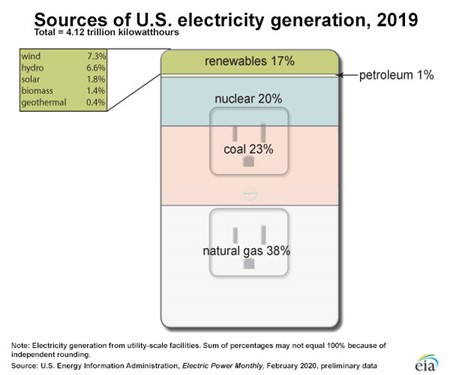
Our nation’s electricity is produced mainly by fossil fuels and nuclear energy.  The role played by renewables is relatively small, even though the public seems to believe it is greater.  This is probably because the media apparently wants the public to believe it is so.  The Chart 1 below is from the Energy Information Administration (eia), an arm of the Department of Energy:

                                                   CHART 1 

Wind and solar represent 9.1% of the sources of US electricity generation in 2019. 

The sources noted in the picture above feed their power output into systems called the grids.  These grids distribute the power to the users in their area. The grids do their utmost to be a source of uninterruptable electricity at a specific frequency.  This they do reliably. 

All of us have experienced a power loss at our home or business and you know how disruptive that is.  But most power losses we have experienced are almost always local disruptions, e.g.  wind, snow, lightning, power pole meets vehicle, transformer failure, etc. But not a grid failure.

The grids fine tunes their delivery of power, matching the increases and decreases of demand.  The grid operators dictate to the suppliers what is needed.  For example, the operators can use Nuclear and Coal based plants as a base load.  These two sources are predictable and steady suppliers but may not be able to quickly react to changes in demand.  The grid operator’s natural gas plants can adjust quickly to changes to prevent supply disruptions. Most businesses need electricity to be uninterrupted as downtime is costly.

Wind and solar are non-dispatchable because they are neither predictable nor steady suppliers of electricity. The wind driving the wind turbines can go from near gale force to calm very quickly.   Solar can do the same as cloud banks appear overhead.  The grid operator has no control over how much or how little the renewables are producing.  If renewables are supplying the grid, the operator must have backup capacity to prevent shutdown of the grid. By the way, grids are not capable of storage of electricity.

The following is from a posting by American Experiment titled “No State Imports More Electricity Than California” by Isaac Orr:

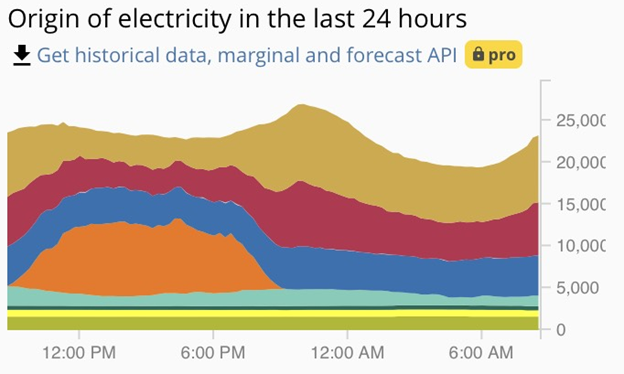
“The Chart 2 below is from Electricity Map, and it shows electricity generation by source on April 3, 2019 in California. The orange section represents solar, the blue hydroelectric, light blue, wind, green, nuclear, red natural gas, and the brown section is imported electricity.

                                                   Chart 2

As you can see, imports fall when it is sunny out, and increase again when the sun goes down. It just so happens that the sun was not shining when the demand for electricity in California was highest. California’s policies promoting renewables at the expense of dispatchable generation place it in an odd predicament, it must pay other states to take the excess electricity generated by renewables when their generation is high, and it must also pay other states for their power when renewable generation is low.”

From Chart 2, you can see solar cells negatives. 

 Solar cell production is not at its maximum at sunrise nor sunset.  It peaks around noon when the sun is directly overhead. The eia Chart 3 below shows typical electricity production in Los Angeles.   Using the gold curve, that assumes that the solar cell has tracking, at 3pm, the watts are about 550 Watts and at 7pm it is at zero.  At the peak demand midpoint, say 5 pm, it can only produce about 250 watts.  (This would be the output of a single solar cell.  However, it represents the rest of the solar cells.  The change in watts is equivalent to the percent reduction the entire solar cell farm would experience.)

                                             Chart 3

The energy production Chart3 would suggest that a solar cell is not a major contributor during peak demand.  That matches the illustrated Chart 2.

  • The greens imagine pairing solar cells and wind turbines producing energy for a grid.  In this case, regardless of the capacity of the solar cells, the wind must be able to produce all the power to satisfy the capacity rating of the location. Every day, after the sun sets, the wind turbines would have to match demand.  Solar cells can never support the daily capacity rating of the location. So why have them?

I am not a proponent of either wind turbines or solar cells.  Earlier in this posting I outlined the fact that they are not dispatchable.   Industry could not function with an unreliable energy supply.  Nor would the public accept it.  Brown outs and black outs are inevitable without a backup. 

Power Engineering posted “Study Says Renewable Power Still Reliant on Backup from Natural Gas” by Wayne Barber.   In this posting he covers a study by the Massachusetts-based National Bureau of Economic Research that stated:

“We show that a 1 percent increase in the share of fast-reacting fossil generation capacity is associated with a 0.88% percent increase in renewable in the long run,” the NBER authors say in the report.

cbdakota

UN Forecast Year 2100 World Population At 10.9Billion. Only Nuclear Can Provide Needed Energy


The “UN 2019 Revision of World Population Prospects” report says that by the end of this century the world’s population will be about 10.9 people. What does this mean with respect to the UN goals of having only renewable power—wind and solar –and the elimination of fossil fuels as an energy source? 

The Pew Research Center analyzed the UN report and came up with some eye-opening observations.   China will begin to lose population by the end of this century.  India will have the world’s largest population, surpassing China.   Africa will have 4.3 billion people at the turn of the century, substantially more that the 1.5 billion it has in 2020.  And Africa’s average age will be 35. The World’s median age will be 42.

Look at this chart:

By 2100, Asia and Africa combined will be 9.0 billion of the forecast total world population of 10.9 billion. We can expect that the really undeveloped populations of the world will be demanding a standard of living approaching that of Europe and North America. 

China and India have already launched programs to achieve a very much improved standard of living for their people.  Africa will surely do the same and with a relatively young population they will be aggressive.  That standard of living will only be realized through energy.

It will not come from renewables.  It probably cannot be fully realized by fossil fuels.   It will have to come from nuclear energy.  Ultimately, nuclear will dominate the energy sector.  

For the US, economics are causing some shutdowns of nuclear plants as natural gas generates energy at a lower cost.  In the long run, nukes should be the lowest cost reliable energy.

However, there are several nukes that are being shutdown because a governing body does not like them.  These are bad choices.

Germany seems to have an irrational fear of nukes that were prompted by the Japanese Fukushima nuke plants being flooded by a tsunami.  When was the last time a tsunami hit Germany?

It is my opinion that the greens opposition to nukes is that the nukes have the potential to solve the energy problem. Many leaders of the green movement have publicly announced that their goal is a one-world socialist government based out of the UN. They would prefer an energy limited world where they would be in charge.   Nukes could solve the energy problem, destroying their dream.  

Ok, will these population estimates prove-out?  Will Ebola wipe out millions of Africans?   Will there be a war or wars that slash these estimates?   Could the expectations for lower fertility be wrong and the world population grows even larger?   Of course, I don’t know answers to any of those questions.  But for the moment, I am assuming these estimates are going to be accurate.

cbdakota

Renewables Are Better At Creating Jobs Than At Creating Energy


Anericanexperiment blog posted”Energy Industry There to Produce Energy, not Jobs” written by John Phelan..The author begins by quoting Gregg Mast of Clean Energy Economy Minnesota who is boasting about clean energy jobs growth.  Mast says:

 “The fact is,the number of clean-energy jobs has grown every year since the release of the first Clean Jobs Midwest-Minnesota report in 2016, and these good-paying jobs have been added at a faster pace than the statewide average.”


Countering Gregg Mast’s boast,  Phelan responds by saying:

“This might sound like great news, but there is something missing from this celebration. It is something vital. Indeed, from an economic point of view, it is the most vital thing of all: How much energy are these workers actually producing?  Increasing productivity — the ratio of outputs produced to inputs used — is key to economic growth and raising living standards”.

So, how productive are these new clean-energy workers? How much energy does each produce?  Sadly, the answer seems to be “not much.” According to data on electric-power generation by primary energy sources from the Energy Information Administration and figures for employment in each sector from the U.S. Energy and Employment Report, we can see that, in 2017,   the 412 workers employed in Minnesota’s natural-gas sector produced an average of 16,281 megawatt hours of electricity each. For coal, the figure was 13,230 megawatt hours produced for each of the 1,722 workers employed in the state.

But for renewable wind and solar, the numbers are far less encouraging. In terms of megawatt hours produced per worker, Minnesota’s wind sector came in a somewhat distant third. Each of the 1,966 workers here generated an average of just 5,665 megawatt hours in 2017. This was just 43 percent of the amount of electricity a Minnesota coal worker produced annually and 35 percent of that produced by a natural-gas worker.

For solar, the numbers are even worse. In 2017, each of Minnesota’s 3,800 solar-energy workers produced an average of just 157 megawatt hours. This was just 1.2 percent of the energy produced by a coal worker and only 1 percent of that which a natural-gas worker produced.

The chart below illustrates the above:


In terms of that vital ratio of outputs (energy generated) to inputs (number of workers), wind energy is a low-productivity sector compared to natural gas and coal. Solar is even worse. Piling more inputs into these sectors when they could be more productive in other sectors lowers productivity and economic welfare. This is certainly not something to be celebrated — from an economic point of view, at least.

Mast and Clean Energy Economy Minnesota need to remember that the point of an energy industry is to generate energy, not to generate jobs.

A response by supporters of wind and solar is that there are workers out there insulating homes.  How many of solar’s 3800 jobs are insulating homes?

cbdakota

New Energy Economy” An Exercise in Magical Thinking Part 10 Energy Revolutions Are Still Beyond The Horizon


This is the final part of the serialization of Mark Mills’ report New Energy Economy: An Exercise in Magic Thinking.

=======================================================================

Energy Revolutions Are Still Beyond the Horizon

 When the world’s poorest 4 billion people increase their energy use to just 15% of the per-capita level of developed economies, global energy consumption will rise by the equivalent of adding an entire United States’ worth of demand.92 In the face of such projections, there are proposals that governments should constrain demand, and even ban certain energy-consuming behaviors. One academic article proposed that the “sale of energy-hungry versions of a device or an application could be forbidden on the market, and the limitations could become gradually stricter from year to year, to stimulate energy-saving product lines.”93 Others have offered proposals to “reduce dependency on energy” by restricting the sizes of infrastructures or requiring the use of mass transit or car pools.94

The issue here is not only that poorer people will inevitably want to—and will be able to—live more like wealthier people but that new inventions continually create new demands for energy. The invention of the aircraft means that every $1 billion in new jets produced leads to some $5 billion in aviation fuel consumed over two decades to operate them. Similarly, every $1 billion in data centers built will consume $7 billion in electricity over the same period.95 The world is buying both at the rate of about $100 billion a year.96

The inexorable march of technology progress for things that use energy creates the seductive idea that something radically new is also inevitable in ways to produce energy. But sometimes, the old or established technology is the optimal solution and nearly immune to disruption. We still use stone, bricks, and concrete, all of which date to antiquity. We do so because they’re optimal, not “old.” So are the wheel, water pipes, electric wires … the list is long. Hydrocarbons are, so far, optimal ways to power most of what society needs and wants.

More than a decade ago, Google focused its vaunted engineering talent on a project called “RE<C,” seeking to develop renewable energy cheaper than coal. After the project was canceled in 2014, Google’s lead engineers wrote: “Incremental improvements to existing [energy] technologies aren’t enough; we need something truly disruptive. … We don’t have the answers.”97 Those engineers rediscovered the kinds of physics and scale realities highlighted in this paper.

An energy revolution will come only from the pursuit of basic sciences. Or, as Bill Gates has phrased it, the challenge calls for scientific “miracles.”98 These will emerge from basic research, not from subsidies for yesterday’s technologies. The Internet didn’t emerge from subsidizing the dial-up phone, or the transistor from subsidizing vacuum tubes, or the automobile from subsidizing railroads.

However, 95% of private-sector R&D spending and the majority of government R&D is directed at “development” and not basic research.99 If policymakers want a revolution in energy tech, the single most important action would be to radically refocus and expand support for basic scientific research.

Hydrocarbons—oil, natural gas, and coal—are the world’s principal energy resource today and will continue to be so in the foreseeable future. Wind turbines, solar arrays, and batteries, meanwhile, constitute a small source of energy, and physics dictates that they will remain so. Meanwhile, there is simply no possibility that the world is undergoing—or can undergo—a near-term transition to a “new energy economy.”

================================================================

 I know it was a lot of reading, but Mills does a marvelous job of making his thoughts easily understandable and convincing.

Mills’ entire report can be downloaded by clicking here. 

The pages of numbered references are found by clicking “to read more”.

cbdakota

Continue reading