Category Archives: Environment

Genetically Modified Crops–Part 1—Are They Beneficial?


Genetically modified crops (GMC also known as GMO) are plants that have their DNA modified by the addition of other sourced DNA. This is done to impart additional characteristics to the plant so as to reduce their vulnurability to attacks by certain viruses, insects, and molds, for example. This ability has made GMCs in demand world-wide .

According to Wikipedia:

Between 1996 and 2015, the total surface area of land cultivated with GM crops increased by a factor of 100, from 17,000 km2 (4.2 million acres) to 1,797,000 km2 (444 million acres).[2] 10% of the world’s arable land was planted with GM crops in 2010.[3] In the US, by 2014, 94% of the planted area of soybeans, 96% of cotton and 93% of corn were genetically modified varieties.[4] Use of GM crops expanded rapidly in developing countries, with about 18 million farmers growing 54% of worldwide GM crops by 2013.[1] A 2014 meta-analysis concluded that GM technology adoption had reduced chemical pesticide use by 37%, increased crop yields by 22%, and increased farmer profits by 68%.[5] This reduction in pesticide use has been ecologically beneficial, but benefits may be reduced by overuse.[6] Yield gains and pesticide reductions are larger for insect-resistant crops than for herbicide-tolerant crops. Yield and profit gains are higher in developing countries than in developed countries

SAFE FOR PEOPLE

Is the use of GMCs safe? From  Wikipedias we learn that:

There is a scientific consensus[7][8][9][10] that currently available food derived from GM crops poses no greater risk to human health than conventional food,[11][12][13][14][15] but that each GM food needs to be tested on a case-by-case basis before introduction.

DEVELOPMENT HISTORY

Lets go back for some history related to hybrid crops. Past, modifications to crops:

Continue reading

Earth Is Greening And It Is Caused By Atmospheric CO2


Because the Earth is greening and the cereal crops are setting new records for production, one needs to ask why, especially since the catastrophic man-made global warming crowd have predicted that can’t happen. Drought, you know. Temperatures too high. Etc..

Yet  NASA ‘s “Carbon Dioxide Fertilization Greening Earth, Study Finds” posted on 26 April 2016 states the following:

“From a quarter to half of Earth’s vegetated lands has shown significant greening over the last 35 years largely due to rising levels of atmospheric carbon dioxide, according to a new study published in the journal Nature Climate Change on April 25.”

The greening represents an increase in leaves on plants and trees equivalent in area to two times the continental United States.”

“Results showed that carbon dioxide fertilization explains 70 percent of the greening effect, said co-author Ranga Myneni, a professor in the Department of Earth and Environment at Boston University.”


Because they don’t want to be ostracized, their press release also adds the usual about how CO2 is in fact a bad thing. Further they say it CO2 levels can get too high and all this will stop.

Continue reading

Want-To-Be Warmers Are Only Getting Part Of The Story


This posting uses an article from the Cosmopolitan magazine. Not a place where you would expect to find something about global warming. The title of the piece is “8 Signs You’re Not the Environmentalist You Think You Are” by Yvette d’Entremont. It is not too profound but it has a lot of honest values that most would be environmentalist never are exposed to. I have extracted just pieces of the author’s reasons why they have been misled. If you read all of her article, she makes some more good points

gorecarbonman

The following are the eight signs:

1. You buy only organic.

Organic is definitely not better for you, and it uses older, dirtier farming techniques that are, across the board, not as environmentally friendly. Contrary to rumors, organic farming uses pesticides, in some cases equally toxic pesticides that need to be applied more frequently.

Continue reading

Pew Research Report Data Not Supported By The Interviews. Human Caused CO2 Claimed To Be 48% But In Reality Is 31%


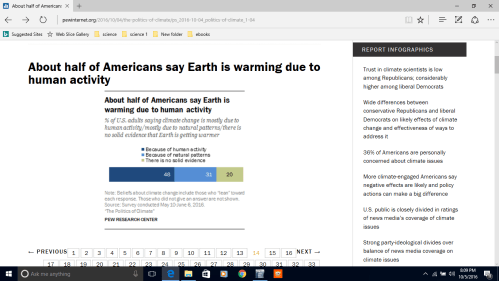
Pew Research Center has just released a survey of American’s opinions about global warming. They interviewed about 1500 people over a period from 10 May to 6 June this year. There are many findings but the one I want to take issue with is their claim that about half of the American’s interviewed say Earth is warming due to human activity. From the Pew Research Center survey the chart displayed says that 48% believe Earth is warming because of human activity, 31% because of natural patterns and 20% say there is no solid evidence that Earth is getting warmer.

2016-10-05-3

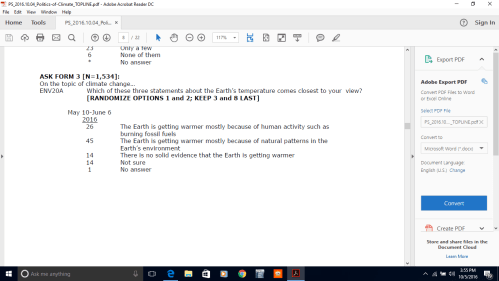
The Pew document presents the results of the interviews. The above conclusion was made from the following interviews:

2016-10-05


Above is the first interview results. Only 26% said global warming is caused by human activity. Wow that would not do. I guess they were saying “how can we fix this. We can’t publish this.” So they came up with a plan.

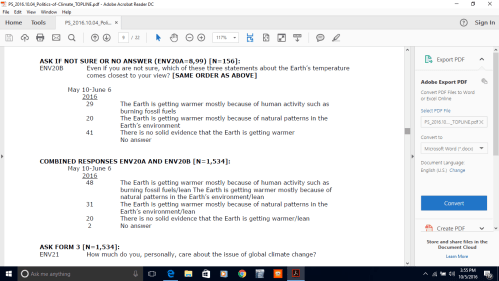
Some of the interviewed said they were not sure or had no answer. So they decided to re-interview these people to see which of the three statements would be their second choice. Now there were 1534 interviewees in the beginning. Thus the “not sures” and the “no answers” would be 0.15X1534=230 people. In the next chart it appears that they only re-interviewed only 156 of the 230. Below are the results of the re-interview.

2016-10-05-1

The results of the re-interview is that 29% said their second choice would be human caused warming, 20% said the warming was natural and 41% there was no evidence that the world is getting warmer.

Now comes the magic. You can see it in the bottom part of the above chart where it says the “combined responses” gave a new set of percentages for each of the three possible answers. However the answer for one of the three changed. It now includes both human caused and natural caused warming even though there still is a natural caused warming category.

I have gone through the math. The “human caused” in the first interview was 26% or 398 people. The “natural” was 45% or 690 people. “No evidence” was 14% or 215 people. As noted above the number re interviewed was 156 although the percentage would have called for 230. Note also that the percentage listed in the chart is only 90% or 140 people. The bottom line for people actually giving an opinion looks to be 1443 rather than the 1534 they began with. But the discrepancies in total number make little difference to the outcome. The human caused would be 398 original people plus 45 of the re interviewed for a total of 443 representing the share of the total 31%. Natural 690 plus 31 for a total of 721 and 50%. No evidence came in with 215 plus 64 for 279 and 19%. So only 31% said warming was human caused.

Obviously the surveyors could not let the initial result stand—–only 26% thought warming in human caused. So they came up with a way to obscure the results.

I have plowed through the rest of the interview material. It is obvious that most of the people have little concept of the issues surrounding renewable fuels/renewable energy.

2016-10-05-6

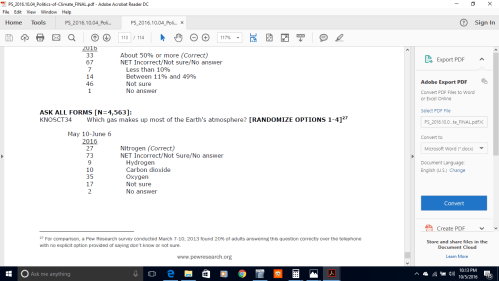
Their level of the science knowledge is probably pretty well summed up by the interview question shown above where they were asked to name the major gas that makes up our atmosphere. Seventy-three per cent did not know the answer. I would hazard a guess that most of our politician would do no better on that question.

If you want to look in detail at the full report and the interviews click here and then click on “Complete Report PDf

cbdakota

Sales Of EV’s Are Not Impressive.


cartoonevforseptblogSales of electric vehicles (EV) jumped in the second quarter of this year. This was enough to convince Real Clear Energy to post “Surge in EV Sales Bucks Cheap Gasoline, Broader Auto Industry Trends”. The posting says that while President Obama’s goal of 1 million EV’s on US roads by 2015 was not met, it was only about half that number in 2015, the surge “gives reason for fresh optimism about the future…..” EV Sales in the first half of 2015 were 70,296 versus 2016 first half sales of 99,634—a 42% change. That looks pretty impressive in the abstract.

However,  EV sales need to be evaluated versus all US automobile sales

Detailed Data for sales in August are readily available but June 2016 detailed data are behind a pay wall.  In reality the exact numbers are not significantly going to change the fact that EV sales were about 1..2% of total sales.  YCharts forecast annual sales based upon  auto sales by using the current month’s actual sales.  In June , half of the year, the Y chart number for total sales was 17.09 million automobiles.  This number counts cars and light truck and it includes EV sales in this number.  The 2016 auto sales  for the year based upon August July sales was18.15 million. Because the biggest sales months are in the fall of the year,  the official forecast for 2016 sales is 18.75 million.

Anyway,  if the annual forecast at the end of June was 17.09  roughly the year to date sales for the first six months sales would have been about 8.5 million.

The math:        0.1 million EVsales /8.5 million total sales = 1.2% of the total sales were EVs.

Real Clear Energy really has to be reaching to say that this gives them “fresh optimism.”

A hat tip to David Middleton for this story line based upon his posting in WUWT titled “Green math must be a Common Core product“.  I have modified it because I believe his calculation was erroneous. He arrived at number of 0.6% rather than what I believe is the correct number. Middleton’s conclusion however  is unchanged by my calculation of 1.2%.

cbdakota


Back In The Saddle Again. (Thanks Gene Autry)


typing-clipart-1886_picture_of_a_happy_disabled_man_in_a_wheelchair_typing_at_his_deskMy postings since May are nearly zero.  I have been catching up on things that needed doing more than any need to be writing about the faulty catastrophic global warming theories.  The family has to come first.  In addition, to many honey dos weren’t getting done.

I suppose you are wondering what so difficult about writing a blog, if anything.  Mainly the issue is trying not to make mistakes.  Blovating is pretty easy.  But checking out what is being blovated needs to be reasonably well supported.  —A for instance.—-  I just finished a posting on how small the sales of EVs really are.  I had planed to use as one of my references a posting by a man for whom I have a great deal of respect.  When I tried to confirm his numbers I could not do it.   In this case, I think he made some mistakes, or at least I can’t confirm his numbers.  So I used mine.

I like doing this so, I hope that I am back in the saddle again, —time will tell.

cbdakota


Make The Climate Change Radicals Walk The Walk, Not Just Talk The Talk


Glenn Reynolds, a Tennessee University Law Professor posted in USAToday, where he frequently contributes opinion columns, “ Ban AC for DC “ with the subtitle being “If our rulers think global warming is a crisis, let them be a good example for the rest of us”

goreandhairdryer


Reynolds says:

“In this, I’m inspired by Rep. Lamar Smith, R-Tex., who noticed something peculiar recently. It seems that EPA Administrator Gina McCarthy, who spends a lot of time telling Americans that they need to drive less, fly less, and in general reduce their consumption of fossil fuels, also flies home to see her family in Boston “almost every weekend“; the head of the Clean Air Division, Janet McCabe, does the same, but she heads to Indianapolis. In air mileage alone, the Daily Caller News Foundation estimates that McCarthy surpasses the carbon footprint of an ordinary American.

Smith has introduced a bill that wouldn’t target the EPA honchos’ personal travel, though: It provides, simply, that “None of the funds made available by this Act may be used to pay the cost of any officer or employee of the Environmental Protection Agency for official travel by airplane.”

This makes sense to me. We’re constantly told by the administration that “climate change” is a bigger threat than terrorism.  And as even President Obama has noted, there’s a great power in setting an example: “We can’t drive our SUVs and eat as much as we want and keep our homes on 72 degrees at all times … and then just expect that other countries are going to say OK.”

Reynolds thinks expanding Representative Smith’s proposed legislation would useful as he notes in the following:

  1. Extend Smith’s bill to cover the entire federal government. We have Skype now, and Facetime. There’s no reason to fly to meetings. I’d let the President keep Air Force One for official travel, but subject to a requirement that absolutely no campaign activity or fundraisers take place on any trips in which the president travels officially.
  2. Obama makes a great point about setting the thermostat at 72 degrees. We should ban air conditioning in federal buildings. We won two world wars without air conditioning our federal employees. Nothing in their performance over the last 50 or 60 years suggests that A/C has improved things. Besides, The Washington Post informs us that A/C is sexist, and that Europeans think it’s stupid.
  3. In fact, we should probably ban air conditioning in the entire District of Columbia, to ensure that members of Congress, etc. won’t congregate in lobbyists’ air-conditioned offices.
  4. Speaking of which, members of Congress shouldn’t be allowed to fly home on the weekends. Not only does this produce halfhearted attention to their jobs — the so-called “Tuesday to Thursday Club” — but, again, it produces too much of a carbon footprint. Even if they pay for the travel out of campaign funds, instead of their own budgets, they need to set an example for the rest of us — and for those skeptical foreigners that Obama mentioned.

Reynolds takes a swipe at Leonardo DiCapprio as well. And what about Michelle Obama’s vacations!!!

The full posting is a good read, ( somewhat tongue-in-cheek in some parts.)

Do you think the warmers really believe in this catastrophic global warming stuff? Does not look like it. I think it demonstrates that they are using this to increase the size of the government through regulations (and thus their power.) That was the motivation of the founders of this movement.

cbdakota

Hysteria and DDT


The Pacific Research Institute has released a video entitled “Hysteria’s History: Why is Alarmism so Dangerous?-Part 4“. The video’s purpose is to expose people to the historical progression of environmental alarmism that has often resulted in poor and contradictory policy proposals” This video discusses the ban on DDT. DDT had been very successful in nearly eradicating malaria around the world. Following the ban, malaria deaths skyrocketed.

DDT sprayed indoors, where it can keep  mosquitos in check and have no effect on the local wild life is a responsible action.   But it took skeptics to point this out over and over again before the green movement reeled in their efforts to keep DDT banned.

Hopefully, we skeptics,  showing that the catastrophic global warming movement is more hysteria than facts, will eventually cause the greens to concede in this case as well.

cbdakota


UK Scientist Doubts Decarbonization by 2050 Is Possible. Thinks Other Unfunded Threats Are More Compelling.


M J Kelly, Electrical Engineering Division Department of Engineering, Universtiy of Cambridge has written “Lessons from Technology Development for Energy and Sustainability” and posted on the  Cambridge Journals on Line.

The following is the Abstract from his posting where he sets up the quandary that faces the organizations wishing to decarbonize the planet by 2050.

There are lessons from recent history of technology introductions which should not be forgotten when considering alternative energy technologies for carbon dioxide emission reductions.

The growth of the ecological footprint of a human population about to increase from 7B now to 9B in 2050 raises serious concerns about how to live both more efficiently and with less permanent impacts on the finite world. One present focus is the future of our climate, where the level of concern has prompted actions across the world in mitigation of the emissions of CO2. An examination of successful and failed introductions of technology over the last 200 years generates several lessons that should be kept in mind as we proceed to 80% decarbonize the world economy by 2050. I will argue that all the actions taken together until now to reduce our emissions of carbon dioxide will not achieve a serious reduction, and in some cases, they will actually make matters worse. In practice, the scale and the different specific engineering challenges of the decarbonization project are without precedent in human history. This means that any new technology introductions need to be able to meet the huge implied capabilities. An altogether more sophisticated public debate is urgently needed on appropriate actions that (i) considers the full range of threats to humanity, and (ii) weighs more carefully both the upsides and downsides of taking any action, and of not taking that action.


M J Kelly discusses this issue at length in his posting and I suggest you read it in its entirety . This posting will look at conclusions and some suggestions Kelly derives when he examined the current  programs to reduce CO2. He’s not optimistic that decarbonization has much of a chance of accomplishing what the greens want. In fact he thinks the money could be spend better on addressing more immediate threats than those posed by the so-call catastrophic global warming. Here he summarizes his thoughts:

It is surely time to review the current direction of the decarbonization project which can be assumed to start in about 1990, the reference point from which carbon dioxide emission reductions are measured. No serious inroads have been made into the lion’s share of energy that is fossil fuel based. Some moves represent total madness. The closure of all but one of the aluminium smelters that used gas-fired electricity in the UK (because of rising electricity costs from the green tariffs that are over and above any global background fossil fuel energy costs) reduces our nation’s carbon dioxide emissions. 62 However, the aluminium is now imported from China where it is made with more primitive coal-based sources of energy, making the global problem of emissions worse! While the UK prides itself in reducing indigenous carbon dioxide emissions by 20% since 1990, the attribution of carbon emissions by end use shows a 20% increase over the same period.

Interestingly, he talks about the UK exporting manufacturing to other nations in order to reduce CO2 emissions.  Then the goods from these nations come back to the UK made in less efficient factories and the attributed CO2 result in an increase in the UK net emissions.     

It is also clear that we must de-risk all energy infrastructure projects over the  next two decades. While the level of uncertainty remains high, the ‘insurance policy’ justification of urgent large-scale intervention is untenable, and we do not pay premiums if we would go bankrupt as a consequence. Certain things we do not insure against, such as a potential future mega-tsunami, 64 or a supervolcano, 65 or indeed a meteor strike, even though there have been over 20 of these since 2000 with the local power of the Hiroshima bomb! 66 Using a significant fraction of the global GDP to possibly capture the benefits of a possibly less troublesome future climate leaves more urgent actions not undertaken.

Two important points remain. The first is that there is no alternative to business as usual carrying on, with one caveat expressed in the following paragraph. Since energy use has a cost, it is normal business practice to minimize energy use, by increasing energy efficiency (see especially the recent improvement in automobile performance), 67 using less resource material and more effective recycling. These drivers have become more intense in recent years, but they were always there for a business trying to remain competitive.

The second is that, over the next two decades, the single place where the greatest impact on carbon dioxide emissions can be achieved is in the area of personal behaviour. Its potential dwarfs that of new technology interventions. Within the EU over the last 40 years there has been a notable change in public attitudes and behaviour in such diverse arenas as drinking and driving, smoking in public confined spaces, and driving without a seatbelt. If society’s attitude to the profligate consumption of any materials and resources including any forms of fuel and electricity was to regard this as deeply antisocial, it has been estimated we could live something like our present standard of living on half the energy consumption we use today in the developed world. 68 This would mean fewer miles travelled, fewer material possessions, shorter supply chains, and less use of the internet. While there is no public appetite to follow this path, the short term technology fix path is no panacea.

Over the last 200 years, fossil fuels have provided the route out of grinding poverty for many people in the world (but still less than half of all people) and Fig. 1 shows that this trend is certain to continue for at least the next 20 years based on the technologies of scale that are available today. A rapid decarbonization is simply impossible over the next 20 years unless the trend of a growing number who succeed to improve their lot is stalled by rich and middle class people downgrading their own standard of living. The current backlash against subsidies for renewable energy systems in the UK, EU and USA is a sign that all is not well with current renewable energy systems in meeting the aspirations of humanity.

Figure 1. (a) The 40% growth of global energy consumption since 1995 and the projected 40% growth until 2035, with most of the growth between 1995 and 2035 being provided by fossil fuels, 21and (b) the cause of this growth is the rise in the number of people living in the middle class as described in the text. 22


Finally, humanity is owed a serious investigation of how we have gone so far with the decarbonization project without a serious challenge in terms of engineering reality. Have the engineers been supine and lacking in courage to challenge the orthodoxy? Or have their warnings been too gentle and dismissed or not heard? Science and politicians can take too much comfort from undoubted engineering successes over the last 200 years. When the sums at stake are on the scale of 1–10% of the world’s GDP, this is a serious business.

cbdakota

*M.J. Kelly (2016). Lessons from technology development for energy and sustainability. MRS Energy & Sustainability, 3, E3 doi:10.1557/mre.2016.3.


Making It Criminal To Be A Skeptic—The First Amendment Is Under Siege


Senator Whitehouse (D-RI) is calling for RICO investigations of skeptics and fossil fuel companies. California legislators writing a bill allowing for the prosecution of climate change dissent—fortunately it died this past  Thursday. Seventeen  State Attorney Generals investigating Exxon. Calls to silence skeptical views are becoming more frequent. A number of major US newspapers are prohibiting discussion of Skeptical views.  This theme parallels the Social Justice Warriors efforts to impose their view of politically correct and thus allowable speech. The First Amendment to the Constitution is under siege by the media and the government itself. The Amendment was designed to prevent the Government from squashing dissenting views and is often considered the medias first line of defense from the government crackdowns such as are common in socialist, communist and dictatorial governments (e.g. Venezuela, China and Iran.)

From an earlier Climate Change Sanity blog:

”Climate science acts like it is fighting a holy war. There are only those who are just and those who must be silenced and stopped at all costs. Anyone who mounts reasonable logical, empirical, or skeptical challenges to the orthodoxy must be ruined, not by counterfactual evidence, but by vicious attack”.

Obviously the warmers are not winning the hearts and minds of free people. One reason for this is that the disinformation primarily comes from the warmers. The predictions of catastrophe are many and they have not come true. And you do not need to be a climate scientist to understand how the warmers continue to get it wrong. The mainstream media is complicit in the distribution of this disinformation.


Look at these postings where you can get some idea of how poor their predictions are:

CAGW Predictions –Zombie And Others

Quotes from the Founders Of the Global Warming Movement

More Green Predictions Are Way Off Base

5 IPCC Assessments Don’t Show Correlation Of Temperature and Severe Weather

How Reliable Are Climate Models?

And some stories of manipulation of Data to get the results they want

Can We Trust the EPA Secrete Science

Doctor Brown and Temperature Tampering

Research Papers Show IPCC Climate Sensitivity Are Too High

And Bjon Lomborg shows how just a fraction of the money wasted on these erroneous green studies could really make a difference in people’s lives:

Bjorn Lomborg Say Global Warming Poor Place to Spend Money

These are just a few of postings on Climate Change Sanity that show you need to be a skeptic.

And please contact you legislators and tell them to protect the public from those who want to take away our First Amendment rights.

cbdakota