Category Archives: Electricity

The Weakness of the Wind Turbine Operability is Exposed. Stop The Transition to Renewables


Backgound

Many believe that Germany is the leading, major nation regarding transitioning energy sources from thermal and nuclear to renewable. Germany’s major renewables are wind turbines, solar cells, hydro and biomass.  The thermal resources are lignite, hard coal and natural gas.  At the beginning of 2023, nuclear energy was a sources but it was abandoned on15 April after generating 7TWhs .  The electricity demand for the year 2023, was 457 TWh.  In 2023 the wind turbines produced 140 TWh and Solar produced 60 TWh of that supply.    The remaining 247 TWh were produced by natural gas, coal, lignite, hydro, and biomass energy sources. The wind turbines rated capacity is 613TWh and solar rated capacity is 707 TWh.  That adds up to 1320TWh rated capacity versus demand of 457 TWh.     Why weren’t wind and solar producing all the electricity?  Together their rated capacity is 3-fold more than the demand. It is alleged that electricity from these renewable is dirt cheap, so, they should be making the electricity.   But that is not the case. The German wind turbines had a rated capacity of 60 GWs that should provide 525 TWh per year, yet they  only made 140 TWh.  That makes the capacity factor only  22.8%. The thermal fuel electricity production was greater than the wind turbine production , with lignite, hard coal and natural gas producing 176TWh opposite the 140TWh that the turbines produced. That level of thermal production capacity allowed  the weather dependence  of the non-dispatchable wind turbines.   

The Source

The data for this posting are mostly from  this excellent  German  document :  “Fraunhofer Public Net Electricity Generation 2023 in Germany: Renewables Cover the Majority of the Electricity Consumption for the First Time”      https://www.ise.fraunhofer.de/en.html

I chose the year 2023  because a full year’s data is tabulated

Can wind turbines supply a grid without out back up?

The question is could renewables without thermal sources make a reliable 24/7 grid?  Looking at it from that perspective of capacity factor of 22.8% , one answer to that question would be at least 4 times the current numbers of  wind turbines would be needed to meet the 457 TWh  with some extra to cover peak demands.   Yet using average year data may not tell the score.  Lets look at monthly performance. This is needed as weather has seasons.   Wind is the main propellant  for these turbines and it is changeable.

Deeper dive into the question.

In 2023 the record maximum output from these 60GW wind turbines was 53 GW  for a short time. Simply stated is that these beasts only respond to weather.  Wind speed can be so fast that the turbines must be shutdown to protect them from serious damage. The wind speed can also be slow, all the way to calm.  .  

Examining how German wind turbines function, gives us some insight why it is doubtful that renewables  alone could supply a gird without thermal sources backup.  The Germans collect the energy being produced by the turbines and all the other resources every 15 minutes. This data collection allows an excellent opportunity to examine how things are operating, far surpassing yearly averages. For instance, the wind turbine production is not running steady  at the capacity factor of 22.3%, as you would inherently know. But it allows us a deeper understanding of the make-up of the 22.3% capacity factor. The Germans employ both onshore and offshore wind turbines.  Combining the two for each month will provide a monthly capacity factor versus the 2023 demand.    

Using an average GWh     457TWh/12 months=38.1TWh per month.

MONTH         TURBINES PRODUCTION   CAPACITY FACTOR(versus demand)

                                     TWh                                                           %

Jan                            17,039                                                         44.6

Feb                           11,832                                                         31.0

Mar                           13,901                                                         36.5

Apr                            9,967                                                           26.2

May                          8,147                                                           21.4

Jun                            5,895                                                            15.5

Jul                              9,537                                                            25.0

Aug                           6,877                                                            18.0

Sep                           6,627                                                            17.4

Oct                            14,240                                                         37.4

Nov                           17,240                                                         45.2

Dec                          19,080                                                         50.1

In this we see that weather conditions are not always favorable for maximizing  production with wind turbines.   December suggests that increasing the number of turbines would only require a little more that 2 times plus a  little more for peak demands.   But going solo (nothing but wind turbines), June would require 7 times the number of wind turbines would be needed to meet average demand. If the wind turbines were the only source of electricity , June sets the target for the number of wind turbines required.   The summer month’s weather was not favorable to maximizing wind turbine electricity production

The turbines need to be able to match demand and that means June.

Taking an even deeper dive.

Looking deeper,   the data proves that wind turbines alone are not feasible. The data shows the turbines can fail to even produce 1GW at times.  Just a sample is tabled as follows:

Date             ONSHORE GW   OFF SHORE GW    TOTAL GW

04/05                       0.334                        0.021                        0.355

04/05                       0.727                        0.238                        0.955

05/28                       0.675                        0.119                        0.794  

06/05                       0.893                        0.001                        0.894

06/15                       0.765                        0.049                        0.814

06/17                       0.647                        0.079                        0.726

06/17                       0.947                        0.040                        0.987

06/18                       0.371                        0.150                        0.521

06/18                       0.216                        0.074                        0.290

06/25                       0.444                        0.173                        0.617

07/19                       0.664                        0.167                        0.831

09/02                       0.364                        0.199                        0.563

09/09                       0.469                        0.261                        0.730

09/10                       0.166                        0.010                        0.176

09/14                       0.469                        0.523                        0.992

09/27                       0.667                        0.205                        0.875

These  less than 1.GW  performances  have to be considered a “complete collapse of power”. 

Why does it have a “complete collapse?”

When the speed of the wind dies it can cause a very sharp loss of production of electricity .

Penn State description of wind speed vs power follows: (revised to shorten the narrative.)

The power in the wind is given by the following equation:

Power (W) = 1/2 x ρ x A x v3

Thus, the power available to a wind turbine is based on the density of the air (usually about 1.2 kg/m3), the swept area of the turbine blades (picture a big circle being made by the spinning blades), and the velocity of the wind. Of these, clearly, the most variable input is wind speed. However, wind speed is also the most impactful variable because it is cubed, whereas the other inputs are not.

The following are calculations for power available in the wind at  different velocities for a Northwind 100C turbine.  The calculations will show what happens when you double the wind speed. Take a moment to think about how much available power will increase if you double the velocity:

  • The standard(link is external) density of air is 1.225 kg/m3
  • The turbine has a 24 m diameter, which means the radius is 12 m. Thus, the swept area of the turbine is: (pi)r2 = 3.14159(122) = 452.4 m2
  • We’ll start with a 6 m/s wind.
  • The power in the wind at 6 m/s is: 1/2 x ρ x A x v3 = 0.5 x 1.225 kg/m3 x 452.4 m2 x (6 m/s)3 = 59,851 W = 59.85 kW
  • At 12 m/s: 1/2 x ρ x A x v3 = 0.5 x 1.225 kg/m3 x 452.4 m2 x (12 m/s)3 = 478,808 W = 478.8 kW (8 times as large)
  • Returning to 6m/s, the power generated falls to 59.85kW.   

Wind is always changing.  It’s irregularity is demonstrated in the German data.  Sometimes the change is large and the turbine production of electricity goes low.  The data shows that the thermal sources have to act to manage the output to the gird. Remember, thermal sources produced more electricity than the wind turbines in 2023.

German solar data

The solar capacity factor is 8.5%.  Solar should not be brought into a discussion about keeping a grid operating. The solar cells do not run at night.  So they can’t back up the wind turbines.  Maybe, there will be a miracle battery that could be charged by solar cells.   If a capable and affordable  battery is ever available it might be used as backup. Only then solar can be brought into the discussion

If the only statement  of operability of wind turbines is the annual data point, power factor, it can be  misleading.  Thanks to the German 15 minute data, the weakness of the wind turbine operability is exposed.

In my next blog, two cases of complete loss of power in 2024, one it Canada and one in Australia  due to weather conditions.    And it will review the high cost of renewable energy.  

cbdakota

Data Centers and Artificial Intelligence-Stop Energy Transition Part 3


ENERGY

The United States of America is built on energy. Primarily produced by fossil fuels.  The transportation area, cars, trucks, airplane, ships, etc. are propelled by gasoline, jet fuel, diesel oil, bunker fuel, propane, etc., all fossil fuels.  Transportation is 90% reliant on fossil fuels. About 60% of the Electricity is produced by fossil fuels.  Quoting Denny Ervin:   “Economies and standards of living hinge on having an adequate, economic, and reliable energy source—attributes that are non-negotiable for an optimal energy infrastructure. Our current trajectory risks creating inadequate, unaffordable, and unreliable energy supplies, which would devastate the U.S. economy and standard of living”.

Mr. Ervin has hit the nail on the head

Electricity Generation

The US generated 4.18Trillion Kilowatt hours in 2023.  A trillion Kilowatt-hour are called Petawatt hour.  That means that it is 4.18 followed by 15 zeros.  Because billing is usually done in kilo watts hours-,  it would be 4.18 Tera kilowatt-hours or as it is expressed in the  graph, 4.18 trillion kilowatt hours.   These vast numbers are here to stay.    Primer: Kilo is a thousand; Mega is a million; Giga is a billion; Tera is trillion and Peta is a quadrillion.

The primary source was thermals (natural gas, coal  and petroleum) at 60%, Nuclear added 18.6 %.   The renewables came in at 21.4 %.   Within that renewables list is Wind and solar and they are the rising sources.  They came sourced at 14.1%   They are non-dispatchable, meaning that their generation is a  wild card function of the weather.

Artificial Intelligence Creates Demand For Electricity

Power generation in 2023 was slightly lower than the 2022 generation.  Why? Due to higher price of electricity and use of power saving devices like LED bulbs.  But the demand is forecasted to increase soon and require a lot of additional generating sources, and transmission lines to carry the increase.   This increase is attributed to data center growth.  There are an estimated 2700 data centers in the US.  Data centers are the backbone of the digital world.  They host the internet from not only the US but a big share of the World’s internet.  It is in data centers where the Clouds store data for businesses and websites are housed. A large new power demand is forecasted for the Artificial Intelligence (AI).   DataCenterDynamics says that data center power consumption in the US is set to reach 35GW by the end of the decade, almost double its 2022 level.

Goldman Sachs posted on 13 May 2024, “AI is showing ‘very positive’ signs of eventually boosting GDP and productivity”.   That feeling seems to be universal.  The posting says: “Some of the academic literature and economic studies that have looked at the increase in productivity that we’ve seen following AI adoption, in a few specific cases, supports our view that large productivity gains are possible. The average increase in productivity is about 25%. Case studies of companies that have adopted AI imply similarly large efficiency gains. And so, you know, there’s a lot of reasons to be optimistic. It will just take a little bit more time to see these productivity gains realized.”

That is an incredible gain.  The nation must do what it takes to accomplish that goal. 

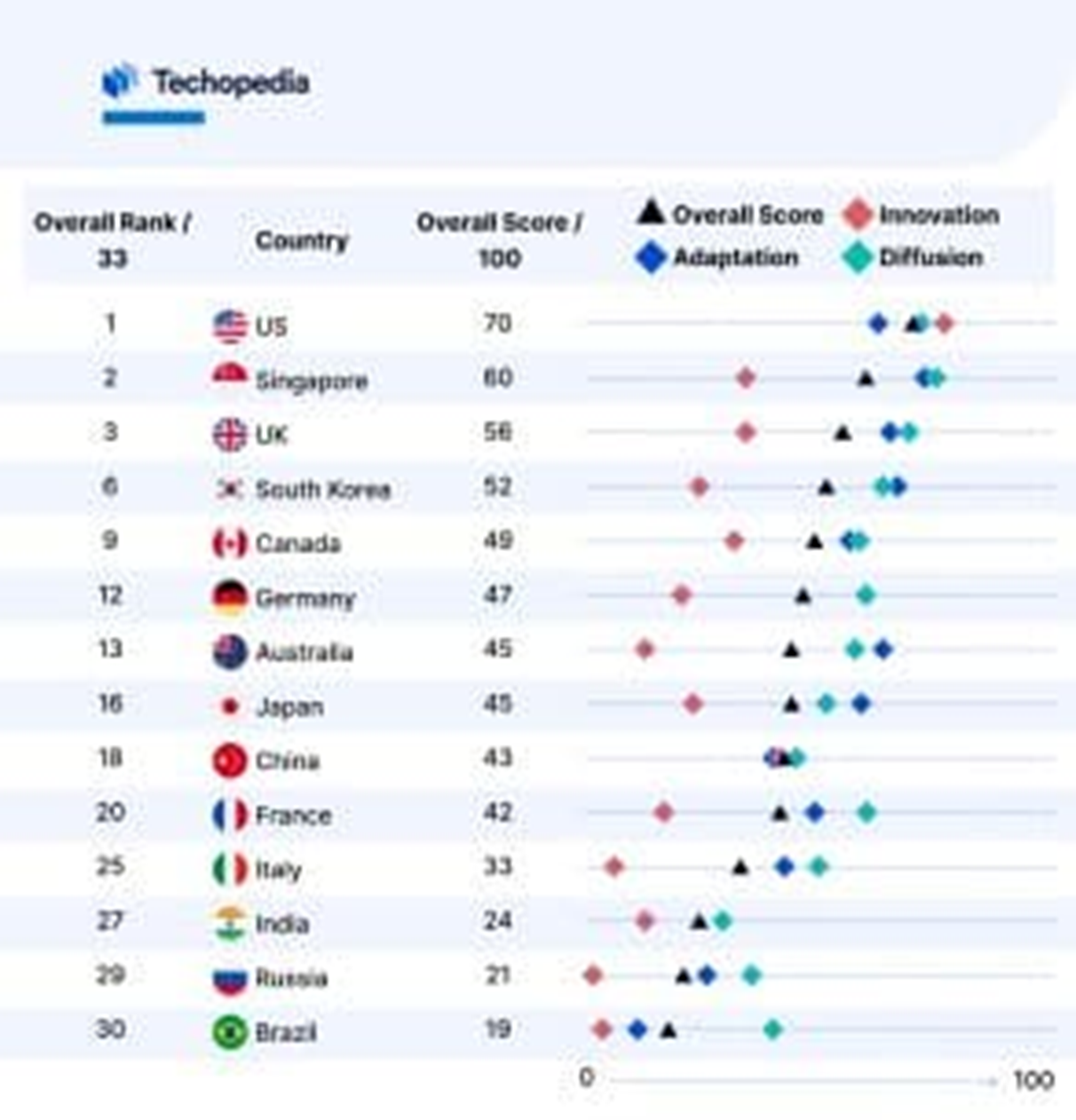
Techopedia predicts that the US gain the most:

Techopedia offers why the US will dominate.

The US leads the way, reflecting its size, private and public investment in research and development, and the talent nurtured by its higher education system”.

Techopedia offers why the US will dominate.

There are impediments to AI success.

The major impediment is the Energy Transition from thermal sources to renewable sources. 

There are 3 major actors in this transition.  First is the Administration putting up big subsidies to make solar cells and wind turbines installations to assure Crony Capitalist will make money.   Second is the EPA that writes regulations that force the demise of reliable thermal sources, particularly coal based.  And lastly are the States that write laws, that are ill thought-out, declarations of what sources are allowed, what percentage and the time line.  See here and here. This triple bogey is not escaping notice.  The grid operators have been telling everyone that their systems are headed for collapse.   FERC has been telling the same story.  But the Governmental bodies believe themselves to know more about the grids than the grid operators. The companies that are planning to spend vast sums of money to bring AI online seem to be aware of this huge pothole in the road to delivery.  They need electricity that is reliable, and they need it now.  That can only come from thermal sources. The WSJ front page on October 1, 2024 posted “AI fever abates in stocks’ latest quarter.” The stock market sees that AI is not unfolding as was forecast.  You can bet that China is going to provide the power to their AI plans.

The Daily Caller posts: “‘Inevitable And Foreseeable’: Grid Operators Beg Court To Nix EPA Rules To Save Electricity System From Collapse”:

“The Biden-Harris administration says that its stringent power plant rules won’t harm long-term power reliability, but four grid operators stated the exact opposite in a legal brief filed Friday.

The Environmental Protection Agency (EPA) finalized its aggressive emissions rules for America’s power plants in April, saying at the time that the regulations would “improve public health without disrupting the delivery of reliable electricity.” However, four major regional grid operators argued the exact opposite in an amicus brief filed in support of red states’ legal challenge against the rule, stating explicitly that the rules will jeopardize Americans’ ability to reliably secure sufficient amounts of power if they are enforced as is”

Specifically, the EPA’s rules will mandate existing coal plants to harness 90% of their emissions by 2032 if they want to stay open past 2039, and they will also require new natural gas-fired plants to do the same in order to stay open past 2039, according to the agency. The EPA is essentially requiring power plants to meet those emissions cuts using carbon capture and sequestration (CCS) technology, which the four grid operators contend is too expensive and unproven to be mandated on such a tight timeline.”  

The EPA is setting up rules that require the operators to use unproven systems (CCS). Coal plants in operation now provide low cost energy. They provide dispatchable electricity.  They have a distinct advantage in that they usually have several months of coal stored at their site.  Gas units normally do not have a storage that could be used if there is an interruption in the supply line. Nuclear sourced electricity has many months, perhaps as long as a year on plant fuel

The Energy Bad Boys posted:” PJM, MISO, SPP, and ERCOT Join the Legal Fight Against EPA’s Carbon Rules”

The four— PJM, the Midcontinent Independent Systems Operator (MISO), Southwest Power Pool (SPP), and the Electric Reliability Council of Texas (ERCOT)— stretch from New Jersey to parts of New Mexico and serve more than 156 million Americans in their respective service territories.

“The rules on carbon dioxide emissions are not the only regulations threatening the viability of the existing thermal fleet.  Under the Biden-Harris administration, the EPA has written or updated regulations like the Ozone Transport Rule, the Coal Combustion and Residual Rule, and the Mercury and Air Toxics Standards, all of which are designed to place enough straws on the backs of reliable coal-fired power plants to compel their owners to shut them down”.


AI builders Must Have Reliable Energy Sources

Here are some appeals for reliability:

Larry Fink, Chairman and CEO of Black Rock Investment Management Corporation said no to renewables. Fink spoke at the World Economic Forman that AI will be big and profitable.  He wants the suppliers for his operations to use only dispatchable energy sources because they are reliable sources of power 24/7. 

Dominion CEO Robert Blue said: “We’re going to continue to be a big builder of renewables. We’re building a big offshore wind farm. We’re building a lot of solar. We’re adding a lot of storage. … But we also recognize that we’re going to need some more natural gas in order to keep the lights on.”  In addition to developing more natural gas plants to balance power grids from expansions of intermittent renewables, rising demands are also delaying some retirement of coal plants.

Dominion wants to build a 1,000-megawatt natural gas plant in Chesterfield County, where a coal plant closed last year, stating that the addition is critically important for reliability.  Significant costs for these increased power demands — including transmission infrastructures — will be passed on to household and business consumers.

Alphabet, Microsoft, and Amazon, three of the largest AI data center users, have previously criticized a proposal by utility company Georgia Power to expand natural gas use at the expense of hurting their renewable energy programs. The problem is that those centers require huge amounts of reliable electricity to operate, and no nearly adequate hydrocarbon replacement exists. As former Microsoft vice president Brian Janous observes, whereas “No data center wants to be tied to the need for new fossil resources, that’s the problem… You can’t throw this much [data-center] capacity at the system and not have some degree of fossil resources to support it.”

Amazon states that their data centers are powered by renewable energy.  This seems improbable as the industry knows that renewable energy is not dispatchable. They are using a ploy that is provided to make companies feel good about themselves while using fossil fuels.  Its called RECs.  The RECs provide certified proof that you’re using renewable energy from the grid without installing solar panels or other renewable energy systems at your home or business

 Amazon invests in renewable energy projects that generate electricity, which is then fed into the grid. They then purchase or are allocated an equivalent amount of energy from the grid for their use. This is often done through renewable energy certificates (RECs), which represent proof that 1 megawatt-hour (MWh) of electricity was generated from an eligible renewable energy resource.

Meanwhile, the Biden Administration, largely through the perversely titled “Inflation Reduction Act” (IRA), is providing massive and unsustainable economic incentives to move the electric generation market towards virtually exclusive reliance upon renewable energies (wind and solar in particular) plus batteries.  However, such forms of electric energy pose inherent problems; especially to the ultra-high electric energy “purity” requirements of AI/data centers. Data centers and AI generally require nine-nines reliability and quality metrics such as voltage, frequency, harmonics, etc.

Summary

The US electricity generation is forecast to have a large new demand to power data centers.

Major grid operators are going to court to cancel EPA rules.  They said this must be done or their girds will collapse. 

Data center owners/operators recognize that their systems must have dispatchable,  reliable electricity.  Renewables are not dispatchable.

Next part will examine the non dispatchable  wind and solar .

cbdakota.

 WE MUST REVERSE ENERGY TRANSITION, NOT JUST STOP IT.


Subscribe to continue reading

Subscribe to get access to the rest of this post and other subscriber-only content.

Stop Energy Transitioning and Direct The Effort To Erase Enemy Attacks


 The Grids must be a functioning machines to support the lives, economy and freedom of the people of the United States.   The Grids distribute electrical energy to sub stations that lower the voltage for distribution to families, businesses, industry, hospitals, etc.  If the functionality of the grids, and substations is destroyed, the loss of electricity would make anything you can think of as bad, to be child’s play compared to loss of the Grid.  Our nation runs on electricity.  And if it is no longer available, food would run out in the stores because the trucking of food to the stores, would soon be impossible as gasoline and diesel fuel of run out.  You would lose the water supply to your home. The heating source would disappear. No jobs, no telephones and as soon as your batteries are discharged, no more functioning cell phones.                    

Practical Engineering described it thus:

Electricity is not just a luxury. It is a necessity of modern life. Even ignoring our own direct use of it, almost everything we depend on in our daily lives, and indeed the orderly conduct of a civil society, is undergirded by a functioning electrical grid.

Energy Transition says:” After two weeks without power, civilization collapses.

If you have food, you may be visited by a lot of people.  Some may be determined to take all of your food.

  Off The Grid News reports:

“Direct terrorist attacks against the power grid.

It wouldn’t take anything as sophisticated as cyber-warfare or an EMP to take down the grid. In 2014, an attack was conducted on a power substation in San Jose, California. However, while the perpetrators were never caught, many think this was a practice run for a direct terrorist attack.

In fact, taking out as few as nine critical substations in the country could destroy the entire grid, according to a Federal Energy Regulatory Commission (FERC) report. While the locations of those particular substations are a tightly held secret, our enemies certainly are trying to learn where they are.”

CNN reports that:

“China’s hackers are positioning on American infrastructure in preparation to wreak havoc and cause real-world harm to American citizens and communities, if or when China decides the time has come to strike,” Wray told the House Select Committee on the Chinese Communist Party.

The Chinese hackers are working “to find and prepare to destroy or degrade the civilian critical infrastructure that keeps us safe and prosperous,” Wray said. “And let’s be clear: Cyber threats to our critical infrastructure represent real world threats to our physical safety.”

From CNN:
“Cyberattacks are hitting water and wastewater systems “throughout the United States” and state governments and water facilities must improve their defenses against the threat, the White House and Environmental Protection Agency warned US governors on Tuesday.”

“In November, hackers breached industrial equipment at multiple US water facilities to display an anti-Israel message on the equipment, according to US officials. The Biden administration blamed the Iranian government for the hacks.

Chinese state-backed hackers have also infiltrated US water facilities, according to US officials. It’s a hacking campaign that the Biden administration worries Beijing could use to disrupt critical infrastructure in the event of a conflict with the US. China denies the allegations.

So what do you think of this.   From Fox News:   “The FBI and Department of Defense have reportedly tracked more than 100 incidents of Chinese nationals posing as tourists to attempt to breach U.S. military bases and other federal sites. 

Those responsible, dubbed “gate crashers,” range from Chinese nationals detected crossing into a U.S. missile range in New Mexico, to scuba divers caught swimming in murky waters near a U.S. government rocket launch site in Florida, several U.S. officials recently told The Wall Street Journal. The growing trend represents a potential espionage threat, as authorities believe the Chinese government in some cases is compelling nationals into service in order to test out and report back about security practices at the installations.” 

It does not appear that any jailing or any outrage are coming from the current breaching.  If an American violated the military bases in China, Russia, North Korea, etc. my bet is that that person would be in jail and facing chargers of spying.  The US authorities are as lax as the judicial organizations in Los Angeles is for petty theft.

Perhaps there are many more cases of espionage that we do not know about.  Considering the influx of Chinese I suspect there are more.

New York Post tells us: “Chinese migration to the US continues at a record pace, with 30,000 arrested for illegally crossing the border nationwide since October.

That number surpasses the 24,000 Chinese migrants encountered during the whole of fiscal year 2023, according to Border Patrol data leaked to The Post.

There has been an explosion in immigration from China during the Biden administration.

In the whole of fiscal year 2021 — which runs from October 1 to September 30 — just 342 Chinese migrants were encountered at the border.”

It has been suggested that many Islamic soldier types have been moving into the US.  They may be at strength. 

May be the Second Amendments US militias will have to form up and defend us from the invaders.  The National Guard may need help.

It just doesn’t end with foot soldiers. 

Fox News reports:

“China reportedly secured a secret billion-dollar deal with Cuba to build a listening station targeting the U.S. on the island nation less than 100 miles off the American mainland. 

The Wall Street Journal reported Thursday that China and Cuba have reached a secret agreement for China to establish an electronic eavesdropping facility on the island, allowing Chinese intelligence services to “scoop up electronic communications throughout the southeastern U.S., where many military bases are located, and monitor U.S. ship traffic.” 

Your life and your families lives are hanging in the balance.   These people are our enemies.  The US Energy transition is a developing  train wreck.  

Stop energy transition and work on the real threats that are becoming so obvious.   Enemy armies and the hackers of our infrastructure.  Use the money that we are wasting for energy transitioning and redirect it into erasing the enemy’s attack on our nation.     

cbdakota

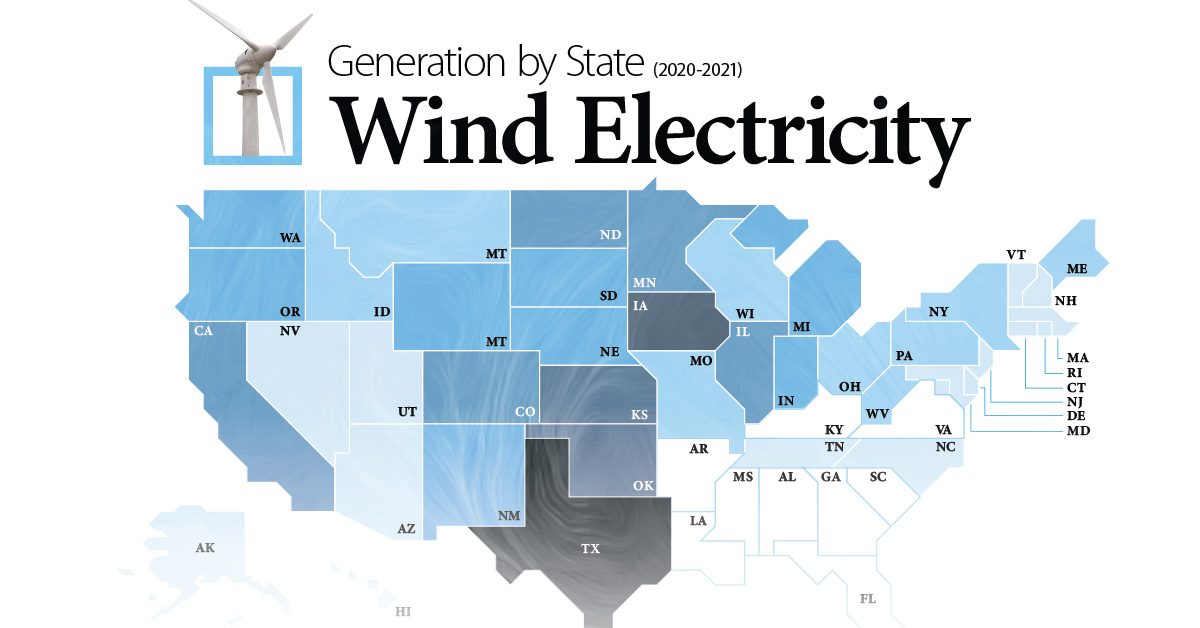
Decarbonation Channel— visualization of Wind, Solar and Nuclear Energy


“Visual Capitalist” is an interesting site.  It provides charts and some dialog on a broad range of topics. A partial list of the categories are Markets, Technology, Money, Health Care, Energy, etc. Often you get a new chart every weekday on some topic or other.   It is easy to subscribe to the site.

Even though it has a man-made global warming bias, its a useful site.  I am providing a link to this site and it will come up with visualizations of Wind, Solar and Nuclear energy.  These topics are covered often, and usually of interest. The site predicts that by the year 2026 wind and solar will produce more electricity than natural gas, coal and nuclear combined. This 8 June 2022 prediction will not be realized.

You can link with the site by clicking here.

cbdakota

More Pork For Renewable Energy


Hugh subsidies are lavished on wind and solar energy in a newly enacted Federal bill.  More pork for crony capitalism.  More high-priced electricity for the customers. 

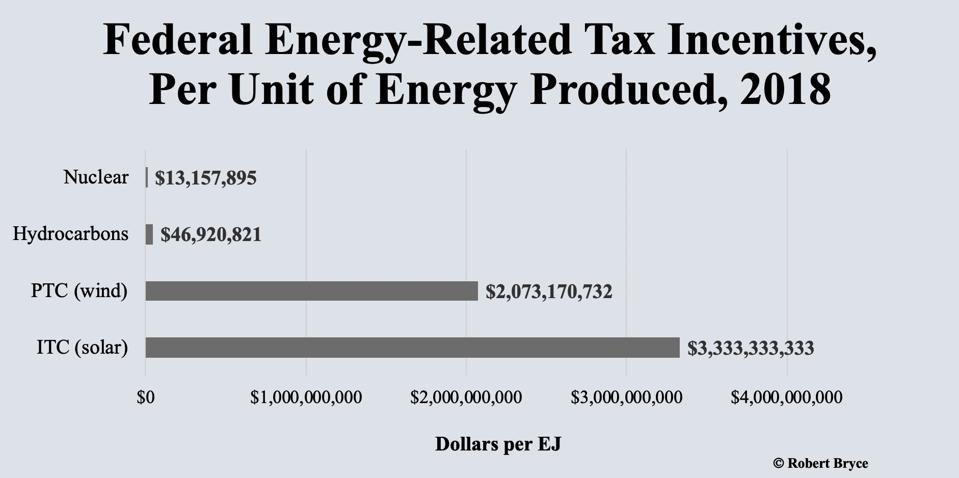
The proponents of wind and solar energy say that subsides for fossil fuels and nuclear are bigger than those for these so-called renewable energy systems. Forbes posted “Why is solar energy getting 250 times more in Federal tax credits than nuclear “by Robert Bryce.  Bryce’s posting shows that this is not the case.

 “According to a December 21 estimate from the Joint Committee on Taxation, the extension of the solar sector’s investment tax credit (ITC) will cost the American treasury another $7 billion between now and 2030. (The ITC may also be used for offshore wind projects.) The extension of the wind industry’s production tax credit (PTC) — which like the ITC was supposed to be phased out — will cost another $1.7 billion. Those billions will be added to the $27 billion in ITC  credits that were already designated for the solar sector and $34 billion in PTC that will be collected by Big Wind between now and 2029. (Those last two numbers are from the Treasury Department.) “

“Given the tens of billions of dollars that are being lavished on solar, wind, and other politically popular energy programs — tax credits for fuel cells, carbon capture and sequestration, and “two-wheeled plug-in electric vehicles” also got extensions in the budget bill — I decided to seek an answer to a simple question: which energy technology gets the most in federal tax incentives? “

“The answer, by two country miles, is solar energy.

In 2018, the American solar industry got roughly 250 times as much in federal tax incentives as the nuclear sector, when compared by the amount of energy produced. Coming in a close second is the wind sector, which got about 160 times as much as nuclear. “

EJ = Exajoule   An exajoule is a measure of energy.  Exa is 10 to the 18th power. An exajoule is equal to 277.8 terawatt-hours

“In 2018, as shown in the graphic, America’s nuclear sector received about $13.1 million in tax incentives per EJ while the solar sector soaked up $3.3 billion per EJ – or 253 times the amount given to nuclear. The wind sector got $2 billion per EJ, or about 158 times as much as nuclear.

Congress is allocating yet more money for solar and wind even though America’s nuclear sector is producing about twice as much carbon-free electricity every year as wind and solar, combined. Despite its importance to America’s climate goals, the nuclear sector is foundering. Numerous reactors have closed over the past few years and more will be shuttered in the months and years ahead. In New York, the Unit Three reactor at Indian Point will be shuttered in April. In Illinois, Exelon EXC -1% is planning to shutter two nuclear plants. In California, the Diablo Canyon nuclear plant is slated for closure in 2025.” 

I recommend that you read Bryce’s full posting by clicking this link.

I am agnostic about carbon dioxide’s (CO2) role in climate change.  Theoretically it is a player but the positive feedback that is claimed for it, looks to be exaggerated. Especially when nature’s negative feedbacks are ignored. Moreover, nuclear energy appeals to me in that it satisfies my desire to have something that can be reliably making electricity for a long, long time into the future.  It will extend the availability of fossil fuels to make valuable products, not just heat—perhaps the Earth will make natural gas and oil at an equilibrium with the fossil fuels withdrawal. Who knows?

One would think that the Greens would welcome nuclear energy based upon their crusade to eliminate man-made CO2 emissions.  But they don’t.  And they say that their programs are science based?

cbdakota

Solar Cells Are Not Able to Supply Daily Power Demand Alone


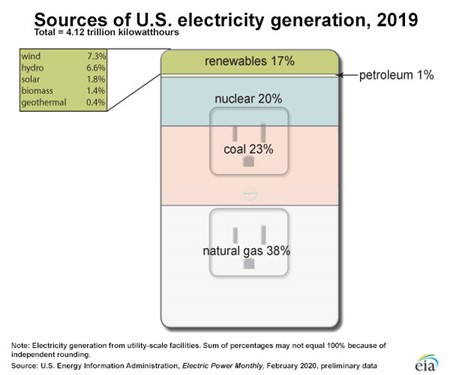
Our nation’s electricity is produced mainly by fossil fuels and nuclear energy.  The role played by renewables is relatively small, even though the public seems to believe it is greater.  This is probably because the media apparently wants the public to believe it is so.  The Chart 1 below is from the Energy Information Administration (eia), an arm of the Department of Energy:

                                                   CHART 1 

Wind and solar represent 9.1% of the sources of US electricity generation in 2019. 

The sources noted in the picture above feed their power output into systems called the grids.  These grids distribute the power to the users in their area. The grids do their utmost to be a source of uninterruptable electricity at a specific frequency.  This they do reliably. 

All of us have experienced a power loss at our home or business and you know how disruptive that is.  But most power losses we have experienced are almost always local disruptions, e.g.  wind, snow, lightning, power pole meets vehicle, transformer failure, etc. But not a grid failure.

The grids fine tunes their delivery of power, matching the increases and decreases of demand.  The grid operators dictate to the suppliers what is needed.  For example, the operators can use Nuclear and Coal based plants as a base load.  These two sources are predictable and steady suppliers but may not be able to quickly react to changes in demand.  The grid operator’s natural gas plants can adjust quickly to changes to prevent supply disruptions. Most businesses need electricity to be uninterrupted as downtime is costly.

Wind and solar are non-dispatchable because they are neither predictable nor steady suppliers of electricity. The wind driving the wind turbines can go from near gale force to calm very quickly.   Solar can do the same as cloud banks appear overhead.  The grid operator has no control over how much or how little the renewables are producing.  If renewables are supplying the grid, the operator must have backup capacity to prevent shutdown of the grid. By the way, grids are not capable of storage of electricity.

The following is from a posting by American Experiment titled “No State Imports More Electricity Than California” by Isaac Orr:

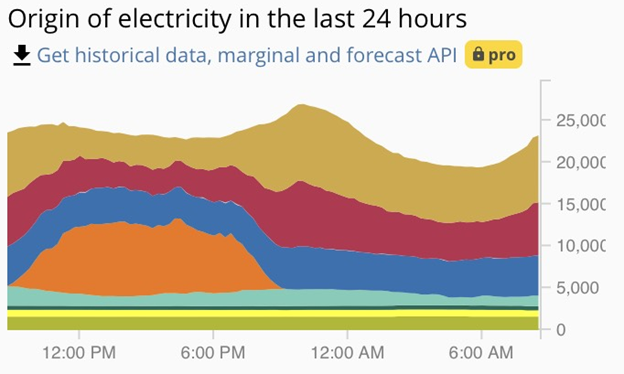
“The Chart 2 below is from Electricity Map, and it shows electricity generation by source on April 3, 2019 in California. The orange section represents solar, the blue hydroelectric, light blue, wind, green, nuclear, red natural gas, and the brown section is imported electricity.

                                                   Chart 2

As you can see, imports fall when it is sunny out, and increase again when the sun goes down. It just so happens that the sun was not shining when the demand for electricity in California was highest. California’s policies promoting renewables at the expense of dispatchable generation place it in an odd predicament, it must pay other states to take the excess electricity generated by renewables when their generation is high, and it must also pay other states for their power when renewable generation is low.”

From Chart 2, you can see solar cells negatives. 

 Solar cell production is not at its maximum at sunrise nor sunset.  It peaks around noon when the sun is directly overhead. The eia Chart 3 below shows typical electricity production in Los Angeles.   Using the gold curve, that assumes that the solar cell has tracking, at 3pm, the watts are about 550 Watts and at 7pm it is at zero.  At the peak demand midpoint, say 5 pm, it can only produce about 250 watts.  (This would be the output of a single solar cell.  However, it represents the rest of the solar cells.  The change in watts is equivalent to the percent reduction the entire solar cell farm would experience.)

                                             Chart 3

The energy production Chart3 would suggest that a solar cell is not a major contributor during peak demand.  That matches the illustrated Chart 2.

  • The greens imagine pairing solar cells and wind turbines producing energy for a grid.  In this case, regardless of the capacity of the solar cells, the wind must be able to produce all the power to satisfy the capacity rating of the location. Every day, after the sun sets, the wind turbines would have to match demand.  Solar cells can never support the daily capacity rating of the location. So why have them?

I am not a proponent of either wind turbines or solar cells.  Earlier in this posting I outlined the fact that they are not dispatchable.   Industry could not function with an unreliable energy supply.  Nor would the public accept it.  Brown outs and black outs are inevitable without a backup. 

Power Engineering posted “Study Says Renewable Power Still Reliant on Backup from Natural Gas” by Wayne Barber.   In this posting he covers a study by the Massachusetts-based National Bureau of Economic Research that stated:

“We show that a 1 percent increase in the share of fast-reacting fossil generation capacity is associated with a 0.88% percent increase in renewable in the long run,” the NBER authors say in the report.

cbdakota

Mayor’s, Governor’s, and Corporate Exe’s Green Virtue Signaling is Exposed.


When President Trump walked away from the Paris Agreement in 2017, Democrats, principally, around the US, were enraged.  They decided they would show the world that even without the support of the Trump Administration they were “woke” and would do the job without him.  Mayors, Governors and Corporate Executives rallied one another and began setting carbon dioxide reductions goals. Most of these goals contained the CO2 amounts and timelines.   I am reasonably confident that most of this crowd does not understand the real-world consequences of their actions.  I think they were motivated by politics.

The Brookings Institute, a liberal think tank, surveyed the top 100 cites to see how they were doing. On 22 October 2020, E&E News posted their take on the Brookings Institute survey titledU.S. cities struggling to meet lofty climate goals”.  They began by saying:

Most major U.S. cities that have signed on to the climate fight with pledges to cut greenhouse gas emissions are failing to meet their goals or haven’t even started to track local progress, according to a survey by the Brookings Institution.

The report, “Pledges and Progress,” looked for climate policy and actions in the nation’s 100 most populous cities, finding that two-thirds have made commitments to address citywide emissions.”

 The E&E News continues:

But the Brookings analysis found that actions taken by cities aren’t matching up with their pledges to address climate change.

Among the 100 largest cities, only 45 set specific targets for cutting greenhouse gas emissions during the past decade and inventoried emissions levels within city boundaries as baselines for measuring progress.

Twenty-two more cities have made general pledges to address emissions. But the Brookings analysis found they haven’t set emissions targets or inventoried current emissions levels.

“Half the cities aren’t doing anything,” said David Victor, co-chair of the Brookings Initiative on Energy and Climate.

Ok, you may be thinking that the corona virus is the reason.   E&E reports that Brookings does not think that is the major reason: 

“But roadblocks facing mayors in the climate campaign were obvious even before the coronavirus pushed the nation’s economy into a dramatic downturn.

The Brookings results point to the challenges faced by cities whose climate commitments diverge from policies at the state level. Another challenge for cities is the limits within which they operate. City governments can’t control everything that happens within their borders.

For example, when Pittsburgh inventoried greenhouse gas emissions in 2013, it estimated an annual citywide total of 4.8 million metric tons. Emissions from operations directly under City Hall control came to just 115,069 metric tons. The city government plans more reductions in part by buying refuse trucks that run on lower emission compressed natural gas. Its Parking Authority is teaming with Duquesne Light Co. to bring 16 new electric vehicle chargers to city parking lots.

These are marginal changes in a city and county with nearly 694,000 registered passenger vehicles. Most of them run on gasoline engines that pump out carbon emissions.”

The Paris Agreement is the Green’s framework for reducing CO2 and the timeline for reaching their goal of preventing the global temperature from ever rising more than 0.5C over the current global temperature,  I sure you have heard that the world is all in step with this goal, except for the US, of course. Well they are not.  First of all, the nation that leads in emissions of CO2 is China.  And by agreement with then President Obama, they do not need to start to reduce their emissions before 2030.  By then they will probably be emitting twice as much CO2 as the US.  Further, India, the number 3 CO2 emitter has no plans to stop increasing their emissions.

China has a political move going called the Belt and Road Initiative.  The less developed nations in south east Asia, for example want to improve their citizens lives by providing electricity.   The World Bank bans making loans to these countries as the Bank, taking guidance from the UN does not want them to put in coal plants.  But China is loaning them the money.  This raises China’s political standing in these nations.  More than 1,600 coal plants are scheduled to be built by Chinese corporations in over 62 countries and that will make China the world’s primary provider of high-efficiency, low-emission technology.

And quoting from a posting by the Global Warming Policy Forum, titled “New Coal War: China and Japan Compete For Hundreds Of New Coal Plants in Southeast Asia” we get this:

But Japan is not exactly twiddling its thumbs, either. Since the 2011 Fukushima disaster, Tokyo has ramped up coal use and has raced ahead in clean coal technology development. Japan now boasts the world’s most efficient coal-fired plant, which uses less coal to produce more electricity. Seizing on this competitive advantage, Japanese Prime Minister Shinzo Abe has tried to capitalize on these capabilities in a bid to increase Japan’s reach across Southeast Asia – and in China’s backyard. Through the Japan-led Asian Development Bank, Tokyo has pledged US$6.1 billion for projects throughout the Mekong as well as for various other projects from Vietnam to Myanmar, providing an alternative to China’s regional designs.

A coal plant can be made more efficient, but don’t kid yourself into thinking that this makes them close to the much lower CO2 emissions created by a natural gas-based facility.

And do not think the European Nations are still on board with the Paris Agreement.  The EU leadership in Brussels are deeply into this the Paris Agreement, but most of the Nations have not even met their meager 2020 commitments. Each year the required commitments become much greater, too.   And the nominal leader of the EU, German politicos are not getting much support from their industries. They see themselves becoming non-competitive with China and all these developing nations.  Their auto industry sees themselves even becoming non-competitive in the US market.

Former President Obama also committed to be the big sugar-daddy for the Paris Agreement fund to give money to the underdeveloped nations to hold down production of CO2  Each year the developed nations are to pay $100 billion to the fund.  This as I have noted is not a once and done fund, it is to be refunded each year.  So, assuming that the Trump administration are not playing nice with the Paris Agreement, those Mayors and Governors and Corporate Exes are going to have pay at least $5 billion every year.  And get this, China is not obligation to put money into this fund because they are said to be a developing nation.  Meaning China can draw money from the fund for their own use.

cbdakota

Michael Shellenberger Exposes Global Warming Alarmists


The man-made global warming eco-alarmists are composed of a cabal of scientists and bureaucrats that use scare tactics to frighten the public into supporting them.  Their objective is to destroy capitalism and replace it with Marxism.  This is fact, not opinion. Their leadership have repeatedly said that their movement is not about environmentalism. To accomplish their objective, for years they have been making predictions designed to frighten the general populace.  The literature is filled with predictions of the apocalypse that have never happened.  One of their most recent one is that the world is doomed in something like 12 years if we do not empower them to do the things they say need to be done.  To these eco-alarmists, the cost of their plans is not an issue.

Why am I highlighting Shellenberger as he is not the only one that has challenged them? First, Shellenberger is a certified environmentalist. He was Time Magazine’s “Hero of the Environment”. He has testified before Congress as an expert and he was invited to be an expert reviewer of the Intergovernmental Panel on Climate Change (IPCC) next Assessment Report.  A summary of his background can be found by clicking here.

Secondly, despite what you may have read, skeptics are not the recipients of large sums of money.  The eco-alarmists are recipients almost all the money spent on global warming.  Anyone that does not toe the line, endangers the alarmist’s incomes.  There are few scientists that are willing to sacrifice their jobs by openly speaking out. Shellenberger insists that he believes in the man-made theory of global warming, but he cannot sit by and let the alarmist poison the scientific dialog. That is unacceptable.

I think that he represents many scientists that do not agree with the alarmists but are afraid to speak their mind.  Perhaps Shellenberger’s example will encourage others to follow his lead.   A Skeptic, on the other hand, might not be able to instill the needed courage.

I have purchased Shellenberger’s book. It is powerful.  I recommend it.  He has developed an outline of his book and the following are excerpts:

Continue reading

UN Forecast Year 2100 World Population At 10.9Billion. Only Nuclear Can Provide Needed Energy


The “UN 2019 Revision of World Population Prospects” report says that by the end of this century the world’s population will be about 10.9 people. What does this mean with respect to the UN goals of having only renewable power—wind and solar –and the elimination of fossil fuels as an energy source? 

The Pew Research Center analyzed the UN report and came up with some eye-opening observations.   China will begin to lose population by the end of this century.  India will have the world’s largest population, surpassing China.   Africa will have 4.3 billion people at the turn of the century, substantially more that the 1.5 billion it has in 2020.  And Africa’s average age will be 35. The World’s median age will be 42.

Look at this chart:

By 2100, Asia and Africa combined will be 9.0 billion of the forecast total world population of 10.9 billion. We can expect that the really undeveloped populations of the world will be demanding a standard of living approaching that of Europe and North America. 

China and India have already launched programs to achieve a very much improved standard of living for their people.  Africa will surely do the same and with a relatively young population they will be aggressive.  That standard of living will only be realized through energy.

It will not come from renewables.  It probably cannot be fully realized by fossil fuels.   It will have to come from nuclear energy.  Ultimately, nuclear will dominate the energy sector.  

For the US, economics are causing some shutdowns of nuclear plants as natural gas generates energy at a lower cost.  In the long run, nukes should be the lowest cost reliable energy.

However, there are several nukes that are being shutdown because a governing body does not like them.  These are bad choices.

Germany seems to have an irrational fear of nukes that were prompted by the Japanese Fukushima nuke plants being flooded by a tsunami.  When was the last time a tsunami hit Germany?

It is my opinion that the greens opposition to nukes is that the nukes have the potential to solve the energy problem. Many leaders of the green movement have publicly announced that their goal is a one-world socialist government based out of the UN. They would prefer an energy limited world where they would be in charge.   Nukes could solve the energy problem, destroying their dream.  

Ok, will these population estimates prove-out?  Will Ebola wipe out millions of Africans?   Will there be a war or wars that slash these estimates?   Could the expectations for lower fertility be wrong and the world population grows even larger?   Of course, I don’t know answers to any of those questions.  But for the moment, I am assuming these estimates are going to be accurate.

cbdakota