Category Archives: Electric Vehicles

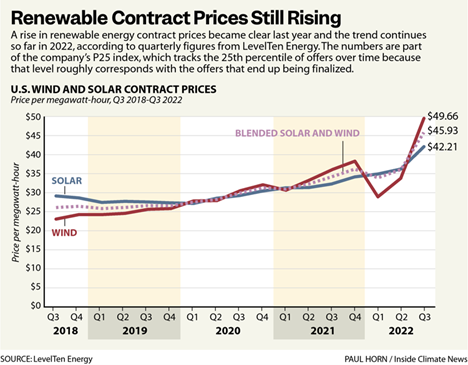
Renewable Prices Rise 37%


This chart comes from a posting by Inside Climate News (https://insideclimatenews.org/news/20102022/inside-clean-energy-wind-solar-prices/. )The author adds this:

“The trend is unmistakable. Prices are rising—by a lot”.

“But the good news for the wind and solar industries is that their resources remain among the least expensive, largely because every major source of electricity is also experiencing a spike in costs. And the Inflation Reduction Act, passed in August, contains incentives for renewable energy manufacturers to build their products in the United States, which could set the stage for a new era of growth in the domestic supply of wind and solar components, and could help to reduce prices.”

I underlined the long sentence above because this drives me crazy.  If renewables are least expensive—Why do they need subsidies?  Well of course subsidies and being parasites on the backs of fossil fuels are the reason they appear like they are the” least expensive”.  You might counter that big money people are building the wind turbines and the solar cells. So they must be good investments. We, the taxpayer are securing these investments. The Fed’s have made them almost impossible for the investors to loose any money.  Really not just lose money but make big money. The Feds, not the market are driving the attempt at transition from fossil fuels to renewables.. 

But lets look at the Fed largesse. Robert Bryce posted “Talk about corporate welfare: Federal giveaways to wind, solar sectors are about to explode”.  He reviews how much money is being given away based upon the approval of badly misnamed “Inflation Reduction Act of 2022”.  Bryce focused on how the $370 billion in energy-related spending will be divvied up.

Click on Page 2 to go to read Robert Bryce’s posting.

The Word’s Energy Crisis Has Been Created by Biden and The Climate Alarmists


Rupert Darwall points his finger at President Biden and the Climate Alarmists as the creators of the current world energy crisis in his posting “Joe Biden’s Energy Crisis”.   He says:

“…the energy crisis was not sparked by Saudi Arabia and its Gulf allies or by Iranian ayatollahs. It was self-inflicted, a foreseeable outcome of policy choices made by the West: Germany’s disastrous Energiewende that empowered Vladimir Putin to launch an energy war against Europe; Britain’s self-regarding and self-destructive policy of “powering past coal” and its decision to ban fracking; and, as Joseph Toomey shows in his powerful essay, President Biden’s war on the American oil and gas industry.”

“Hostilities were declared during Joe Biden’s campaign for the Democratic presidential nomination. “I guarantee you. We’re going to end fossil fuel,” candidate Biden told a climate activist in September 2019, words that the White House surely hopes get lost down a memory hole.”

The Biden Administration’s actions are all over the map. When US gasoline prices skyrocketed, and they found their policy on the wrong side they begged Venezuela, Iran and Russia to send their production to the US. Their campaign promises were abandoned by their fear of losing votes come November. How do you spell “hypocrites”?

“Although the price of oil has slipped back from recent highs, the factors behind high gasoline prices remain in place. Foremost among these is the steep decline in U.S. oil refinery capacity triggered when Covid lockdowns crushed demand but continued after the economy reopened. There has never been such a large fall in operable refinery capacity.

Just recently, the Biden Administration said that Big Oil was failing to keep the Northeastern states inventory of gasoline up to standard capacity. Darwall responds”

“Moreover, Gulf Coast refineries were operating at 97 percent of their operating capacity in June 2022. As Toomey remarks, “There isn’t any more blood to be squeezed out of this turnip.”

Darwall notes where climate alarmists are part of the problem. He says:

“Corporate and Wall Street ESG** policies are another factor driving refinery closures, especially of facilities owned by European oil companies to meet punishing decarbonization targets that will effectively end up sunsetting them as oil companies. If finalized as proposed, the Securities and Exchange Commission’s proposed climate disclosure rules, with the strong support of the Biden administration, will heighten the vulnerability of U.S. oil and gas companies to climate activists and woke investors to force them to progressively divest their carbon-intensive activities, such as refining crude oil, and eventually out of the oil and gas sector altogether. To these should be added aggressive federal policies aimed at phasing out gasoline-powered vehicles in favor of electric vehicles (EVs); an administration staffed from top to bottom by militants who believe that climate is the only thing that matters in politics; and an increasingly hostile political climate (“you know the deal,” Biden said of oil executives when campaigning for the presidency. “When they don’t deliver, put them in jail”).”

cbdakota

**ESG (Environmental, Social, Governance) has become a major issue of interest in the modern corporate world. Usually associated with things like climate change, pollution and resource scarcity, in reality, ESG covers a much wider spectrum of socio-economic issues like employability practices, diversity, social and cultural ethics, data security and sustainability.

SRI investors seek companies that promote ethical and socially conscious themes including diversity, inclusion, community-focus, social justice, and corporate ethics, in addition to fighting against racial, gender, and sexual discrimination.

Part 2: The Fragile Electric Grid


See the source image

This is part two of Robert Bryce’s testimony to the House Select Committee on The Climate Crisis.

Our electric grid is fragile.  Robert Bryce writes that the Department of Energy’s Office of Cybersecurity, Energy Security and Emergence Response illustrates the declining reliability of our grid.  Bryce says:

“In 2002, there were 23 “major disturbances and unusual occurrences” on the domestic electric grid. Those outages were caused by things like ice storms, fires, vandalism, and severe weather. By 2016, the number of disturbances and unusual occurrences had increased six-fold to 141. In 2020, the number of events jumped to 383 – an increase of 270% in just four years.  Even more alarming: through the first two months of 2021, there have been 122 of these outages.”

Bryce says:

Electrifying everything is the opposite of anti-fragile.  Attempting to halt the use of liquid motor fuels and replace them with electricity will make our transportation system more vulnerable to disruptions caused by extreme weather, saboteurs, equipment failure, accidents, or human error. Electrifying our transportation system will reduce societal resilience because it will put all our energy eggs in one basket. Electrifying transportation will reduce fuel diversity and concentrate our energy risks on a single grid, the electric grid, which will make it an even-more-appealing target for terrorists or bad actors.

Furthermore, and perhaps most important, attempting to electrify transportation makes little sense given the ongoing fragilization of our electric grid. The closures of our nuclear plants is reducing the reliability and resilience of the electric grid and making it more reliant on gasfired power plants and weather-dependent renewables.”

While skeptics have known for years that the alarmist’s forecasts of doom are not likely to be realized, the alarmists oddly want to shut down all nuke plants. Nuke plants that do not emit their enemy carbon dioxide (CO2).  Bryce notes Congress inaction regarding this issue when he says:

“Instead, Congress is standing idly by as our nuclear plants – our most reliable, safest, and most power-dense form of electricity production – are being shuttered. Nuclear plants are, as writer Emmet Penney recently put it, our “industrial cathedrals.” If policymakers want to decarbonize our transportation system while enhancing the resilience of our society, the best option would be to have a grid that is heavily reliant on nuclear energy.”

Bryce discusses recent issues that demonstrate the gird’s declining reliability in his report.  They can be reviewed by clicking here.

See part two about supply chains and mineral needs.

Mayor’s, Governor’s, and Corporate Exe’s Green Virtue Signaling is Exposed.


When President Trump walked away from the Paris Agreement in 2017, Democrats, principally, around the US, were enraged.  They decided they would show the world that even without the support of the Trump Administration they were “woke” and would do the job without him.  Mayors, Governors and Corporate Executives rallied one another and began setting carbon dioxide reductions goals. Most of these goals contained the CO2 amounts and timelines.   I am reasonably confident that most of this crowd does not understand the real-world consequences of their actions.  I think they were motivated by politics.

The Brookings Institute, a liberal think tank, surveyed the top 100 cites to see how they were doing. On 22 October 2020, E&E News posted their take on the Brookings Institute survey titledU.S. cities struggling to meet lofty climate goals”.  They began by saying:

Most major U.S. cities that have signed on to the climate fight with pledges to cut greenhouse gas emissions are failing to meet their goals or haven’t even started to track local progress, according to a survey by the Brookings Institution.

The report, “Pledges and Progress,” looked for climate policy and actions in the nation’s 100 most populous cities, finding that two-thirds have made commitments to address citywide emissions.”

 The E&E News continues:

But the Brookings analysis found that actions taken by cities aren’t matching up with their pledges to address climate change.

Among the 100 largest cities, only 45 set specific targets for cutting greenhouse gas emissions during the past decade and inventoried emissions levels within city boundaries as baselines for measuring progress.

Twenty-two more cities have made general pledges to address emissions. But the Brookings analysis found they haven’t set emissions targets or inventoried current emissions levels.

“Half the cities aren’t doing anything,” said David Victor, co-chair of the Brookings Initiative on Energy and Climate.

Ok, you may be thinking that the corona virus is the reason.   E&E reports that Brookings does not think that is the major reason: 

“But roadblocks facing mayors in the climate campaign were obvious even before the coronavirus pushed the nation’s economy into a dramatic downturn.

The Brookings results point to the challenges faced by cities whose climate commitments diverge from policies at the state level. Another challenge for cities is the limits within which they operate. City governments can’t control everything that happens within their borders.

For example, when Pittsburgh inventoried greenhouse gas emissions in 2013, it estimated an annual citywide total of 4.8 million metric tons. Emissions from operations directly under City Hall control came to just 115,069 metric tons. The city government plans more reductions in part by buying refuse trucks that run on lower emission compressed natural gas. Its Parking Authority is teaming with Duquesne Light Co. to bring 16 new electric vehicle chargers to city parking lots.

These are marginal changes in a city and county with nearly 694,000 registered passenger vehicles. Most of them run on gasoline engines that pump out carbon emissions.”

The Paris Agreement is the Green’s framework for reducing CO2 and the timeline for reaching their goal of preventing the global temperature from ever rising more than 0.5C over the current global temperature,  I sure you have heard that the world is all in step with this goal, except for the US, of course. Well they are not.  First of all, the nation that leads in emissions of CO2 is China.  And by agreement with then President Obama, they do not need to start to reduce their emissions before 2030.  By then they will probably be emitting twice as much CO2 as the US.  Further, India, the number 3 CO2 emitter has no plans to stop increasing their emissions.

China has a political move going called the Belt and Road Initiative.  The less developed nations in south east Asia, for example want to improve their citizens lives by providing electricity.   The World Bank bans making loans to these countries as the Bank, taking guidance from the UN does not want them to put in coal plants.  But China is loaning them the money.  This raises China’s political standing in these nations.  More than 1,600 coal plants are scheduled to be built by Chinese corporations in over 62 countries and that will make China the world’s primary provider of high-efficiency, low-emission technology.

And quoting from a posting by the Global Warming Policy Forum, titled “New Coal War: China and Japan Compete For Hundreds Of New Coal Plants in Southeast Asia” we get this:

But Japan is not exactly twiddling its thumbs, either. Since the 2011 Fukushima disaster, Tokyo has ramped up coal use and has raced ahead in clean coal technology development. Japan now boasts the world’s most efficient coal-fired plant, which uses less coal to produce more electricity. Seizing on this competitive advantage, Japanese Prime Minister Shinzo Abe has tried to capitalize on these capabilities in a bid to increase Japan’s reach across Southeast Asia – and in China’s backyard. Through the Japan-led Asian Development Bank, Tokyo has pledged US$6.1 billion for projects throughout the Mekong as well as for various other projects from Vietnam to Myanmar, providing an alternative to China’s regional designs.

A coal plant can be made more efficient, but don’t kid yourself into thinking that this makes them close to the much lower CO2 emissions created by a natural gas-based facility.

And do not think the European Nations are still on board with the Paris Agreement.  The EU leadership in Brussels are deeply into this the Paris Agreement, but most of the Nations have not even met their meager 2020 commitments. Each year the required commitments become much greater, too.   And the nominal leader of the EU, German politicos are not getting much support from their industries. They see themselves becoming non-competitive with China and all these developing nations.  Their auto industry sees themselves even becoming non-competitive in the US market.

Former President Obama also committed to be the big sugar-daddy for the Paris Agreement fund to give money to the underdeveloped nations to hold down production of CO2  Each year the developed nations are to pay $100 billion to the fund.  This as I have noted is not a once and done fund, it is to be refunded each year.  So, assuming that the Trump administration are not playing nice with the Paris Agreement, those Mayors and Governors and Corporate Exes are going to have pay at least $5 billion every year.  And get this, China is not obligation to put money into this fund because they are said to be a developing nation.  Meaning China can draw money from the fund for their own use.

cbdakota

New Energy Economy:An Exercise in Magical Thinking Part 9 Digitalization Won’t Uberize the Energy Sector.


Continuing the serialization of Mark Mills’ report New Energy Economy: An Exercise in Magical Thinking.  This part is Digitalization Won’t Uberize the Energy Sector.

=================================================

Digitalization Won’t Uberize the Energy Sector     

Digital tools are already improving and can further improve all manner of efficiencies across entire swaths of the economy, and it is reasonable to expect that software will yet bring significant improvements in both the underlying efficiency of wind/solar/battery machines and in the efficiency of how such machines are integrated into infrastructures. Silicon logic has improved, for example, the control and thus the fuel efficiency of combustion engines, and it is doing the same for wind turbines. Similarly, software epitomized by Uber has shown that optimizing the efficiency of using expensive transportation assets lowers costs. Uberizing all manner of capital assets is inevitable. Uberizing the electric grid without hydrocarbons is another matter entirely.

The peak demand problem that software can’t fix

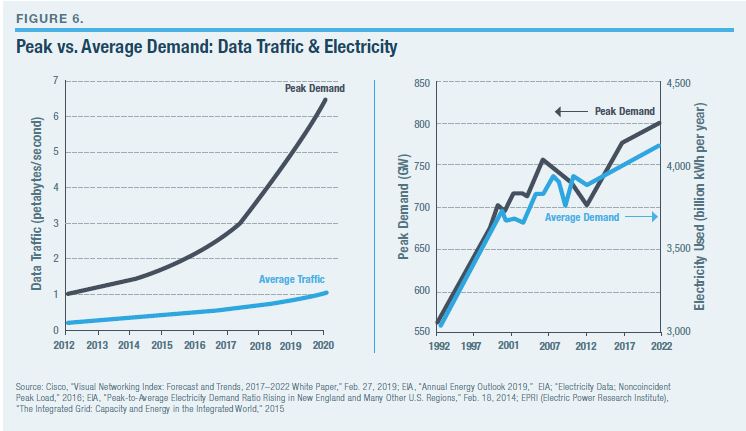
In the energy world, one of the most vexing problems is in optimally matching electricity supply and demand (Figure 6). Here the data show that society and the electricity-consuming services that people like are generating a growing gap between peaks and valleys of demand. The net effect for a hydrocarbon-free grid will be to increase the need for batteries to meet those peaks.


All this has relevance for encouraging EVs. In terms of managing the inconvenient cyclical nature of demand, shifting transportation fuel use from oil to the grid will make peak management far more challenging. People tend to refuel when it’s convenient; that’s easy to accommodate with oil, given the ease of storage. EV refueling will exacerbate the already-episodic nature of grid demand.

To ameliorate this problem, one proposal is to encourage or even require off-peak EV fueling.85 The jury is out on just how popular that will be or whether it will even be tolerated.


Although kilowatt-hours and cars—key targets in the new energy economy prescriptions—constitute only 60% of the energy economy, global demand for both is centuries away from saturation. Green enthusiasts make extravagant claims about the effect of Uber-like options and self-driving cars. However, the data show that the economic efficiencies from Uberizing have so far increased the use of cars and peak urban congestion.86 Similarly, many analysts now see autonomous vehicles amplifying, not dampening, that effect.87

That’s because people, and thus markets, are focused on economic efficiency and not on energy efficiency. The former can be associated with reducing energy use; but it is also, and more often, associated with increased energy demand. Cars use more energy per mile than a horse, but the former offers enormous gains in economic efficiency. Computers, similarly, use far more energy than pencil-and-paper.

Uberizing improves energy efficiencies but increases demand

Every energy conversion in our universe entails builtin inefficiencies—converting heat to propulsion, carbohydrates to motion, photons to electrons, electrons to data, and so forth. All entail a certain energy cost, or waste, that can be reduced but never eliminated. But, in no small irony, history shows—as economists have often noted—that improvements in efficiency lead to increased, not decreased, energy consumption.

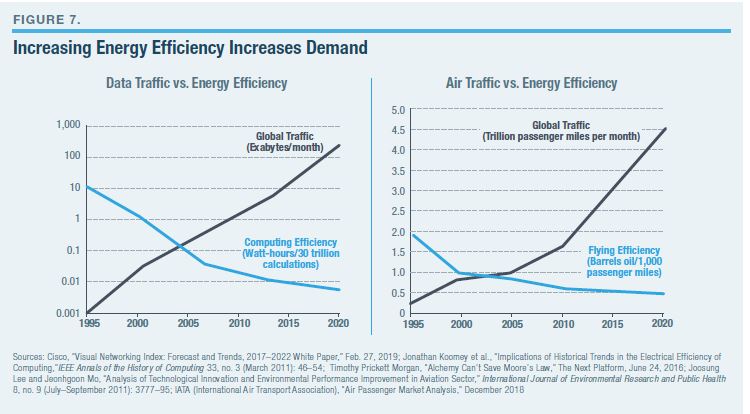
If at the dawn of the modern era, affordable steam engines had remained as inefficient as those first invented, they would never have proliferated, nor would the attendant economic gains and the associated rise in coal demand have happened. We see the same thing with modern combustion engines. Today’s aircraft, for example, are three times as energy-efficient as the first commercial passenger jets in the 1950s.88 That didn’t reduce fuel use but propelled air traffic to soar and, with it, a fourfold rise in jet fuel burned.89

Similarly, it was the astounding gains in computing’s energy efficiency that drove the meteoric rise in data traffic on the Internet—which resulted in far more energy used by computing. Global computing and communications, all told, now consumes the energy equivalent of 3 billion barrels of oil per year, more energy than global aviation.90

 The purpose of improving efficiency in the real world, as opposed to the policy world, is to reduce the cost of enjoying the benefits from an energy-consuming engine or machine. So long as people and businesses want more of the benefits, declining cost leads to increased demand that, on average, outstrips any “savings” from the efficiency gains. Figure 7 shows how this efficiency effect has played out for computing and air travel.91


Of course, the growth in demand growth for a specific product or service can subside in a (wealthy) society when limits are hit: the amount of food a person can eat, the miles per day an individual is willing to drive, the number of refrigerators or lightbulbs per household, etc. But a world of 8 billion people is a long way from reaching any such limits.

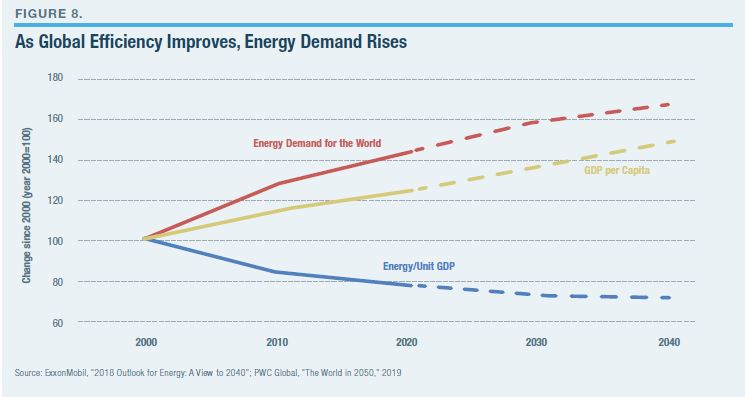
The macro picture of the relationship between efficiency and world energy demand is clear (Figure 8). Technology has continually improved society’s energy efficiency. But far from ending global energy growth, efficiency has enabled it. The improvements in cost and efficiency brought about through digital technologies will accelerate, not end, that trend.


=====================================================

The serialization of Mark Mills’ report concludes with the next part titled Energy Revolutions Are Still Beyond the Horizon.

cbdakota

New Energy Economy: An Exercise in Magical Thinking Part 6 Batteries Cannot Save the Grid or the Planet


This is part 6 of the serialization of Mark Mills’ report, New Energy Economy: An Exercise in Magical Thinking.

A discussion  of batteries being proposed as backups for renewables is an important topic.  So, I have chosen to bring together that which Mills has written about them in one posting, making it somewhat long.  Consider the recent threat by the Chinese that they would withhold, from the US,  the mined products that are necessary to make these batteries. 

===================================================

 Batteries Cannot Save the Grid or the Planet    

Batteries are a central feature of new energy economy aspirations. It would indeed revolutionize the world to find a technology that could store electricity as effectively and cheaply as, say, oil in a barrel, or natural gas in an underground cavern.47 Such

Jump-starting Frankenstein’s monster

electricity storage hardware would render it unnecessary even to build domestic power plants. One could imagine an OKEC (Organization of Kilowatt-Hour Exporting Countries) that shipped barrels of electrons around the world from nations where the cost to fill those “barrels” was lowest; solar arrays in the Sahara, coal mines in Mongolia (out of reach of Western regulators), or the great rivers of Brazil.

 But in the universe that we live in, the cost to store energy in grid-scale batteries is, as earlier noted, about 200-fold more than the cost to store natural gas to generate electricity when it’s needed.48 That’s why we store, at any given time, months’ worth of national energy supply in the form of natural gas or oil.

 Battery storage is quite another matter. Consider Tesla, the world’s best-known battery maker: $200,000 worth of Tesla batteries, which collectively weigh over 20,000 pounds, are needed to store the energy equivalent of one barrel of oil.49 A barrel of oil, meanwhile, weighs 300 pounds and can be stored in a $20 tank. Those are the realities of today’s lithium batteries. Even a 200% improvement in underlying battery economics and technology won’t close such a gap.

Nonetheless, policymakers in America and Europe enthusiastically embrace programs and subsidies to vastly expand the production and use of batteries at grid scale.50 Astonishing quantities of batteries will be needed to keep country-level grids energized—and the level of mining required for the underlying raw materials would be epic. For the U.S., at least, given where the materials are mined and where batteries are made, imports would increase radically. Perspective on each of these realities follows.

 How many batteries would it take to light the nation? A grid based entirely on wind and solar necessitates going beyond preparation for the normal daily variability of wind and sun; it also means preparation for the frequency and duration of periods when there would be not only far less wind and sunlight combined but also for periods when there would be none of either. While uncommon, such a combined event—daytime continental cloud cover with no significant wind anywhere, or nighttime with no wind—has occurred more than a dozen times over the past century—effectively, once every decade. On these occasions, a combined wind/solar grid would not be able to produce a tiny fraction of the nation’s electricity needs. There have also been frequent one hour periods when 90% of the national electric supply would have disappeared.51

 So how many batteries would be needed to store, say, not two months’ but two days’ worth of the nation’s electricity? The $5 billion Tesla “Gigafactory” in Nevada is currently the world’s biggest battery manufacturing facility.52 Its total annual production could store three minutes’ worth of annual U.S. electricity demand. Thus, in order to fabricate a quantity of batteries to store two days’ worth of U.S. electricity demand would require 1,000 years of Gigafactory production.

Wind/solar advocates propose to minimize battery usage with enormously long transmission lines on the observation that it is always windy or sunny somewhere. While theoretically feasible (though not always true, even at country-level geographies), the length of transmission needed to reach somewhere “always” sunny/windy also entails substantial reliability and security challenges. (And long-distance transport of energy by wire is twice as expensive as by pipeline.)53

Building massive quantities of batteries would have epic implications for mining.  A key rationale for the pursuit of a new energy economy is to reduce environmental externalities from the use of hydrocarbons. While the focus these days is mainly on the putative long-term effects of carbon dioxide, all forms of energy production entail various unregulated externalities inherent in extracting, moving, and processing minerals and materials.

Radically increasing battery production will dramatically affect mining, as well as the energy used to access, process, and move minerals and the energy needed for the battery fabrication process itself. About 60 pounds of batteries are needed to store the energy equivalent to that in one pound of hydrocarbons. Meanwhile, 50–100 pounds of various materials are mined, moved, and processed for one pound of battery produced.54 Such underlying realities translate into enormous quantities of minerals—such as lithium, copper, nickel, graphite, rare earths, and cobalt—that would need to be extracted from the earth to fabricate batteries for grids and cars.55 A battery-centric future means a world mining gigatons more materials.56 And this says nothing about the gigatons of materials needed to fabricate wind turbines and solar arrays, too.57

Even without a new energy economy, the mining required to make batteries will soon dominate the production of many minerals. Lithium battery production today already accounts for about 40% and 25%, respectively, of all lithium and cobalt mining.58 In an all-battery future, global mining would have to expand by more than 200% for copper, by at least 500% for minerals like lithium, graphite, and rare earths, and far more than that for cobalt.59

Then there are the hydrocarbons and electricity needed to undertake all the mining activities and to fabricate the batteries themselves. In rough terms, it requires the energy equivalent of about 100 barrels of oil to fabricate a quantity of batteries that can store a single barrel of oil-equivalent energy.60

Given the regulatory hostility to mining on the U.S. continent, a battery-centric energy future virtually guarantees more mining elsewhere and rising import dependencies for America. Most of the relevant mines in the world are in Chile, Argentina, Australia, Russia, the Congo, and China. Notably, the Democratic Republic of Congo produces 70% of global cobalt, and China refines 40% of that output for the world.61

China already dominates global battery manufacturing and is on track to supply nearly two-thirds of all production by 2020.62 The relevance for the new energy economy vision: 70% of China’s grid is fueled by coal today and will still be at 50% in 2040.63 This means that, over the life span of the batteries, there would be more carbon-dioxide emissions associated with manufacturing them than would be offset by using those batteries to, say, replace internal combustion engines.64

Transforming personal transportation from hydrocarbon-burning to battery-propelled vehicles is another central pillar of the new energy economy. Electric vehicles (EVs) are expected not only to replace petroleum on the roads but to serve as backup storage for the electric grid as well.65

Lithium batteries have finally enabled EVs to become reasonably practical. Tesla, which now sells more cars in the top price category in America than does Mercedes-Benz, has inspired a rush of the world’s manufacturers to produce appealing battery-powered vehicles.66 This has emboldened bureaucratic aspirations for outright bans on the sale of internal combustion engines, notably in Germany, France, Britain, and, unsurprisingly, California.

Such a ban is not easy to imagine. Optimists forecast that the number of EVs in the world will rise from today’s nearly 4 million to 400 million in two decades.67 A world with 400 million EVs by 2040 would decrease global oil demand by barely 6%. This sounds counterintuitive, but the numbers are straightforward. There are about 1 billion automobiles today, and they use about 30% of the world’s oil.68 (Heavy trucks, aviation, petrochemicals, heat, etc. use the rest.) By 2040, there would be an estimated 2 billion cars in the world. Four hundred million EVs would amount to 20% of all the cars on the road—which would thus replace about 6% of petroleum demand.

In any event, batteries don’t represent a revolution in personal mobility equivalent to, say, going from the horse-and-buggy to the car—an analogy that has been invoked.69 Driving an EV is more analogous to changing what horses are fed and importing the new fodder.

====================================================================

I like the last paragraph as it puts batteries in perspective.

Part 7 will be “Moore’s Law Misapplied”

cbdakota

Can Wind and Solar Sources Replace Fossil Fuels by 2050?


Can wind and solar sources replace fossil fuels by 2050?   Beginning with today’s positing, I will let Mark Mills answer that question.  I plan a series of posting on this topic beginning with  a summary of Mills’ views. The summary is a condensation of his report titled “THE “NEW ENERGY ECONOMY”: AN EXERCISE IN MAGICAL THINKING “.  I plan to serialized the report as a follow-up for those who want to dig deeper.  I bet you will find the serialized posting to be enlightening and what little math is used is  limited to multiplication, addition and subtraction.

cbdakota

=====================================================

Want an Energy Revolution?

by Mark Mills

Throughout history, some 60 percent to 90 percent of every nation’s economy has been consumed by food and fuel costs. Hydrocarbons changed the way that humans organize their productive capacity. The coal age, followed by the oil age, and now by the ascendant age of natural gas, has (at least for developed nations) driven the share of GDP devoted to acquiring food and fuel down to around 10 percent. That transformation constitutes one of the great pivots for civilization.

Many analysts claim that yet another such consequential energy revolution is upon us: “clean energy,” in the form of wind turbines, solar arrays, and batteries, they say, is about to become incredibly cheap, making it possible to create a “new energy economy.” Polls show that nearly 80 percent of voters believe that America is “capable of creating a new electricity system.”

We can thank Silicon Valley for popularizing “exponential change” and “disruptive innovations.” The computing and communications revolutions that have transformed many industries have also shaped both expectations and rhetoric about how other technologies evolve. We hear claims, as one Stanford professor put it, that clean tech will follow digital technology in a “10x exponential process which will wipe fossil fuels off the market in about a decade.” Or, as the International Monetary Fund recently summarized, “smartphone substitution seemed no more imminent in the early 2000s than large-scale energy substitution seems today.” The mavens at Singularity University tell us that with clean tech, we’re “on the verge of a new, radically different point in history.” Solar, wind, and batteries are “on a path to disrupt” the old order dominated by fossil fuels.

Never mind that wind and solar—the focus of all “new energy economy” aspirations, including its latest incarnation in the Green New Deal—supply just 2 percent of global energy, despite hundreds of billions of dollars in subsidies. After all, it wasn’t long ago that only 2 percent of the world owned a pocket-sized computer. “New energy economy” visionaries believe that a digital-like energy disruption is not just possible, but imminent. One professor predicts that we will see an “Apple of clean energy.”

As it happens, energy does have something to do with the fact that today’s smartphones are much cheaper and more powerful than a room-size IBM mainframe from the 1980s. The essential feature of that transformation is that engineers collapsed the energy appetite and size of transistors, consequently increasing their number per chip roughly twofold every two years. In other words, computing power per energy unit doubled five times per decade. The compound effect of that kind of progress—formally dubbed Moore’s Law, after Intel cofounder Gordon Moore—has indeed caused a “disruptive” revolution. A single iPhone at 1980 energy efficiency would require as much power as a Manhattan office building. Similarly, a single data center at 1980 efficiency would require as much power as the entire U.S. grid. But because of efficiency gains, the world today has billions of smartphones and thousands of datacenters.

A similar transformation in how energy is produced or stored isn’t just unlikely: it’s impossible. Drawing an analogy between information production and energy production is a fundamental category error. They entail different laws of physics. Logic engines don’t produce physical action or energy; they manipulate the idea of the numbers one and zero. Silicon logic is rooted in simply knowing and storing the position of a binary switch—on or off.

But the energy needed to move a ton of people, heat a ton of steel or silicon, or grow a ton of food is determined by properties of nature, whose boundaries are set by laws of gravity, inertia, friction, and thermodynamics—not clever software or marketing. Indeed, the differences between the physical and virtual are best illustrated by the fact that, using mathematical magic, one can do things like “compress” information to reduce the energy needed to transport that information. But in the world of humans and objects with mass, comparable “compression” options exist only in Star Trek.

If, in some alternative universe, the performance of silicon solar cells followed Moore’s Law, a single postage-stamp-size solar cell could fuel the Empire State Building. Similarly, a single battery the size of a book would cost 3 cents and power a jumbo jet to Asia. Such things happen only in comic books because, ultimately, physics, not policies, dictates the possibilities—and thus the economics—for energy technologies, regardless of subsidies and mandates.

Spending $1 million on wind or solar hardware in order to capture nature’s diffuse wind and sunlight will yield about 50 million kilowatt-hours of electricity over a 30-year period. Meantime, the same money spent on a shale well yields enough natural gas over 30 years to produce 300 million kilowatt-hours. That difference is anchored in the far higher, physics-based energy density of hydrocarbons. Subsidies can’t change that fact.

And then batteries are needed, and widely promoted, as the way to convert wind or solar into useable on-demand power. While the physical chemistry of batteries is indeed nearly magical in storing tiny quantities of energy, it doesn’t scale up efficiently. When it comes to storing energy at country scales, or for cargo ships, cars and aircraft, engineers start with a simple fact: the maximum potential energy contained in hydrocarbon molecules is about 1,500 percent greater, pound for pound, than the maximum theoretical lithium chemistries. That’s why the cost to store a unit of energy in a battery is 200 times more than storing the same amount of energy as natural gas. And why, today, it would take $60 million worth of Tesla batteries—weighing five times as much as the entire aircraft—to hold the same energy as is held in a transatlantic plane’s onboard fuel tanks.

For a practical example of the physics-anchored gap between aspiration and reality, consider Florida Power & Light’s (FPL) recently announced plan to replace an old gas-fired power station with the world’s biggest battery project—promised to be four times bigger than the current number one, a system Tesla installed, to much fanfare, last year in South Australia. The monster FPL battery “farm” will be able to store just two minutes of Florida’s electricity needs. That’s not going to change the world, or even Florida.

Moreover, it takes the energy equivalent of about 100 barrels of oil to manufacture a battery that can store the energy equal to one oil barrel. That means that batteries fabricated in China (most already are) by its predominantly coal-powered grid result in more carbon-dioxide emissions than those batteries, coupled with wind/solar, can eliminate. It’s true that wind turbines, solar cells, and batteries will get better, but so, too, will drilling rigs and combustion engines. The idea that “old” hydrocarbon technologies are about to be displaced wholesale by a digital-like, clean-tech energy revolution is a fantasy.

If we want a disruption to the energy status quo, we will need new, foundational discoveries in the sciences. As Bill Gates has put it, the challenge calls for scientific “miracles.” Any hoped-for technological breakthroughs won’t emerge from subsidizing yesterday’s technologies, including wind and solar. The Internet didn’t emerge from subsidizing the dial-up phone, or the transistor from subsidizing vacuum tubes, or the automobile from subsidizing railroads. If policymakers were serious about the pursuit of the next energy revolution, they’d be talking a lot more about reinvigorating support for basic science.

It bears noting that over the past decade, U.S. production of oil and natural gas has increased by 2,000 percent more than the combined growth of (subsidized) wind and solar. Shale technology has utterly transformed the global energy landscape. After a half-century of hand-wringing about import dependencies, America is now a major exporter. Now that’s a revolution.

Want an Energy Revolution?


Paris Agreement and Paris Agreement Hollow Echos


Virginia goes Don Quixote 

State will defy Trump, double down on renewables and CO2 reductions – and hurt poor families.  By Paul Driessen

Democrat Ralph Northam had barely won the Virginia governor’s race when his party announced it would impose a price on greenhouse gases emissions, require a 3% per year reduction in GHG emissions, and develop a cap-and-trade scheme requiring polluters to buy credits for emitting carbon dioxide.

Meanwhile, liberal governors from California, Oregon and Washington showed up at the COP23 climate confab in Bonn, Germany to pledge that their states will remain obligated to the Paris climate treaty, and push ahead with even more stringent emission, electric vehicle, wind, solar and other programs.  Leaving aside the unconstitutional character of states signing onto an international agreement that has been repudiated by President Trump (and the absurdity of trying to blame every slight temperature change and extreme weather event on fossil fuels), there are major practical problems with all of this.

To read the complete posting click here

———————————————————————————————-

Germany-to-miss-co2-reduction-targets  By P Gosselin on 6. December 2017

The latest forecast shows snow and cold moving across much Germany this weekend, again. Despite Germany ‘s ruddy CO2 emissions, winter keeps coming.

German public broadcasting, here for example, reports today that despite all the green, climate-preaching, Germany will miss its 2020 CO2 reductions by a mile. More embarrassingly, the country has not reduced its CO2 equivalent emissions in 9 years when 2017 is counted in the statistics.

To read the complete posting click here

——————————————————————————————–

From the New York Time: “What Happened (and Didn’t) at the Bonn Climate Talks

The New York Times puts a happy face on the Bonn meeting on the Paris agreement,  it is clear that virtually none of the parties are meeting their commitments:

Click here to read the complete posting.

——————————————————————————————–

Even Without Paris Agreement, U.S. Leads World in Declining Carbon Dioxide Emissions: “While the decision to pull out of the deal had diplomatic consequences, the U.S. has dramatically lowered its carbon emissions in the last year, largely without government mandates. These emissions reductions came as the result of price drops for both natural gas and solar panels. How significant this reduction is, however, demonstrates the challenges of gauging emissions on a global scale.

Click here to read the complete posting  

Can Tesla Survive The Loss Of Subsidies?


Three years ago, The Los Angeles Times posted “Elon Musk’s growing empire is fueled by $4.9 billion in government subsidies”. I have not seen a summary of the current total of Musk’s subsidies but it is certainly more than $4.9 billion now. When The LA Times speaks about an “empire” it included Tesla, Space X and Solar City—all Musk controlled businesses.

This discussion will focus on the Tesla electric vehicle (EV) business.

Subsidies start with the Federal Tax Credit of $7,500 given to each buyer of a Tesla EV.  (Every EV maker gets the same treatment.).  California also provides a $2500 subsidy per car.

The following is from the LA Times posting:

“Tesla has also collected more than $517 million from competing automakers by selling environmental credits.  The regulation was developed in California and has been adopted by nine other states.”

These regulations require that companies selling automobiles must also sell a certain percentage of EVs.  Sales of an EV gives the seller environmental credits.   Manufacturers are penalized for not selling enough EVs and must buy credits to offset their failure. Because Tesla sells only EVs it gets a lot of credits which they sell to the other car makers.

The following 2016 video discusses what the Wall Street Journal thinks subsidies mean to the Tesla’s bottom line: (Please excuse the 15 second commercial.  When video ends click back to this page.)

https://video-api.wsj.com/api-video/player/v3/iframe.html?guid=00E58A9F-9315-47FE-BFED-7C79B2C3A98B&shareDomain=null

Continue reading

Tesla Model 3 Sales Will Be Make Or Break For The Company


Is Tesla a major player in the transportation market?  The answer is no.  But will Tesla be?  We read that automobile engineers at the major vehicle producers begin shaking all over when they think of the threat Tesla poses.  So maybe they have magic.

Have not seen it yet and I could be wrong not being an auto engineer.

How is a stock market analyzing firm ranking Tesla versus competition?

Company TTM Sales $million $/Share Recommended Buy Price $/Share
Tesla    10,069 345 99
VW adr  267,350   31 29
Toyota adr  256,791 113 68
Damlier adr  189,396   74 56
Ford  153,596   11   8
General Motors  170,231   36 31

A casual glance says that Tesla share price is not based on actual sales but on investors belief that the company is something special.  Note that the firm that provided the above data ventured that the actual Tesla share price was about 3.5 times their recommended buy price.  The actual prices were greater than the recommend buy price for each of the companies shown in the table. But the relationship was in most cases about 1.3 or so.  Some analysts believe that Tesla is looked at more of a Tech stock than and stock of a company making vehicles.

In August 2016, Elon Musk,  the force behind the Tesla  said that he plans to sell 500,000 vehicles by 2018 and one million by 2020. From my readings, I would guess the majority of analysts don’t think he will accomplish that goal.

Several years ago, Consumer Reports (CR)  said theTesla was the best car ever.  They still believe it to have superior performance but no longer rate it an unqualified success because of reports of lack of reliability. (The Toyota in my garage was purchased based upon CR’s reliability rating of the car—and CR got it right.

The lowest priced  Tesla vehicle is the Model S.  The S’s price starts at $69,500 and grows based upon the options the buyer elects to add. The new Model 3 is said to have a base price of $35,000.

CR posted some info on the likely cost of the new Model 3 which may disappoint some potential purchasers of Model 3. In an updated (8 August 17)  posting CR said this

The base model will be black, with a Tesla-estimated range of 220 miles and 0-60 mph acceleration of 5.6 seconds. (If you want a color other than black, it’ll add $1,000.) Notable standard equipment counts WiFi and LTE internet connectivity, navigation, and the hardware to enable active safety systems, including eight cameras, forward radar, and a dozen ultrasonic sensors.

Initial Model 3 cars will feature the long-range battery (a $9,000 option) and the Premium Upgrades package (a $5,000 option), which adds heated, 12-way adjustable front seats; premium audio system; glass roof; folding/heated side mirrors; fog lamps; and a center console with covered storage and docking for two smartphones.

Enhanced Autopilot (a $5,000 option) bundles futuristic capabilities such as active cruise control, lane-keep assist, automatic lane changing and freeway exiting, and self parking. Tesla advises more such features will be added via software updates.

In the future, Tesla will offer an addition to Enhanced Autopilot that claims “full self-driving capability” for $3,000. The company says, “Model 3 will be capable of conducting trips with no action required by the person in the driver’s seat.” We are concerned that such a claim encourages distracted driving.

We expect typically equipped (early-delivery) cars will cost $57,700, which includes long-range battery, choice of color, Premium Upgrades package, Enhanced Autopilot, and 19-inch wheels.

A typically equipped model with the standard battery is expected to cost about $42,200, and comes with your choice of color and Enhanced Autopilot.

The free charging of the battery at Tesla stations will not extend to the Model 3

Car and Driver rated the new Model 3 the best of all the EV on the market.  However that rating was based on a prototype.  How valid is a prototype rating?

The US government tax credit of $7,500 has been helping Tesla sell its cars.  This tax credit ends when a manufacturer reaches sales of 200.000 vehicles.  It has been estimated that there have been over 100,000 Tesla sold using the tax credit.  The impact of the subsides provided by governmental bodies on the sale of EVs is examined in the next posting.

How successful the Model 3 is,  will define the future of the Tesla company.

cbdakota