Category Archives: CO2

Climate Model Forecasts Proven Wrong


Where would the theory of Anthropogenic Global Warming (AGW, aka: man-made global warming) be if it weren’t for the climate models that forecast devastatingly high temperatures, sea level change that will make hundreds of millions of people homeless, mass extinctions of all manner of creatures, etc? What if those forecasts consistently were in error?  You would have to conclude, that the warmers don’t have a viable theory and they would quickly fade away.  Well, the forecasts are consistently in error and warmers still have not faded away.  So what is going on?

Because it is Father’s Day, let’s look at James Hansen’s (father of the current man-made global warming cult) forecast presented to the US Congress in 1988:

Chart from: James Hansen et al. Global Climate Changes as Forecast by Goddard Institute for Space Studies Three-Dimensional Model journal of Geophysical Research.

The chart forecasts a global temperature increase that will be caused by different levels of CO2 emissions.  Scenarios “A” (blue) which postulated an increase in CO2 emissions by 1.5% per year
 and “B” (green): constant increase in CO2 emissions after 2000
 and “C” (red): no increase in CO2 emissions after 2000The black line is the actual global temperature.

Since 2000, the CO2 emissions have increased about 2.5% per year.  So one would expect the observed temperature to have exceeded the blue line “A”. Yet we see the actual temperature increase matching or perhaps coming in lower than that forecast by the red line “C” that was based upon a forecast of O% per year increase in CO2 after 2000. How many ways can you say FAIL!!!

Hansen’s influential presentation was widely broadcast and had a profound effect on Congress.  If you had been in the Capitol that day, you might have become concerned.   But with time, the Hansen forecast has been demonstrated to be very wrong.   The Chart above came from Wattsupwiththat (WUWT) blog and the comments by readers to the WUWT posting are quite interesting.  The warmers that commented essentially said—well, sure, it was wrong but some things happened; volcanoes, less fluorocarbons in the atmosphere, less methane in the atmosphere and the positive feedback he used is now imagined to be less than it was imagined to be at the time of the Hansen forecast.

Wow, that is a lot of things going wrong considering we are still being told that only CO2 really matters.  Isn’t it amazing that when the forecasts play out for a lot of years (in Hansen’s case, 24 years), only then can you find out if they are really any good.  Forecasting today what the world will look like in 2100 is an interesting exercise but only fools would believe that it was likely to be accurate.

We know that money and control drives the warmers and the politicians to continue this charade.  But the media has bought into this lock, stock and barrel.  What drives them?  I know that bad news (fear of global warming caused catastrophe) sells more papers than good news.  And the falling readership that the mainstream media is experiencing, makes them desperate to continue echoing everything the green alarmists say.  Why are there no latter-day Woodwards and Bernsteins that want to expose the lies after some 20 years of flat global temperatures and failed predictions?   Skeptics are gaining the upper hand with regard to public opinion, but if the media owned up to the facts and began questioning the AGW theory, this round of Lysenkoism could be ended.

cbdakota


Do The Planets Control Our Climate?


The scientists that believe that the planets have a major influence on the Earth’s climate do not broadcast about aliens and UFOs from a house trailer outside of Elko, Nevada from midnight to six am.  But rather, they are legitimate and they have good arguments/research going for them.
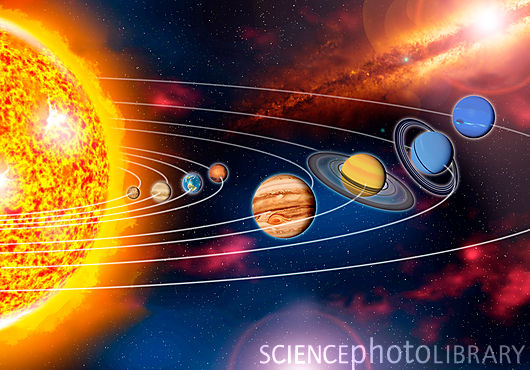
Courtesy of: Jose Antonio Penas/Science Photo Library

They are persuaded that the Sun, not CO2, is the primary driver of the Earth’s climate.  History shows that solar cycles that have low activity are accompanied by cooling climate.   For example, several minimally active cycles in succession have yielded the Maunder Minimum and the Dalton Minimum.  The temperature drop during the Maunder Minimum was so large as to give that Minimum the name—-“little ice age”.   The earlier Minimums were characterized by the low sunspot count.  Now we can add to that the F10.7cm radio flux, the geomagnetic readings, and many other ways to characterize the level of solar activity.  Even as new satellites and other investigative science provide us with greater understanding of the Sun, it still is not clear as to why Solar Cycle 24 is so inactive.  While many observers claim they knew 24 was going to be minimally active, the record shows most forecast that 24 would be pretty robust and not be appreciably different from Cycle 23.  Just like the weatherman that forecast rain for Maryland tomorrow because it is raining in West Virginia today, the solar experts now “know” that Cycle 25 will be like Cycle 24.

Dr. Hathaway of NASA observes that the Sun’s plasma Great Conveyor Belt (GCB) moved very rapidly in 2008 and 2009 but was notably slower in 2000 and 2001.  “I believe this could explain the unusually deep solar minimum we’ve been experiencing,” says Dr. Hathaway. The high speed of the conveyor belt challenges existing models of the solar cycle and it has forced us back to the drawing board for new ideas.”

Well ok, but why did the GCB change speeds?  Could the planets be the forcing  for this and other changes?

Planets as forcing agents

What is the relationship of the planets and Earth’s climate? There is a theory based upon on the conservation of momentum that links every planet to the Sun.  Another theory is the planet induced tidal effect upon the Sun’s plasma surface. Undoubtedly there are more, but two are enough for now.

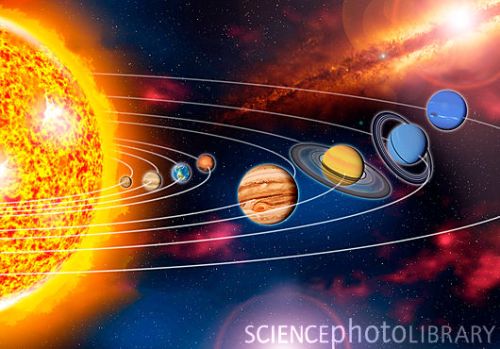
Refresher:   Some of my readers may need a refresher regarding the solar system planets.

Solar System Planetary Data (rounded)

Body Distance from Sun10^6km Mass10^22kg OrbitDays Orbit Circ.10^6 km OrbitSpeed 10^6km/day
Mercury 58 33 88 364 4.1
Venus 108 487 225 679 3
Earth 150 598 365 942 2.6
Mars 228 64 687 1432 2.1
Jupiter 778 190,000 4332 4887 1.1
Saturn 1429 56,900 10760 8977 0.8
Uranus 2871 8690 30700 18036 0.6
Neptune 4504 10280 60200 28294 0.5

The mass of the Sun is 1048 times that of Jupiter or 1.989X 10^30 .

 The Landschiedt Minimum

In 2003, Dr. Theodor Landscheidt published a paper  “New Little Ice Age Instead of Global Warming?”  In that paper he predicted that the Earth would start cooling with the coolest period about 2030 and that it would be equivalent of the Maunder Minimum (aka, “the Little Ice Age’).   Landscheidt used the Gleissberg cycle of 80 to 90-years to identify periods of cool climate on Earth. He said that within the Gleissberg cycle there is an 83-year cycle in the change of the rotary force driving the Sun’s oscillatory motion about the center of mass of the solar system.  His premise was that the collective angular momentum of the giant outer planets imposed a torque on the Sun that varies the speed of the Sun’s equatorial rotational velocity.  Some people are saying that this minimum should be called the Landscheidt Minimum. (Landscheidt died in 2004.) Landscheidt further predicted that another minimum would occur about 2200.

One might presume that the center of the Sun is the likely solar system center of mass.  Only on occasion is that true.  The center of the solar system’s mass is called the barycenter.  Watch this video to get an appreciation for the effect of the planets on the barycenter.  (no sound)

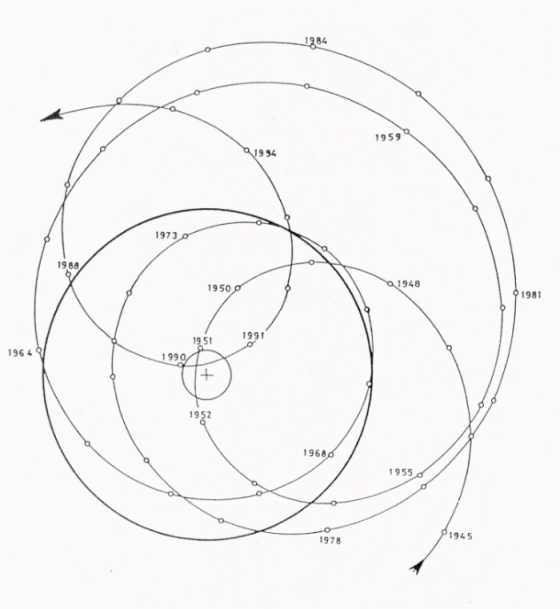
The following chart shows where the barycenter is relative to the Sun by year.
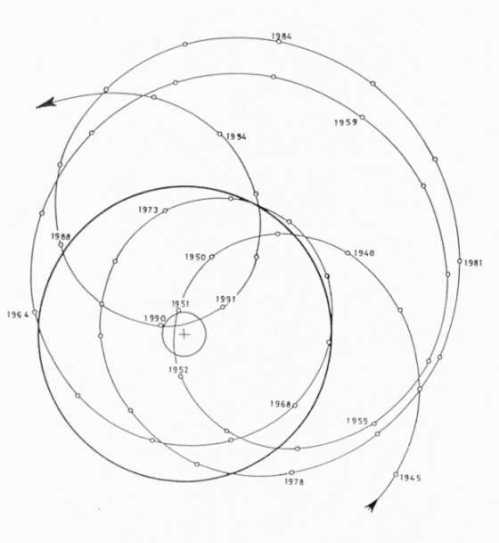
                      Figure 8:  Solar System Barycenter

Landscheidt said:

The solar dynamo theory developed by Babcock, the first still rudimentary theory of solar activity, starts from the premise that the dynamics of the magnetic sunspot cycle is driven by the sun’s rotation. Yet this theory only takes into account the sun’s spin momentum, related to its rotation on its axis, but not its orbital angular momentum linked to its very irregular oscillation about the centre of mass of the solar system (CM). Figure 8 shows this fundamental motion, described by Newton three centuries ago. It is regulated by the distribution of the masses of the giant planets Jupiter, Saturn, Uranus, and Neptune in space. The plot shows the relative ecliptic positions of the centre of mass (small circles) and the sun’s centre (cross) for the years 1945 to 1995 in a heliocentric coordinate system.

The large solid circle marks the sun’s surface. Most of the time, the CM is to be found outside of the sun’s body. Wide oscillations with distances up to 2.2 solar radii between the two centres are followed by narrow orbits which may result in close encounters of the centres as in 1951 and 1990. The contribution of the sun’s orbital angular momentum to its total angular momentum is not negligible. It can reach 25 percent of the spin momentum. The orbital angular momentum varies from -0.1�1047 to 4.3� 1047 g cm2 s-1, or reversely, which is more than a forty-fold increase or decrease (Landscheidt, 1988). Thus it is conceivable that these variations are related to varying phenomena in the sun’s activity, especially if it is considered that the sun’s angular momentum plays an important role in the dynamo theory of the sun’s magnetic activity.

Variations of more than 7% in the sun’s equatorial rotational velocity, going along with variations in solar activity, were observed at irregular intervals (Landscheidt, 1976, 1984). This could be explained if there were transfer of angular momentum from the sun’s orbit to the spin on its axis. I have been proposing such spin-orbit coupling for decades (Landscheidt, 1984, 1986). Part of the coupling could result from the sun’s motion through its own magnetic fields. As Dicke (1964) has shown, the low corona can act as a brake on the sun’s surface. The giant planets, which regulate the sun’s motion about the CM, carry more than 99 percent of the angular momentum in the solar system, whereas the sun is confined to less than 1 percent. So there is a high potential of angular momentum that can be transferred from the outer planets to the revolving sun and eventually to the spinning sun.

From wiki, a somewhat analogous to the Planets/Sun interaction: The conservation of angular momentum in Earth–Moon system results in the transfer of angular momentum from Earth to Moon (due to tidal torque the Moon exerts on the Earth). This in turn results in the slowing down of the rotation rate of Earth (at about 42 nsec/day[citation needed]), and in gradual increase of the radius of Moon’s orbit (at ~4.5 cm/year rate[citation needed]).

If you want to dig further into the concept of angular momentum, the following may be of interest to you:

Angular momentum is conserved in a system where there is no net external torque, and its conservation helps explain many diverse phenomena. For example, the increase in rotational speed of a spinning figure skater as the skater’s arms are contracted is a consequence of conservation of angular momentum.  Moreover, angular momentum conservation has numerous applications in physics and engineering (e.g. the gyrocompass).  See here, here and here to get the math behind conservation of angular momentum, angular momentum, and torque.

 Tidal Effect

Dr Nicola Scafetta of the Active Cavity Radiometer Solar Irradiance Monitor Lab (ACRIM) and Duke University has recently published in the Journal of Atmospheric and Solar-Terrestrial Physics  “Does the Sun Work as a nuclear fusion amplifier of planetary tidal forces?  Etc.”

Lets look at a summary of some of the planetary interactions with the Sun that affect the nominal 11 year solar cycle that he listed in his abstract to the article:

Numerous empirical evidences suggest that planetary tides may influence solar activity. In particular, it has been shown that: (1) the well-known 11-year Schwabe sunspot number cycle is constrained between the spring tidal period of Jupiter and Saturn, 􏰁 9:93 year, and the tidal orbital period of Jupiter, 􏰁 11:86 year, and a model based on these cycles can reconstruct solar dynamics at multiple time scales (Scafetta, in press); (2) a measure of the alignment of Venus, Earth and Jupiter reveals quasi 11.07-year cycles that are well correlated to the 11-year Schwabe solar cycles; and (3) there exists a 11.08 year cyclical recurrence in the solar jerk-shock vector, which is induced mostly by Mercury and Venus

Scafetta proposes that the planets cause surface tides on the Sun.  While very small, he believes the tidal gravitational potential energy dissipated in the Sun by the tides, may produce irradiance output oscillations with a sufficient magnitude to influence the solar dynamo processes.   More from the abstract:

Here we explain how a first order magnification factor can be roughly calculated using an adaptation of the well-known mass-luminosity relation for main-sequence stars similar to the Sun. This strategy yields a conversion factor between the solar luminosity and the potential gravitational power associated to the mass lost by nuclear fusion: the average estimated amplification factor is A􏰂4:25×10^6. We use this magnification factor to evaluate the theoretical luminosity oscillations that planetary tides may potentially stimulate inside the solar core by making its nuclear fusion rate oscillate. By converting the power related to this energy into solar irradiance units at 1 AU we find that the tidal oscillations may be able to theoretically induce an oscillating luminosity increase from 0.05–0.65 W/m^2 to 0.25–1.63 W/m^2, which is a range compatible with the ACRIM satellite observed total solar irradiance fluctuations. In conclusion, the Sun, by means of its nuclear active core, may be working as a great amplifier of the small planetary tidal energy dissipated in it. The amplified signal should be sufficiently energetic to synchronize solar dynamics with the planetary frequencies and activate internal resonance mechanisms, which then generate and interfere with the solar dynamo cycle to shape solar dynamics, as further explained in Scafetta (in press). A section is devoted to explain how the traditional objections to the planetary theory of solar variation can be rebutted.

Both theories have many critics.  I am not knowledgeable enough to support or deny these theories.   However,  Dr Hathaway’s comment about varying speeds in the Great Conveyor Belt would lend some support to these theories especially Landscheidts.   Anyway, the Sun is where the action is with respect to global climate change.  And it will probably be a number of years before any theory wins out.  Remember how much bad press the cosmic ray theory got from the experts, and this case I mean the warmers.  Now after some work at CERN, it is looking like a winner, just not yet announced.  There is hope.

cbdakota

A123 Systems Li-ion Battery Maker Loses $125M In1Q


A 123 Systems Inc. expects to post a net loss of $125 million(M) for the first quarter on revenue of $10.9M.  A123 Systems revised their 2012 revenue forecast downward from $230M to $300m to $145 M to $175 M.  Because the $300M revenue initially forecast less the $125M first quarter loss equals the new $175M revenue forecast, it looks like they think the rest of the year will be pretty smooth sailing.  That is an optimistic call, it would seem, in view of only $10.9M revenue in the 1st quarter. Part of the first quarter loss was a $51M charge to fix the Fisker batter packs.  To read more click here.

Besides making batteries for Fisker which I suppose is their principal client, A123 systems have made batteries for the GM Spark, BMW, and Shanghai Automotive.  They have supplied batteries for Tata transit buses and Daimler hybrid buses.  They have installed some 90MW of storage capacity for wind farms.

A1213 participated in Obama’s Energy Department and the State of Michigan’s incentives programs.  In September 2010, A123 received a $249 million grant from the Energy Department and $125 million in state of Michigan incentives.

Do you think this company will survive?  It’s a close call,one would think.

cbdakota

California’s Global Warming Solutions Act”—Part 2.


The Democratic polling firm of Fairbank, Maslin, Maullin, Metz & Associates at the request of the “Vote Solar Initiative” organization polled some 400 Los Angles residents and found according to an Aol Energy blog posting:

“The vast majority of Los Angeles residents are demanding more renewable energy, especially solar power, according to a new survey. Around 87 percent of voters want solar energy to generate more electricity and 79 percent welcome more wind power. Around three out of four voters (76 percent) say the solar power should be generated from rooftop panels.”

Aside from a pro-solar organization hiring a liberal Democrat polling organization to fashion a poll to get them the answers they wanted, the poll results show how far removed from reality are the LA citizens.  They are clamoring for more government intervention which is what has given California the 3rd highest unemployment rate in the country,  the 9th highest electricity rate and the 3rd highest gasoline cost. It’s the poorer people that are suffering the most.  This will be made even worse as the price of electricity continues its climb as they force in more uneconomical solar based production and drive out much lower cost fossil fuel production. This conclusion is also dawning on the Germans according to the Global Warming Policy Foundation: “The current funding of Germany’s green energy transition is anti-social, according to a new report by the Institute of the German Economy. The economic burden due to the Renewable Energy Sources Act (EEG) is up to 10 times higher for low-income households than for high-income households.”

The preliminary 2012 Energy Information Administration’s (EIA) estimates for levelized costs per kilowatt-hour in 2017 are 15.7 cents for a photovoltaic solar plant and 25.1 cents for a thermal solar plant.  That is far more expensive than the 6.7 cents per kilowatt-hour for conventional combined cycle natural gas and the 10 cents per kilowatt-hour for conventional coal in those same EIA estimates.  Also,  the EIA inflates the cost of coal by the equivalent of $15 per metric ton of carbon dioxide emitted to represent the difficulty of obtaining financing for coal plants. Further, it does not appear that the EIA levelized cost for conventional combined cycle natural gas plant is getting credited for the lower price of natural gas resulting from fracking shale.

The survey also said that:

“Most voters believe Los Angeles should create 1,200 megawatts of power from the sun, which is LADWP’s percentage of the state goal of 12,000 megawatts of local clean power by 2020.”  

And they inform us that 1200megawatts is enough to power 260,000 homes.  The calculation for number of homes powered  is suspect as it is varies from solar power promoter to promoter.  Without power storage, some other source of electricity most likely from a fossil fuel powered source is necessary because the lights would go out on these homes at night when the sun is no longer shining.  So much for reducing carbon emissions.  I wonder if California Air Resources Board (CARB) has put that in their solar energy calculations?

More on Solar cell reliability, etc. in my next posting on this topic.

cbdakota

California Law “Global Warming Solutions Act”—Is It A Black Hole?


The California environmentalists got Governor Schwarzenegger and the legislators to pass the “Global Warming Solutions Act” in 2006.   The law called “AB 32” is sweeping in its authority to regulate fossil fuels.  The stated objective of AB 32 is to implement a “transformative” standard that will reduce carbon emissions to 1990 levels by 2020.  In 2013, electric power and major industrial emitters of about 160million metric tons of carbon dioxide equivalent (MTCO2e) will be compelled to begin reductions. This will require fuel-switching, new lower-emitting plants and contracting for lower-carbon generated power form out of state. The program is essentially Cap and Trade.  In 2015, transportation, natural gas, smaller emitters, etc accounting for about 230MTCO2e will be required to begin reductions.   How this sector is to accomplish this is not clear and what ever it is, is expected to be expensive.   Off-sets seem to be one way but these are limited and further, no emitter can use more than 8% offsets to comply with the law.

AB32 has not gone unchallenged.  For one challenge, the Renewable Fuel Association (RFA), mainly representing ethanol producers say they will be ruled out of the California market.  The law is based on the study of total emission from “seed to wheel” and California Air Resources Board (CARB) sets a standard that the ethanol producers say makes compliance too expensive.  The RFA  got an injunction to stop implementation saying that the law was  unconstitutional because it violates the commerce clause which was intended to stop states from introducing laws that would discriminate against businesses located in other states.  But the US Court of Appeal (9th District) has now lifted the injunction.  The ruling on AB 32’s constitutionality is expected soon and the lifting of the injunction probably indicates they will say it is constitutional.

AB 32 was the product of Western Climate Initiative (WCI) that was formed in 2007.  The partners in the WCI were California, Arizona, New Mexico, Oregon and Washington and later expanded by the addition of Montana and Utah plus the Canadian Provinces of British Columbia, Manitoba, Ontario and Quebec 2008. Each State or Province would not bound by AB32; they would have to pass similar bills in their respective legislative bodies.

All the US states dropped out when AB 32 was passed obviously not on-board with the size and scope of the act and that it was unlikely to get passed in their respective states.  The four Canadian Provinces have remained and have issued AB 32 as guidelines.   It would seem that the tar sands oil in Canada would be negatively affected by these guidelines if they become law in the four Provinces.

The trend for California to get their electrical power from out of state will be affected by this law as well.  CARB wants to limit “leakage” where emissions drop only because the generation source is out of the state.  So any emissions that occur in the process of generating the imported electricity are to be accounted for.

So why the comment about a black hole?  The size of the California market is huge. In the years past,  if California made an environmental change, the nation often followed. The Federal Clean Air Act was pretty much a product of California. Before retirement I pushed a program to amend the Clean Air Act to permit the use of up to 5% methanol mixed with ethanol in gasoline.  It was necessary to work with CARB if you wanted to do business in California. At that time they wanted to use methanol but not as a low level blend but as the primary fuel.  I think CARB and California have become too zealous.  The fact that all the states dropped out of the WCI is pretty telling.   When the price of electricity, gasoline, and other fossil fuel associated products get way out of step with rest of the nation and more industries flee the cost burden to more friendly states, I hope California residents get the message.

Next posting will look at the Californian’s wanting more solar power.  I don’t believe they know how costly this will be.

cbdakota

Obama Administration And A UN World Government


Is there a connection between the Obama Administration and a UN world government?

The Obama Administration policy, known as the Global Climate Change Initiative (GCCI), is intended to help developing countries combat the effects of man-made global warming.  Since 2010, the Obama Administration, in the name of GCCI, has given away  $2.5 billion.  Obama has requested another $770 million for 2013.  The objectives of this anti-global warming foreign aid are: adaption, clean energy and sustainable landscapes.  Adaption is to provide better climate data and to teach them how to adapt to floods, droughts, and sea level rise.  Clean energy is to help them develop their own green energy programs.  And sustainable landscapes is to save the forests from over-logging, for example.

The Congressional Research Service (CRS) has voiced some excellent reasons for not spending this money among which are the following:

  • Man-made global warming is at best uncertain.
  • The Nation is facing another year of $1trillion budget deficits so this expenditure could be fiscally responsible.
  • Foreign Aid is often misused or wasted in these countries.

CRS does note that sometimes such a program can be effective in preserving the US leadership role in the world and other intangibles.

The United Nations Climate Change Conferences, e.g. Copenhagen, Cancun, have developed Accords that say the Developed Nations owe the Developing Nations monies as “environmental justice” because the former have prospered at the expense of the latter.

The Cancun Accord summary released December, 2010 by the parties at the Conference outlines the transfer of monies:

“Following negotiations that ran through early Saturday morning, delegates at the 16th Conference of the Parties (COP16) in Cancun adopted by consensus the Cancun Accords, a series of documents that will provide the basis for efforts to confront climate change after the Kyoto Protocol expires.

The accords include a $30 billion-package for 2012 to aid nations taking immediate actions to halt effects of global warming, as well as financing for long-term projects to protect the environment through a Green Fund, which will provide $100 million annually for adaptation and mitigation measures.  Delegates also approved the creation of the forestry program Reducing Emissions from Deforestation and Forest Degradation (REDD+) to facilitate the flow of resources to communities dedicated to forest conservation”.

The reasons given by the Administration for the GCCI seem to mirror those in the UN Cancun Accord.  The US delegates at this conference supported the Cancun Accord, unfortunately.  That of course does not make the Accord law, but it does represent the mindset of the Administration and their delegates

The monies are a part of the Warmers overall objective of giving the UN control of global environmental regulation’s enforcement.  The environmental control would mean that the UN would be able to control energy use, development, etc. —the lifeblood of every nation.  Easy to see how this would make the UN the world government.  Do you want the UN to govern our nation?

cbdakota

Bogus Mercury Scare Used To Shutdown Coal Electricity Generating Plants


Before he was elected, President Obama said that he would bankrupt anyone who built a new coal-base power generation plant.  He planed to do this by enacting Cap and Trade legislation that would target coal-based facilities. Because coal-based plants emit more CO2 than do natural gas-based plant per kW of electricity, the CO2 tax levied on coal-based facilities would make them uneconomical to build and operate.  However a bill for his signature could not get out of Congress.  (A little discussion of the regulation of CO2 later.) The administration refocused their efforts to put coal out of business by issuing new regulations that reduced the amount of mercury and other air pollutants in coal plant emissions (CO2 was not included).   Mercury is clearly the poster child for these new regulations and that is obvious by the many press releases and stories in the media. According to the EPA, children exposed to the reduced mercury levels will be healthier and have higher IQs.

How solid is the contention that it will make our children healthier?   A posting by Willie Soon and Paul Driessen, titled “US: The myth of killer mercury” shows the EPA’s actions to not be based on good science:

According to the Centers for Disease Control’s National Health and Nutrition Examination Survey, which actively monitors mercury exposure, blood mercury counts for US women and children decreased steadily 1999-2008, placing today’s counts well below the already excessively “safe” level established by EPA.

A 17-year evaluation of mercury risk to babies and children, by the Seychelles Children Development Study, found “no measurable cognitive or behavioral effects” in children who eat five to twelve servings of ocean fish every week, far more than most Americans do.

The World Health Organization and US Agency for Toxic Substances and Disease Registry assessed these findings in setting mercury risk standards that are 2-3 times less restrictive than EPA’s. Even under WHO and ATSDR guidelines, no American children are even remotely at risk from mercury.

EPA ignored these findings. Instead, the agency based its “safe” mercury criteria on a study of Faroe Islanders, whose diet is far removed from our own. They eat few fruits and vegetables, but do feast on pilot whale meat and blubber that is high in mercury and polychlorinated biphenyls (PCBs) – but very low in selenium. The study is clearly irrelevant to this rulemaking.

Finally, EPA maintains that mercury deposition, its conversion to methylmercury, and MeHg accumulation in fish and humans is a simple process that can be controlled by curtailing emissions from US power plants. That is not correct. In fact, mercury emissions (from all sources) and raw mercury levels in fresh or ocean waters are only part of the story.

Complex, nonlinear interactions among at least 50 natural variables control the biological and chemical processes that govern elemental mercury conversion to methylmercury and MeHg accumulation in fish. Those variables, and selenium levels in fish tissue, are beyond anyone’s ability to control.

So clearly the EPA has grossly exaggerated the threat of mercury.

Another question that needs to be asked is how much mercury is released each year and how much of that comes from US coal-based plants.

Mercury Emissions – Natural and Man-Made

Source Emission Quantity, Mg/Year % of Total
Natural 5207 69
Manmade 2320 31
            TOTAL 7527 100
North American Coal Plants 65 0.9

 Data From Global mercury emissions to the atmosphere from anthropogenic and natural sources” Atmos. Chem. Phys., 10, 5951–5964, 2010 by N. Pirrone, S. Cinnirella, X. Feng, et al.

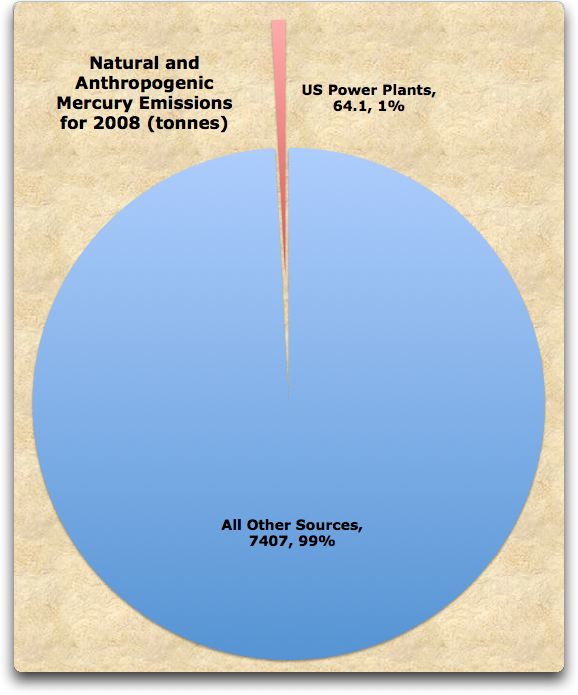
The mercury emissions total from the North American coal-based plants are less than one per cent of global emissions!!  So the effect on the health of people in the US through reduction of some fraction of the coal-based plants mercury emissions is essentially too small to measure.  However the effect of the increased cost of electricity will directly affect the health of the people in the US and especially the poorest among us.

See this posting by the Institute for Energy Research to get a sense of the loss of generating capacity that this EPA regulation will cause.

Willis Eshenbach developed two charts for his posting “The EPA’s Mecurial Madness” on the WUWT website.   They visually illustrate the futility of the EPA action to make any difference in mercury levels.

The EPA has more “kill coal-based power generation capacity” arrows in its quiver, and I plan to post on this soon.  As a preview, they are proposing a standard that will not permit the installation of new coal-based plants.

cbdakota

$141M Solar Plant Has 5 Full Time Employees.This is a Success?


The Nevada Copper Mountain Solar 1 plant is being visited today, 21 March by President Obama where he will deliver remarks on his Administration’s focus on diversifying our energy portfolio.   Solar 1 is the US’s largest photovoltaic power plant.  It cost $141 million to build.  According to the Nevada Journal: “Funding included $42 million in federal-government tax credits and $12 million in tax-rebate commitments from the state of Nevada.”  It has 5 full-time employees.  About $10 M of incentives per green job.  Apparently the President considers this a success.

President Obama’s visit to the Solar 1 Facility in Boulder City is the perfect illustration of why the president’s economic policies are such a failure,” said Andy Matthews, president of Nevada Policy Research Institute, (NPRI). “The government has spent over $50 million to ‘create’ five permanent jobs and build a plant producing a product — expensive solar energy — that no one would purchase without a government mandate.

“That’s not a path to a vibrant economy; it’s the road to serfdom. This mindset — of government attempting to pick winners and losers in the economy through subsidies and regulation — is a major reason why the national unemployment rate is at 8.3 percent, Nevada’s unemployment rate is 12.7 percent and the national debt is over $15.5 trillion.”

Kyle Gillis, a reporter for the Nevada Journal, the source of much of this posting, adds: “Solar plants aren’t the only government-funded energy projects in Nevada that haven’t lived up to their proponents’ promises. The Reno Gazette-Journal recently reported that seven local windmills that cost taxpayers $1 million to install have only saved the City of Reno $2,785 in electricity costs over their 18 months of existence”.

The Solar 1 plant is associated with Bolder City, NV but the power generated is being sent to Southern California.  California mandate’s power must be 20% renewable by 2010, 33% renewable by 2020. They did not achieve the 2010 level of 20%.  If the California Utilities supplying the energy do not comply, they risk being fined.  Californians seem to want to drive business from their state with many environmental policies that businesses just can’t afford.  California’s electricity price is 9th highest in the nation only surpassed by Hawaii, and group of Northeastern states such as Connecticut, and New York. By the way, hydroelectric power is not considered renewable under this California mandate.

Obama used his “luddite” and “straw man” speech today. I cannot recall a President in my lifetime that has been so incautious with what he says.   I guess it goes with the territory of being on a constant campaign.  I would think the appropriate name for the President is “fabulist”—and of course I am saying that politely.

I want to leave you with a chart that shows the hill that solar and wind have to climb to reach the heights that the President and his sycophants have set.   As you look at the chart below, think of Matt Ridley’s words: “To the nearest whole number, the percentage of the world’s energy that comes from wind turbines today is: zero.

 WORLD ENERGY USE 

This chart is from Wikipedia.   The data is 2006 but it things wont have changed much by 2011 in terms of percentages.

cbdakota

Global Temperature Update—February 2012


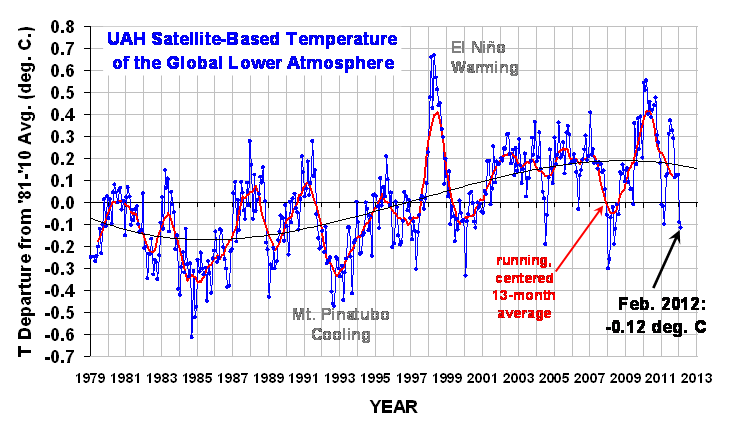
The UAH satellite global temperatures have been posted by Dr Roy Spencer on his website.  The February temperature anomaly is -0.12 C.   That is just slightly down from the January number of -0.09C.

Above is Dr Spencer’s chart (click on it to enlarge) of the global temperature anomalies since the start of the satellite temperature-measuring program in the late seventies.  The average global temperature departure is about 0.16C warmer that the average temperature for the period 1981-2010.  Dr Spencer might not approve of this calculation but 0.16 C over that 30-year period might indicate a warming of about 0.6C per century.  Further, if solar Cycle 24 and the next Cycle 25 perform as many are now forecasting, we may see the anomaly go negative for many years.

cbdakota

Lubos Motl’s 104 Reasons To Be A Skeptic


Lubos Motl’s skeptical website, The Reference Frame, is widely read and cited.  Motl counters John Cook’s assertions about man-made global warming.  Motl provides background science that will serve skeptics in any discussion and/or debate.  Motl introduces his material as follows:

John Cook, a former student of physics in Australia, has constructed an interesting website trying to attack the opinions of climate skeptics.

It’s been in my climate bookmarks for quite some time but no one really cared about it so I didn’t want to respond. However, his talking counter-points were recently adopted by an iPhone application. Moreover, Andrew Revkin promoted the website, too. So let us look at his points and counter-points.

Motl matches the headings from Cook’s listing of “myths” and Motl adds his view illustrating what the real story is. Below are two of the 104 topics so you can get a flavor of what is included. To read to all of Motl’s work click here.

On his (Cook) website, you can currently see 102 observations by the skeptics (or some skeptics); 2 of them were added by March 29th and I can’t constantly update this web page so that he’s likely to surpass his 104 points sometime in the future. Each of the “slogans” is accompanied by a short attempted rebuttal by John Cook. And if you click it, you get to a long rebuttal. So let’s look at them:

1. It’s the sun: I agree with Richard Lindzen that it’s silly to try to find “one reason behind all climate change”, because the climate is pretty complex and clearly has lots of drivers, and this applies to the opinion that “everything is in the Sun”, too. Cook shows that the solar irradiance is too small and largely uncorrelated to the observed changes of temperatures. I agree with that: a typical 0.1% change of the output is enough for a 0.025% change of the temperature in Kelvins which is less than 0.1 °C and unlikely to matter much. But I find it embarrassing for a student of solar physics such as himself to be so narrow-minded. The Sun influences the Earth’s atmosphere not only directly by the output but also indirectly, by its magnetic field and its impact on the cosmic rays (via solar wind etc.) and other things. He has completely ignored all these things. Of course, I am actually not certain that these effects are very important for the climate but the evidence – including peer-reviewed articles – is as diverse as the evidence supporting CO2 as an important driver.

104. Southern sea ice is increasing: Cook agrees but says that it surely has nothing to do with warming or global climate change. It must be due to “complex phenomena” such as changes of the winds and circulation. Note that such comments would be unthinkable if he tried to discuss the Northern sea ice. As we have noticed, all “warming” observations are about the climate, important signals that you should appreciate, worship, extrapolate, and be afraid of. On the other hand, all “cooling” observations are just an irrelevant weather that you should dismiss, humiliate, and spit on. With such a biased attitude, it shouldn’t be shocking that Mr Cook ends up with an irrational orthodoxy based on 104 largely obscure misinterpretations, misunderstandings, and myths – and that his opinions about the most important questions are upside down.

Go through all of them, you will might learn something that you didn’t know.

cbdakota