Category Archives: CO2

CO2 Causes What? Part 2—The Carbon Cycle


The theory of catastrophic anthropogenic (man-made) global warming (CAGW) as interpreted by a certain group (the warmers) is predicated on the idea that carbon dioxide (CO2) in the atmosphere has the potential to do serious harm to the Earth. Their theory goes like this: Nature releases and then recaptures CO2, thus the atmospheric CO2 content is stable. They then add, largely, through the CO2 produced from burning fossil fuels , man has upset that balance and CO2 is accumulating in the atmosphere. The chart below by the National Oceanic and Atmospheric Administration (NOAA) is a representation of the “Carbon Cycle”.

CO2blogcarboncycleThe numbers on the chart are Giga tons of carbon on an annual basis. A giga ton is one billion tons, that is to say 1,000,000,000 tons.

According to this chart, every year the “gross global primary production and respiration” releases 119 giga tons and then takes in 120 giga for growing vegetation. The ocean’s emit 88 giga tons and absorb 90 giga tons. Fossil fuel combustion and other industrial processes emit 6.3 giga tons and have no returns. Land use changes are small at 1.7 emited and 1.9 returned. It also tells us that 730 giga tons of carbon are in the atmosphere.   In our last posting we related that the atmospheric CO2 is at 400ppm. That gives you some idea of how vast the Earth’s atmosphere is.

There are many drawings of the carbon cycle and they often have different numbers than the one shown above. But the idea is the same in all cases. The chart makers really are guessing at the numbers anyway. The fossil fuels number is the only one where data are largely available. So it is likely the best one. Another thing to know about this chart is that it is in tons of carbon. There are other sources of carbon such as methane, CH4. But because CO2 is the major carbon source you can read the chart as essentially a gross measure of CO2 for our purposes.

The net exchange by this chart results in an annual carbon accumulation of 4.1 giga tons into the atmosphere. The total from the chart of the emissions to the atmosphere are about 205 giga tons of which 8 giga tons are man-made or 4% of the total CO2 emissions. This raises the obvious question: if the big natural numbers (in blue) are no more than broad estimates, do we really know what is going on?

The next posting will examine a version of the Greenhouse Effect.

cbdakota


CO2 Causes What? Part 1– How Much CO2 Is In The Atmosphere?


When a discussion of “greenhouse gases” takes place, one sometimes wonders if the reader is aware of the make up of the Earth’s atmosphere.   Many of you, especially the engineers and scientists that read this blog, know about the elements that make up the atmosphere and what the carbon cycle is. But for those that don’t have this background,  this may help.

The measured atmospheric CO2 is about 400 parts per million (ppm) at present. That means that for every 1,000,000 gas molecules in our atmosphere, about 400 of the gas molecules are carbon dioxide.

Continue reading

2014: The Year That Wasn’t The Hottest


globalwarmingcartoonstock-vector-global-warming-cartoon-illustration-with-globe-and-thermometer-measuring-the-planet-temperature-28859638It is truly amazing that no major US media outlet managed to challenge the recent NASA/GISS statement that 2014 was the warmest year ever. There was no equivocation in the US media about that being the truth. And they quoted “scientists” that said this proved that man-made global warming was an unarguable fact.

A UK media organization took the time to read the presser and concluded that the leader of NASA’s GISS organization needed to be challenged. The upshot is that GISS’s Director Gavin Schmidt, according to the DailyMail.com “ has now admitted NASA thinks the likelihood that 2014 was the warmest year since 1880 is just 38 per cent.”

Wow, perhaps it could be said that it is 62% unlikely to be the warmest year ever.

Continue reading

No Global Warming For 18 Years And 3 Months


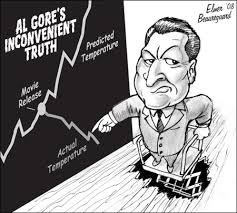
GoreNo global warming for 18 years and 3 months.   The catastrophic global warming crowd knows this to be true. They have been working very hard at coming up with an explanation for the pause. In fact there are at least 52 (some say up to 70) published competing theories trying to understand why the temperature is not rising even though atmospheric carbon dioxide (CO2) continues to rise. The chart below, Figure 1, from  a WattsUpWithThat posting  by Christopher Monckton of Brenchley illustrates the flat global temperature:

notempchangeclip_image002_thumb

Figure 1. The least-squares linear-regression trend on the RSS satellite monthly global mean surface temperature anomaly dataset shows no global warming for 18 years 3 months since October 1996

Monckton says:

The Great Pause is a growing embarrassment to those who had told us with “substantial confidence” that the science was settled and the debate over. Nature had other ideas.

Read the full paper by clicking here.

cbdakota

Solar Cycle 24: 2014 Review


ancientsun6289386788_3f700efdbc_zSolar Cycle 24 maximum occurred in February of this year when the International sunspot number peaked at 102. An earlier  maximum call was made in late 2011 when the sunspot number reached about 96.  That was followed by several months of declining sunspot counts, then activity picked up and a “double peak” resulted. The smoothed¹ number for the peak is 82 (versus the actual monthly value of 102). December 2014 sunspot number was 78. So the smoothed number for December has not yet been calculated, but it is estimated that it will be about 68.

Continue reading

NASA Satellite:Highest Levels Of CO2 In Southern Hemisphere


A new NASA satellite finds the highest levels of atmospheric CO2 in the Southern Hemisphere. One would have expected the highest levels over the Northern Hemisphere where the highest concentration of fossil fuel use occurs. This result is the first publication of the satellite’s measurements so it may be an anomaly.

NASA provided the following “Average CO2 Concentration Oct 1 to Nov. 11, 2014” chart:

OCO-2image2Note the scale on the bottom of the chart, that ranges from 387 to 402.5 ppm atmospheric CO2. As you can see the more red the coloring on the chart the higher the CO2 level. Roughly the red begins about 400 ppm. The reddest areas are over South America, Africa, Indonesia, China, the Northern Pacific East of Japan and the Southern Pacific East of Australia.

Continue reading

Obama Agrees To Give China A 16-Year Advantage On Energy Costs.


onionpicofobamaandJinping700President Obama announced a “historic” (probably should have said “hysterical”) agreement with China regarding greenhouse gases.  The President says we will reduce CO2 emissions by an economy-wide targets by 26%-28% below its 2005 level in 2025.    This will require an equivalent reduction of the use of fossil fuels (oil, natural gas and coal).   China will continue to increase its CO2 emissions to sometime around 2030 and to make best efforts to peak early and intends to increase the share of non-fossil fuels in primary energy consumption to around 20% by 2030.   So, the US will incur sharp increases in the cost of energy over this period of time.  China gets the green light to use the cheapest form of energy production until at least 2030.

Continue reading

Chinese Reject Electric Cars


Henry Lee of the Harvard Kennedy School reports the Chinese chineseelectricsimagesgovernment cannot make their people buy electric cars. The American “Green” press insists that China is the leader in green technology and that they want to join in a pact to reduce CO2 emissions.   Well if you watch what the Chinese do rather than what they say, you would know they have no intention of cutting back on the use of fossil fuels.

Continue reading

Climate Cooling Predicted by New Solar Theory


Dr David Evans has proposed a new theory that he believes  demonstrates the link between the Sun’s total solar irradiance (TSI) and the Earth’s climate. The idea that TSI and the Earth’s Climate are linked is not a new or novel theory. Evan’s has built a computer program that provides a time delay between a change in TSI and the time that climate begins to respond. He believes the key to his program is the use of “notch filter” similar to those used in the communications industry to filter out “noise”.

He also is asking for peer review of this program via “crowd sourcing”.   Reading the comment sections of the sites where he has posted his theory and provided much of the coding, he certainly has been successful in getting comments.  At the time of my last survey,  the comments  he has received are mostly positive but some others are skeptical.

For this study, Evans derived a new transform that he calls the “optimal Fourier transform (OFT)” for this paper. This transform provides the “notch”.  One commenter suggested that the use of another type of Fourier transform would improve Evan’s program and appears that Evans agrees.   (I did take a course in Laplace Transforms, but not being an Electrical Engineer, I have forgotten what I learned. This comment is a way of letting the reader know that I am unable to intelligently comment on the math used in Evans’ program. )


WHY IT’S GOING TO COOL

“The reason for the cooling is the dramatic fall in solar radiation that started around 2004. Here is a graph of solar radiation since 1610, when sunspots were first recorded. The brown line is the solar radiation, and it peaks every 11 years or so because of the sunspot cycle. We put an 11-year smoother through it to give us the red line, which shows the trends in solar radiation.”    (Click on charts for improved clarity.)

EVANStotal-solar-irradiance-1.1

Figure 1

Evans says there have been three steep falls in TSI in the last 400 years and each of these falls have been accompanied by major global cooling.

That the global temperature has fallen in sync with the drop off of TSI appears to be an awfully good correlation. But many skeptics as well as warmers argue that it must have been for some other reason other than TSI because (look at the vertical axis) the total change in TSI is too little to be of consequence.

This blog has always proposed that the Sun is the major forcing agent in global climate. Perhaps the causation is not the TSI, but I continue to believe the something correlated to the Sun’s activity is the causation. Having said that, time to move back to Evans’ theory.

Continue reading

Shutting Down U.S. Coal Based Power Plants Will Not Lower Global Temperatures


The U.S. Environmental Protection Agency (EPA) recently issued a new set of proposed regulations aimed at reducing carbon dioxide emissions from existing U. S. power plants. The premise for this EPA action is that unless CO2 emissions are reduce global temperatures would rise by the end of this century to levels that would cause catastrophic climate change damage. But the basis for such action is not science but rather politics. In our previous posting, it was shown that climate models that predict global temperature are not skilled and have not predicted actual measured global temperatures. Using these models to base legislation is playing Russian Roulette with the US economy.

Knappenberger and Michaels (K&M) posted on 12 June in WUWT “EPA leaves out the most vital number in their fact sheet”. They show that this initiative will not have any measureable effect on global temperatures. K&M summarize the “regulation”:

“The EPA’s regulations seek to limit carbon dioxide emissions from electricity production in the year 2030 to a level 30 percent below what they were in 2005. It is worth noting that power plant CO2 emissions already dropped by about 15% from 2005 to2012, largely, because of market forces which favor less-CO2-emitting natural gas over coal as the fuel of choice for producing electricity.”


“For some reason, they left off their Fact Sheet how much climate change would be averted by the plan. Seems like a strange omission since, after all, without the threat of climate change, there would be no one thinking about the forced abridgement of our primary source of power production in the first place, and the Administration’s new emissions restriction scheme wouldn’t even be a gleam in this or any other president’s eye.”

“But no worries.  What the EPA left out, we’ll fill in.

“Using a simple, publically-available, climate model emulator called MAGICC that was in part developed through support of the EPA, we ran the numbers as to how much future temperature rise would be averted by a complete adoption and adherence to the EPA’s new carbon dioxide restrictions*.”

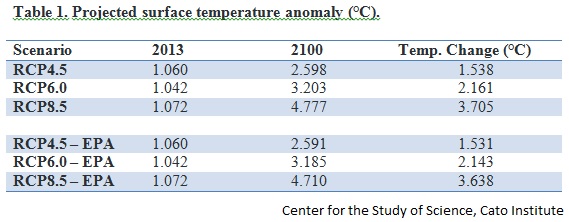
The answer? Less than two one-hundredths of a degree Celsius by the year 2100.   0.018°C to be exact. 

Well how did they come up with that number?

  • They used the Model for the Assessment of Greenhouse-gas Induced Climate Change (MAGICC)— to examine the climate impact of proposed regulations.They used the three IPCC Representative Concentration Pathways (RCP). RCP4.5=low-end emissions, RCP6.0=middle of the road and RCP8.5=high emissions.
  • They estimated the US power plant CO2 emissions.

KMcarbonemissionscenariosgsr_061114_fig1Figure 1. Carbon dioxide emissions pathways defined in, or derived from, the original set of Representative Concentration pathways (RCPs), for the global total carbon dioxide emissions as well as for the carbon dioxide emissions attributable to U.S. electricity production.

“We then used MAGICC to calculate the rise in global temperature projected to occur between now and the year 2100 when with the original RCPs as well as with the RCPs modified to reflect the EPA proposed regulations (we used the MAGICC default value for the earth’s equilibrium climate sensitivity (3.0°C)).”

KMglobalavgsurfacetempgsr_061114_fig2Figure 2. Global average surface temperature anomalies, 2000-2100, as projected by MAGICC run with the original RCPs as well as with the set of RCPs modified to reflect the EPA 30% emissions reductions from U.S power plants.

Because the difference between lines is so small, the authors added two tables for the data illustrated in figure 2.

KMtable1gsr_061114_fig3a

KMtable2gsr_061114_fig4a

Yes,  this posting says that the computer models are not suitable to make policy decisions and yet the K & M posting is predicated on a computer model. Two things here. First, in the course of making this new policy the EPA climate model must have been run by the EPA. They did not list a drop in global temperatures so they know it is devastating.   Second, the EPA is not likely to claim the K & M work is invalid because EPA must use this model in their other pronouncements about climate .


The K& M posting should be read in its entirety.

cbdakota