The “Kinda” New Warmer Narrative–Ocean Acidification


Because global temperatures were not responding to increasing atmospheric CO2, the warmers began looking for new narratives to use to frighten the public into giving them more money. The oceans were thought to be a good target. To explain why global temperatures were only inching up, they jumped on the sea shellsimagestheory that the heat was being trapped in the ocean. Just like that, the “heat” decided to go into the ocean and not warm the atmosphere. The logic of that proposition was viewed as somewhat problematic, to say the least.

Another narrative was to say that the ocean was being made acidic and that would have a devastating effect on sea life. This narrative, acidification of the ocean, had been around for a number of years. But it needed some spicing up. Former head of NOAA, Jane Lubchenco, referred to ocean “acidification” as global warming’s “equally evil twin.”


Continue reading

This Is “Man-Made” Global Warming Courtesy Of NASA


Tony Heller posting on RealClimateScience.com shows how the global temperature increase is indeed man-made.  Man-made as in “man”ipulating the data. Heller says NASA has changed the data over the past 15 years so that it now shows the year 2001 is about 0.2°C higher on the NASA 2016 chart than it was on NASA’s 2001 chart.

NASA_Fig._A_2001vs2016

And you can note that the 1880 temperature anomaly was made colder by 0.3°C between the 2001 and the 2016 charts.  Those two changes increase the amount of  “man-made” warming by about 0.5°C over those years.

The warmers have also been waring against the satellite temperature  measurements saying they are in error.  But the weather balloons temperature measurements confirm the satellite’s temperature measurements.   There are no independent checks on the NASA system (GISS) or other surface measuring systems.

The chart below show the temperatures by year for the period from 2000 to 2016 using RSS satellite and GISS temperatures and the temperature trends for those years.

woodfortrees2016-01-20-13-31-07

Note that while the surface measuring GISS shows warming, the RSS satellite system show a cooling trend.

Heller says “The fact that the US space agency is ignoring satellite data, is a pretty strong indication that the agency has collapsed into a hopelessly corrupt and decadent state”.

cbdakota

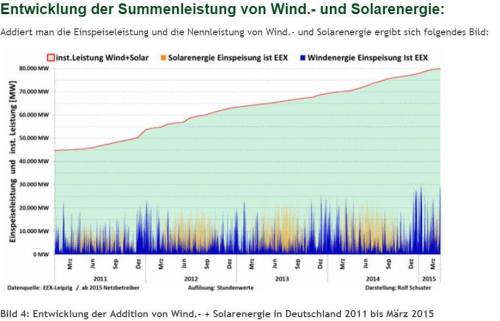
Germany’s Renewables Can Only Provide 11% Of Their Rated Capacity


Here is a look at the German renewable energy program. The NoTricksZone is a site that covers German media and reports it in English. The site is managed by Pierre Goselin and he recently posted “Two Great Destructive Lies German Leaders Refuse To Abandon”. The first of the two “lies” relates performance of wind and solar systems and it is that:

German renewable energies sun and wind are a success!”

germansolarwindcapvsactual

Continue reading

El Nino–Walker Circulation


The prior posting, “Some Background Regarding An El Nino began like this: “Currently, the weather is being strongly affected by an El Nino.  El Nino is but one part of a weather/climate system known as the El Nino Southern Oscillation (ENSO).  There are three phases of ENSO — El Nino, La Nina and Neutral.   ENSO is important because of its ability to change the global atmospheric circulation, which in turn, influences temperature and precipitation across the globe. The global atmospheric circulation is called the Walker Cycle   Circulation“.

This posting examines the Walker Circulation.(I have seen both cycle and circulation used but much of my sourcing for this posting uses Circulation.)

First lets talk about high and low pressure centers. Fair weather generally accompanies a high-pressure center while clouds and precipitation generally accompany a low-pressure center.  Low-pressure centers are formed by a hot surface. For example, the hot Pacific Ocean water that is driven to the Maritime Continent by the trade winds along the equator. The air is hot and moisture laden and as it rises, it cools and the moisture becomes rain. It reaches high-level winds that drive it to the west or east. This air is now dry and cool. It begins to fall forming a high-pressure center.   The air in the high-pressure center begins to flow toward the low pressure center residing above the hot seawater located in the Maritime Continent. Along the way it begins to warm and pick up moisture and then rise. This completes the circulation.

Continue reading

Some Background Regarding An El Nino


Currently the weather is being strongly affected by an El Nino. El Nino is but one part of a weather/climate system known as the El Nino Southern Oscillation (ENSO). There are three phases of ENSO — El Nino, La Nina and neutral.   ENSO is important because of its ability to change the global atmospheric circulation, which in turn, influences temperature and precipitation across the globe. The global atmospheric circulation is called the Walker Cycle and we will look  at that in the next posting.

Many of you already are fully informed about the ENSO but my guess is that some of you are not. I thought it might be helpful to provide some background information. (1)

First of all, we are talking about the Pacific Ocean. The Pacific Ocean from South America to the Maritime Continent(2), a distance of about 10k miles along the equator. Usually the trade winds blow along the equator toward the west. This moves the hot surface water to the Western Pacific. The sea surface is about ½ meter higher in Indonesian than it is in Ecuador. 
Usually, sea-surface temperatures off South America’s west coast range from the 60°s to 70°s F, while they exceed 80°F in the “warm pool.” This description is essentially that of the neutral phase.

On occasions the easterly winds weaken and the hot water begins to flow eastward toward South America. This is the beginning of an El Nino. It typically starts in the May-June timeframe as the water flows eastward. It reaches it peak strength about December. January through March/April typically are the months that the El Nino begins to lose it strength. Some El Ninos maintain strength longer such as the 1998/1999 El Nino, which is considered one of the strongest ever.

Continue reading

EPA Chief Provides Non-Answer To Reporter.


Environmental Protection Agency Administrator Gina McCarthy spoke at the Council on Foreign Relations in Washington, D.C., on Jan. 7, 2016. The event seerimageswas focused on the “threat” of climate change. A CNSnews.com posting “EPA Chief: Climate Change Is Certain But You Can’t Predict the Future” related the comments made by the Administrator at that meeting.

A CNS News reporter asked the Administrator the following question:

“According to the Energy Information Administration – although alternative and renewables are growing slightly – fossil fuels will still account for 80 percent of U.S. energy needs through 2040. Federal data also shows that U.S. carbon emissions are at almost a 20-year low right now. How do those facts fit into the picture the EPA is painting of the U.S. energy landscape?”

Continue reading

GISS Directors (Hansen and Schmidt) Are Marvelous Communicators?


NASA’s Goddard Institute for Space Studies(GISS) has had three directors since its founding in 1961. It’s first director was Robert Jastrow. From 1981 to 2013, GISS was directed by James E. Hansen. In June 2014, Gavin A. Schmidt was named the institute’s third director.

The last two are noted for their complete commitment to the theory of man- made catastrophic global warming (CGW). Hansen is considered by many as the godfather of this movement. His testimony in a Congressional hearing was the “alarm bell” for the liberal politician. He presented charts that were very alarming and have subsequently been shown to be very wrong.   He was (and still is ) an activist having been arrested many times for impeding coal trains and other tricks in an attempt to gain publicity for his cause. But it seems he has been wrong much more than he has been right. The following is one of his many scary predictions that have not been realized. Hansen is informing the newly elected President Obama in January 2009 that there were only 4 years left to save Earth.

From the January, 2009  Guardian posting “President ‘has four years to save Earth’” James Hansen said:”

Barack Obama has only four years to save the world. That is the stark assessment of Nasa scientist and leading climate expert Jim Hansen who last week warned only urgent action by the new president could halt the devastating climate change that now threatens Earth. Crucially, that action will have to be taken within Obama’s first administration, he added.

Soaring carbon emissions are already causing ice-cap melting and threaten to trigger global flooding, widespread species loss and major disruptions of weather patterns in the near future. “We cannot afford to put off change any longer,” said Hansen. “We have to get on a new path within this new administration. We have only four years left for Obama to set an example to the rest of the world. America must take the lead.”

Hansen said current carbon levels in the atmosphere were already too high to prevent runaway greenhouse warming. Yet the levels are still rising despite all the efforts of politicians and scientists.

Doesn’t Hansen contradict himself when he says that Obama can save the Earth but that “current carbon levels in the atmosphere were already too high to prevent runaway greenhouse warming”?  Sounds like a mixed message to me. And of course, those 4 years pass almost 8 years ago.

Can you trust the science that Hansen communicates?

Hansen’s successor, Gavin Schmidt, gained his notoriety as a climate modeler. Dr Schmidt does promote the theory of CGW but seems to have an aversion to actually debating the topic.   The last time he was to debate, he agreed to show up but not at the same time as his debate opponent. HUM, wonder what that means.

According to Wiki he has received recognition for his communicative skills: “In October 2011, the American Geophysical Union awarded Schmidt the Inaugural Climate Communications Prize, for his work on communicating climate-change issues to the public.”

Yet he doesn’t think he can communicate with Texans. Well,  let him explain as he does on the Youtube below:

So it is because a Jewish, atheist from New York cannot communicate with Texans. That explains it. He obviously is an open-minded person of the type that is needed to sort though the differences between warmers and skeptics, of course unless they are Texans.(sarc)

By the way, he was born, raised and educated in England.

cbdakota

Why Not Make North America, the New Middle East?


Several years ago, a study done by the Manhattan Institute titled “ Unleashing the North American Energy Colossus: Hydrocarbons Can Fuel Growth and Prosperity”, by Mark P Mills pointed out that we have the capability to replace the Middle East as the major source of crude oil.  This, he says, would be of shaleoilhuge economic benefit to the US, Canada and Mexico. Something like $7 trillion dollars of value over the next 15 or 20 years.

Mills argues that the problems with becoming the New Middle East are political, not geological nor technological. One of the political roadblocks was resolved when the latest Federal budget bill was enacted. The bill included the removal of the prohibition against selling US crude oil on the world market. That prohibition had stood since the Nixon Administration.

While the Executive Summary that follows is probably enough for most readers,  Mill’s full report, some twenty pages in length, can be read by clicking here.

EXECUTIVE SUMMARY

The United States, Canada, and Mexico are awash in hydrocarbon resources: oil, natural gas, and coal. The total North American hydrocarbon resource base is more than four times greater than all the resources extant in the Middle East. And the United States alone is now the fastest-growing producer of oil and natural gas in the world.

The recent growth in hydrocarbons production has already generated hundreds of thousands of jobs and billions in local tax receipts by unlocking billions of barrels of oil and natural gas in the hydrocarbon-dense shales of North Dakota, Ohio, Pennsylvania, Texas, and several other states, as well as the vast resources of Canada’s oil sands.

It is time to appreciate the staggering potential economic and geopolitical benefits that facilitating the development of these resources can bring to the United States. It is no overstatement to say that jobs related to extraction, transport, and trade of hydrocarbons can awaken the United States from its economic doldrums and produce revenue such that key national needs can be met—including renewal of infrastructure and investment in scientific research.

An affirmative policy to expand extraction and export capabilities for all hydrocarbons over the next two decades could yield as much as $7 trillion of value to the North American economy, with $5 trillion of that accruing to the United States, including generating $1–$2 trillion in tax receipts to federal and local governments. Such a policy would also create millions of jobs rippling throughout the economy. While it would require substantial capital investment, essentially all of that would come from the private sector.

The underlying paradigms embedded in American energy policy and regulatory structures are anchored in the idea of shortages and import dependence. A complete reversal in thinking is needed to orient North America around hydrocarbon abundance—and exports.

In collaboration with Canada and Mexico, the United States could—and should—forge a broad pro-development, pro-export policy to realize the benefits of our hydrocarbon resources. Such a policy could lead to North America becoming the largest supplier of fuel to the world by 2030. For the U.S., the single most effective policy change would be to emulate Canada’s solution for permitting major energy projects: create a one-portal, one-permit federal policy for all permits.

The recent preoccupation with technologies directed at creating alternatives to hydrocarbons misses how technology also unleashes alternative sources of hydrocarbons themselves. A number of detailed analyses of the new hydro- carbon realities have emerged, not least of which are excellent ones from Citi, Wood Mackenzie, IHS, and the U.S. Chamber of Commerce.

The authors of Citi’s detailed report “Energy 2020: North America, the New Middle East?” note that “[t]he main obstacles to developing a North American oil surplus are political rather than geological or technological.”

The projected growth in total world energy demand through 2030 is equal to an additional two Americas’ worth of consumption. Every credible forecast shows hydrocarbons fueling the major share of that growth, as they have in the past. While alternative energy has grown rapidly, the overall contribution to U.S. and world supply remains de minimus and stays that way in every credible future scenario.

There will doubtless be objections to the idea of a radical shift in policies and attitudes toward hydrocarbons. But the benefits to the U.S., to the rest of North America, and to the rest of the world are so dramatic and important that abandoning them without serious policy deliberations would be unconscionable.

cbdakota


Media Buried These Stories On “Global Warming”


The Investors Business Daily posted “Three More Global Warming Stories Media Don’t Want You To See”. The stories are about the so-called consensus, the loss of Greenland ice and climate model performance.

The Scientific Consensus on the theory of man-made global warming.

First is a peer-reviewed paper showing that only 36% of 1,077 geoscientists and engineers surveyed believe in the man-made global warming crisis as defined by the United Nations’ Kyoto model.

According to the paper, the Kyoto position expresses “the strong belief that climate change is happening, that it is not a normal cycle of nature, and humans are the main or central cause.”

Thirty-six percent is not insignificant. But it certainly is a long way from the oft-cited 97% “consensus” among scientists that man is causing temperatures to change.

Researchers behind “Science or Science Fiction? Professionals’ Discursive Construction of Climate Change,” which appeared in Organization Studies, also found “the proportion of papers” collected from a science database “that explicitly endorsed anthropogenic climate change has fallen from 75%” between 1993 and 2003 “to 45% from 2004 to 2008.”

The Heartland Institute’s James Taylor reminds us in Forbes that “survey results show geoscientists (also known as earth scientists) and engineers hold similar views as meteorologists. Two recent surveys of meteorologists revealed similar skepticism of alarmist global warming claims.”

Continue reading

Al Gore Says We Only Have 3 Weeks Left To Save The Planet


The great elucidator of the man-made global warming theory, Al Gore, made a pronouncement on 26 January 2006  saying that:

“Americans have been hearing it for decades, wavering between belief and skepticism that it all may just be a natural part of Earth’s cyclical warming and cooling phases.

And politicians and corporations have been ignoring the issue for decades, to the point that unless drastic measures to reduce greenhouse gases are taken within the next 10 years, the world will reach a point of no return,” Gore said.

He sees the situation as “a true planetary emergency.”

“If you accept the truth of that, then nothing else really matters that much,” Gore said in an interview with The Associated Press. “We have to organize quickly to come up with a coherent and really strong response, and that’s what I’m devoting myself to.”

I would suggest you update your will, but according to him it wont make any difference because we are all doomed.   Lets see—-10 years, that’s up on 26 January 2016. That’s only 3 weeks away. My gosh, my bucket list is only partially completed.

cbdakota

h/t to Thomas Lifson in the American Thinker