The scientists that believe that the planets have a major influence on the Earth’s climate do not broadcast about aliens and UFOs from a house trailer outside of Elko, Nevada from midnight to six am. But rather, they are legitimate and they have good arguments/research going for them.
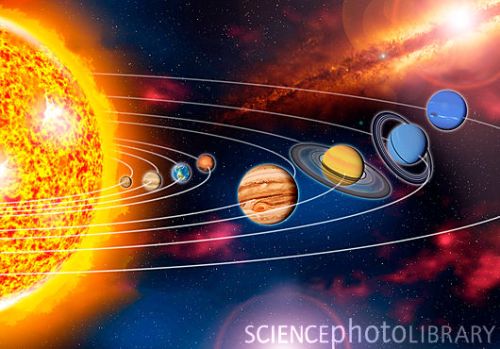
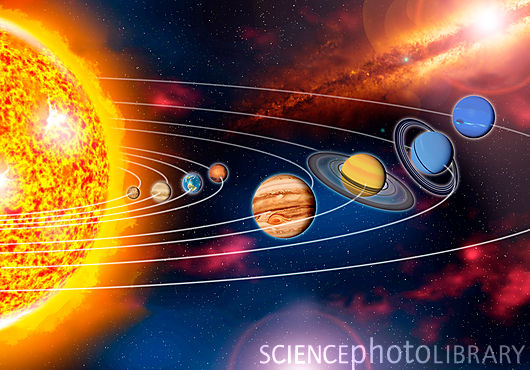
Courtesy of: Jose Antonio Penas/Science Photo Library
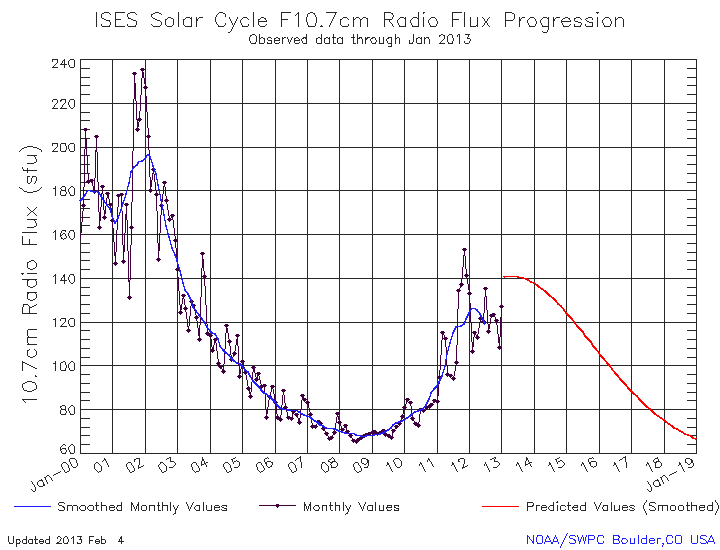
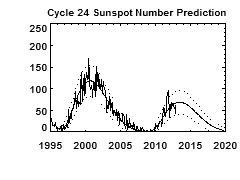
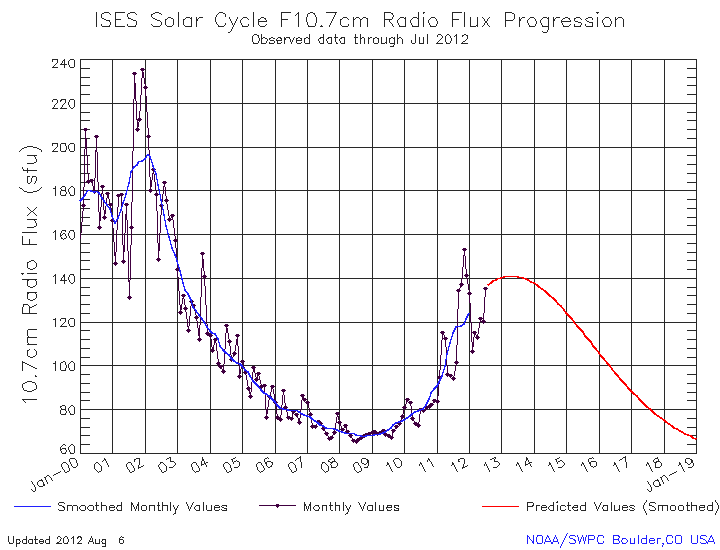
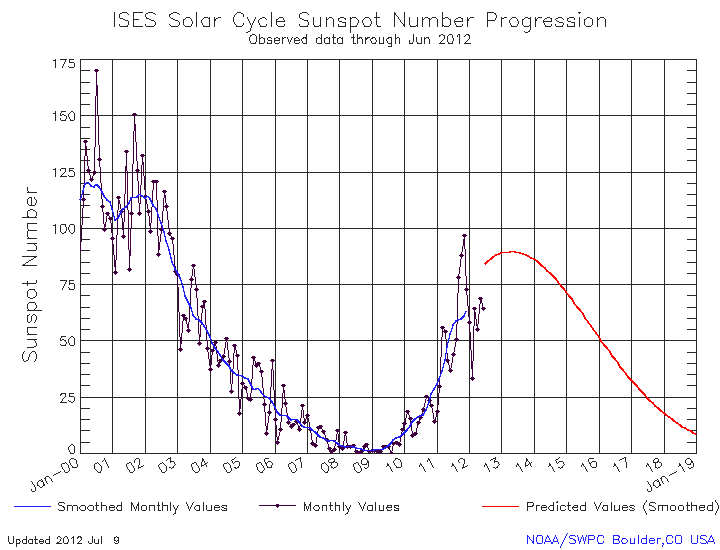
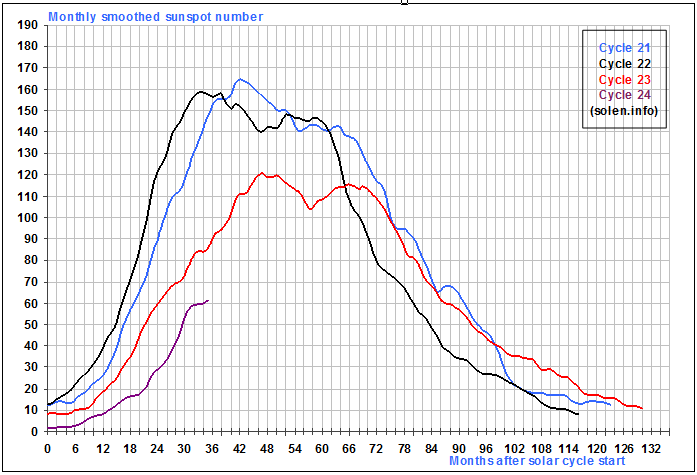
They are persuaded that the Sun, not CO2, is the primary driver of the Earth’s climate. History shows that solar cycles that have low activity are accompanied by cooling climate. For example, several minimally active cycles in succession have yielded the Maunder Minimum and the Dalton Minimum. The temperature drop during the Maunder Minimum was so large as to give that Minimum the name—-“little ice age”. The earlier Minimums were characterized by the low sunspot count. Now we can add to that the F10.7cm radio flux, the geomagnetic readings, and many other ways to characterize the level of solar activity. Even as new satellites and other investigative science provide us with greater understanding of the Sun, it still is not clear as to why Solar Cycle 24 is so inactive. While many observers claim they knew 24 was going to be minimally active, the record shows most forecast that 24 would be pretty robust and not be appreciably different from Cycle 23. Just like the weatherman that forecast rain for Maryland tomorrow because it is raining in West Virginia today, the solar experts now “know” that Cycle 25 will be like Cycle 24.
Dr. Hathaway of NASA observes that the Sun’s plasma Great Conveyor Belt (GCB) moved very rapidly in 2008 and 2009 but was notably slower in 2000 and 2001. “I believe this could explain the unusually deep solar minimum we’ve been experiencing,” says Dr. Hathaway. The high speed of the conveyor belt challenges existing models of the solar cycle and it has forced us back to the drawing board for new ideas.”
Well ok, but why did the GCB change speeds? Could the planets be the forcing for this and other changes?
Planets as forcing agents
What is the relationship of the planets and Earth’s climate? There is a theory based upon on the conservation of momentum that links every planet to the Sun. Another theory is the planet induced tidal effect upon the Sun’s plasma surface. Undoubtedly there are more, but two are enough for now.
Refresher: Some of my readers may need a refresher regarding the solar system planets.
Solar System Planetary Data (rounded)
| Body |
Distance from Sun10^6km |
Mass10^22kg |
OrbitDays |
Orbit Circ.10^6 km |
OrbitSpeed 10^6km/day |
| Mercury |
58 |
33 |
88 |
364 |
4.1 |
| Venus |
108 |
487 |
225 |
679 |
3 |
| Earth |
150 |
598 |
365 |
942 |
2.6 |
| Mars |
228 |
64 |
687 |
1432 |
2.1 |
| Jupiter |
778 |
190,000 |
4332 |
4887 |
1.1 |
| Saturn |
1429 |
56,900 |
10760 |
8977 |
0.8 |
| Uranus |
2871 |
8690 |
30700 |
18036 |
0.6 |
|
|
|
|
|
|
| Neptune |
4504 |
10280 |
60200 |
28294 |
0.5 |
|
|
|
|
|
|
The mass of the Sun is 1048 times that of Jupiter or 1.989X 10^30 .
The Landschiedt Minimum
In 2003, Dr. Theodor Landscheidt published a paper “New Little Ice Age Instead of Global Warming?” In that paper he predicted that the Earth would start cooling with the coolest period about 2030 and that it would be equivalent of the Maunder Minimum (aka, “the Little Ice Age’). Landscheidt used the Gleissberg cycle of 80 to 90-years to identify periods of cool climate on Earth. He said that within the Gleissberg cycle there is an 83-year cycle in the change of the rotary force driving the Sun’s oscillatory motion about the center of mass of the solar system. His premise was that the collective angular momentum of the giant outer planets imposed a torque on the Sun that varies the speed of the Sun’s equatorial rotational velocity. Some people are saying that this minimum should be called the Landscheidt Minimum. (Landscheidt died in 2004.) Landscheidt further predicted that another minimum would occur about 2200.
One might presume that the center of the Sun is the likely solar system center of mass. Only on occasion is that true. The center of the solar system’s mass is called the barycenter. Watch this video to get an appreciation for the effect of the planets on the barycenter. (no sound)
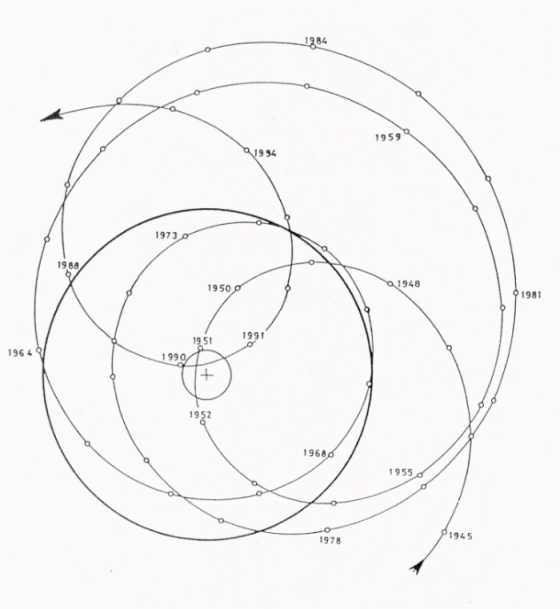
The following chart shows where the barycenter is relative to the Sun by year.
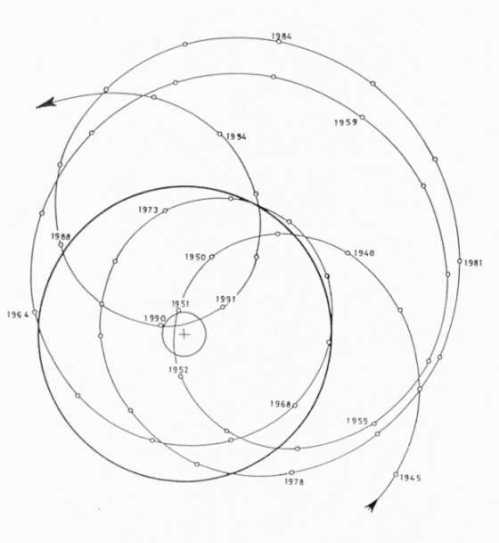
Figure 8: Solar System Barycenter
Landscheidt said:
The solar dynamo theory developed by Babcock, the first still rudimentary theory of solar activity, starts from the premise that the dynamics of the magnetic sunspot cycle is driven by the sun’s rotation. Yet this theory only takes into account the sun’s spin momentum, related to its rotation on its axis, but not its orbital angular momentum linked to its very irregular oscillation about the centre of mass of the solar system (CM). Figure 8 shows this fundamental motion, described by Newton three centuries ago. It is regulated by the distribution of the masses of the giant planets Jupiter, Saturn, Uranus, and Neptune in space. The plot shows the relative ecliptic positions of the centre of mass (small circles) and the sun’s centre (cross) for the years 1945 to 1995 in a heliocentric coordinate system.
The large solid circle marks the sun’s surface. Most of the time, the CM is to be found outside of the sun’s body. Wide oscillations with distances up to 2.2 solar radii between the two centres are followed by narrow orbits which may result in close encounters of the centres as in 1951 and 1990. The contribution of the sun’s orbital angular momentum to its total angular momentum is not negligible. It can reach 25 percent of the spin momentum. The orbital angular momentum varies from -0.1�1047 to 4.3� 1047 g cm2 s-1, or reversely, which is more than a forty-fold increase or decrease (Landscheidt, 1988). Thus it is conceivable that these variations are related to varying phenomena in the sun’s activity, especially if it is considered that the sun’s angular momentum plays an important role in the dynamo theory of the sun’s magnetic activity.
Variations of more than 7% in the sun’s equatorial rotational velocity, going along with variations in solar activity, were observed at irregular intervals (Landscheidt, 1976, 1984). This could be explained if there were transfer of angular momentum from the sun’s orbit to the spin on its axis. I have been proposing such spin-orbit coupling for decades (Landscheidt, 1984, 1986). Part of the coupling could result from the sun’s motion through its own magnetic fields. As Dicke (1964) has shown, the low corona can act as a brake on the sun’s surface. The giant planets, which regulate the sun’s motion about the CM, carry more than 99 percent of the angular momentum in the solar system, whereas the sun is confined to less than 1 percent. So there is a high potential of angular momentum that can be transferred from the outer planets to the revolving sun and eventually to the spinning sun.
From wiki, a somewhat analogous to the Planets/Sun interaction: The conservation of angular momentum in Earth–Moon system results in the transfer of angular momentum from Earth to Moon (due to tidal torque the Moon exerts on the Earth). This in turn results in the slowing down of the rotation rate of Earth (at about 42 nsec/day[citation needed]), and in gradual increase of the radius of Moon’s orbit (at ~4.5 cm/year rate[citation needed]).
If you want to dig further into the concept of angular momentum, the following may be of interest to you:
Angular momentum is conserved in a system where there is no net external torque, and its conservation helps explain many diverse phenomena. For example, the increase in rotational speed of a spinning figure skater as the skater’s arms are contracted is a consequence of conservation of angular momentum. Moreover, angular momentum conservation has numerous applications in physics and engineering (e.g. the gyrocompass). See here, here and here to get the math behind conservation of angular momentum, angular momentum, and torque.
Tidal Effect
Dr Nicola Scafetta of the Active Cavity Radiometer Solar Irradiance Monitor Lab (ACRIM) and Duke University has recently published in the Journal of Atmospheric and Solar-Terrestrial Physics “Does the Sun Work as a nuclear fusion amplifier of planetary tidal forces? Etc.”
Lets look at a summary of some of the planetary interactions with the Sun that affect the nominal 11 year solar cycle that he listed in his abstract to the article:
Numerous empirical evidences suggest that planetary tides may influence solar activity. In particular, it has been shown that: (1) the well-known 11-year Schwabe sunspot number cycle is constrained between the spring tidal period of Jupiter and Saturn, 9:93 year, and the tidal orbital period of Jupiter, 11:86 year, and a model based on these cycles can reconstruct solar dynamics at multiple time scales (Scafetta, in press); (2) a measure of the alignment of Venus, Earth and Jupiter reveals quasi 11.07-year cycles that are well correlated to the 11-year Schwabe solar cycles; and (3) there exists a 11.08 year cyclical recurrence in the solar jerk-shock vector, which is induced mostly by Mercury and Venus
Scafetta proposes that the planets cause surface tides on the Sun. While very small, he believes the tidal gravitational potential energy dissipated in the Sun by the tides, may produce irradiance output oscillations with a sufficient magnitude to influence the solar dynamo processes. More from the abstract:
Here we explain how a first order magnification factor can be roughly calculated using an adaptation of the well-known mass-luminosity relation for main-sequence stars similar to the Sun. This strategy yields a conversion factor between the solar luminosity and the potential gravitational power associated to the mass lost by nuclear fusion: the average estimated amplification factor is A4:25×10^6. We use this magnification factor to evaluate the theoretical luminosity oscillations that planetary tides may potentially stimulate inside the solar core by making its nuclear fusion rate oscillate. By converting the power related to this energy into solar irradiance units at 1 AU we find that the tidal oscillations may be able to theoretically induce an oscillating luminosity increase from 0.05–0.65 W/m^2 to 0.25–1.63 W/m^2, which is a range compatible with the ACRIM satellite observed total solar irradiance fluctuations. In conclusion, the Sun, by means of its nuclear active core, may be working as a great amplifier of the small planetary tidal energy dissipated in it. The amplified signal should be sufficiently energetic to synchronize solar dynamics with the planetary frequencies and activate internal resonance mechanisms, which then generate and interfere with the solar dynamo cycle to shape solar dynamics, as further explained in Scafetta (in press). A section is devoted to explain how the traditional objections to the planetary theory of solar variation can be rebutted.
Both theories have many critics. I am not knowledgeable enough to support or deny these theories. However, Dr Hathaway’s comment about varying speeds in the Great Conveyor Belt would lend some support to these theories especially Landscheidts. Anyway, the Sun is where the action is with respect to global climate change. And it will probably be a number of years before any theory wins out. Remember how much bad press the cosmic ray theory got from the experts, and this case I mean the warmers. Now after some work at CERN, it is looking like a winner, just not yet announced. There is hope.
cbdakota

 Chart curtsey of Solen.com








 Climate Change Sanity