Category Archives: Solar Cycle 25

Little Ice Age By 2030?


Professor Valentian Zharkova of Northumbria University presented her results Cold-Weather-Cartoonfor a new model of the Sun’s interior dynamo to the Royal Astronomical Society. Zharkova and her team believe they have made a discovery that allows them to predict solar activity. From the Royal Astronomical Society’s National Astronomy Meeting 2015 – report 4” posting:

“We found magnetic wave components appearing in pairs; originating in two different layers in the Sun’s interior. They both have a frequency of approximately 11 years, although this frequency is slightly different [for both] and they are offset in time,” says Zharkova. The two magnetic waves either reinforce one another to produce high activity or cancel out to create lull periods.

The model predicts that the magnetic wave pairs will become increasingly offset during Cycle 25, which peaks in 2022. Then during Cycle 26, which covers the decade from 2030-2040, the two waves will become exactly out of synch, cancelling one another out. This will cause a significant reduction in solar activity. “In cycle 26, the two waves exactly mirror each other, peaking at the same time but in opposite hemispheres of the Sun. We predict that this will lead to the properties of a ‘Maunder minimum’,” says Zharkova”

Continue reading

Sunspot Number History Change Is Underway


For those readers of this blog that follow the monthly update of Solar Cycle 24, things are about to change. For the better I think, but until the final report is 400yrsofsunspotcyclesUnknownreleased, we wont know for sure. Sunspot Index and Long-term Solar Observations (SILSO) a part of the World Data Center has issued a Sunspot Bulletin that says:”

                                           Warning of Major Data Change

Over the past 4 years a community effort has been carried out to revise entirely the historical sunspot number series. A good overview of the analyses and identified corrections is provided in the recent review paper: Clette, F., Svalgaard, L., Vaquero, J.M., Cliver, E. W.,”Revisiting the Sunspot Number. A 400-Year Perspective on the Solar Cycle”, Space Science Reviews, Volume 186, Issue 1-4, pp. 35-103.

Now that the new data series has been finalized, we are about to replace the original version of our sunspot data by an entirely new data set on July 1st. On this occasion, we decided to simultaneously introduce changes in several conventions in the data themselves and also in the distributed data files.

Continue reading

Skeptic Reference Sources–Part 1


There are several excellent sources for Skeptics. This posting provides a the sunsource for Solar Research Papers.   The amount of Sun based research may surprise you, because the Warmers continue to tell us that the Sun is not important.

Some of the research is readily available and some is behind paywalls. But I suspect that just looking at the available research will occupy you for some long time.   The source is Club du Soleil  Click here to see  this source.

There are several additional resources that I will post soon.

cbdakota

Predicting Solar Cycle 25. Are We Heading For Another Maunder Minimum?


A study was published in 2012, Sudden transitions and grand variations in the solar dynamo, past and future” by Cornelis DeJager and Silvia Duhan . The authors attempt to predict whether Solar Cycle 25 will transition to a “Grand Minimum” or “Regular “ Episode. They believe the Sun is transitioning from a “Grand Maximum” to one or the other aforementioned Episodes. This study is being used because their prediction was based upon knowing the Solar Cycle 24’s maximum Sunspot number which we now have.

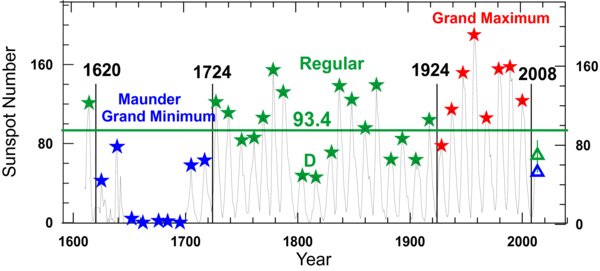
First a look at the “Episodes” that the authors have placed the Solar Cycles from 1620 to the present.

grandcyclesswsc120009-fig4The diagram shows the sunspot numbers plotted against time. The three Grand Episodes are marked by their different colors. They are separated by vertical black lines.

Continue reading

Solar Cycle 24: 2014 Review


ancientsun6289386788_3f700efdbc_zSolar Cycle 24 maximum occurred in February of this year when the International sunspot number peaked at 102. An earlier  maximum call was made in late 2011 when the sunspot number reached about 96.  That was followed by several months of declining sunspot counts, then activity picked up and a “double peak” resulted. The smoothed¹ number for the peak is 82 (versus the actual monthly value of 102). December 2014 sunspot number was 78. So the smoothed number for December has not yet been calculated, but it is estimated that it will be about 68.

Continue reading

Climate Cooling Predicted by New Solar Theory


Dr David Evans has proposed a new theory that he believes  demonstrates the link between the Sun’s total solar irradiance (TSI) and the Earth’s climate. The idea that TSI and the Earth’s Climate are linked is not a new or novel theory. Evan’s has built a computer program that provides a time delay between a change in TSI and the time that climate begins to respond. He believes the key to his program is the use of “notch filter” similar to those used in the communications industry to filter out “noise”.

He also is asking for peer review of this program via “crowd sourcing”.   Reading the comment sections of the sites where he has posted his theory and provided much of the coding, he certainly has been successful in getting comments.  At the time of my last survey,  the comments  he has received are mostly positive but some others are skeptical.

For this study, Evans derived a new transform that he calls the “optimal Fourier transform (OFT)” for this paper. This transform provides the “notch”.  One commenter suggested that the use of another type of Fourier transform would improve Evan’s program and appears that Evans agrees.   (I did take a course in Laplace Transforms, but not being an Electrical Engineer, I have forgotten what I learned. This comment is a way of letting the reader know that I am unable to intelligently comment on the math used in Evans’ program. )


WHY IT’S GOING TO COOL

“The reason for the cooling is the dramatic fall in solar radiation that started around 2004. Here is a graph of solar radiation since 1610, when sunspots were first recorded. The brown line is the solar radiation, and it peaks every 11 years or so because of the sunspot cycle. We put an 11-year smoother through it to give us the red line, which shows the trends in solar radiation.”    (Click on charts for improved clarity.)

EVANStotal-solar-irradiance-1.1

Figure 1

Evans says there have been three steep falls in TSI in the last 400 years and each of these falls have been accompanied by major global cooling.

That the global temperature has fallen in sync with the drop off of TSI appears to be an awfully good correlation. But many skeptics as well as warmers argue that it must have been for some other reason other than TSI because (look at the vertical axis) the total change in TSI is too little to be of consequence.

This blog has always proposed that the Sun is the major forcing agent in global climate. Perhaps the causation is not the TSI, but I continue to believe the something correlated to the Sun’s activity is the causation. Having said that, time to move back to Evans’ theory.

Continue reading

Early look at Solar Cycle 24 July Activity


Since late last year, Solar Cycle 24 has picked up activity as it goes through a double peak maximum.   I doubt that is an official term but it does describe what has been going on. It was generally though that the peak International Smoothed Sunspot number for Cycle 24 was going to be about 66.   But the recent activity will result in a smoothed peak number of 81 or there about.  (Click on charts for clarity.)

solensolarterrestialjuly26-14

This chart of approximately the last 12 months, shows that F-10.7cm solar flux and Sunspot numbers are closely aligned, both being good proxies for solar activity.

Continue reading

Penn And Livingston Cycle 25 Sunspot Forecast


Penn and Livingston, in their September 2010 IAU publication “Long-Term Evolution Of Sunspot Magnetic Fields” predicted that Solar Cycle 24 would peak at an International Sunspot number of 66 and Solar Cycle 25 at 7!!

Sunspotdiagram

Considering that NASA believes that the peak for Cycle 24 will be 67, their prediction looks pretty good.   So would you bet against their Cycle 25 prediction of 7?

Continue reading

IPCC Errs When Concluding The Sun Is Not A Major Factor In Global Temperatures


While the IPCC doesn’t have an answer for why there has been no statistical increase in global temperatures for going on 17 years,  they don’t think the Sun has been a significant factor.  They  generalize that  volcanoes, deep ocean warming,  and particulate matter in the atmosphere may be the cause.

Duncan Q&A : on change of climate change : Earth and Sun

Copy of Woodcutting by TheGuardian.com by Duncan Clark

Continue reading

Solar Cycle 24 September 13 Update


The International Sunspot number for September dropped to 37 from 66 in August.    The F10.7cm solar flux moved downward as well from 115 in August to 103 in September.   Both are measures of Solar activity.  Again, Solar Cycle 24 is decidedly less active than recent Solar Cycles. (Click on the charts to improve clarity.  All charts are  by “Solar Terrestrial Activity Report”).

ssncycle24=0ct13

This chart, from Solen etc, is interesting.  The black line labled Ri is the International Sunspot number. The Rnorth indicates the number of Sunspots that were counted in the Sun’s northern hemisphere and Rsouth those formed in the southern hemisphere. Rnorth plus Rsouth equal Ri.  Rnorth peaked in late 2011 at about 97 Sunspots.  Rsouth peaked at about 50  in the middle of  last year.  The smoothed number is the official count.  The smoothed number is calculated by doing a 13 month average from the numbers that lag 6 months behind the current month.  The maximum smoothed number for Cycle 24 so far is 66.9 which occurred in early 2012.  Most of the solar cycle experts believe that will be the maximum for Cycle 24.

Below is the solar polar field strength chart updated for September showing the south and north poles have both crossed the  Sun’s equator.  It is suggested that you read the discussion regarding solar polar fields by clicking on this Forecasting Solar Cycle 25 Using The Solar Polar Field Strength”.

solarpolarfields-oct13

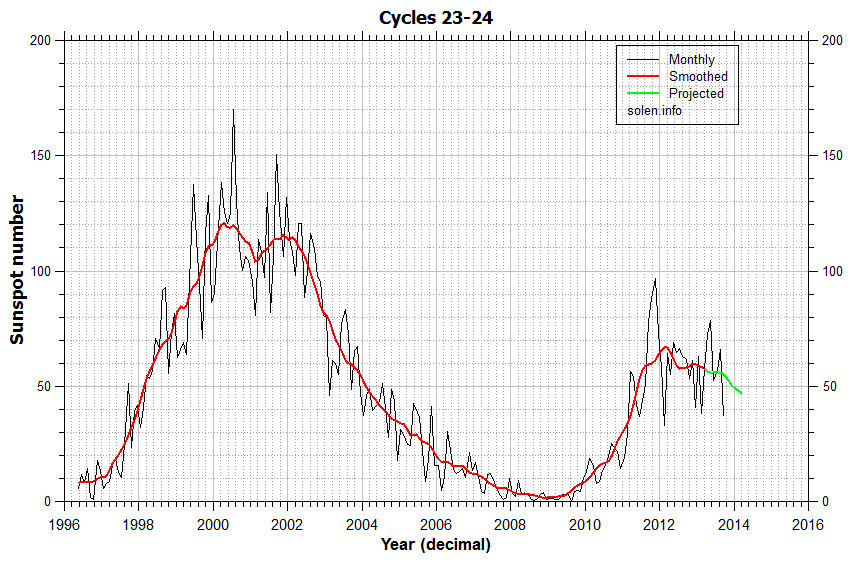
This chart puts Cycle 24 in perspective with Cycle 23.

ssncycles23_24-oct13

The projected Sunspot number, shown in green, is also a 13 month average but it has no six month delay built into the calculation.

cbdakota