Category Archives: Renewable Energy

2020 UN Treaty: US And Europe’s Energy Use To Match The Philippines?


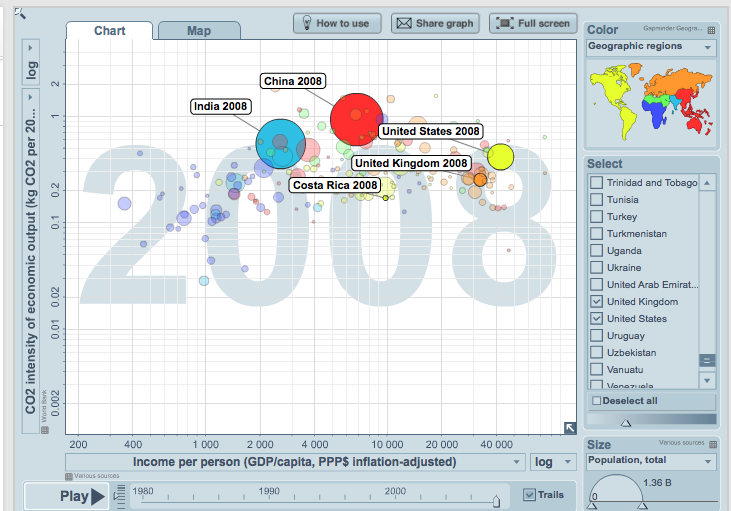
The target of 1 trillion tonnes of CO2 is part of the discussion underway in Poland at COP 19.  The delegates want to get a treaty in place by 2020 which all nations will sign when the Kyoto Treaty expires.  The new treaty will demand two things.  Reparations for the developing nations for the “damage” resulting from global warming that the developed nations are responsible for and an agreement by which CO2 emissions are dramatically reduced. (Click on charts to enlarge.)

Screen Shot 2013-11-14 at 12.38.03 PM

The developed nations had agreed to supply $30 billion in the period of 2010-2012.  Five nations–US, Germany, Norway, UK and Japan—gave a total of $27 billion. The desired treaty will include vast sums of money to be transferred between developed and less developed countries.  There was a study done of how much money would be needed to accomplish the objective of never letting the atmospheric CO2 exceed 1 trillion tonnes and the number was $5.7 trillion.  Not all of this is transfer money.  Much of it would go for changes to the global energy structure.

Continue reading

It Is Better To Adapt Than Mitigate CO2 Emission-Mitigation Is 50X More Costly


Paraphrasing Hamlet, “Is it better to mitigate CO2 emissions from sources such as fossil fuels or adapt to global changes that might happen if emissions were not regulated?  Ah that’s the question.”

hamlet220px-Edwin_Booth_Hamlet_1870

Continue reading

Fuel Cell Vehicles


Like the tide, going in and out and so does the Fuel Cell Vehicle favorability.   Right now favorability is pretty well in the tank, but not completely.  The city of London is installing hydrogen (H2) fueling stations with the objective of encouraging their use.  California has a similar program, as does Germany.

Some of you may not be familiar with fuel cell cars because they have been  out of the spotlight recently.  The following is an overview of  the  fuel cell and the fuel cell car.   The cartoon below pictures most of the hardware needed.

Fuelcellcarforblog

Courtesy of http://www.imageproduction.nl

Continue reading

Bloom Box Surcharge Increases 570%, Stunning Delaware Utility Customers


In 2012 the Governor of the State of Delaware, Jack Markel, entered into a long-term contract with Bloom Energy.  The contract obligated Bloom to begin manufacturing their “Bloom Boxes” in the closed Chrysler Assembly plant.  Delaware was obligated to subsidize Bloom to the tune of the difference of the cost of the electricity produced by Bloom Boxes and the cost of open market electricity.  That subsidy rose from $0.67 in October 2012 to $3.83 for September 2013, a 570% increase, where it increases each ratepayers month’s bill. Delaware has mandated a requirement to buy renewable energy produced electricity that grows to 25% of the total energy used in the State by 2025.  The open market electricity price has been dropping due to the increased availability  of  natural gas from fracking operations around the Nation. The natural gas is becoming the major source of energy for producing electricity.   Natural gas is not considered a “renewable” form of energy.  But the State passed an exception to their renewable energy law that allows  Bloom Box energy  to be called “renewable” even though these boxes use natural gas as their energy source.  The irony here is that the electricity  produced using natural gas the standard way, the electricity is much less expensive than electricity produced by Bloom Boxes.   But remember, the State has a law  that demands the use of “renewable” energy produced electricity.

Continue reading

Department Of Energy Forecasts 2040 World and US Energy Use/Source


The Department of Energy (DOE) projects that global energy consumption will increase 56% between 2010 and 2040 from 524 quadrillion Btus to 820 quadrillion Btus.

worldenergyconsump

Continue reading

European Renewables Bubble Is Collapsing


The European nations have led the world in the installation of wind and solar, the renewable technologies.  But now the high subsidies that were imposed to make these renewables look attractive are becoming intolerable.

Peter Glover has posted “The ‘Great Renewables Scam’ unravels” on thecommentator.com.   Glover writes:

Energy insiders have long known that the notion of ‘renewable energy’ is a romantic proposition – and an economic bust. But it is amazing what the lure of guaranteed ‘few strings attached’ government subsidies can achieve. Even the Big Oil companies bought into the renewables revolution, albeit mostly for PR reasons. Like Shell, however, many quickly abandoned their fledgling renewable arms. Post-2008, they knew, the subsidy regimes could not last. Neither was the public buying into the new PR message.

Continue reading

Kyoto Did Not Level The Playing Field, But Obama’s New Climate Policies May Do That


President Obama’s outlined his new climate policies in a recent speech.   My take away from the speech is that it is a way to increase Federal revenue by taxing carbon use.  And it is mainly done through new regulations developed by his EPA.  Congress just a well go home because they never see the need to challenge the usurping of their powers.    The consequence of these policies will be significantly higher electricity prices, and the poorest among us will be the primary victims of this action.  Once again, in the name of the environment,  he will forego focusing on bringing about  the nation’s recovery.   Interestingly, one posting suggests that this will level the playing field between the US and Europe.  That was the basis for the European’s support of the Kyoto Treaty, but it did not work for them because the US chose not to enter into the Treaty.  A posting on notrickszone.com by Peter Gosselin titled “Obama Is Merely Leveling The Energy Playing Field With Europe – Declares An End To Cheap American Energy is interesting to get his view from Europe.  He writes:

Continue reading

Steep Depreciation Rates For EVs A Serious Problem


According to the National Automobile Dealers Association the used plug-in electric vehicles depreciate at a 30% rate that is the highest depreciation of any vehicle segment in the American automotive market. For other vehicles, according to Carsdirect.com: “New cars depreciate about 20% the moment you drive them off the lot.”   Then the depreciation is about 15% per year for the second and third year and less in subsequent years.

TheDetroitBureau.com says:

“The steep rate of depreciation for used plug-in electric vehicles can be attributed to limited range, manufacturer incentives and federal tax credits intended to offset the higher prices of new plug-in electric vehicles,” said Jonathan Banks, executive automotive analyst for the NADA Used Car Guide.

If the forecasted decline continues, it could be a serious problem for both manufacturers struggling to boost demand for their latest plug-in hybrids and pure battery-electric vehicles, as well as federal and state government officials who have been using financial incentives to help promote the technologies.

 Another ominous sign for the EV business.

cbdakota

Chinese Academy Of Science Adopt Heartland’s “Climate Change Reconsidered”


The Nongovernmental International Panel on Climate Change (NIPCC) books, Climate Change Reconsidered and Climate Change Reconsidered: 2011 Interim Report published by the Heartland Institute has been translated from English to Chinese by the Chinese Academy of Sciences (CAS).  These books “..present a sweeping rebuttal of the findings of the United Nations’ controversial Intergovernmental Panel on Climate Change (IPCC), whose reports were widely cited as the basis for taking action to stop or slow the advance of climate change”.

According to the Heartland Institute:

“The Chinese Academy of Sciences is the world’s largest academy of sciences, employing some 50,000 people and hosting more than 350 international conferences a year. Membership in the Academy represents the highest level of national honor for Chinese scientists. The Nature Publishing Index in May ranked the Chinese Academy of Sciences No. 12 on its list of the “Global Top 100” scientific institutions – ahead of the University of Oxford (No. 14), Yale University (No. 16), and the California Institute of Technology (No. 25).

The first 856-page volume of Climate Change Reconsidered, published in 2009, and its follow-up, the 430-page Climate Change Reconsidered: 2011 Interim Report,were produced by a team of scientists originally convened by Dr. S. Fred Singer under the name of the Nongovernmental International Panel on Climate Change (NIPCC).

chinaccrcoverclimatechangereconsidered

                  Climate Change Reconsidered is translated into Chinese


Jim Lakely, director of communications at the Heartland Institute told Breitbart  News:

“Translating and publishing nearly 1,300 pages of peer-reviewed scientific literature from English to Chinese is no small task, and indicative of how important CAS considers Climate Change Reconsidered to the global climate change debate. That CAS has invited the authors and editors of Climate Change Reconsidered to a conference this Saturday in Beijing to introduce the studies is yet another indicator of how important it is to get this information out to a wider audience.”

Heartland Institute President Joseph Bast added:

“A December 2012 UN meeting designed to provide climate change regulations ended in failure after China refused to sign a global climate change treaty. China was joined by the United States, as well as Canada, India, Japan, Russia, and Brazil. “Opposition to a new climate treaty is justified based upon the real science presented in Climate Change Reconsidered.”

Hopefully,  the mainstream media will take note.

cbdakota

CONGRATULATIONS!! Some Rich Californian Thanks You For Helping Pay For His New Tesla


Now the Tesla is a sweet looking car with some impressive stats.  Perhaps not as good as advertised, see this posting, but still right up there with the best.
teslamodelcimages
 And while you may not be able to afford one—early models went for over $109,000 and the new S model goes for about $70,000—some people, wealthy ones anyway, are buying them.  Tesla sold an estimated 9,650 S models by the end of April this year. Things are going so well that Tesla made a profit in the first quarter.