Category Archives: government subsidies

Data Centers and Artificial Intelligence-Stop Energy Transition Part 3


ENERGY

The United States of America is built on energy. Primarily produced by fossil fuels.  The transportation area, cars, trucks, airplane, ships, etc. are propelled by gasoline, jet fuel, diesel oil, bunker fuel, propane, etc., all fossil fuels.  Transportation is 90% reliant on fossil fuels. About 60% of the Electricity is produced by fossil fuels.  Quoting Denny Ervin:   “Economies and standards of living hinge on having an adequate, economic, and reliable energy source—attributes that are non-negotiable for an optimal energy infrastructure. Our current trajectory risks creating inadequate, unaffordable, and unreliable energy supplies, which would devastate the U.S. economy and standard of living”.

Mr. Ervin has hit the nail on the head

Electricity Generation

The US generated 4.18Trillion Kilowatt hours in 2023.  A trillion Kilowatt-hour are called Petawatt hour.  That means that it is 4.18 followed by 15 zeros.  Because billing is usually done in kilo watts hours-,  it would be 4.18 Tera kilowatt-hours or as it is expressed in the  graph, 4.18 trillion kilowatt hours.   These vast numbers are here to stay.    Primer: Kilo is a thousand; Mega is a million; Giga is a billion; Tera is trillion and Peta is a quadrillion.

The primary source was thermals (natural gas, coal  and petroleum) at 60%, Nuclear added 18.6 %.   The renewables came in at 21.4 %.   Within that renewables list is Wind and solar and they are the rising sources.  They came sourced at 14.1%   They are non-dispatchable, meaning that their generation is a  wild card function of the weather.

Artificial Intelligence Creates Demand For Electricity

Power generation in 2023 was slightly lower than the 2022 generation.  Why? Due to higher price of electricity and use of power saving devices like LED bulbs.  But the demand is forecasted to increase soon and require a lot of additional generating sources, and transmission lines to carry the increase.   This increase is attributed to data center growth.  There are an estimated 2700 data centers in the US.  Data centers are the backbone of the digital world.  They host the internet from not only the US but a big share of the World’s internet.  It is in data centers where the Clouds store data for businesses and websites are housed. A large new power demand is forecasted for the Artificial Intelligence (AI).   DataCenterDynamics says that data center power consumption in the US is set to reach 35GW by the end of the decade, almost double its 2022 level.

Goldman Sachs posted on 13 May 2024, “AI is showing ‘very positive’ signs of eventually boosting GDP and productivity”.   That feeling seems to be universal.  The posting says: “Some of the academic literature and economic studies that have looked at the increase in productivity that we’ve seen following AI adoption, in a few specific cases, supports our view that large productivity gains are possible. The average increase in productivity is about 25%. Case studies of companies that have adopted AI imply similarly large efficiency gains. And so, you know, there’s a lot of reasons to be optimistic. It will just take a little bit more time to see these productivity gains realized.”

That is an incredible gain.  The nation must do what it takes to accomplish that goal. 

Techopedia predicts that the US gain the most:
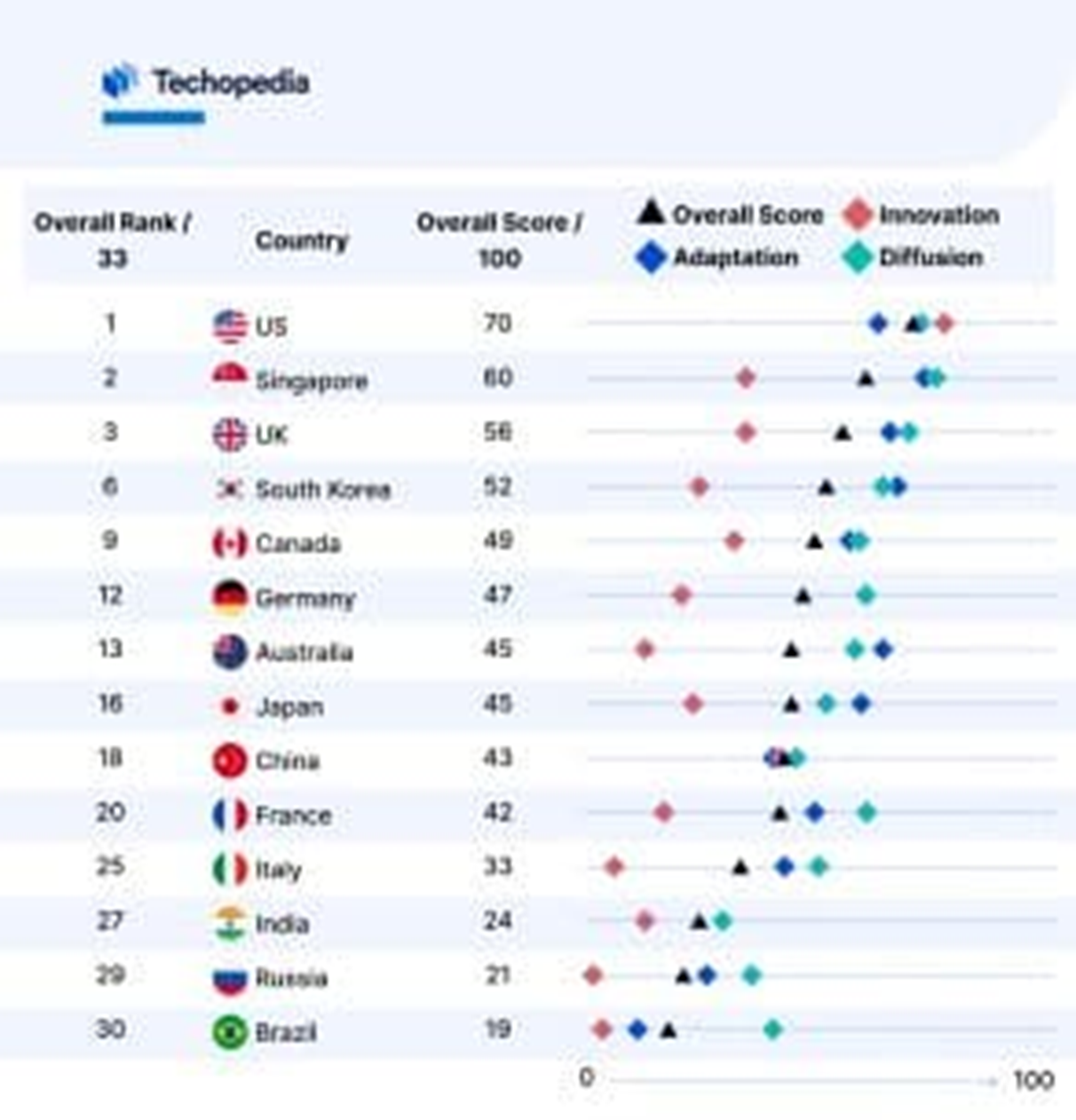
Techopedia offers why the US will dominate.

The US leads the way, reflecting its size, private and public investment in research and development, and the talent nurtured by its higher education system”.

Techopedia offers why the US will dominate.

There are impediments to AI success.

The major impediment is the Energy Transition from thermal sources to renewable sources. 

There are 3 major actors in this transition.  First is the Administration putting up big subsidies to make solar cells and wind turbines installations to assure Crony Capitalist will make money.   Second is the EPA that writes regulations that force the demise of reliable thermal sources, particularly coal based.  And lastly are the States that write laws, that are ill thought-out, declarations of what sources are allowed, what percentage and the time line.  See here and here. This triple bogey is not escaping notice.  The grid operators have been telling everyone that their systems are headed for collapse.   FERC has been telling the same story.  But the Governmental bodies believe themselves to know more about the grids than the grid operators. The companies that are planning to spend vast sums of money to bring AI online seem to be aware of this huge pothole in the road to delivery.  They need electricity that is reliable, and they need it now.  That can only come from thermal sources. The WSJ front page on October 1, 2024 posted “AI fever abates in stocks’ latest quarter.” The stock market sees that AI is not unfolding as was forecast.  You can bet that China is going to provide the power to their AI plans.

The Daily Caller posts: “‘Inevitable And Foreseeable’: Grid Operators Beg Court To Nix EPA Rules To Save Electricity System From Collapse”:

“The Biden-Harris administration says that its stringent power plant rules won’t harm long-term power reliability, but four grid operators stated the exact opposite in a legal brief filed Friday.

The Environmental Protection Agency (EPA) finalized its aggressive emissions rules for America’s power plants in April, saying at the time that the regulations would “improve public health without disrupting the delivery of reliable electricity.” However, four major regional grid operators argued the exact opposite in an amicus brief filed in support of red states’ legal challenge against the rule, stating explicitly that the rules will jeopardize Americans’ ability to reliably secure sufficient amounts of power if they are enforced as is”

Specifically, the EPA’s rules will mandate existing coal plants to harness 90% of their emissions by 2032 if they want to stay open past 2039, and they will also require new natural gas-fired plants to do the same in order to stay open past 2039, according to the agency. The EPA is essentially requiring power plants to meet those emissions cuts using carbon capture and sequestration (CCS) technology, which the four grid operators contend is too expensive and unproven to be mandated on such a tight timeline.”  

The EPA is setting up rules that require the operators to use unproven systems (CCS). Coal plants in operation now provide low cost energy. They provide dispatchable electricity.  They have a distinct advantage in that they usually have several months of coal stored at their site.  Gas units normally do not have a storage that could be used if there is an interruption in the supply line. Nuclear sourced electricity has many months, perhaps as long as a year on plant fuel

The Energy Bad Boys posted:” PJM, MISO, SPP, and ERCOT Join the Legal Fight Against EPA’s Carbon Rules”

The four— PJM, the Midcontinent Independent Systems Operator (MISO), Southwest Power Pool (SPP), and the Electric Reliability Council of Texas (ERCOT)— stretch from New Jersey to parts of New Mexico and serve more than 156 million Americans in their respective service territories.

“The rules on carbon dioxide emissions are not the only regulations threatening the viability of the existing thermal fleet.  Under the Biden-Harris administration, the EPA has written or updated regulations like the Ozone Transport Rule, the Coal Combustion and Residual Rule, and the Mercury and Air Toxics Standards, all of which are designed to place enough straws on the backs of reliable coal-fired power plants to compel their owners to shut them down”.


AI builders Must Have Reliable Energy Sources

Here are some appeals for reliability:

Larry Fink, Chairman and CEO of Black Rock Investment Management Corporation said no to renewables. Fink spoke at the World Economic Forman that AI will be big and profitable.  He wants the suppliers for his operations to use only dispatchable energy sources because they are reliable sources of power 24/7. 

Dominion CEO Robert Blue said: “We’re going to continue to be a big builder of renewables. We’re building a big offshore wind farm. We’re building a lot of solar. We’re adding a lot of storage. … But we also recognize that we’re going to need some more natural gas in order to keep the lights on.”  In addition to developing more natural gas plants to balance power grids from expansions of intermittent renewables, rising demands are also delaying some retirement of coal plants.

Dominion wants to build a 1,000-megawatt natural gas plant in Chesterfield County, where a coal plant closed last year, stating that the addition is critically important for reliability.  Significant costs for these increased power demands — including transmission infrastructures — will be passed on to household and business consumers.

Alphabet, Microsoft, and Amazon, three of the largest AI data center users, have previously criticized a proposal by utility company Georgia Power to expand natural gas use at the expense of hurting their renewable energy programs. The problem is that those centers require huge amounts of reliable electricity to operate, and no nearly adequate hydrocarbon replacement exists. As former Microsoft vice president Brian Janous observes, whereas “No data center wants to be tied to the need for new fossil resources, that’s the problem… You can’t throw this much [data-center] capacity at the system and not have some degree of fossil resources to support it.”

Amazon states that their data centers are powered by renewable energy.  This seems improbable as the industry knows that renewable energy is not dispatchable. They are using a ploy that is provided to make companies feel good about themselves while using fossil fuels.  Its called RECs.  The RECs provide certified proof that you’re using renewable energy from the grid without installing solar panels or other renewable energy systems at your home or business

 Amazon invests in renewable energy projects that generate electricity, which is then fed into the grid. They then purchase or are allocated an equivalent amount of energy from the grid for their use. This is often done through renewable energy certificates (RECs), which represent proof that 1 megawatt-hour (MWh) of electricity was generated from an eligible renewable energy resource.

Meanwhile, the Biden Administration, largely through the perversely titled “Inflation Reduction Act” (IRA), is providing massive and unsustainable economic incentives to move the electric generation market towards virtually exclusive reliance upon renewable energies (wind and solar in particular) plus batteries.  However, such forms of electric energy pose inherent problems; especially to the ultra-high electric energy “purity” requirements of AI/data centers. Data centers and AI generally require nine-nines reliability and quality metrics such as voltage, frequency, harmonics, etc.

Summary

The US electricity generation is forecast to have a large new demand to power data centers.

Major grid operators are going to court to cancel EPA rules.  They said this must be done or their girds will collapse. 

Data center owners/operators recognize that their systems must have dispatchable,  reliable electricity.  Renewables are not dispatchable.

Next part will examine the non dispatchable  wind and solar .

cbdakota.
Its The EV Battery, Stupid!


The title is paraphrasing the Ragin Cajun, political adviser to the Clintons, James Carville. Carville said when asked about the biggest issue in an upcoming election, “it’s the economy, stupid” I contend that the biggest issue for the electric vehicle (EV) is the battery.

The battery represents the proposed transition from gasoline and diesel fuel to electricity.  The transition will not be easy, if at all.  Usually, major transitions have occurred because some new thing is better than the existing thing.  That is not happening here.  The EV is more costly, is less flexible, not as capable and is planned to be charged from an electrical grid that is sourced from wind turbines and solar cells.  The latter, the so-called renewable energy, has not demonstrated that it is capable of keeping the grids supplying a reliable supply of electricity 24/7. Nowhere. Nada. see here But politicians keep throwing money at these schemes.  You must wonder why they would do that.  Well maybe not.

The EV sales are not displacing gasoline and diesel vehicles because they are better.  No.  It is replacing those fuel driven vehicles by Government fiat.  Governments are giving EVs huge subsidies, and enacting regulatory systems making gasoline and diesel vehicles attain goals that are not reachable nor necessary.  Six states have legislated that no gasoline or diesel-powered vehicle can be manufactured or sold after 2030 to 2035. And the Feds are considering that too.

The WSJ blog posted Car Dealers to Biden: EV’s Are Not Selling reporting that 3900 US car dealerships wrote a letter to President Biden saying his EV sales mandate is not working. They told him that:

Dealers have a 103-day supply of EVs compared to 56 days for all cars. It takes them on average 65 days to sell an EV, about twice as long as for gas-powered cars. EV sales are slowing though manufacturers have slashed prices and increased discounts.

But most consumers aren’t “ready to make the change,” in part because EVs are still too expensive. Many apartment renters also don’t have garages for home charging, and public charging networks are spotty with one in four not functional, according to one study.

“Customers are also concerned about the loss of driving range in cold or hot weather,” the auto dealers say. “Some have long daily commutes and don’t have the extra time to charge the battery.

The dealers want the Administration to “tap the brakes” on its proposed tailpipe emissions rules that would effectively mandate that EVs comprise two-thirds of car sales by 2032

The dealers’ letter is an important political signal that progressive climate coercion isn’t as popular as Democrats think. Americans don’t like to be told what to do or what they must buy. As the dealers put it, “many people just want to make their own choice about what vehicle is right for them.” Imagine that.


The liabilities that are built in the EV battery are, to name a few:

  • The Range—how many miles can a charged battery propel a vehicle?
  • How long does it take to charge the battery?
  • What is the life of the battery?
  • How much is the cost of a replacement battery?
  • How safe are these batteries?
  • Will insurance rates be hiked up?
  • If most the materials needed to make a battery are suppled from
    China, is that worrisome?
  • Battery recycling?
  • Major electrical  revisions to supply @ home charging?
  • New fees replacing gasoline tax such as miles driven tax or a tax for charger use.
  • Government overreach?

The future postings will address these liabilities.

cbdakota

Projected Renewables Two to Five Times More Expensive than Natural Gas Power in New York


Wall Street Journal posting reports:

“New York State Energy Research and Development Authority (Nyserda), large offshore wind developers are asking for an average 48% price adjustment in their contracts to cover rising costs. The Alliance for Clean Energy NY is also requesting an average 64% price increase on 86 solar and wind projects.”

The WSJ goes on to say that:

“The Inflation Reduction Act (IRA) includes hundreds of billions of dollars in subsidies for green energy, yet now renewable developers want utility rate-payers in New York and other states to bail them out.”
“The climate lobby says power from wind and solar is cheaper than from fossil fuels, but that’s true only with generous subsidies and near-zero interest rates. Price adjustments that renewable developers want in New York would make solar and wind two- to five-times more expensive than natural gas power.”

“Don’t be surprised if the state eventually asks New Yorkers to turn down their thermostats or turn off the lights at some hours of the day. The green energy crunch and bailout are coming.”

And this does not seem to be a problem only in New York.  

“Nyserda adds that “requests for inflationary relief on clean energy projects” have also been submitted in California, Connecticut, Hawaii, Indiana, Maine, Maryland, Massachusetts, Michigan, New Jersey, New Mexico, and Rhode Island, among other states. Electric customers will get no such relief when their bills increase.”

cbdakota

The Wall Street Journal posting is behind a paywall. But if you are a subscriber the link is       The Coming Green Energy Bailout – WSJ

More Pork For Renewable Energy


Hugh subsidies are lavished on wind and solar energy in a newly enacted Federal bill.  More pork for crony capitalism.  More high-priced electricity for the customers. 

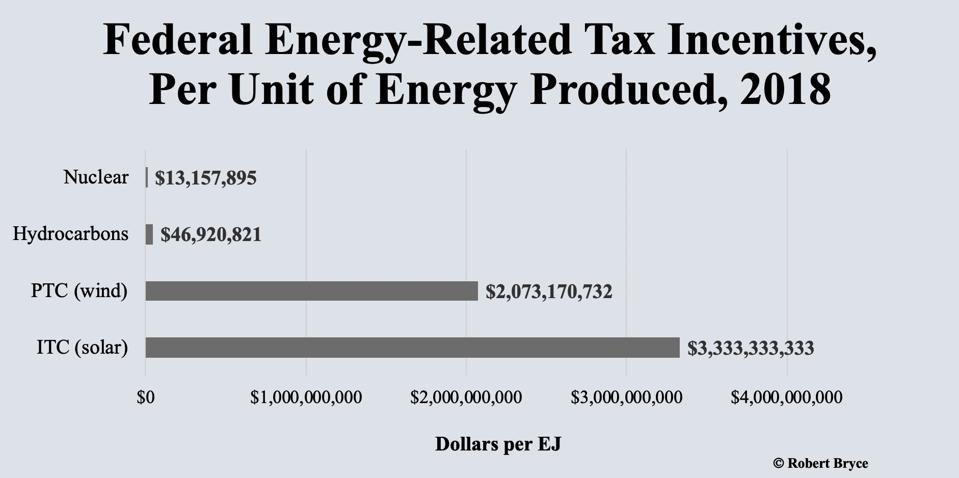
The proponents of wind and solar energy say that subsides for fossil fuels and nuclear are bigger than those for these so-called renewable energy systems. Forbes posted “Why is solar energy getting 250 times more in Federal tax credits than nuclear “by Robert Bryce.  Bryce’s posting shows that this is not the case.

 “According to a December 21 estimate from the Joint Committee on Taxation, the extension of the solar sector’s investment tax credit (ITC) will cost the American treasury another $7 billion between now and 2030. (The ITC may also be used for offshore wind projects.) The extension of the wind industry’s production tax credit (PTC) — which like the ITC was supposed to be phased out — will cost another $1.7 billion. Those billions will be added to the $27 billion in ITC  credits that were already designated for the solar sector and $34 billion in PTC that will be collected by Big Wind between now and 2029. (Those last two numbers are from the Treasury Department.) “

“Given the tens of billions of dollars that are being lavished on solar, wind, and other politically popular energy programs — tax credits for fuel cells, carbon capture and sequestration, and “two-wheeled plug-in electric vehicles” also got extensions in the budget bill — I decided to seek an answer to a simple question: which energy technology gets the most in federal tax incentives? “

“The answer, by two country miles, is solar energy.

In 2018, the American solar industry got roughly 250 times as much in federal tax incentives as the nuclear sector, when compared by the amount of energy produced. Coming in a close second is the wind sector, which got about 160 times as much as nuclear. “

EJ = Exajoule   An exajoule is a measure of energy.  Exa is 10 to the 18th power. An exajoule is equal to 277.8 terawatt-hours

“In 2018, as shown in the graphic, America’s nuclear sector received about $13.1 million in tax incentives per EJ while the solar sector soaked up $3.3 billion per EJ – or 253 times the amount given to nuclear. The wind sector got $2 billion per EJ, or about 158 times as much as nuclear.

Congress is allocating yet more money for solar and wind even though America’s nuclear sector is producing about twice as much carbon-free electricity every year as wind and solar, combined. Despite its importance to America’s climate goals, the nuclear sector is foundering. Numerous reactors have closed over the past few years and more will be shuttered in the months and years ahead. In New York, the Unit Three reactor at Indian Point will be shuttered in April. In Illinois, Exelon EXC -1% is planning to shutter two nuclear plants. In California, the Diablo Canyon nuclear plant is slated for closure in 2025.” 

I recommend that you read Bryce’s full posting by clicking this link.

I am agnostic about carbon dioxide’s (CO2) role in climate change.  Theoretically it is a player but the positive feedback that is claimed for it, looks to be exaggerated. Especially when nature’s negative feedbacks are ignored. Moreover, nuclear energy appeals to me in that it satisfies my desire to have something that can be reliably making electricity for a long, long time into the future.  It will extend the availability of fossil fuels to make valuable products, not just heat—perhaps the Earth will make natural gas and oil at an equilibrium with the fossil fuels withdrawal. Who knows?

One would think that the Greens would welcome nuclear energy based upon their crusade to eliminate man-made CO2 emissions.  But they don’t.  And they say that their programs are science based?

cbdakota

Green Energy Train To Energy Poverty


The Claim: Europe and Australia are benefiting from their green energy policies. We should follow their example.

The Facts: The Ice Cap blog refutes that claim in a posting titled:“Green Energy Train To Energy  Poverty”.

Joseph D’Aleo shows that green energy is pricing the Europeans out of a number of markets and is wreaking real damage on their poorer citizens.

Two of the many  charts that  D”Aleo uses to make his case are as follows:


And the following chart equates the amount of installed wind and solar renewable energy with the cost of electricity:


Read D’Aleo’s full posting by clicking here:

cbdakota

Can Tesla Survive The Loss Of Subsidies?


Three years ago, The Los Angeles Times posted “Elon Musk’s growing empire is fueled by $4.9 billion in government subsidies”. I have not seen a summary of the current total of Musk’s subsidies but it is certainly more than $4.9 billion now. When The LA Times speaks about an “empire” it included Tesla, Space X and Solar City—all Musk controlled businesses.

This discussion will focus on the Tesla electric vehicle (EV) business.

Subsidies start with the Federal Tax Credit of $7,500 given to each buyer of a Tesla EV.  (Every EV maker gets the same treatment.).  California also provides a $2500 subsidy per car.

The following is from the LA Times posting:

“Tesla has also collected more than $517 million from competing automakers by selling environmental credits.  The regulation was developed in California and has been adopted by nine other states.”

These regulations require that companies selling automobiles must also sell a certain percentage of EVs.  Sales of an EV gives the seller environmental credits.   Manufacturers are penalized for not selling enough EVs and must buy credits to offset their failure. Because Tesla sells only EVs it gets a lot of credits which they sell to the other car makers.

The following 2016 video discusses what the Wall Street Journal thinks subsidies mean to the Tesla’s bottom line: (Please excuse the 15 second commercial.  When video ends click back to this page.)

https://video-api.wsj.com/api-video/player/v3/iframe.html?guid=00E58A9F-9315-47FE-BFED-7C79B2C3A98B&shareDomain=null

Continue reading

Tesla Model 3 Sales Will Be Make Or Break For The Company


Is Tesla a major player in the transportation market?  The answer is no.  But will Tesla be?  We read that automobile engineers at the major vehicle producers begin shaking all over when they think of the threat Tesla poses.  So maybe they have magic.

Have not seen it yet and I could be wrong not being an auto engineer.

How is a stock market analyzing firm ranking Tesla versus competition?

Company TTM Sales $million $/Share Recommended Buy Price $/Share
Tesla    10,069 345 99
VW adr  267,350   31 29
Toyota adr  256,791 113 68
Damlier adr  189,396   74 56
Ford  153,596   11   8
General Motors  170,231   36 31

A casual glance says that Tesla share price is not based on actual sales but on investors belief that the company is something special.  Note that the firm that provided the above data ventured that the actual Tesla share price was about 3.5 times their recommended buy price.  The actual prices were greater than the recommend buy price for each of the companies shown in the table. But the relationship was in most cases about 1.3 or so.  Some analysts believe that Tesla is looked at more of a Tech stock than and stock of a company making vehicles.

In August 2016, Elon Musk,  the force behind the Tesla  said that he plans to sell 500,000 vehicles by 2018 and one million by 2020. From my readings, I would guess the majority of analysts don’t think he will accomplish that goal.

Several years ago, Consumer Reports (CR)  said theTesla was the best car ever.  They still believe it to have superior performance but no longer rate it an unqualified success because of reports of lack of reliability. (The Toyota in my garage was purchased based upon CR’s reliability rating of the car—and CR got it right.

The lowest priced  Tesla vehicle is the Model S.  The S’s price starts at $69,500 and grows based upon the options the buyer elects to add. The new Model 3 is said to have a base price of $35,000.

CR posted some info on the likely cost of the new Model 3 which may disappoint some potential purchasers of Model 3. In an updated (8 August 17)  posting CR said this

The base model will be black, with a Tesla-estimated range of 220 miles and 0-60 mph acceleration of 5.6 seconds. (If you want a color other than black, it’ll add $1,000.) Notable standard equipment counts WiFi and LTE internet connectivity, navigation, and the hardware to enable active safety systems, including eight cameras, forward radar, and a dozen ultrasonic sensors.

Initial Model 3 cars will feature the long-range battery (a $9,000 option) and the Premium Upgrades package (a $5,000 option), which adds heated, 12-way adjustable front seats; premium audio system; glass roof; folding/heated side mirrors; fog lamps; and a center console with covered storage and docking for two smartphones.

Enhanced Autopilot (a $5,000 option) bundles futuristic capabilities such as active cruise control, lane-keep assist, automatic lane changing and freeway exiting, and self parking. Tesla advises more such features will be added via software updates.

In the future, Tesla will offer an addition to Enhanced Autopilot that claims “full self-driving capability” for $3,000. The company says, “Model 3 will be capable of conducting trips with no action required by the person in the driver’s seat.” We are concerned that such a claim encourages distracted driving.

We expect typically equipped (early-delivery) cars will cost $57,700, which includes long-range battery, choice of color, Premium Upgrades package, Enhanced Autopilot, and 19-inch wheels.

A typically equipped model with the standard battery is expected to cost about $42,200, and comes with your choice of color and Enhanced Autopilot.

The free charging of the battery at Tesla stations will not extend to the Model 3

Car and Driver rated the new Model 3 the best of all the EV on the market.  However that rating was based on a prototype.  How valid is a prototype rating?

The US government tax credit of $7,500 has been helping Tesla sell its cars.  This tax credit ends when a manufacturer reaches sales of 200.000 vehicles.  It has been estimated that there have been over 100,000 Tesla sold using the tax credit.  The impact of the subsides provided by governmental bodies on the sale of EVs is examined in the next posting.

How successful the Model 3 is,  will define the future of the Tesla company.

cbdakota