Category Archives: Fracking/Shale Gas

Gasland Part II Reviewed


Gasland Part II, a sequel to “Gasland “, was released 28 June (a limited release according to Rotten Tomatoes).  It carries the same theme that fracking is bad. The documentary “stars” are Josh Fox, the director and Dennis Kucinich, former US Representative from Ohio. Can’t imagine that Kucinich is going to bring people into the theater.   The documentary has not yet appeared in the “Box Office” top 50 grossing films.  TheAmericanInterest.com reviewed the documentary with it’s posting “Gasland II: Muddying a Fractured Debate”.   The reviewer tries to play it down the middle saying that the movie and the movies critics tend to go over the top.  But he writes this:

Gasland II is chock-full of errors and falsehoods. Some might be unintentional (Fox readily admits that he’s a “theater guy,” not an engineer or chemist), but at least one seems to be a case of deceit. At one point, Fox throws up a graph purportedly showing the high rate of cement casing failures in fracking wells. Its steeply ascending red bars make for an alarming picture, and as he triumphantly explains, “[gas companies’] own documents showed that cement encasings failed in five percent of wells immediately upon drilling, and that the failure rate increased over time; that over a thirty year period, fifty percent of wells failed.” But the caption to the graph, barely visible in the film explains that it’s showing sustained casing pressure (SCP), a condition that can lead to cement casing failure. Worse, the graph showed the SCP only for offshore wells, explicitly stating, “[t]hese data do not include wells in state waters or land locations,” a fact conveniently left out of the film.

Continue reading

European Renewables Bubble Is Collapsing


The European nations have led the world in the installation of wind and solar, the renewable technologies.  But now the high subsidies that were imposed to make these renewables look attractive are becoming intolerable.

Peter Glover has posted “The ‘Great Renewables Scam’ unravels” on thecommentator.com.   Glover writes:

Energy insiders have long known that the notion of ‘renewable energy’ is a romantic proposition – and an economic bust. But it is amazing what the lure of guaranteed ‘few strings attached’ government subsidies can achieve. Even the Big Oil companies bought into the renewables revolution, albeit mostly for PR reasons. Like Shell, however, many quickly abandoned their fledgling renewable arms. Post-2008, they knew, the subsidy regimes could not last. Neither was the public buying into the new PR message.

Continue reading

President Obama’s Climate Change Fantasies


The noted environmentalist Bjorn Lomborg thinks that President Obama has some fantasies about climate issues.  Lomborg posted on usatoday.com “Obama should confront climate change fantasies”.  In reviewing the President’s recent speech on his new climate policies, he lists these four:

  • Renewables are a major part of the solution today. No, they are almost trivial. Today, the world gets 81% of its energy from fossil fuels – by 2035, in the most green scenario, we will still get 79% from fossil fuels. Wind and solar will increase from 0.8% to 3.2% — impressive, but not what is going to matter.

Continue reading

Kyoto Did Not Level The Playing Field, But Obama’s New Climate Policies May Do That


President Obama’s outlined his new climate policies in a recent speech.   My take away from the speech is that it is a way to increase Federal revenue by taxing carbon use.  And it is mainly done through new regulations developed by his EPA.  Congress just a well go home because they never see the need to challenge the usurping of their powers.    The consequence of these policies will be significantly higher electricity prices, and the poorest among us will be the primary victims of this action.  Once again, in the name of the environment,  he will forego focusing on bringing about  the nation’s recovery.   Interestingly, one posting suggests that this will level the playing field between the US and Europe.  That was the basis for the European’s support of the Kyoto Treaty, but it did not work for them because the US chose not to enter into the Treaty.  A posting on notrickszone.com by Peter Gosselin titled “Obama Is Merely Leveling The Energy Playing Field With Europe – Declares An End To Cheap American Energy is interesting to get his view from Europe.  He writes:

Continue reading

Will The OPEC Cartel Break Up?


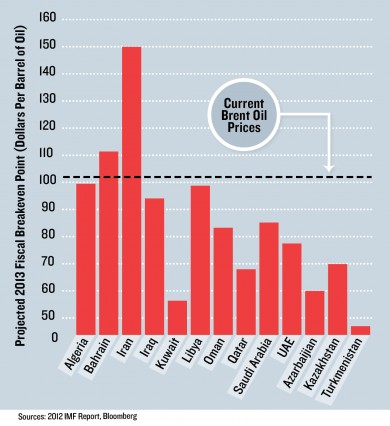
Because the OPEC cartel provides about 40% of the world’s crude oil, it has been able to control the crude oil price.  Its members meet and set the amount of crude they will produce for sale opposite the forecast world demand.  They can reduce or increase production to raise or lower prices. Other major crude producers outside of OPEC have been able to sell all their crude oil but acting independently are unable to displace OPEC’s role as the selling price arbiter.   As you would expect, OPEC wants the price to be high but recognizes that if they set it too high, demand will drop and competitors will be encouraged to prospect for more crude.   Within OPEC, the members have their own issues that make setting the production levels and thus the price, not easy.  However, Saudi Arabia, currently the world’s largest producer of  crude oil,  is said to be the primary voice in this process.  When the OPEC members meet, as they did on May 31st, to set the production level/price, one big factor was how much of their government’s budget is derived from the oil revenues.  And what is the price of crude oil that makes that budget whole? The graph below, from the American Interest’s posting “OPEC Sweats: How Low Can Oil Prices Go?illustrates the price needed to balance their government’s budget:

2013_fiscal_breakeven_point-e1370293236725

Continue reading

Oil and Gas Reserves Are Increasing And Fugitive Methane Emissions Are Decreasing.


The National Journal posting “The U.S. Has Much, Much More Gas and Oil Than We Thought” relates that the Interior Department says that the Bakken and Three Forks formations in North and South Dakota and Montana have twice as much oil and three times as much gas as previously estimated in 2008.  The USGS  now believes that these two formations hold 7.4 billion barrels of technically recoverable oil and 6.7 trillion cubic feet of natural gas.  This is good news and surely there will be more upward valuations of  US oil and natural gas reserves in other  formations.

Does Al Gore Think Glenn Beck Is More To Be Feared Than An Oil Nation?


Al Gore’s syndicate is selling the Current TV Network to Al Jazeera, the Qatar-owned news network, for something like $500 million. Glenn Beck had earlier tried to buy Current TV but he was turned down with the stated reason being that Current TV wanted to sell to someone that shared their views and Beck didn’t.  However it seems that Qatar does have the same views.  This is difficult to get your mind around.   Gore has made a fortune bashing anyone associated with crude oil and the products from crude like gasoline (petrol) thus fossil fuel-financed Al Jazeera would seem an unlikely candidate.  One can only conclude that if Gore has to decide between money and principal, money wins.  Gore is reported to get $100 million from this sale.
A little background.  Current TV was founded in 2005.  Current TV has been a ratings disaster.  It had access to some 40 million households via contracts with companies like Time-Warner Cable but its programing was so dismal that it has been said that total daily views were in the 50,000 range.  Time-Waner Cable cancelled their association with Current TV following the announcement of the sale to Al Jazeera.
We know how Gore feels about fossil fuels, but how does Al Jazeera match up with Gore’s liberal views that would not let him sell to conservative Glenn Beck.  USA Today reports that some people are skeptical about this being a good thing. The following are excepts from their report which can be read in its entirety by clicking here.
Media watchers in the Middle East say the Arabic news network Al Jazeera is well known for promoting radical Islamist causes overseas, but it remains to be seen how it will present the news on its newly purchased U.S. cable channel.
Itamar Marcus, director of Palestinian Media Watch, an Israeli research institute that studies Palestinian society and the Arab world through their media and educational materials, said there is “a big difference” between Al Jazeera’s Arabic programming and its international English-language broadcasts.
“The Arab broadcasts very often promote a very radical Islamist approach,” said Marcus.
“What’s brilliant,” Marcus said, is the way the company “binds this in with all the latest technology and even occasionally interviews with differing opinions, including Israeli leaders.” This creates a “perception” of balanced reporting, Marcus said, “but in fact, the overall underlying agenda is very radical.”
Daoud Kuttab, the Jordan-based director of the Community Media Network, a Middle East media group, said Al Jazeera’s Arabic-language programming “is very different” from its English counterpart.
 Al Jazeera was begun in 1996 and owned by the emir of Qatar, Sheikh Hamad bin Khalifa, an Arab monarch who has offered support to Hamas, the U.S.-designated terrorist group in Gaza, and presides over an authoritarian regime.
Freedom House, a U.S.-based group that monitors repression worldwide, has given Qatar its lowest rating of “Not Free.” Homosexuality is a crime in Qatar, journalists are sometimes jailed and non-Muslims are discriminated against.
The news media watchdog Committee for Accuracy in Middle East Reporting in America or CAMERA, which frequently takes U.S. outlets to task over errors in reporting on Israel, says the network has been assailed for bias even in the Middle East.
In 2004, interim Iraqi Prime Minister Ayad Allawi temporarily shut down Al Jazeera’s broadcast in Iraq because he said it was inciting violence and racial hatred. In 2008, former ABC-TV Nightline reporter Dave Marash, brought on to anchor Al Jazeera English for American audiences, quit after two years and said the anti-American bias at the station was “reflexive.”
The agreement by Al Jazeera cable television network to buy Current TV is not necessarily a plus for U.S. cable operators or their audiences,” said Andrea Levin, president and executive director of CAMERA. Al Jazeera Arabic “is not the Middle East equivalent of CNN, as it is often but mistakenly described,” Levin said.
CAMERA says one of the network’s most popular programs is Shariah and Life, hosted by Sheik Yusuf al-Qaradawi, a former “spiritual guide” of the Muslim Brotherhood. Al-Qaradawi has called for conversion of Europe and North America to Islam and a Muslim-led genocide of Israel and the Jews, Levin said.
Al Gore is an opportunist.  His stardom in the green movement came about from the movie, “An Inconvenient Truth” despite the fact that it is full of half truths and deceptions.  He has recently said he made a mistake backing the ethanol fuel initiative.  When I heard this, I thought that perhaps he was finally getting it.  But in view of this sale, I have to wonder if he was taken off the payroll by the ethanol producers and he got back at them by saying it was wrong to mandate ethanol into gasoline.
cbdakota

2012 Volt and Leaf Sales


The 2012 Volt sales were 23,461 which surpassed by a wide margin the 2011 sales of 7,671.  As reported, Californians were responsible for more than half of the 2012 sales. The HOV (high occupancy vehicle) lanes now allow the Volt even if there is only one person in the vehicle.  Initially, the Volt emission levels weren’t low enough when operating on gasoline to qualify for driving in the HOV lanes. This problem was corrected. If you have ever driven in California, you know just how packed roads can be out there.

My wife and I have been driving South several times a year. We use the HOV lanes when driving south out of Washington, DC, around Charlotte, North Carolina and through downtown Atlanta, Georgia.  Two things are noticeable;  one is that we hardly have to slow down from normal interstate driving speeds and  the other is that ours is often the only vehicle in the HOV lane. The vast, and I mean vast majority of the cars, trucks, etc, have only one person in the them. I can understand the allure that driving in the HOV lane must have in Los Angles.

In addition GM worked up an attractive leasing program for the Volt.  According to Money.CNN website:”….. the Volt has also been helped by aggressive leasing incentives offered in 2012. Last year, GM was offering the car for $289 a month with a $2,800 down payment. That was far less than a car with the Volt’s nearly $40,000 purchase price would ordinarily lease for, even factoring in a $7,500 plug-in car tax credit.”

The Nissan Leaf improved over last years sales by about 1.5% with total 2012 sales of about 9,800 vehicles.

The sales of the Volt,  along with the Toyota Prius are the most successful hybrids on the market, are really not that impressive when you consider  2012 total vehicle sales in the US of 14.5 million. EVs, like the Leaf, are even less impressive.  My guess is that gasoline prices are not going to skyrocket in the near term because of the continued world-wide recession and the introduction of a lot of new fossil fuels from fracking.  Low fuel prices will depress hybrid and EV sales.  And one has to wonder how long GM will be willing to subsidize the Volt.

cbdakota

Russia’s Federal Budget Depends On High Price Crude Sales


A summary of the Russian Federal budget was posted by Reuters in July of this year.  It said that Russian crude oil had to be sold at or above $116 per barrel or the budget would show a deficit for the year.  A cursory look at the Ural blend (Russian Trading System, comparable to the WTI or Brent) crude pricing for the year suggests that it probably fell short of the goal.  To get some feel for whether or not they accomplished the price requirement, understand that the Ural and Brent crude price indices have been essentially the same for 2012.  The posting tables the Draft Three Year Budget:

DRAFT THREE-YEAR BUDGET 2013-2015 (in trillion roubles unless

stated)

Year                                         2012    2013     2014      2015

Break-even oil price ($)  116.2    113.9     106.0    105.4

Average oil price ($)              115      97        101      104

Nominal GDP                         60.6     65.8      73.4     81.5

Revenues                                  12.7     12.4      13.6     15.2

Expenditures                          12.7     13.4      14.1     15.3

Deficit (% GDP)                      – 0.1      1.5       0.6      0.11

Non-oil deficit (% GDP)     10.6     10.1      8.9      8.6

$1  =  31 rubles

By 2015, the draft budget forecasts break even price at $105.4.

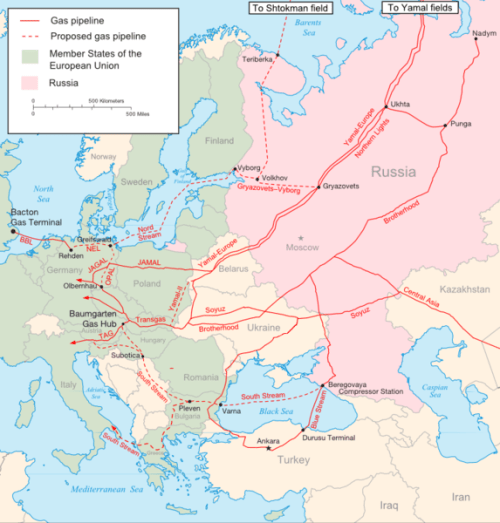
Both Poland and Romania have shale oil and natural gas potential and are known to be evaluating whether it can be profitably exploited.  This is a real threat to Russia.  Any development of Western European shale is a major problem for Russia.  Like crude oil sales, natural gas sales are a major source of income for Russia.  Russia currently provides most of the natural gas and much of the oil to Western Europe.  Russia has not been reluctant to shut off supplies.  In 2009 a dispute between the Ukraine and Russia over unpaid bills resulted in shutting off natural gas to the Ukraine.  Other countries felt the effect with low  pressure or no  pressure in their pipelines.  While the official story was about unpaid bills there was a belief that Russia’s real reason was to warn neighboring countries not to join NATO. They probably are prepared to put pressure on these nations to persuade them to not develop shale gas or oil.

Below is a 2009 map of the Russian natural gas pipelines supplying European nations.

Russiannaturalgassupplylines573px-Major_russian_gas_pipelines_to_europe

Stefano Casertano,  managing director of the Berlin based “The Energy Affairs Company” posted “From Fracks to Riches” on the Stratfor website.  A number of countries are dependent on sale of oil and natural gas to provide the revenue to balance their budgets. In addition to the numbers above for Russia,  Casertano lists what he says are the crude oil prices (in dollars per barrel) to achieve the needed revenue for several other countries as follows:

Iran——-$117

Libya —-$117

Algeria–$105

Iraq—–$112

The US economy can get an enormous boost from an ample supply of low priced fossil fuels. The fear is that the President does not really see this boost as aligning with his political objectives.  He can use his rigged fracking safety study group to impose many “safety” restrictions as a means to cut short this very beneficial exploitation of our shale.  The consequence of slowing or even stopping the US shale boom will be appreciated by Russia and OPEC.

cbdakota

Why Is US Crude Oil Priced Lower Than European Crude?


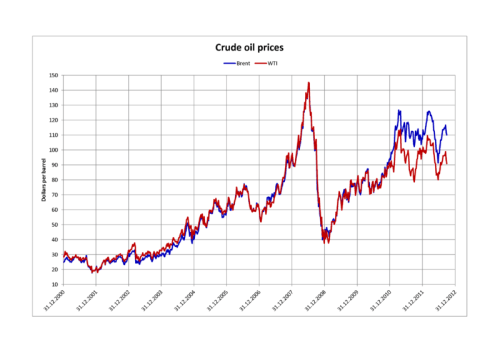
The price standard for US crude oil is West Texas Intermediate (WTI). WTI is called light and sweet referring to its density and relatively low sulfur content.  It is often considered the premium crude and historically has been the benchmark for global oil pricing.  Brent Crude from the North Sea and an OPEC Reference Basket are other standards by which crude is valued.  WTI should carry a wellhead price premium over other crude sources.  But about two years ago,  Brent and WTI prices began separating and the price today, 26 December 2012,(at 4 pmEST) for Brent per barrel is $108.80 and WTI is $88.75.  The  Wikipedia chart below shows the historic trend since the beginning of 2001 through the later part of 2012.   (Click on Charts for clarity.)