Category Archives: CO2

Reblogging: Dear Climate Alarmists – We Will Never Forget nor Forgive.


I am reblogging Adam Piggot’s posting “Dear Climate Alarmists—We Will Never Forget nor Forgive.

The author lays out his complaints about the way the warmers treat the data and as well as how they have treated him.  He believes the catastrophic man-made global warming theory is unraveling and the skeptics will be vindicated. So what do you think about the following?


It’s been a rough ten years as a so-called “climate denier”. Every year the climate data would show a complete refusal to follow the accepted and official line, and every year the faith of the climate change faithful only seemed to get stronger and stronger. And their abuse of heretics like myself only got stronger and stronger. I have lost friendships over my stance on this issue. I have been attacked publicly by those around me on numerous occasions. And I have endured the casual mockery at social gatherings where the accepted response has been to pat me on the head in a condescending manner – here he is; our own climate denier. Isn’t he precious?

I have watched landscapes I love destroyed by the looming figures of gigantic wind farms that stand in mute mockery of my continued resistance to this enormous scam. I have observed with silent loathing the hypocrites who swan around in their enormous SUVs while proudly parading their dubious green credentials, even as ordinary families struggle with the reality of paying their ever-increasing power bills. Only a few months ago, a piece I wrote on the climate change scam elicited concerned emails and calls from people I know who cautioned me with the treacherous path I was taking.

But money talks and bulls— walks, and the money is beginning to drop out of this con to end all cons.

Continue reading

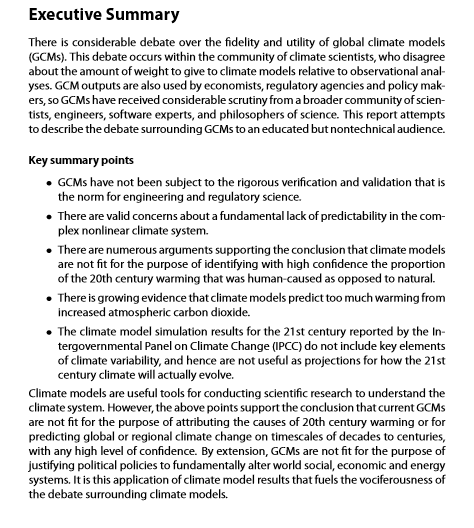
Dr. Judith Curry Says Global Climate Models Are Not Good Enough To Make Policy Decisions


Dr. Judith Curry posts  “Climate Models for the layman”.  The Executive Summary may be enough for some readers.   Here is the link to the full posting where the reader can gain an in depth understanding of Dr. Curry’s thinking that she used to derive the Key Summary Points shown below: 

currygcmfullpage


cbdakota

What Do Scientist Say About Man-Made Global Warming?


Richard Lindzen, (Alfred P. Sloan Professor of Meteorology, Department of Earth, Atmospheric and Planetary Sciences, MIT) discusses the beliefs of three groups.  Group 1 are the IPCC scientist that believe that CO2 emissions are causing global warming.  Group 2 are scientist that are typical called skeptic and Group 3 are the politicians, media and environment groups plus some hangers-on’s.

Lindzen asks “where do we really stand on the issue of Global Warming”, and discusses this in the following video:


 cbdakota

For The Left, The NGOs and The Technical Societies, The Battle Over EPA Regulations Is All About Money


The EPA has been overstepping its authority. This has led to regulations that are unnecessary, burdensome and often not in concert with bills passed by Congress and signed into law by the President. At times, the EPA has been acting as a law making body, which is beyond their authority.  The current Administration intends to correct this situation.

gore-making-money

As the Administration undertakes this task, the Left will mount a campaign intended to defeat the Administrations objestives.  The Left will tell you that the Administration is going to poison your children, make all rivers a sewer, make the air you breathe toxic and Earth will be destroyed by catastrophic climate change. None of which is true.  The media of course will join in and support anything the Left says.  They will report about someone who is supposed to be suffering because of the actions of the Administration. They will ignore the many who are able now make a success of their business as the useless regulations are canceled. The left knows they will miss their opportunity to tax and regulate if the Administration is successful.

Continue reading

EU Does Not Count CO2 Emissions From Wood Burning Power Plants


I am l taking a section out of an excellent posting by James Delingpole title “Delingpole: Why Renewables are doomed and fossil fuels are the future” from the Breitbart website.  It is a very long posting and before I decide to try to summarize it, I want to have you take a look at an ignorant or disingenuous statements by a Brit CEO.

“There is currently in much of the West a vast gulf between where government policy sits on the renewables issue and where reality lies. A good example of this is Britain’s largest power station Drax which has been encouraged by UK government policy introduced in the Labour era – but not opposed by David Cameron’s pretend-Conservatives – to stop using coal and instead burn wood chips, supposedly because they’re carbon neutral, “renewable” and therefore more eco-friendly.

Except in fact this policy has been appalling for the environment – how is it eco-friendly to chop down acres of North Carolina forest and ship them 3,800 miles to be burned for fuel? – and has done nothing to reduce CO2 levels.

It is symptomatic of the bizarre, looking glass world we inhabit that when Christopher Booker pointed this out in this Sunday Telegraph column, the CEO of Drax Dorothy Thompson felt able to reply with this letter:

 woodburningeu


But as Paul Homewood demonstrates here in some detail, many of these claims just aren’t true. The only reason that Dorothy Thompson can get away with them with even a hint of good conscience is simply that she is backed up by an apparatus of official lies.

As he notes, for example, in his reply to her letter:

Dorothy Thompson (Letters, 5th Feb) claims that Drax’s biomass plant makes carbon savings of 80%, compared with coal. However, this is based on EU accounting rules, which classify burning wood as “zero carbon”.

Drax’s own figures show that CO2 emissions from biomass are actually 12% greater than coal for each unit of electricity generated.


Burning wood produces ZERO CARBON EMISSIONS!!!  Based on that EU logic, North Korea might be the most environment friendly nation in the world.  North Korea has cut down nearly every tree in the country. See “Did CO2 Cause North Korea To Collapse?”

cbdakota


The Paris Agreement Has It Wrong–Developed Nations Are Not The Primary Sources Of Greenhouse Gases.


The website EnergyMatters’ posting titled “Attributing the blame for global warming” is one of the most intriguing postings I have read lately.   The posting discusses a report made by a UN group to determine who is responsible for the man-made greenhouse gases that the warmers say have damaged the Earth. The Paris Agreement, for example, blames the Developed Nations and wants them to pay reparations to the rest of the world. The posting, on the contrary, persuasively argues that the developed nations aren’t not the primary sources of greenhouse gases.  Further the folly of the “Developed Nations are at fault theme” is that when projected into the future the evidence says it is even less true.  For those of us that believe that nature is the primary forcing agent with regard to global climate change, who is to “blame” is not particularly our big issue, but it is for the warmers.  This posting seems to point out they continue to get it wrong:

Continue reading

The Sad State Of The German Energy Program–By Fritz Vahrenholt


The following is from a posting by PowerEngineeringInternational titled “Vahrenholt rails against the ‘climate priests”.

PowerEngineeringInternation is pretty much into catastrophic man-made global warming (CAGW); but to their credit, they did capture most of the thought of Professor Fritz Vahrenholt on the sad state of the German energy program and the transition to renewables.  At the end of their posting, they list quotes by warmer scientists that provide their thoughts about what Prof. Vahrenholt said presumably to maintain PowerEngineeringIntenational in the good stead with the powers that be in CAGW.  It is instructive that they avoid actually challenging Vahrenholt’s points.  They revert to the “everybody knows the globe is warming” standby.

At a mid-January meeting in parliament buildings in London, Professor Fritz Vahrenholt provided a very detailed monologue on the motivations behind Germany’s energy transition, and why he feels it’s misguided and potentially disastrous.

Had the lecture been delivered by somebody from the coal power sector, they might have been written off as a ‘climate denier’, but given Vahrenholt’s background and pedigree as a backer of renewable energy, he is not so easily dismissed and his position must cause some unease for those so adamant that climate change is manmade.

It should give pause for thought too to the public at large. Governments and media around the world, not just in Germany, are convinced that man is responsible for the recently observed temperature rises and Polar ice cap reduction.

But Vahrenholt believes that the Intergovernmental Panel on Climate Change (IPCC), the main body from which the rest of the world takes its cue on such matters, is not approaching the problem with the correct scientific rigour.

The merits of the science aside, he takes most issue with the behaviour of his own country’s government for ‘trying to save the world.’

Germany has the second highest electricity prices in Europe, and in phasing out nuclear while stimulating over-production of renewables, it has reduced power prices to a pitiful extent, and ironically came to rely on coal. The last two factors mean the prospect of a lack of investment in the country’s future energy infrastructure, while targets for reducing CO2 look likely to be missed.

Much of Germany’s current problems arise from what he believes was an emotional reaction to the Fukushima disaster by Chancellor Angela Merkel – an order to accelerate the phasing out of a power source that had provided 30 per cent of the country’s electricity.

Vahrenholt says there is an endgame for the Energiewende, ‘though this reckless policy has worked until now’, referring to the German proverb ‘the donkey goes on to the ice until it breaks.’

“There will come a point when the rural population, or wildlife protection agencies, or a weakening economy or failures in the grid itself will force a return to conventional generation.”

He said one of the reasons the German population still backed the policy is because they are still relatively economically prosperous, with a weak euro and the work done by Merkel’s predecessor, Gerhard Schroeder, continuing to sustain the economy.

“The second reason it works is that energy intensive industries are exempted from the levy. They are profiting because of the overcapacity from renewables leading to sinking prices.”

Vahrenholt mocked the government’s current strategy of trebling wind farm capacity as the wind cannot be predicted and their output fluctuates enormously.

“Nil multiplied by x is still nil,” he said, while the price keeps mounting, and the carbon price remains too low to encourage carbon capture and storage at lignite plants which remain essential to fill the intermittency gaps, as gas-fired power plants are mothballed or closed completely.

He reserved his gravest criticism for the damage being wrought on the German countryside where the use of biofuels is having a bad impact. Pesticide use and monoculture has led to major declines in bird of prey numbers.

He calculated that to maintain the policy there would have to be a wind turbine ‘every 2.7km whether the landscape is lakes, wood or towns.’

A particularly acute sign of the failure of the policy is the current rate of progress and expense in bringing renewables from wind plants in the north to the south, where nuclear shutdowns are most keenly felt.

“6100 km cables are planned to be built but four years later only 80 km have been laid. Government has underestimated the resistance to the imposition of overhead power lines on this scale– so all plans have been torn up and they areof course also be added on to household bills.”

We are talking about DC cables which have never been built at this scale underground. In the best case scenario these cables will be laid five years after the nuclear shutdown.” now going underground at huge extra cost, which will

Re-dispatching of power is another feature of the new reality for the German electricity system. The grid operator would previously be called upon to interfere between power plants and customers once a day on average. This procedure now occurs 20 times a day, amounting to 6000 interventions a year in order to have guarantee system stability.

Because the merit order that facilitated market prices for power no longer works, thanks to the success of renewable energy, no new conventional power plants are being built. 69 power plants with a total capacity of 8000 MW are in the red as a result, as power plants are no longer profitable in the current scenario.

Due to a lack of supply in southern Germany the government was forced to intervene, creating a law whereby plants were only permitted to close by the grid agency with a minimum lead time of one year. These requests are being denied anyway, according to Vahrenholt, who very much paints a picture of a government making it all up on an ad-hoc basis.

“A term used in banking was system relevancy = the same term is now in use for power plants who are not allowed to close in Germany even on negative figures.”

“The owner of the plant receives only the operational cost,” Vahrenholt said, with obvious implications for investment in new plants.

Noting the latest figures showing a 2.5 per cent rise in CO2 in Germany last year, he also expressed doubt about the claims for storage (prohibitively expensive) and electro mobility (limited solution) as potential answers, making for a very dark narrative indeed.

To add more to an already gloomy picture, the professor said the Energiewende was creating an ‘ecological disaster’ through its assertiveness in building wind farms and biogas plants.

“Turning grassland into monoculture maize means deserts of maize replacing other food sources and ruining ecologies, a disaster for biodiversity. Birds of prey are also victims of the green religion. Take the lesser spotted eagle – there are only 100 braces left in Germany. The red kite lose 1000 each year due to wind turbines. The common buzzard is losing 11000 per year. The environment minister says the red kite could be gone by 2025.”

“The same problem exists for bats. Wind turbines are going into forests and other sensitive areas – because we want to save the world and destroy our nature.”

“In the transportation of equipment to the forest, paths are created and bats take that freeway and fly directly into turbines. They go through but their lungs are bursting and evolution has not prepared them so 240 000 bats are killed each year in Germany even though by law it is forbidden to kill a bat.”

He said the chance of a ‘policy correction’ would only happen under certain circumstances:
The average global temperature doesn’t rise as much as predicted
Loss of German competitiveness becomes acutely felt
or
the spoiling of the German landscape becomes a major political issue.

The glimmer of hope in Vahrenholt’s thinking is that future generations would have technology such as thorium reactors or nuclear fission that could save the day, but ‘it will take a long time to redress this misguided energy policy.

cbdakota


Four Key Charts for a Climate Change Skeptic


Rebloging from WattsUpWithThat “4 Key Charts for the Climate Change Skeptic”.
I could have used these charts to illustrate my reply to a commenter who said that I must not believe in climate change.
From my blog:
Dave
I don’t know any skeptic that does not believe in climate change. Every 100,000 years or so, the Earth experiences roughly 80,000 years of a very cold climate and about 20,000 years of warm climate called the interglacial period. As you can tell the geological scientists mean that the warm period is squeezed in between glacial periods. This cycle has been going on for about a million years. The question is not, does the climate change, but rather what causes it to do so. Surely you don’t think that this natural cycle has been caused by man burning fossil fuels.
Most skeptics believe the primary cause of the change is natural and most think that man’s activities may play a minor role in the recent climate change. What we believe in is actual measurable data. What we don’t believe in is climate models that have proved time and time again to fail to be even close to actual measurements. For eighteen years or so, there was no statistically significant rise in global temperatures. You may think that the recent temperature spike due to a natural event, El Nino, has caused the “pause” to be broken. I ask you to look at the predicted temperatures versus the current temperature and you will still see that it is way below what is predicted by the computer models. And here is a kicker, the atmospheric CO2 levels used in these selected mean computer temperature predictions are typically lower than the actual measured CO2 level. Wow. That should make the spread between actual and computer predicted temperatures even bigger.
No, I don’t want dirty water or air. You propose so many strawmen that you could populate a remake of the Wizard of Oz. I support the Clean Water and Clean Air Acts. Have done so as an engineer and manager of design and installation of environmental facilities throughout my industrial career. But how is it that one could support regulations that are predicated on SECRET SCIENCE? The EPA is out of control. Congress makes the laws. The EPA cannot be allowed to do that.
cbdakota (two minor grammatical corrections from the original reply.)

The WUWT is below:

Undoing Obama Administration Regulations


There are many regulations  issued by ex-President Obama that the current Administration would like to rescind.  But if you have been following this issue, you would have probably heard that only new regulations passed within the last 60 days can be rescinded by President Trump.  In fact it appears the law may not be so limiting.  One of the authors of the Congressional Review Act of 1996 (CRA), Todd Gaziano says the law gives the Republicans much more power to overrule the regulations.  Scott Johnson posted on the PowerLine website “Review This.” A review of Kim Strassel’s WSJ posting “A GOP regulatory game changer”—(Behind a paywall.).

“The accepted wisdom in Washington is that the CRA can be only used against new regulations, those finalized in the past 60 legislative days.  That would allow the Republicans to reach back to June 2016 , teeing up 180 rules or so for override.  Included are biggies like the Interior Department’s “streams” rule, the Labor Department’s overtime-pay rule, and the Environmental Protection Agency’s methane rule.

“But what Mr Gaziano told Republicans on Wednesday was that the CRA grants them far greater powers, including the extraordinary ability to overrule regulations even back to the start of the Obama administration. The CRA also would allow the GOP to dismantle these regulations quickly, and to ensure those rules can’t come back, even under a future Democratic president. No kidding.”

Strassel goes on to explain”

“ It turns out that the first line of the CRA requires any federal agency promulgating  a rule to submit a “report” on it to the House and Senate. The 60 day clock starts either when the rule is published or when Congress receives the report—which ever comes first.

“There was always intended to be consequences if agencies didn’t deliver these reports,” Mr. Gaziano tells me. “And while some Obama agencies may have been better at sending reports, others, through incompetence or spite, likely didn’t.” Bottom line: There are rules for which there are no reports. And if the Trump administration were now to submit those reports—for rules implemented long ago—Congress would be free to vote the regulations down.”

Also from the posting is the following:

cra-regulatory-loop-hole


Some of the regulations that deserve to be overruled may have followed the rule by submitting a report to Congress which apparently makes them exempt.  Let’s hope that no report was submitted for the most of them.


cbdakota

Cap And Trade Group (RGGI) Overstates Its Accomplishments


The Regional Greenhouse Gas Initiative (RGGI, aka Reggie) has posted “New Study: Carbon Cap and Trade Has Saved Lives”.  (The  RGGI posting can be seen at the end of this posting.).  RGGI has a membership of nine states, that have collectively set caps on greenhouse gas emissions.    RGGI states that they have cut emissions by 37%, lowered electricity prices, saved lives and improved the health of vast number of people.  Actually the emission cut is essentially too tiny to measure in the big picture.   Data from the US Department of Energy makes the claim of lower electricity prices questionable and the improved health unsubstantiated.  Let’s examine RGGI’s  claims.

The following chart has been prepared using data from  the US Department of Energy’s Energy Information Administration (EIA).

CO2 Emission in millions of metric tons.   Data from Department of Energy,      
State 2008 2014               %                delta, metric tons
Connecticut 37.7 35.1 -7 -2.6
Delaware 16.2 13.3 -18 -2.9
Maine 19.1 16.6 -13 -2.5
Maryland 73.8 61.5 -17 -12.8
Massachusetts 76.7 63.9 -17 -13.1
New Hampshire 18.7 15 -20 -3.7
New York 190 169.7 -11 -20.3
Rhode Island 10.7 10.6 -1 -0.1
Vermont 5.9 5.9 0 0
RGGI CO2 EMISSIONS 448.8 391.6 -12.3 -58
US CO2 EMISSIONS** 6022 5489 -8.9 -533
GLOBAL CO2 EMISSIONS** 29728 33355 12.2 3627
** 2007 rather than 2008

The nine States that make up the RGGI are listed.  RGGI’s stated goal  is to reduce emissions from fossil fuel powered electrical generation facilities.  The numbers in the above chart are for the all sources of CO2 emissions in each state. The period from 2008 to 2014 is used because that is the range used in the current (September 2016) RGGI report: “The Investment of RGGI Proceeds Through

The total reduction of CO2 emissions for the RGGI group States for the period from 2008 to 2014 are 58 million metric tons.  That looks impressive but in the big picture, it is a drop in vast atmospheric ocean.  During the time that these 58 million metric tons were not emitted, the global addition was estimated at somewhere around 210,ooo million metric tons.  The net effect is too small to  measure.  The EIA estimates that China and India will emit 11,460 million metric tons of CO2 in 2017 and they are forecast at 11,705 million in 2018.  And former President Obama signed a pact with China that allows them to continue increasing their emissions until 2030 while the US is to reduce its emissions some twenty percent.  Isn’t that a “great” deal?

The RGGI is a “cap and trade” program.  When the US Congress rejected a “cap and trade” program sponsored by ex President Obama, these States developed the RGGI program which was fully operable by 2008.  They reduce the amount of CO2 each year that these power plants can emit.  The reduction has varied but is nominally about 3% per year. If other facilities in their States have a CO2 baseline than exceeds their needs, they can sell it through RGGI to the highest bidder.   These “CO2 allowance”  sold last year at about $3.30/ton.   The income from these sales so far is about $2.5billion. Obviously, this is a State revenue scheme.  RGGI uses this money to insulate homes, put in renewable energy systems, help some people pay their power bills among other things.  In 2014, paying the bills of low income families was nearly non-existent except in Vermont where 98% of their share of the income from sales of CO2 Allowances was used to help single family homes with bills and home efficiency improvements.  It appears that RGGI’s installation of renewable energy systems are a major user of the funds from sales of CO2 Allowances.  So, they probably off-set the cost of installation of solar cells., for example.  One of the States has just set up a deal with Solar One to install these systems. Most of the installations of roof top solar systems that I have  seen are made in communities where affluent people live.  Are the wealthy benefiting the most from RGGI’s programs?

The RGGI posting also said that “Recent assessments of the program have shown none of the negative economic impacts that some feared at the outset.  In contrast, economies in RGGI states have actually grown faster than in other states. Electricity costs have declined by a few percent, on average .”

Using the EIA data for the Average Price Electricity to Ultimate Customer by End Use Sectors for the YEAR 2015—Cents per Kilowatt-hour we constructed this chart:

STATE Residential* Commercial Industrial Transport
Connecticut 20.94 15.97 12.95 13.18
Massachusetts 19.83 15.79 13.54 7.76
Rhode Island 19.29 15.78 13.76 18.54
New York 18.54 15.31 6.31 12.95
New Hampshire 18.50 14.96 12.74 —–
Vermont 17.09 14.54 10.27 —–
California 16.99 15.73 12.17 8.99
New Jersey 15.81 12.79 10.64 10.25
Maine 15.61 12.47 9.05 ——
Michigan 14.42 10.55 7.02 11.44
Wisconsin 14.11 10.89 7.58 14.66
Maryland 13.82 11.00 8.53 8.34
Pennsylvania 13.64 9.60 7.20 7.28
Delaware 13.42 10.25 8.28 —–
\

In Bold are the 9 RGGI States. 

New Jersey, once in the RGGI, dropped out.

(*Beginning with Connecticut, these 14 States have the highest residential rates in the continental US.  (Hawaii and Alaska are the only other States with higher residential rates.)

There must be other things going on to make the statement that the RGGI States “economies are growing faster than in other states.”  It does not look like the electricity prices would be favorable.  I am surprised that the prices for 6 of the RGGI States are higher than those in California.

Another part of the posting by RGGI alleged health benefits.

The following are the health benefits that RGGI lists in their posting:

“Abt Associates used mathematical models to estimate the scale of such health benefits, and found that RGGI has averted:

  • 300 – 830 premature adult deaths
  • 35 – 390 heart attacks
  • 8,200 – 9,900 asthma exacerbations
  • 13,000 – 16,000 respiratory illnesses”


Models!!  UGH!   Anyway, the EPA has a model based upon some secret science that generates these figures. It is 2.5 micron particles that are inhaled that are supposed to cause these health issues.  The EPA is using this secret science to try to put out of existence, all fossil fuel generated electricity.  The EPA has issued regulations that are called the Clean Power Plan. These regulations have been  stayed by several courts.   The Courts along with President Trump’s support, may withdraw the Clean Power Plan.

Before delving into the secret science, let’s lok at what a stretch RGGI is making.  The atmosphere is well mixed and CO2 and these 2.5 micron particles are pretty much in the same amounts in most places around the world. So, it is unlikely that the atmosphere in the RGGI regions is any different from any place else. Nothing the RGGI is doing can be having a measurable effect on the air the people breath, hence the claim is not viable. Remember how small the actual RGGI emission reduction is.

I have made two postings on the Clean Power Plan.  The EPA claims  mercury and 2.5 micron particles are dangerous .  Thus they must be removed from the emissions by fossil fuel (particularily coal) electrical generating plants.  The EPA limit on mercury lacks a good scientific basis.  Click here to review my posting on mercury.   The following is from one of my  posting on the 2.5-micron particle which discusses the secret science the EPA is using.  Cllick here to read it in its entiretly.

———————————————————————————————–

In this case the toxins are particulate matter—2.5microns (PM2.5) or smaller in diameter.   For perspective, how big is a 2.5micron particle? 2.5 microns are equal to 0.00025 centimeters or 0.000099 inches. Yes, you are right, you can’t see them.

The EPA touts a study that says PM2.5 is dangerous, but they won’t share all the study data with anyone. Thus, no other science body can confirm or deny the studies results.  Secret Science. We are told we must take their word for it.

The EPA found it necessary to get a friendly team to do this study because other work, including some of their own, shows no harm. This particular study group has done “friendly” work for the EPA and the American Lung Association. One of principal authors has received over $31 million in payments from the EPA for his studies.   (No energy company can match the EPA and other government bodies when it comes to paying for studies.) The study is called the Harvard 6 Cities Study and this is what Dr Battig** said about it in his posting on WUWT titled “A Physician’s Perspective on the EPA’s “Data Derangement Syndrome”:

“The Harvard Six Cities Study (Laden et al 2006) forms the scientific basis for much of the EPA claims regarding PM toxicology. Yet examination of the data shows that the statistical relative risk (RR) for total mortality claims range from below one to barely above one and a fraction. They do not meet the minimum legal standard of a RR of 2 to identify a significant population risk. In addition, these Harvard studies have walled-off their raw clinical data from independent investigators by claiming patient confidentiality, thereby preventing duplication of results by others. Independent reproducibility and verification of test results are the traditional hallmarks of scientific research. Invoking patient confidentiality to block access to raw data casts doubt on the entire process since providing such patient protection is not particularly difficult.”

Not only will they not allow examination of all the data, the study’s RR does not meet minimum legal standards and yet they want to impose it on us.

Dr Battig adds this:

“The EPA has been conducting controlled human exposure studies to air pollutants on the University of North Carolina campus for more than thirty years. During that time more than six-thousand volunteers have been studied without a single serious adverse event being observed…so is there a health problem to investigate or not? How much more testing looking to define a disease? It looks more like a disease concept in search of a susceptible victim”.

At the 10th International Conference on Climate Change, Dr Battig; Scientific Integrity Institute President James Enstrom; and S. Stanley Young, a fellow at the American Association for the Advancement of Science did an outstanding panel discussion on this topic.

News.heartland.org posted “Conference Panelists Criticize EPA Health Scares” written by ALYSSA CARDUCCI carried this insight from S Stanley Young:

“After examining reams of data, Young concluded the threats of air pollution, PM2.5, and ozone contributing to deaths are “imaginary”.

Young received “the biggest data sets on the planet” to study the effects of air pollution on human health in California. The dataset included 13 years of data on eight California air basins and daily electronic death certificates equaling more than two million certificates and a total of 37,000 days of exposure.

Using standard statistical techniques, Young and two other statisticians found there were “no acute or chronic effect on deaths in California.”

“I call this a fact,” Young said. “We have the biggest data set on the planet for looking at this, and there is no effect.

“If air pollution was a killer, it would be killing everywhere, and the fact that we’ve established that it’s not killing in California puts every other paper at risk for the claims that they have made,” Young said.

Dr Battig adds:

“In view of EPA PM2.5 mortality claims at 35µg/m3, why are airport smokers and the Shanghai population not dropping dead on the spot? Airport smoker lounges have ambient levels of 600µg to 10,000µg PM2.5. A single draw on a cigarette floods a smoker’s lungs with 10,000µg to 40,000µg. The Shanghai press reports PM outdoor levels of 600µg/m3. It also reports that the average life expectancy there is 82.5 years…a life expectancy greater than any major U.S. city. Where are the overflowing emergency rooms and mortuaries?”

It’s clear that the EPA doesn’t have science to support this bill. Extensive testing by the EPA and in California for just two examples, show no correlation between PM2.5 and “premature death” or apparently, any deaths. The study they are using is by scientists that seem to be bought by the EPA. And obviously, they know that the study data cannot stand the light of day, hence it becomes another use of SECRET SCIENCE.

My take on RGGI is that it really has not done much for what they set out to do, and that was to reduce the amount of CO2 emitted into the atmosphere. Perhaps they recognized the futility of that objective and decided that the tax would work out just fine.  One more bureaucracy taxing and regulating.  Would it not have been better to just lower the price of electricity and rather than collecting money and trying to pick winners and losers?

The thrust of the posting by RGGI (see it in its entirety below)  was that they were saving lives.  Firstly, the basis for the saving lives is some secret science that would not need to be secret if was actually verifiable.  Secondly, the actual reduction of CO2 and related emissions is too small to have any effect what so ever.  Thirdly, because the atmosphere is well mixed, there never will be a pocket of significantly cleaner air just over the RGGI States.

cbdakota

** Dr Charles Battig resume

Charles Battig

Charles Battig is a retired physician with a postgraduate degree in electrical engineering. In the 1960s he served as principal scientist in bio-medical monitoring systems at North American Aviation Los Angeles in support of the Apollo Moon Mission. From 1967 to 1969, he held the rank of senior surgeon/commander in the U.S. Public Health Service at the National Institutes of Health, Bethesda, Maryland, in the biomedical engineering branch. Following teaching appointments in anesthesiology at UCLA and Mt. Sinai,New York, he entered the private practice of anesthesiology until retirement. After re-settling in the Charlottesville, Virginia area, he undertook to provide an alternate voice on climate change issues in the backyard of the University of Virginia, the former home of both Patrick Michaels and Michael Mann.

———————————————————————————————

New Study: Carbon Cap And Trade Has Saved Lives

By HEATHER GOLDSTONE  18 HOURS AGO

Living Lab on The Point

TweetShareGoogle+Email

CREDIT BY UNITED STATES NATIONAL INSTITUTE OF HEALTH: HEART, LLUNG AND BLOOD INSTITUTE [PUBLIC DOMAIN], VIA WIKIMEDIA COMMONS

A new study this week finds that a regional carbon cap and trade system has saved hundreds of lives and billions of dollars for New Englanders. Officials from the nine participating states are currently working out the future of the program.

The Regional Greenhouse Gas Initiative (RGGI, pronounced Reggie, for short) began in 2009. There are nine member states – all six New England states, plus New York, Delaware, and Maryland – that collectively set caps on greenhouse gas emissions, and then auctions off allowances for power plants to produce such carbon emissions. To date, participating states have cut emissions by 37% – two and a half times more than non-RGGI states.

Recent assessments of the program have shown none of the negative economic impacts that some feared at the outset. In contrast, economies in RGGI states have actually grown faster than in other states. Electricity costs have declined by a few percent, on average. And, the cap and trade program has generated $2.5 billion in revenue for participating states.

Now, a new study says it has also produced health benefits. It’s a logical conclusion; power plants that emit greenhouse gases also produce particulate air pollution that is linked to adverse health effects, such as asthma, respiratory illnesses, and heart attacks. Conversely, limits on greenhouse gas emissions would be expected to reduce air pollution and their related health impacts.

Abt Associates used mathematical models to estimate the scale of such health benefits, and found that RGGI has averted:

  • 300 – 830 premature adult deaths
  • 35 – 390 heart attacks
  • 8,200 – 9,900 asthma exacerbations
  • 13,000 – 16,000 respiratory illnesses

Since people who are sick (or worse, dead) can’t work, these health benefits also have ramifications for workforce productivity. Abt Associates estimates that the avoided health problems resulted in somewhere between 39,000 and 47,000 regained work days.

Between the savings in health care costs and the restored productivity, Abt Associates says RGGI has saved participating states some $5.7 billion.

That’s one more piece of information RGGI supporters hope officials will factor in as they decide the future of the program. Current emissions caps expire in 2020, and the participating states are currently working to set new caps for 2021-2030. It had been hoped that a new plan, or at least proposal, would be in place by the end of 2016. The process has been delayed by a few months, in part to allow participating states to explore options if President Obama’s Clean Power Plan is struck down in the courts or abandoned by the incoming Trump administration.

Still, RGGI hasn’t fallen off the radar. Earlier this week, New York Governor Andrew Cuomo pledged to cut the RGGI carbon cap 30 percent by 2030. That would be roughly 3 percent per year between 2021 and 2030. That’s less than the 5 percent annual reduction RGGI states have been averaging since 2005.

Last fall, Massachusetts Governor Charlie Baker called for maintaining the annual 5 percent reductions through 2030. This week, Peter Lorenz, a spokesperson for the Baker administration, said they remain committed to RGGI and the “objective of reducing carbon emissions while stabilizing energy bills, preserving electricity system reliability, and creating local jobs and economic growth.”