Category Archives: Batteries

The Grids Reliability Is Endangered By EPA “Climate Change” Regulations And State Ordinances.   


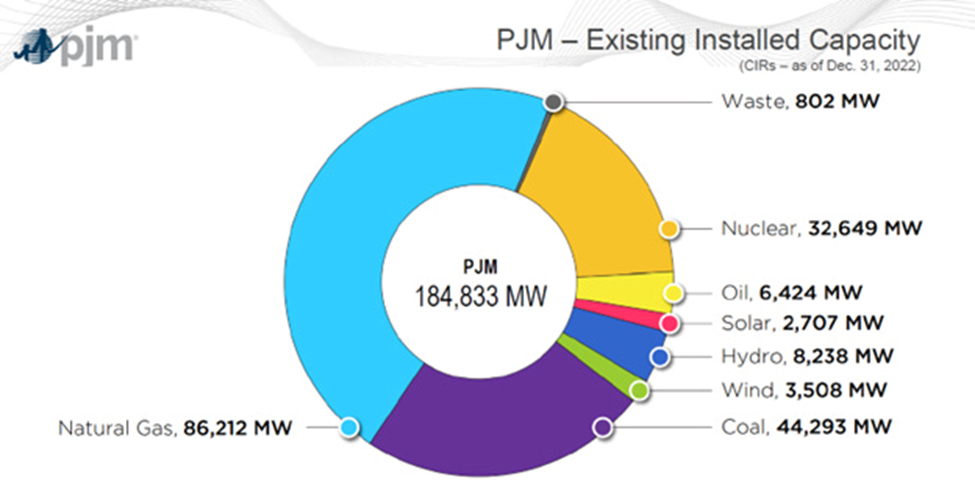
There are a number of grids servicing the US. The  Pennsylvania, New Jersey Maryland grid (PJM) is well managed.  It is the largest grid in the US. It services 13 States and the District of Columbia.  It is the grid that provides my electricity and it has managed to avoid brownouts and blackouts.  The reason is that the ratio of fossil fuel (thermal) energy generation to wind and solar generation is 20 to 1.  If Nuclear is included the ratio is 26 to1. 

The chart shows the PJM Existing Installed Capacity.
The issue PJM is facing is how to make their way through the EPA and States forcing an energy transition. The following explains their fear of losing enough spare capacity to continue to make their Grid reliable:

“Maintaining an adequate level of generation resources, with the right operational and physical characteristics , is essential for PJM’s ability to serve electrical demand through the energy transition. Our research highlights four trends below that we believe, in combination, present increasing reliability risks during the transition, due to a potential timing mismatch between resource retirements, load growth and the pace of new generation entry under a possible “low new entry” scenario: · The growth rate of electricity demand is likely to continue to increase from electrification coupled with the proliferation of high-demand data centers in the region. · Thermal generators are retiring at a rapid pace due to government and private sector policies as well as economics. · Retirements are at risk of outpacing the construction of new resources, due to a combination of industry forces, including siting and supply chain, whose long-term impacts are not fully known. · PJM’s interconnection queue is composed primarily of intermittent and limited-duration resources. Given the operating characteristics of these resources, we need multiple megawatts of these resources to replace 1 MW of thermal generation.”  (My highlighting added).

According to PJM this is what it will look like if the State and Feds current plans are not adjusted.

Completely unworkable. Solar, the major electrical source, only available in the day. 

The “Storage” at 55,037 watts, is at present, nonexistent.  Even if it were charged by excess solar wattage, it, along with the other electrical generators, would not be enough to satisfy peak demands.      

PJM management wants everyone to note that the States, not PJM, have the responsibility to maintain resource adequacy on their electric systems.

The EPA has several regulations that will cause a loss of significant reliable capacity of coal based and Natural gas (Thermal Plants) plants. The following are from the PJM’s study:

EPA REGULATIONS

Effluent Limitation Guidelines: will force closing 3,400 MW thermal based capacity.

Coal Combusting Residuals: Will force closing 2,700 MW thermal-based capacity.

Good Neighbor Rule:   Will force closing 4,400 MW thermal-based capacity.

STATE ORDINACES

Forcing retirement of the following thermal based capacity.

Illinois:  5,800 MW thermal-based capacity.

New Jersey:  3,100 MW thermal-base capacity.

Virginia-North Carolina: 1,533 MW of thermal-based capacity.

Indiana: 1,318 MW of thermal-based capacity.

Maryland: 305 MW thermal-based capacity.

PJM has avoided system blackouts  because they maintain a 22% reserve but the 2030 projected reserve based upon their study will only be 3% . 

There two organizations that are commissioned to make the Grids reliable.

The Federal Energy Regulatory Commission, or FERC, is an independent agency that regulates the interstate transmission of electricity, natural gas, and oil. 

The North American Electric Reliability Corporation (NERC) is a nonprofit corporation that ensures the reliability of the bulk power system in North America, including the continental United States and Canada.

FERC and NERC have launched a joint review of the performance of the bulk power system during recent winter storms that brought Arctic air across much of North America. The review will look at winter preparation activities and gather information to help guide future winter storm preparations and operations.  .The review will look at progress made since FERC and NERC completed joint inquiries into two recent winter storms, Uri in 2021 and Elliott in 2022.  The team plans to deliver the results of the review no later than June 2024.

FERC, in my readings, appears to know that renewables are not reliable.

It is obvious that the transition from thermal based electricity to renewable based electricity is not under control. The PJM grid may be the most reliable large grid in the nation. And if corrections are not made, it’s reserve will be only 3% in six years, and that will spell blackouts

cbdakota

Reliable Electric Energy Is Being Threatened By EPA And The States.


Subscribe to continue reading

Subscribe to get access to the rest of this post and other subscriber-only content.

Will EV Insurance Go Up Because of Fires?—It’s the Battery Stupid, Part4


We are told that EVs do not experience as many fires as do Internal Combustion Engines (ICE) vehicles and that may be true.  But there is no question about EV fires being much more hazardous.  Besides being more hazardous, these fires can be unexpected. For example, EV battery fires in garages have occurred without the owner having any idea it was going to happen.

It is well known that EV batteries that have been exposed to salt water are very likely to ignite.  EVs involved in a collision are dangerous too if the battery housing is damaged.  

Salt water is conductive where common water is not.  The salt water can cause a short in a lithium-ion cell thus resulting in an electricity discharge that heats up the cell.  A thermal runaway reaction can then occur heating up other cells and cause them to burn.  It is possible for this to cause the entire set of batteries cells to begin their own thermal runaway reaction.  

CRS AUTOMOTIVE blog “HOW PRONE ARE ELECTRIC CARS TO CATCHING FIRE” adds this:

“How else is a lithium-ion battery fire different from a gasoline fire? The biggest difference is the time it takes to ignite. Gasoline fires start almost immediately when gasoline comes in contact with a spark or flame and spreads rapidly. Battery fires typically take some time to achieve the heat necessary to start the fire.

In some instances, that delay is very good news. It can let the occupants of a car involved in a crash get out of the vehicle before the fire starts. But it can pose its own problems. Sometimes a battery can be damaged, perhaps by the car running over some debris, and the driver might not be aware of the damage. And then a fire can start well after the initial incident. That could theoretically cause a fire after the car is parked in a garage. With an electric car fire, you need water. That might sound obvious, but in many cases, modern fire departments use foam or dry chemicals that are better than old-fashioned H20 at suppressing fires. While dry chemicals are great at putting down ordinary electrical fires, they may be ineffective with a fire stemming from a car’s Lithium-ion battery

Water is the best approach to a Lithium-ion fire. But that doesn’t mean you should imitate a sprinkler and attempt to dose the whole fire by moving back and forth. Rather, you want to keep a direct and focused stream on the battery until it relents – and you’d need anywhere between two to 30 tonnes (8000 gallons) of water to put out this kind of fire. Also, don’t touch the high voltage components or open up the battery. They’re the most likely part of the battery to absorb heat.”

Special training for firemen is required to deal with a potential electrical charge on the autos frame.

The visual evidence appears to show that an EV fire generally destroys the entire car. Some of the ICE fires do too, but destruction of the entire car is not a given.  Most of the ICE fires occur in older cars that have not had a good maintenance history.  If you had a 2015 Toyota engine fire and had to replace the entire motor, it would cost between $4,000 and $5,500. This includes the cost of parts and labor according to the CAR COSTING blog. Not cheap but certainly less than what a totaled EV would cost.

Some insurers in the UK have already begun to raise the rates of EVs.

cbdakota

Battery Life and Replacement–It’s the EV battery Stupid, Part 4


I think that the industry has not had enough experience to accurately predict life of an EV battery.

Consumer Affairs speaks to this issue in their July, 2023 blog titled “EV battery replacement cost”.  Their findings are summarized:

“We reached out to five mechanics and technicians from different parts of the U.S. to see how much an EV battery replacement costs for different vehicles, and the average results ranged from $4,489 all the way to a staggering $17,658.

  • All EV batteries will eventually fail to hold a charge and require replacement.
  • It’s hard to pinpoint how long EV batteries will last, but most have a life span between eight and 15 years.
  • Sourcing a replacement EV battery from anyone but your car’s manufacturer is nearly impossible, which is the main reason replacement costs are so high.
  • EV battery repair is a growing industry that may help you avoid the high cost of a replacement, but it’s not commonly available yet.
  • The Federal Government requires the car maker to guarantee 100,000 miles or 8 years whichever comes first. Some warranties only cover the EV battery if it no longer holds a charge at all, while others will cover the replacement of any EV battery that has dropped below 60% or 70% of its maximum capacity.

I do not think that a used EV buyer would have any guarantee on battery that had already met one of those stipulations.

The following chart was assembled by Consumer Affairs after interviewing mechanics around the country.  It may look strange to be dealing with 2014 EVs but that reflects the car’s age using the battery. The Prius is a hybrid with a small ICE engine and a battery combination.

          VehicleAverage parts costAverage labor costAverage total cost
          2014 Tesla Model S$13,500$1,500$15,000
          2014 Nissan Leaf$17,269$388$17,657
          2014 Toyota Prius$3,858$631$4,489

Next Car’s June 2022 posting, “EV Batteries 101: Degradation, lifespan, warranties and more” echos Consumer Affairs posting.  NEXT Car adds:  

“Buying a used Tesla with close to or more than 100,000 miles on the odometer, or holding onto the one you already own out of warranty, is a much riskier decision given the high cost of repairs”. 

cbdakota

EV Battery Charging–Its The Battery, Stupid. Part 3


The Alliance for Automotive Innovation says there are approximately 100,000 public charging ports in the US. The Federal Government is attempting to provide more.  The Fed’s target is 500,000 charging ports. If there were more charging stations, there would be less range anxiety.

The rough number of gasoline/diesel filling stations is 145,000.  Well, if it feels like there is a filling station almost anywhere, why would there need to have 500,000 charging ports?  The answer is because it takes so long to recharge the battery.

The Biden Administration’s plan to put up 500,000 charging ports will probably take a while to accomplish.  Currently, the plan is for each State to install a charging station along their major highways, 50 miles apart. Further, a charging station must be within a mile of an on and off Interstate intersection.

A private party that wants to operate a charging station picks a site for the station.  The site is approved. The Feds will pay up to 80% of the cost and the private party must pay 20% or more.  These stations can cost up to $1million.  Each station must have a minimum of 4 charging ports.

The API says that the average fill-uptakes 2 minutes for an ICE vehicle. Then that vehicle could go 300 to 400 miles of highway driving. 

Examining the EV owner’s options for recharging the battery so as it has range of 350 miles.  (Hour charge to miles range from US Department of Transportation-Charger types and speed.)

Level 1 Minimum cost using house AC outlet.  One hour provides 2.5 miles of range.  So about 6 days to get charged to 350 miles range.

Level 2 Purchasing a charger/installation required. 240-volt system, a home installation.  One hour provides 10 to 20 miles of range.   Using the 20 miles per hour charge would need 17 hours to get 350 miles range.

Level 3 Fast DC.  The public stations are mostly at this level.   One hour charge provides about 180-to-240-mile range. Using 240 mile per hour charge would take about an hour and a half to get 350 miles range.

Tesla Supercharger. Dedicated Tesla charging points.  One hour would give 1000 miles range. The 350-mile range would be done in about 20 minutes.

 Some thoughts:

  • Anyone that buys an EV and uses a level1 must have more money than that sense. For certain, that person has an ICE car in the garage.  The EV is for show.
  • If you buy an EV and you live in an apartment, where you only have street parking, you would have to go to public charging stations.
  • Level 2 requires a professional  installation with costs that can be steep, often a thousand dollars or more.  The charger itself isn’t free.     
  •  Level 3.  If you use FastDC you will spend more money for charges than if you use a level 2 installed system using your cheaper home electricity.
  •  Very important: routine charging with Superchargers and Fast DC degrades the batteries to the point they won’t be able to hold their charge as long.  The fast chargers heat up the battery and that can cause loss of battery range. Tesla says that you should use these fast chargers sparingly.
  • Every charge degrades the battery’s capacity a little.  From Wikipedia:

Capacity loss or capacity fading is a phenomenon observed in rechargeable battery usage where the amount of charge a battery can deliver at the rated voltage decreases with use.[1][2]

In 2003 it was reported the typical range of capacity loss in lithium-ion batteries after 500 charging and discharging cycles varied from 12.4% to 24.1%, giving an average capacity loss per cycle range of 0.025–0.048% per cycle.[3]

  • Public charging stations are often not close to an available place that you can retire to, while you wait for your battery to get charged.  Think of sitting in your car in inclement weather, either hot or cold.
  • Public charging stations are not always reliable. The following is from

. Findings from a 2022 University of California, Berkely study showed that one-quarter of public chargers in the San Francisco Bay Area didn’t work due to “unresponsive or unavailable screens, payment system  failures, charge initiation failures, network failures, or broken connectors”. 

The cause may be lack of income the company gets from charging EVs. The US numbers of EVs on the road are not as many as was predicted.

Charging time is very long.  Charging stations are inadequate for even the small number of EVs on the road.  The fast chargers are desirable, but their use shortens the life of the battery.

cbdakota

Range is the Rage: Its The EV Battery, Stupid


Range is the Rage

Car and Driver say that range is the all-important stat.  Car and Driver posting goes on to say:

 “Whether or not you make it to the next public charging spot, are able to complete your daily commute, or are instead stranded on the side of the road depends on it.

Range is so heavily scrutinized because EVs can travel on average barely half the distance of gas-powered vehicles before they require a “fill-up,” and because gas pumps are far more ubiquitous than fast chargers”.

The amount of charge of the EV’s battery is akin to the amount of gasoline (or diesel) in the ICE’s (internal compbution engine)tank.  The battery charge will determine how many miles your EV can go before it is exhausted. That is equivalent to an ICE running empty of gasoline. Many postings by EV owners are about trying to find an EV battery charging station before the battery is “empty”. see here and here and here .Pretty agonizing and unlike the feeling you have, that there is a gasoline station almost anywhere.  You can get more charge and thus miles of range by getting a bigger, heavier battery, but that drives the cost of the vehicle up.  You don’t have to buy a bigger motor to get more range, if you purchase a smaller, lighter ICE vehicle at a lesser cost. 

The EPA rates highway vehicle range and puts the range number on the vehicle’s window sticker in the show rooms.   They do this for Electric vehicles (EV) and internal combustion (ICE –gasoline and diesel) vehicles. The range provided by the EPA for EVs is almost always an overstatement according to Car and Driver. Car and Driver EV range tests are conducted at a steady 75 miles per hour (MPH). They do this “because highway driving is where range most matters”.  By contrast, ICE vehicles almost always beat the EPA ratings in the 75 MPH tests. This is because the ICE vehicles have transmission gears whereas only a few EV models have transmission gearing.  The EV motors must increase revolutions where the motors are less efficient.

There are other factors that affect range. One of which is temperature.  In cold weather, ICE vehicles heat the cabin using the waste heat that comes from combustion of the gasoline. In the summer, ICE engine heat is dissipated by the radiator. The EVs use a resistive heater that consumes a lot of battery power. 

The South Dakota Electric Vehicle Infrastructure Deployment Plan (SDEVIDP) referenced several tests relative to use of heaters in the cold weather and air conditioning in the hot weather.

 According to field testing performed by the Norwegian Auto Federation, operation on a standardized test course in temperatures ranging 21° F to 37° F reduced EV range by approximately 20% and they also lengthened charging times in cold temperatures. A similar result was observed in dynamometer testing by the American Automobile Association that indicated that without internal vehicle heating, EV battery range dropped by 12% at 20° F, but with the heater in operation, it dropped roughly 41%. Consistent with other studies, at 95° F, EV battery range dropped by 4% without air conditioning and by 17% with air conditioning in operation.

The Idaho National Laboratory conducted a study of EV charging under a broad range of temperature conditions over a nearly two-year period, using data collected from a taxi fleet operating in New York City. The study determined that the time to reach 80% state of charge (SOC) doubled or tripled at temperatures below 32° F.

There is another factor that limits range.  The manufacturers of the EV batteries recommend that you always keep the charge between 20% to 80%.  Not 0% to 100%.  So good management of the battery’s life limits the range to just 60%. More on this during the discussion of battery charging.

Summary

The EV range is usually overstated by the EPA.  To increase range, you would need a bigger battery and that is costly. Temperature, cold or warm, reduce the battery charge.  On a cold day, for example, by as much as 40%  if you use the cabin heater on a cold day.  To extend the battery’s life, it should not drop below 20% or exceed 80%.  You will have to recharge it more often to prevent it from going below 20%,

cbdakota

Its The EV Battery, Stupid!


The title is paraphrasing the Ragin Cajun, political adviser to the Clintons, James Carville. Carville said when asked about the biggest issue in an upcoming election, “it’s the economy, stupid” I contend that the biggest issue for the electric vehicle (EV) is the battery.

The battery represents the proposed transition from gasoline and diesel fuel to electricity.  The transition will not be easy, if at all.  Usually, major transitions have occurred because some new thing is better than the existing thing.  That is not happening here.  The EV is more costly, is less flexible, not as capable and is planned to be charged from an electrical grid that is sourced from wind turbines and solar cells.  The latter, the so-called renewable energy, has not demonstrated that it is capable of keeping the grids supplying a reliable supply of electricity 24/7. Nowhere. Nada. see here But politicians keep throwing money at these schemes.  You must wonder why they would do that.  Well maybe not.

The EV sales are not displacing gasoline and diesel vehicles because they are better.  No.  It is replacing those fuel driven vehicles by Government fiat.  Governments are giving EVs huge subsidies, and enacting regulatory systems making gasoline and diesel vehicles attain goals that are not reachable nor necessary.  Six states have legislated that no gasoline or diesel-powered vehicle can be manufactured or sold after 2030 to 2035. And the Feds are considering that too.

The WSJ blog posted Car Dealers to Biden: EV’s Are Not Selling reporting that 3900 US car dealerships wrote a letter to President Biden saying his EV sales mandate is not working. They told him that:

Dealers have a 103-day supply of EVs compared to 56 days for all cars. It takes them on average 65 days to sell an EV, about twice as long as for gas-powered cars. EV sales are slowing though manufacturers have slashed prices and increased discounts.

But most consumers aren’t “ready to make the change,” in part because EVs are still too expensive. Many apartment renters also don’t have garages for home charging, and public charging networks are spotty with one in four not functional, according to one study.

“Customers are also concerned about the loss of driving range in cold or hot weather,” the auto dealers say. “Some have long daily commutes and don’t have the extra time to charge the battery.

The dealers want the Administration to “tap the brakes” on its proposed tailpipe emissions rules that would effectively mandate that EVs comprise two-thirds of car sales by 2032

The dealers’ letter is an important political signal that progressive climate coercion isn’t as popular as Democrats think. Americans don’t like to be told what to do or what they must buy. As the dealers put it, “many people just want to make their own choice about what vehicle is right for them.” Imagine that.


The liabilities that are built in the EV battery are, to name a few:

  • The Range—how many miles can a charged battery propel a vehicle?
  • How long does it take to charge the battery?
  • What is the life of the battery?
  • How much is the cost of a replacement battery?
  • How safe are these batteries?
  • Will insurance rates be hiked up?
  • If most the materials needed to make a battery are suppled from
    China, is that worrisome?
  • Battery recycling?
  • Major electrical  revisions to supply @ home charging?
  • New fees replacing gasoline tax such as miles driven tax or a tax for charger use.
  • Government overreach?

The future postings will address these liabilities.

cbdakota

EVs are Evil


I am rebloging a posting by Issues & Insights titled:

“Its Time to Admit IT:EVs are Evil”.

The authors zero in on these issues:

  • They are not Zero emissions.
  • They are not cheaper to operate.
  • They are built with slave labor.
  • They are environmental rapists.

To read it as I & I wrote it click here.

cbdakota

EXPLODING ELECTRIC BICYCLES


I am forwarding a complete posting from Power Line by John Hinderacker.

cbdakota

EXPLODING ELECTRIC BICYCLES

Steve recently wrote:

One of the first things I teach students on the first day of energy policy classes I have taught is how energy density works, and how a battery is a device to store energy at high densities. But at a certain point, when you increase the energy density enough, we don’t call it a battery any more. We call it a bomb.

I got an email today from a friend that reminded me of Steve’s post. The email said:

I got this notice because I recently bought an electric bike. What kind of notice do you think they send out for electric cars?

Here is the notice:

PLEASE BE AWARE: if partially or totally submerged in water, the lithium-ion battery pack used to power many electric devices and vehicles will suffer damage that will compromise its safety and stability. This damage can be even more severe if your battery pack was submerged in salt water.

Please check your eBike as soon as possible. Unfortunately, if your eBike has been submerged in water during the storm, it’s very likely that its electrical system has been damaged and the eBike is unsafe to use. If the battery pack was partially or totally submerged, we advise that you carefully remove the battery pack from the eBike (or wherever it was stored when submerged), and take it to a safe location OUTDOORS, away from any flammable materials. Leave the affected battery pack OUTDOORS until you are ready to drop it off at the recycling center where it can be safely recycled.

When you are able to properly dispose of the battery, place the battery pack in a clear plastic bag and take it to your municipal household hazardous waste drop-off center. Your local City Hall or Fire Department may have resources to help you find the closest facility in your area, or you can check the Call2Recycle website (https://www.call2recycle.org/locator/) for drop-off locations nearby.

UNDER NO CIRCUMSTANCES SHOULD YOU ATTEMPT TO RECHARGE A LITHIUM-ION BATTERY PACK THAT HAS BEEN PARTIALLY OR TOTALLY SUBMERGED IN WATER.

ATTEMPTING TO CHARGE A COMPROMISED LITHIUM-ION BATTERY PACK CAN RESULT IN A VERY DANGEROUS FIRE THAT GENERATES SIGNIFICANT HEAT, TOXIC GASSES AND IS EXTREMELY DIFFICULT TO CONTROL.

Please consult with your insurance company to see whether the eBike was covered by your homeowner’s policy.

Other common items that use lithium-ion batteries are: laptops, tablets, cell phones, video game controllers, e-readers, and digital cameras.

Is that green, or what?

New Energy Economy:An Exercise in Magical Thinking Part 9 Digitalization Won’t Uberize the Energy Sector.


Continuing the serialization of Mark Mills’ report New Energy Economy: An Exercise in Magical Thinking.  This part is Digitalization Won’t Uberize the Energy Sector.

=================================================

Digitalization Won’t Uberize the Energy Sector     

Digital tools are already improving and can further improve all manner of efficiencies across entire swaths of the economy, and it is reasonable to expect that software will yet bring significant improvements in both the underlying efficiency of wind/solar/battery machines and in the efficiency of how such machines are integrated into infrastructures. Silicon logic has improved, for example, the control and thus the fuel efficiency of combustion engines, and it is doing the same for wind turbines. Similarly, software epitomized by Uber has shown that optimizing the efficiency of using expensive transportation assets lowers costs. Uberizing all manner of capital assets is inevitable. Uberizing the electric grid without hydrocarbons is another matter entirely.

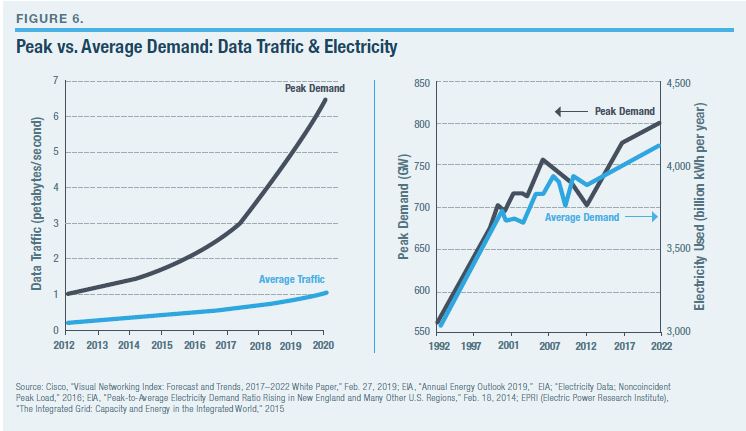
The peak demand problem that software can’t fix

In the energy world, one of the most vexing problems is in optimally matching electricity supply and demand (Figure 6). Here the data show that society and the electricity-consuming services that people like are generating a growing gap between peaks and valleys of demand. The net effect for a hydrocarbon-free grid will be to increase the need for batteries to meet those peaks.


All this has relevance for encouraging EVs. In terms of managing the inconvenient cyclical nature of demand, shifting transportation fuel use from oil to the grid will make peak management far more challenging. People tend to refuel when it’s convenient; that’s easy to accommodate with oil, given the ease of storage. EV refueling will exacerbate the already-episodic nature of grid demand.

To ameliorate this problem, one proposal is to encourage or even require off-peak EV fueling.85 The jury is out on just how popular that will be or whether it will even be tolerated.


Although kilowatt-hours and cars—key targets in the new energy economy prescriptions—constitute only 60% of the energy economy, global demand for both is centuries away from saturation. Green enthusiasts make extravagant claims about the effect of Uber-like options and self-driving cars. However, the data show that the economic efficiencies from Uberizing have so far increased the use of cars and peak urban congestion.86 Similarly, many analysts now see autonomous vehicles amplifying, not dampening, that effect.87

That’s because people, and thus markets, are focused on economic efficiency and not on energy efficiency. The former can be associated with reducing energy use; but it is also, and more often, associated with increased energy demand. Cars use more energy per mile than a horse, but the former offers enormous gains in economic efficiency. Computers, similarly, use far more energy than pencil-and-paper.

Uberizing improves energy efficiencies but increases demand

Every energy conversion in our universe entails builtin inefficiencies—converting heat to propulsion, carbohydrates to motion, photons to electrons, electrons to data, and so forth. All entail a certain energy cost, or waste, that can be reduced but never eliminated. But, in no small irony, history shows—as economists have often noted—that improvements in efficiency lead to increased, not decreased, energy consumption.

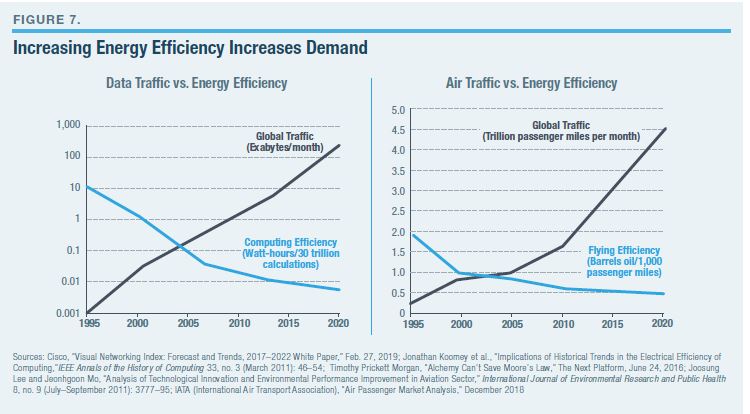
If at the dawn of the modern era, affordable steam engines had remained as inefficient as those first invented, they would never have proliferated, nor would the attendant economic gains and the associated rise in coal demand have happened. We see the same thing with modern combustion engines. Today’s aircraft, for example, are three times as energy-efficient as the first commercial passenger jets in the 1950s.88 That didn’t reduce fuel use but propelled air traffic to soar and, with it, a fourfold rise in jet fuel burned.89

Similarly, it was the astounding gains in computing’s energy efficiency that drove the meteoric rise in data traffic on the Internet—which resulted in far more energy used by computing. Global computing and communications, all told, now consumes the energy equivalent of 3 billion barrels of oil per year, more energy than global aviation.90

 The purpose of improving efficiency in the real world, as opposed to the policy world, is to reduce the cost of enjoying the benefits from an energy-consuming engine or machine. So long as people and businesses want more of the benefits, declining cost leads to increased demand that, on average, outstrips any “savings” from the efficiency gains. Figure 7 shows how this efficiency effect has played out for computing and air travel.91


Of course, the growth in demand growth for a specific product or service can subside in a (wealthy) society when limits are hit: the amount of food a person can eat, the miles per day an individual is willing to drive, the number of refrigerators or lightbulbs per household, etc. But a world of 8 billion people is a long way from reaching any such limits.

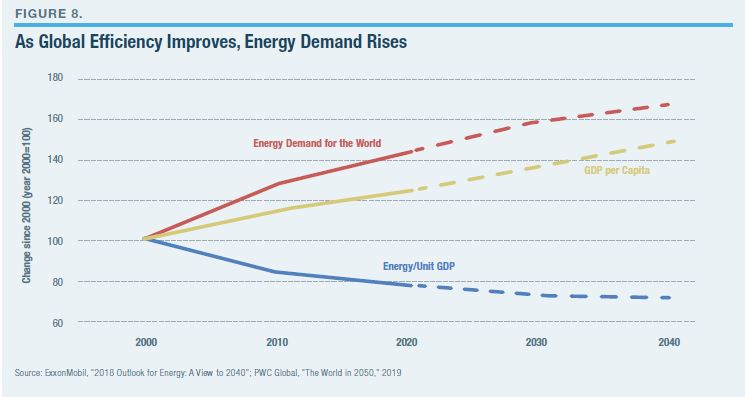
The macro picture of the relationship between efficiency and world energy demand is clear (Figure 8). Technology has continually improved society’s energy efficiency. But far from ending global energy growth, efficiency has enabled it. The improvements in cost and efficiency brought about through digital technologies will accelerate, not end, that trend.


=====================================================

The serialization of Mark Mills’ report concludes with the next part titled Energy Revolutions Are Still Beyond the Horizon.

cbdakota