Category Archives: Alternative Energy

Gasland Part II Reviewed


Gasland Part II, a sequel to “Gasland “, was released 28 June (a limited release according to Rotten Tomatoes).  It carries the same theme that fracking is bad. The documentary “stars” are Josh Fox, the director and Dennis Kucinich, former US Representative from Ohio. Can’t imagine that Kucinich is going to bring people into the theater.   The documentary has not yet appeared in the “Box Office” top 50 grossing films.  TheAmericanInterest.com reviewed the documentary with it’s posting “Gasland II: Muddying a Fractured Debate”.   The reviewer tries to play it down the middle saying that the movie and the movies critics tend to go over the top.  But he writes this:

Gasland II is chock-full of errors and falsehoods. Some might be unintentional (Fox readily admits that he’s a “theater guy,” not an engineer or chemist), but at least one seems to be a case of deceit. At one point, Fox throws up a graph purportedly showing the high rate of cement casing failures in fracking wells. Its steeply ascending red bars make for an alarming picture, and as he triumphantly explains, “[gas companies’] own documents showed that cement encasings failed in five percent of wells immediately upon drilling, and that the failure rate increased over time; that over a thirty year period, fifty percent of wells failed.” But the caption to the graph, barely visible in the film explains that it’s showing sustained casing pressure (SCP), a condition that can lead to cement casing failure. Worse, the graph showed the SCP only for offshore wells, explicitly stating, “[t]hese data do not include wells in state waters or land locations,” a fact conveniently left out of the film.

Continue reading

Solar Panel Defects Surfacing


The NY Times is reporting that solar panels failures are becoming a major concern for the industry.

The photovoltaic cells, incorportated into the panel,  generate electricity when exposed to the sun.  A thin film protects the cell from moisture and it is encapsulated between layers of glass. The life expectation of the cells is 25 years and the economics of their use is predicated upon that length of service.  But inspection of some these panels finds that cheaper materials are being used to bring down the manufacturing costs.

Continue reading

Kyoto Did Not Level The Playing Field, But Obama’s New Climate Policies May Do That


President Obama’s outlined his new climate policies in a recent speech.   My take away from the speech is that it is a way to increase Federal revenue by taxing carbon use.  And it is mainly done through new regulations developed by his EPA.  Congress just a well go home because they never see the need to challenge the usurping of their powers.    The consequence of these policies will be significantly higher electricity prices, and the poorest among us will be the primary victims of this action.  Once again, in the name of the environment,  he will forego focusing on bringing about  the nation’s recovery.   Interestingly, one posting suggests that this will level the playing field between the US and Europe.  That was the basis for the European’s support of the Kyoto Treaty, but it did not work for them because the US chose not to enter into the Treaty.  A posting on notrickszone.com by Peter Gosselin titled “Obama Is Merely Leveling The Energy Playing Field With Europe – Declares An End To Cheap American Energy is interesting to get his view from Europe.  He writes:

Continue reading

Steep Depreciation Rates For EVs A Serious Problem


According to the National Automobile Dealers Association the used plug-in electric vehicles depreciate at a 30% rate that is the highest depreciation of any vehicle segment in the American automotive market. For other vehicles, according to Carsdirect.com: “New cars depreciate about 20% the moment you drive them off the lot.”   Then the depreciation is about 15% per year for the second and third year and less in subsequent years.

TheDetroitBureau.com says:

“The steep rate of depreciation for used plug-in electric vehicles can be attributed to limited range, manufacturer incentives and federal tax credits intended to offset the higher prices of new plug-in electric vehicles,” said Jonathan Banks, executive automotive analyst for the NADA Used Car Guide.

If the forecasted decline continues, it could be a serious problem for both manufacturers struggling to boost demand for their latest plug-in hybrids and pure battery-electric vehicles, as well as federal and state government officials who have been using financial incentives to help promote the technologies.

 Another ominous sign for the EV business.

cbdakota

Chreos Electric Car Claims 640hp And 620 Mile Range!!


Silex Power located in Malta claims they will build an electric car,  powered by  batteries, when fully charged, will have a range of 1000km (620miles), develop 640 horsepower, attain road speeds of 186mph, and to top that all off, it can be recharged in 10minutes.  The concept car looks good, see below:
chreos2013-Silex-Chreos-by-Racer-X-Design-in-black

Volt & Leaf April Sales


It would appear that the Leaf’s Tennessee manufacturing facility is having a positive effect on sales.  In April the Leaf sold 1,937 vehicles versus Volt’s 1,306.    Year-to-date sales are Leaf = 5,476 and Volt = 5,550.  Very close with the Leaf sales really picking-up in the past two months.
The Green Car Report is estimating Tesla Model C sales in April at 2250 to 2500, making it the biggest seller.  Tesla does not report monthly sales so this figure is subject to change.
For the other plug-ins in the sales race,  The Green Car Report offers the following:
Tiny Battery Cars
As for the Mitsubishi i-MiEV, a flurry of sales in January and February that averaged almost 300 cars each month ended in March.
April sales of 127 cars improved on the dismal March number of 31 cars sold, but it remains unclear if the electric minicar will remain above its historic rate of about 50 cars a month.
Finally, either this month or next, the 2013 Smart Electric Drive–the lowest-priced plug-in car in the country–will go on sale, adding to this year’s totals as well.
 
Plug-in hybrids: chugging along
The Toyota Prius Plug-In Hybrid was last year’s second best-selling plug-in car, but it’s been on a downward trend this year.
In April, just 599 were delivered, for a year-to-date total of 2,952. That’s the lowest monthly sales number since the very first month the plug-in Prius went on sale, in March 2012.
The 2014 Honda Accord Plug-In Hybrid logged 55 deliveries in April, more than its total of 45 deliveries in the three months since it went on sale in January. Sales are rising as Honda cautiously rolls out its first-ever plug-in hybrid vehicle in California.
Sales are looking up but Obama’s 2011 State of The Union target of 1,000,000 EVs on the road by 2015 wont be achieved.  Obama has since backed off on that promise, but just for the record , I post it again to remind you how “hopey changey”  fades in the face of reality.
cbdakota

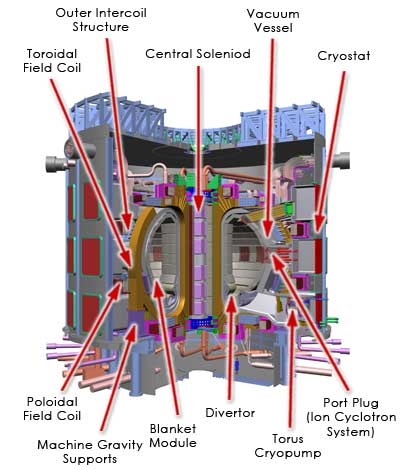
International Nuclear Fusion Project Underway


The UK Independent reports that the Iter fusion project gained final approval “ for the design of the most technically challenging component – the fusion reactor’s “blanket” that will handle the super-heated nuclear fuel.”
The Iter project is designed to produce  at a rate of  500 megawatts of energy using an input of 50 megawatts  during a 1000 seconds run. The Iter fusion project is forecast to cost £ 13billion (US $20 billion) .  The project team is an international combine of 46 nations that are contributing  science and money.  The facility is based in Cadarache, France.
Below is a cut-away of the Iter reactor design and brief description of the elements of the reactor from Howstuffworks.com
fusion-reactor-5

Electric Vehicle March Sales Update And Other News


The Nissan Leaf had it biggest ever sales month in March when it moved 2,236 cars.  The increase was attributed in part to a reduced sales price.  It sells for $28,800.  The  Chevy Volt sales were down 35 % compared to February. Total March sales were 1,478.  The Detroit News reports that the Tesla Model S was the best EV seller for the first quarter:
“ The high-end Model S, which after a Monday announcement will start at about $62,400 after federal tax credits, registered 4,750 deliveries, topping the second-place Volt, which had 4,244 sales through March.  Nissan sold 3,539 Leaf vehicles during the first three months of the year and Toyota Motor Corp. had sold 2,353 of its Prius plug-ins.”
Tesla has decided to quit selling the short range S model that is equipped with the 40kWh battery that is said to have a range of 160 miles.  Only 4% want it over the S Model equipped with the 60 kWh battery that is said to have a range of 230 miles. The 85 kWh battery model is said to have a range of up to 300 miles on a single charge.
The Detroit News cites a Japanese survey that finds that about 1/3 of the current owners of EVs wont buy another. The reasons:
A new report from researcher McKinsey and Co. found that about one in three electric-vehicle buyers felt “seduced” by the prospects of low energy costs, attractive subsidies and good test-drives, but became less enthusiastic about electric vehicles when faced with issues like higher electric bills and lack of charging stations
Renault’s new all-electric car, Zoe, has an advertised range of 130 but Motortrades Insight says:
“British drivers are not expected to warm to the new Renault Zoe, an all-electric city car, after Renault today revealed it can only achieve 60 miles in cold weather and 90 miles in normal conditions.” 
Apparently if you buy the Zoe,  you rent the battery. Motortrades Insight adds:
“Drivers will also have to pay between £70 and £93 every month to ‘hire’ the car’s expensively-manufactured batteries, with Renault replacing them when they become worn out.”
Probably everyone by now has heard that Fisker has laid off all its US workers and will soon file for Bankruptcy.  Autobloggreen says:
“Kirkland & Ellis is advising the California-based maker of the extended-range plug-in Karma for a potential bankruptcy filing, which hasn’t produced a car in about eight months and is losing interest from two prospective China-based buyers. Fisker declined to comment to Reuters.
 cbdakota

“The Magic Washing Machine”—–Limiting Energy Access To The World’s Poor Is Wrong


You have to give credit to the Green NGOs in that they are much more upfront about their goals than most of the Global Governments. Greenies want to stop development of all fossil fuel sources and they would like to see the nuclear industry dismantled and no new nukes built.  The Obama Administration is not quite that ambitious, at least for now, although there is not much difference in their objectives. Examples of goals the Administration have announced are: kill coal,  minimize (and in some cases prevent any) use of Federal lands for accessing the mineral resources and raise the price of gasoline and electricity.
Who is it that will feel the most pain, if this cabal is successful?  It will be the poorest among us, of course.  They justify their actions by saying that the Earth will really, really, really go to hell if we don’t stop burning fossil fuels.  And besides they add, we will have wind and solar farms takeover the job of supplying power.  Wind and solar farms are not ready for prime time and who knows if they will ever be. The experience around the world demonstrates that when and if these renewables do replace fossil fuels, the power supplied will be more costly than that supplied by fossil fuels.  No help for the poor here.

February Volt And Leaf Sales Update


February sales of the Volt and the Leaf were slightly higher than in January. January Volt sales were 1140 and February sales were 1629 while Leaf’s numbers were January 650 and February 653. The recent rise in gas prices will probably result in an increase sales in the next several months.

cbdakota