Category Archives: Alternative Energy

The Weakness of the Wind Turbine Operability is Exposed. Stop The Transition to Renewables


Backgound

Many believe that Germany is the leading, major nation regarding transitioning energy sources from thermal and nuclear to renewable. Germany’s major renewables are wind turbines, solar cells, hydro and biomass.  The thermal resources are lignite, hard coal and natural gas.  At the beginning of 2023, nuclear energy was a sources but it was abandoned on15 April after generating 7TWhs .  The electricity demand for the year 2023, was 457 TWh.  In 2023 the wind turbines produced 140 TWh and Solar produced 60 TWh of that supply.    The remaining 247 TWh were produced by natural gas, coal, lignite, hydro, and biomass energy sources. The wind turbines rated capacity is 613TWh and solar rated capacity is 707 TWh.  That adds up to 1320TWh rated capacity versus demand of 457 TWh.     Why weren’t wind and solar producing all the electricity?  Together their rated capacity is 3-fold more than the demand. It is alleged that electricity from these renewable is dirt cheap, so, they should be making the electricity.   But that is not the case. The German wind turbines had a rated capacity of 60 GWs that should provide 525 TWh per year, yet they  only made 140 TWh.  That makes the capacity factor only  22.8%. The thermal fuel electricity production was greater than the wind turbine production , with lignite, hard coal and natural gas producing 176TWh opposite the 140TWh that the turbines produced. That level of thermal production capacity allowed  the weather dependence  of the non-dispatchable wind turbines.   

The Source

The data for this posting are mostly from  this excellent  German  document :  “Fraunhofer Public Net Electricity Generation 2023 in Germany: Renewables Cover the Majority of the Electricity Consumption for the First Time”      https://www.ise.fraunhofer.de/en.html

I chose the year 2023  because a full year’s data is tabulated

Can wind turbines supply a grid without out back up?

The question is could renewables without thermal sources make a reliable 24/7 grid?  Looking at it from that perspective of capacity factor of 22.8% , one answer to that question would be at least 4 times the current numbers of  wind turbines would be needed to meet the 457 TWh  with some extra to cover peak demands.   Yet using average year data may not tell the score.  Lets look at monthly performance. This is needed as weather has seasons.   Wind is the main propellant  for these turbines and it is changeable.

Deeper dive into the question.

In 2023 the record maximum output from these 60GW wind turbines was 53 GW  for a short time. Simply stated is that these beasts only respond to weather.  Wind speed can be so fast that the turbines must be shutdown to protect them from serious damage. The wind speed can also be slow, all the way to calm.  .  

Examining how German wind turbines function, gives us some insight why it is doubtful that renewables  alone could supply a gird without thermal sources backup.  The Germans collect the energy being produced by the turbines and all the other resources every 15 minutes. This data collection allows an excellent opportunity to examine how things are operating, far surpassing yearly averages. For instance, the wind turbine production is not running steady  at the capacity factor of 22.3%, as you would inherently know. But it allows us a deeper understanding of the make-up of the 22.3% capacity factor. The Germans employ both onshore and offshore wind turbines.  Combining the two for each month will provide a monthly capacity factor versus the 2023 demand.    

Using an average GWh     457TWh/12 months=38.1TWh per month.

MONTH         TURBINES PRODUCTION   CAPACITY FACTOR(versus demand)

                                     TWh                                                           %

Jan                            17,039                                                         44.6

Feb                           11,832                                                         31.0

Mar                           13,901                                                         36.5

Apr                            9,967                                                           26.2

May                          8,147                                                           21.4

Jun                            5,895                                                            15.5

Jul                              9,537                                                            25.0

Aug                           6,877                                                            18.0

Sep                           6,627                                                            17.4

Oct                            14,240                                                         37.4

Nov                           17,240                                                         45.2

Dec                          19,080                                                         50.1

In this we see that weather conditions are not always favorable for maximizing  production with wind turbines.   December suggests that increasing the number of turbines would only require a little more that 2 times plus a  little more for peak demands.   But going solo (nothing but wind turbines), June would require 7 times the number of wind turbines would be needed to meet average demand. If the wind turbines were the only source of electricity , June sets the target for the number of wind turbines required.   The summer month’s weather was not favorable to maximizing wind turbine electricity production

The turbines need to be able to match demand and that means June.

Taking an even deeper dive.

Looking deeper,   the data proves that wind turbines alone are not feasible. The data shows the turbines can fail to even produce 1GW at times.  Just a sample is tabled as follows:

Date             ONSHORE GW   OFF SHORE GW    TOTAL GW

04/05                       0.334                        0.021                        0.355

04/05                       0.727                        0.238                        0.955

05/28                       0.675                        0.119                        0.794  

06/05                       0.893                        0.001                        0.894

06/15                       0.765                        0.049                        0.814

06/17                       0.647                        0.079                        0.726

06/17                       0.947                        0.040                        0.987

06/18                       0.371                        0.150                        0.521

06/18                       0.216                        0.074                        0.290

06/25                       0.444                        0.173                        0.617

07/19                       0.664                        0.167                        0.831

09/02                       0.364                        0.199                        0.563

09/09                       0.469                        0.261                        0.730

09/10                       0.166                        0.010                        0.176

09/14                       0.469                        0.523                        0.992

09/27                       0.667                        0.205                        0.875

These  less than 1.GW  performances  have to be considered a “complete collapse of power”. 

Why does it have a “complete collapse?”

When the speed of the wind dies it can cause a very sharp loss of production of electricity .

Penn State description of wind speed vs power follows: (revised to shorten the narrative.)

The power in the wind is given by the following equation:

Power (W) = 1/2 x ρ x A x v3

Thus, the power available to a wind turbine is based on the density of the air (usually about 1.2 kg/m3), the swept area of the turbine blades (picture a big circle being made by the spinning blades), and the velocity of the wind. Of these, clearly, the most variable input is wind speed. However, wind speed is also the most impactful variable because it is cubed, whereas the other inputs are not.

The following are calculations for power available in the wind at  different velocities for a Northwind 100C turbine.  The calculations will show what happens when you double the wind speed. Take a moment to think about how much available power will increase if you double the velocity:

  • The standard(link is external) density of air is 1.225 kg/m3
  • The turbine has a 24 m diameter, which means the radius is 12 m. Thus, the swept area of the turbine is: (pi)r2 = 3.14159(122) = 452.4 m2
  • We’ll start with a 6 m/s wind.
  • The power in the wind at 6 m/s is: 1/2 x ρ x A x v3 = 0.5 x 1.225 kg/m3 x 452.4 m2 x (6 m/s)3 = 59,851 W = 59.85 kW
  • At 12 m/s: 1/2 x ρ x A x v3 = 0.5 x 1.225 kg/m3 x 452.4 m2 x (12 m/s)3 = 478,808 W = 478.8 kW (8 times as large)
  • Returning to 6m/s, the power generated falls to 59.85kW.   

Wind is always changing.  It’s irregularity is demonstrated in the German data.  Sometimes the change is large and the turbine production of electricity goes low.  The data shows that the thermal sources have to act to manage the output to the gird. Remember, thermal sources produced more electricity than the wind turbines in 2023.

German solar data

The solar capacity factor is 8.5%.  Solar should not be brought into a discussion about keeping a grid operating. The solar cells do not run at night.  So they can’t back up the wind turbines.  Maybe, there will be a miracle battery that could be charged by solar cells.   If a capable and affordable  battery is ever available it might be used as backup. Only then solar can be brought into the discussion

If the only statement  of operability of wind turbines is the annual data point, power factor, it can be  misleading.  Thanks to the German 15 minute data, the weakness of the wind turbine operability is exposed.

In my next blog, two cases of complete loss of power in 2024, one it Canada and one in Australia  due to weather conditions.    And it will review the high cost of renewable energy.  

cbdakota
The Grids Reliability Is Endangered By EPA “Climate Change” Regulations And State Ordinances.   


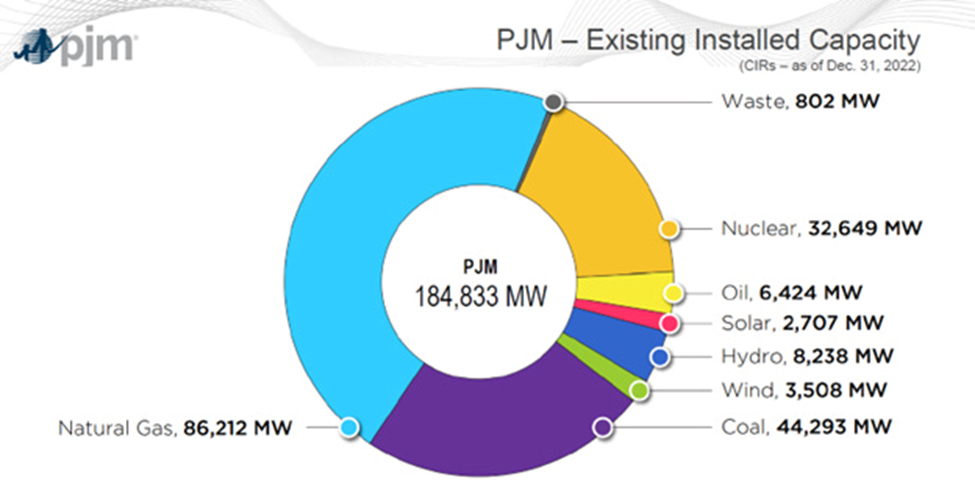
There are a number of grids servicing the US. The  Pennsylvania, New Jersey Maryland grid (PJM) is well managed.  It is the largest grid in the US. It services 13 States and the District of Columbia.  It is the grid that provides my electricity and it has managed to avoid brownouts and blackouts.  The reason is that the ratio of fossil fuel (thermal) energy generation to wind and solar generation is 20 to 1.  If Nuclear is included the ratio is 26 to1. 

The chart shows the PJM Existing Installed Capacity.

The issue PJM is facing is how to make their way through the EPA and States forcing an energy transition. The following explains their fear of losing enough spare capacity to continue to make their Grid reliable:

“Maintaining an adequate level of generation resources, with the right operational and physical characteristics , is essential for PJM’s ability to serve electrical demand through the energy transition. Our research highlights four trends below that we believe, in combination, present increasing reliability risks during the transition, due to a potential timing mismatch between resource retirements, load growth and the pace of new generation entry under a possible “low new entry” scenario: · The growth rate of electricity demand is likely to continue to increase from electrification coupled with the proliferation of high-demand data centers in the region. · Thermal generators are retiring at a rapid pace due to government and private sector policies as well as economics. · Retirements are at risk of outpacing the construction of new resources, due to a combination of industry forces, including siting and supply chain, whose long-term impacts are not fully known. · PJM’s interconnection queue is composed primarily of intermittent and limited-duration resources. Given the operating characteristics of these resources, we need multiple megawatts of these resources to replace 1 MW of thermal generation.”  (My highlighting added).

According to PJM this is what it will look like if the State and Feds current plans are not adjusted.

Completely unworkable. Solar, the major electrical source, only available in the day. 

The “Storage” at 55,037 watts, is at present, nonexistent.  Even if it were charged by excess solar wattage, it, along with the other electrical generators, would not be enough to satisfy peak demands.      

PJM management wants everyone to note that the States, not PJM, have the responsibility to maintain resource adequacy on their electric systems.

The EPA has several regulations that will cause a loss of significant reliable capacity of coal based and Natural gas (Thermal Plants) plants. The following are from the PJM’s study:

EPA REGULATIONS

Effluent Limitation Guidelines: will force closing 3,400 MW thermal based capacity.

Coal Combusting Residuals: Will force closing 2,700 MW thermal-based capacity.

Good Neighbor Rule:   Will force closing 4,400 MW thermal-based capacity.

STATE ORDINACES

Forcing retirement of the following thermal based capacity.

Illinois:  5,800 MW thermal-based capacity.

New Jersey:  3,100 MW thermal-base capacity.

Virginia-North Carolina: 1,533 MW of thermal-based capacity.

Indiana: 1,318 MW of thermal-based capacity.

Maryland: 305 MW thermal-based capacity.

PJM has avoided system blackouts  because they maintain a 22% reserve but the 2030 projected reserve based upon their study will only be 3% . 

There two organizations that are commissioned to make the Grids reliable.

The Federal Energy Regulatory Commission, or FERC, is an independent agency that regulates the interstate transmission of electricity, natural gas, and oil. 

The North American Electric Reliability Corporation (NERC) is a nonprofit corporation that ensures the reliability of the bulk power system in North America, including the continental United States and Canada.

FERC and NERC have launched a joint review of the performance of the bulk power system during recent winter storms that brought Arctic air across much of North America. The review will look at winter preparation activities and gather information to help guide future winter storm preparations and operations.  .The review will look at progress made since FERC and NERC completed joint inquiries into two recent winter storms, Uri in 2021 and Elliott in 2022.  The team plans to deliver the results of the review no later than June 2024.

FERC, in my readings, appears to know that renewables are not reliable.

It is obvious that the transition from thermal based electricity to renewable based electricity is not under control. The PJM grid may be the most reliable large grid in the nation. And if corrections are not made, it’s reserve will be only 3% in six years, and that will spell blackouts

cbdakota

Reliable Electric Energy Is Being Threatened By EPA And The States.


Subscribe to continue reading

Subscribe to get access to the rest of this post and other subscriber-only content.

Most of future Electrical Productiion will not be from Wind and Solar, So EVs will be powered by fossil fuels


 Economically developed Nations around the world are pushing the idea that the global temperature is rising unabated to a point where it will become an existential threat to mankind. The problem, they say, is carbon dioxide (CO2) emissions from the use of fossil fuels.  They think that CO2 emissions created by the use of gasoline, and diesel, along with natural gas and coal must be discontinued.  I think that these Nations are planning to subjugate you under the guise of saying they are just following “science”.

A part of their plan is to accomplish this by using electricity produced from renewable energy sources—Wind Turbines and Solar Cells— and make people buy electric vehicles (EV). This plan will not work.  But it will spend trillions of dollars before it is revealed as a failure.  Their plan will not be accomplished because wind and solar are not dispatchable.  Meaning, the Electric grids must provide, unfailingly, power 24/7.  This is accomplished by the use of fossil fuel power that can be ramped up and down to meet requirements. The renewables are not dispatchable because grid operators cannot ramp them up and down.  No wind, no sun, no renewable power. As they are today, EVs will continue to run on electricity made mostly by the combustion of fossil fuels.

Nevertheless, the government will try to force you into buying an electric vehicle (EV).

The EPA announced the new standards require a 49 mpg fleetwide average by 2026, a 33% increase over model year 2021 standards. The EPA said that these tough new tailpipe emission standards are designed to effectively force the auto industry to phase out the sale of gas-powered cars

The target cars are those powered by Internal Combustion Engines—  aka ICE.

And then they are enacting laws that no gasoline or diesel car can be manufactured and sold after some certain date.

California, always the leader in penalizing the people living in that state, has a  new law that it will be illegal to sell  new gasoline-powered cars after 2035.  Nothing from the Biden Administration yet but they are playing with a date to match California.

 Washington Free Beacon carries this story:

“All CARS ARE BAD” Pete Buttigieg’s Equity Advisers Want You To Stop Driiving

Transportation Secretary Pete Buttigieg is appointing a group of “leading experts” to advise him on “transportation equity,” including several who argue that cars cause climate change and promote racism and therefore should be phased out. 

And wouldn’t you know it, they make this issue, “racism”

So the Government is going to phase out all ICEs.   Let’s see how that will work.

Hedges and Company say” Need to know how many cars there are on Earth in 2023? Here is how many cars there are in the world, including trucks, broken down by world region?

1). Asia: 543 million vehicles on the road
2). Europe: 413 million vehicles (288 million in EU plus 125 million in non-EU countries)1
3). North America: 358 million vehicles
4). South America: 84 million vehicles
5). Middle East: 50 million vehicles
6). Africa: 26 million vehicles
7). Antarctica: about 50 vehicles

That totals up to about 1.5Billion.

Basically only the North American and EU are making rules to get rid of gasoline and diesel vehicles. North American and EU vehicles are less than half of the world’s vehicles.

My guess is that the developing nations will not ban ICE vehicles as they will not have much available electricity to power EVs.

How effective will that be?

What does the vehicle situation in the US look like? 

Statistica says:  In the first quarter of 2023, there were around 286 million vehicles operating on roads throughout the United States. 

From a Heartland posting we learn the following:

Historically, internal combustion engine (ICE) car sales in America are upwards of 55 million annually with about 15 million or 27 percent being new and 40 million or 73 percent being used car sales.

With a total of 50 to 55 million ICE vehicles being sold annually for new and used, it’s obvious that the auto industry and the economy has been benefiting and prospering in the used ICE car market.

The average life of an American vehicle is 13 years. For example, the California rule that no new ICE vehicle can be sold after 2035, would be mostly ineffective in that for years there will be grandfathered ICE vehicles on the road. Of course, California  might get really draconian and try to make ICEs illegal own and drive.

The next blog will examine the new and used EV market.

cbdakota

China’s CO2 Emissions Are About Triple US Emissions


First thing you should see is the following  chart showing CO2 emissions by nations and by continent.  It looks at major contributors.

The chart tells us that China is the primary source of CO2 emissions.  The chart also shows what the two other major industrialized contributors, the North American continent and the European Union.   The North American Continent is made up of Cananda, Mexico and America with the America being the biggest emitter.  

These numbers are a little dated as the US emissions continue to decrease and the Chinese and Indian emissions are increasing.

Asia, consisting of China, India, Japan, Korea, Australia, etc.  are already emitting twice as much as North America and Europe combined.  Leading the Asian nations are China and India.  They are not going to stop building coal based plants. Their rationale is that they need this to bring the living standards of their people up to our standards.  China and India’s populations are each more than 1 billion. They are on their way to more than triple the emissions difference.  Excluding Japan, Korea, and Australia , many of the other Asian nations are underway with plans to use fossil fuels to create wealth for their people.

China has said that in 2030, they will begin to reduce CO2 emissions.  I doubt that they will, because for years they have announced they were through building coal based power plants.  Rather they continually change their mind and announce they are building more of them.  They are the world’s largest manufacturer of solar cells. So, it is not that they do not have renewable energy access, but rather they are enlightened enough to know that solar and wind will never replace fossil fuels.

And what are we doing?  Why, we are spending trillions of dollars on wind and solar energy sources.   The idea of replacing fossil fuels is an illusion.  Certain factions are touting a future where wind and solar are the sole sources of energy. No North American or European nation have ever been able to supply their customers on a 24/7 basis and it is doubt full that they ever will.  For example, Germany, with wind and solar nameplate capacity in place, that exceeds the nation’s electrical demand, have been unable to run without their fossil fuels plants.

And now, a couple of quotes:  

Even if the United States were to get rid of all fossil fuels, this would only make a difference of two-tenths of one degree Celsius in the year 2100, according to Heritage Foundation chief statistician Kevin Dayaratna.”

And a quote from President Biden’s Climate Tsar, John Kerry.

“The fact is that even if every American citizen biked to work, carpooled to school, used only solar panels to power their homes, if we each planted a dozen trees, if we somehow eliminated all of our domestic greenhouse gas emissions, guess what — that still wouldn’t be enough to offset the carbon pollution coming from the rest of the world,” Kerry said in 2015.

So, why are we doing this?  

cbdakota

Renewable Project Rejections by Local Communities are on the Rise


RealClear Energy posted an entry by Robert Bryce titled “Solar Energy Rejections in 2022 that refutes mainstream media’s assertion that the rejections are due to energy companies “misinformation. The following comes from Bryce’s entry:

“You won’t read about this in The New York Times or The New Yorker, but 2022 was a record year for the number of solar energy projects that were rejected by rural communities in the United States. 

As I show in the Renewable Rejection Database, nearly 80 rural governments either banned or restricted solar energy projects last year

In all, more than 40 Ohio townships adopted measures last year that prohibit the construction of large solar or wind projects, or both. Across the U.S., about 106 communities have rejected or restricted solar projects since 2017. The number of wind rejections also jumped last year, with 55 communities enacting ordinances or other measures that prohibit the installation of large wind facilities. Since 2015, about 360 communities across the U.S. have rejected or restricted wind projects. (Note that last year, I published numbers that were slightly higher than that. In my continuing updates to the database, I found some entries that were duplicates and deleted them.) 

To be sure, these facts, and these numbers, don’t fit with the narrative being peddled by legacy media outlets. Last year, National Public Radio ran an article claiming that rural Americans were peddling “misinformation” in their efforts to prevent wind and solar projects from being built in their neighborhoods. Last month, an article published in The New York Times claimed that opposition to wind projects in Michigan included “anti-wind activists with ties to groups backed by Koch Industries.” But the reporter who wrote the article, David Gelles, didn’t provide any proof of any Koch connections. (Gelles did not reply to two emails asking him for substantiation of his claim.) Last month in The New Yorker, climate activist Bill McKibben claimed that “front groups sponsored by the fossil-fuel industry have begun sponsoring efforts to spread misinformation about wind and solar energy.” But like Gelles, McKibben didn’t provide any proof for his claim.

In all of the years I’ve been reporting on these issues, I have seen no evidence of Koch funding or “front groups” sponsored by the hydrocarbon sector. What I have seen is an increasing effort by the wind and solar lobbies and their claqueurs to discredit people who stand in the way of these projects. Perhaps that’s not surprising. Tens of billions of dollars in federal tax credits are at stake. Companies like Apex Clean Energy can’t feed at the federal trough if they don’t build projects.

Land-use conflicts are the binding constraint on the growth of renewables. The fundamental limitation isn’t money, it’s physics. Wind and solar energy have low power density. That means that attempting to use them to displace large quantities of hydrocarbons will require staggering amounts of land. For instance, last year, Jesse Jenkins and several of his colleagues at Princeton University produced a model to predict how much new wind and solar capacity could be built due to the supertanker of cash that Congress earmarked for renewables in the Inflation Reduction Act. In a Q&A published in these pages last year, Jenkins told me that the land required to accommodate the hundreds of megawatts of new wind and solar under the IRA would require a land area about the size of Tennessee. Here’s a newsflash: we don’t have any spare Tennessees lying around. 

Rural Americans are fighting back against wind and solar projects because they want to retain the character of their townships, ranches, farms, and villages. And no amount of spin from The New York Times will change that fact.” 

To read the entire posting click here.

cbdakota

UK Paying An All-Time High of  2,586 Pounds For A Megawatt-Hour


I know that my recent blogs have been centered around Europe’s predicament because of their dependence on wind and solar renewable energy. The blogs may have become boring, but when evidence shows clearly how misguided the Europeans are about renewable energy I just have to pour it on.   The UK newspaper the Guardian, is an unending source of Alarmist propaganda.  Interestingly they just headlined the sky-high price of a Megawatt-hour of electricity.  Here is what the Guardian is reporting:

UK power prices hit record high amid cold snap and lack of wind power

UK power prices have hit record levels as an icy cold snap and a fall in supplies of electricity generated by wind power have combined to push up wholesale costs.

The day-ahead price for power for delivery on Monday reached a record £675 a megawatt-hour on the Epex Spot SE exchange. The price for power at 5-6pm, typically around the time of peak power demand each day, passed an all-time high of £2,586 a megawatt-hour.

The grid that supplies my power here in the USA, uses mostly fossil fuels and nuclear power sources for our electricity.  I just looked at the price from the Electricity Map app and it is $50 a megawatt-hour.

Snow and ice have caused disruption as the cold weather looks set to continue into this week, with snow forecast for parts of east and south-east England, as well as Scotland.

The cold snap, which is expected to last for at least a week, comes as wind speeds reduced sharply, hitting power suppliers.

Live data from the National Grid’s Electricity System Operator showed that wind power was providing just 3% of Great Britain’s electricity generation on Sunday. Gas-fired power stations provided 59%, while nuclear power and electricity imports both accounted for about 15%.

Now comes the Guardian’s cavate it must use when it seems to post data that contradicts the Alarmist’s narrative.

There can be no more hiding, and no more denying. Global heating is supercharging extreme weather at an astonishing speed. Guardian analysis recently revealed how human-caused climate breakdown is accelerating the toll of extreme weather across the planet. People across the world are losing their lives and livelihoods due to more deadly and more frequent heatwaves, floods, wildfires and droughts triggered by the climate crisis.

So how can one discuss these issues with Alarmists when global warming causes everything.  Cold and Hot, drought and rain, snow and no snow, etc.

What they have done is to demonize frequent weather patterns by telling us that it has never been like this before. And of course, they know exactly what the perfect climate is. 

cbdakota

Decarbonation Channel— visualization of Wind, Solar and Nuclear Energy


“Visual Capitalist” is an interesting site.  It provides charts and some dialog on a broad range of topics. A partial list of the categories are Markets, Technology, Money, Health Care, Energy, etc. Often you get a new chart every weekday on some topic or other.   It is easy to subscribe to the site.

Even though it has a man-made global warming bias, its a useful site.  I am providing a link to this site and it will come up with visualizations of Wind, Solar and Nuclear energy.  These topics are covered often, and usually of interest. The site predicts that by the year 2026 wind and solar will produce more electricity than natural gas, coal and nuclear combined. This 8 June 2022 prediction will not be realized.

You can link with the site by clicking here.

cbdakota

Vesta, the World’s Biggest Wind Turbine Maker, Will Have a Negative 5% Profit Margin in 2022


Bloomberg posted “Renewable power’s big mistake was to promise to always get cheaper” because they went too far with the cheap-energy pledge.  Vesta now says that led some people to think “that energy and electricity should become free.”

FOLLOW THE MONEY – saveoursherman (google.com)

Renewable-energy producers have long touted the promise of cheap electricity, an assurance that’s helped them eat into the dominance of fossil fuels. But the pledge has gone too far, according to the world’s biggest wind-turbine maker.

From the Bloomberg’s posting:

“Soaring commodity costs and supply-chain bottlenecks have wiped out profits for much of the wind industry this year. Vestas expects its profit margin to be around -5% in 2022”.

“The output from the turbine has never been more valuable,” Andersen said. “But we are losing money in manufacturing a turbine.” Vestas has raised prices more than 30% in the past year to help stem losses.”

I have said this before—- the parasitic** cost of wind is never used in calculating the cost of wind turbine electricity.   And the recently passed Inflation Reduction Act, that is really Green New Deal in disguise, expanded tax credits.  If you use union labor, you probably can qualify for an expanded Investment Tax Credit (ITC) from 6% to 30%.  The ITC is not used cost wise either.

One more time, if wind and solar energy is so cheap, why do they need any incentives? Do the taxpayers know this, especially the rate paying users of renewable energy that see the price of their electricity bill rise?

  **cb-dakota.com/2022/10/31/wind-and-solar-renewable-energy-are-parasites/

cbdakota

Wind and solar renewable energy are Parasites.


I have been trying to define wind and solar renewables in a way that conveys them at the core.  I am looking for a definition that hits home.   “Not dispatchable” provides a feature of those two renewables but it falls short. Some might not even know what that means.

“Free energy” is used by proponents, but it is not free. That is a misrepresentation. The cost of electricity rises as the use of the wind and solar component of the grid supply increases.

I think that they are PARASITES.   Parasites are normally organisms that survive in or on another entity usually at the entity’s expense. The Criterion for electrical Grids is to provide electricity as demanded without interruption at the appropriate frequency 24/7.  Natural gas, coal and nuclear can do that.  Neither wind nor solar renewable energy can. There are no demonstrations that counter that statement. Not only that, if used, they make accomplishing the criteria difficult if not impossible.  They are Parasites.

Parasites cannot live without a host.  In the grid case, natural gas, coal and nuclear are the host. Why then, if they are parasites, are they part of the grid’s sources of electricity. As you know, Its political.

cbdakota