Do The Planets Control Our Climate?


The scientists that believe that the planets have a major influence on the Earth’s climate do not broadcast about aliens and UFOs from a house trailer outside of Elko, Nevada from midnight to six am.  But rather, they are legitimate and they have good arguments/research going for them.
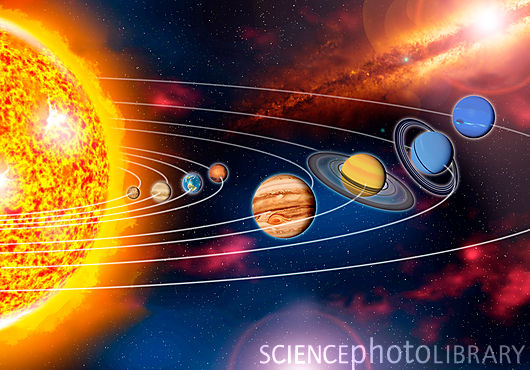
Courtesy of: Jose Antonio Penas/Science Photo Library

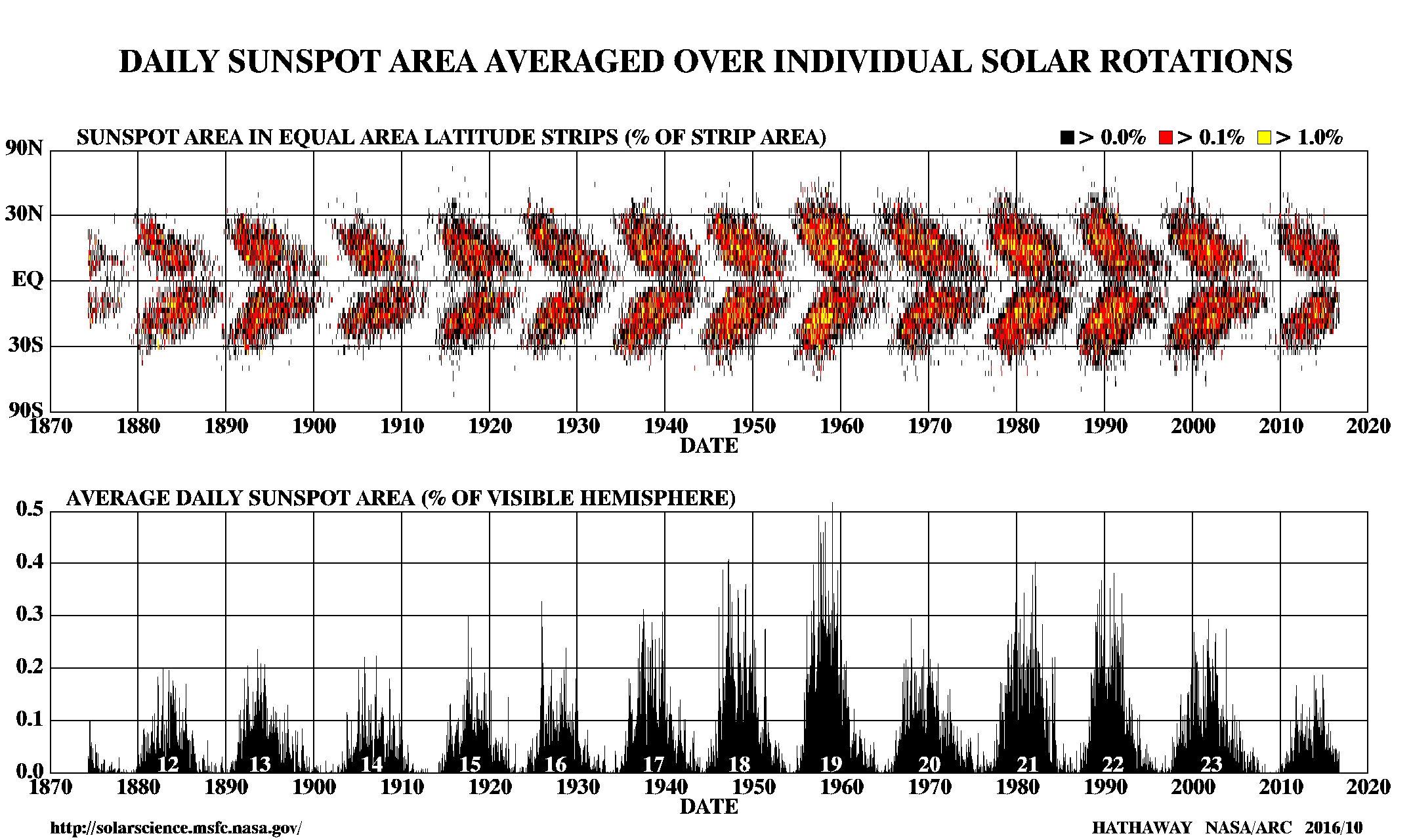
They are persuaded that the Sun, not CO2, is the primary driver of the Earth’s climate.  History shows that solar cycles that have low activity are accompanied by cooling climate.   For example, several minimally active cycles in succession have yielded the Maunder Minimum and the Dalton Minimum.  The temperature drop during the Maunder Minimum was so large as to give that Minimum the name—-“little ice age”.   The earlier Minimums were characterized by the low sunspot count.  Now we can add to that the F10.7cm radio flux, the geomagnetic readings, and many other ways to characterize the level of solar activity.  Even as new satellites and other investigative science provide us with greater understanding of the Sun, it still is not clear as to why Solar Cycle 24 is so inactive.  While many observers claim they knew 24 was going to be minimally active, the record shows most forecast that 24 would be pretty robust and not be appreciably different from Cycle 23.  Just like the weatherman that forecast rain for Maryland tomorrow because it is raining in West Virginia today, the solar experts now “know” that Cycle 25 will be like Cycle 24.

Dr. Hathaway of NASA observes that the Sun’s plasma Great Conveyor Belt (GCB) moved very rapidly in 2008 and 2009 but was notably slower in 2000 and 2001.  “I believe this could explain the unusually deep solar minimum we’ve been experiencing,” says Dr. Hathaway. The high speed of the conveyor belt challenges existing models of the solar cycle and it has forced us back to the drawing board for new ideas.”

Well ok, but why did the GCB change speeds?  Could the planets be the forcing  for this and other changes?

Planets as forcing agents

What is the relationship of the planets and Earth’s climate? There is a theory based upon on the conservation of momentum that links every planet to the Sun.  Another theory is the planet induced tidal effect upon the Sun’s plasma surface. Undoubtedly there are more, but two are enough for now.

Refresher:   Some of my readers may need a refresher regarding the solar system planets.

Solar System Planetary Data (rounded)

Body Distance from Sun10^6km Mass10^22kg OrbitDays Orbit Circ.10^6 km OrbitSpeed 10^6km/day
Mercury 58 33 88 364 4.1
Venus 108 487 225 679 3
Earth 150 598 365 942 2.6
Mars 228 64 687 1432 2.1
Jupiter 778 190,000 4332 4887 1.1
Saturn 1429 56,900 10760 8977 0.8
Uranus 2871 8690 30700 18036 0.6
Neptune 4504 10280 60200 28294 0.5

The mass of the Sun is 1048 times that of Jupiter or 1.989X 10^30 .

 The Landschiedt Minimum

In 2003, Dr. Theodor Landscheidt published a paper  “New Little Ice Age Instead of Global Warming?”  In that paper he predicted that the Earth would start cooling with the coolest period about 2030 and that it would be equivalent of the Maunder Minimum (aka, “the Little Ice Age’).   Landscheidt used the Gleissberg cycle of 80 to 90-years to identify periods of cool climate on Earth. He said that within the Gleissberg cycle there is an 83-year cycle in the change of the rotary force driving the Sun’s oscillatory motion about the center of mass of the solar system.  His premise was that the collective angular momentum of the giant outer planets imposed a torque on the Sun that varies the speed of the Sun’s equatorial rotational velocity.  Some people are saying that this minimum should be called the Landscheidt Minimum. (Landscheidt died in 2004.) Landscheidt further predicted that another minimum would occur about 2200.

One might presume that the center of the Sun is the likely solar system center of mass.  Only on occasion is that true.  The center of the solar system’s mass is called the barycenter.  Watch this video to get an appreciation for the effect of the planets on the barycenter.  (no sound)

The following chart shows where the barycenter is relative to the Sun by year.
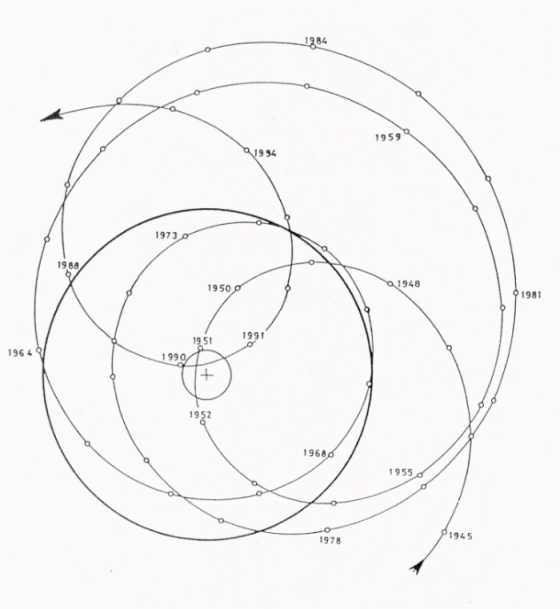
                      Figure 8:  Solar System Barycenter

Landscheidt said:

The solar dynamo theory developed by Babcock, the first still rudimentary theory of solar activity, starts from the premise that the dynamics of the magnetic sunspot cycle is driven by the sun’s rotation. Yet this theory only takes into account the sun’s spin momentum, related to its rotation on its axis, but not its orbital angular momentum linked to its very irregular oscillation about the centre of mass of the solar system (CM). Figure 8 shows this fundamental motion, described by Newton three centuries ago. It is regulated by the distribution of the masses of the giant planets Jupiter, Saturn, Uranus, and Neptune in space. The plot shows the relative ecliptic positions of the centre of mass (small circles) and the sun’s centre (cross) for the years 1945 to 1995 in a heliocentric coordinate system.

The large solid circle marks the sun’s surface. Most of the time, the CM is to be found outside of the sun’s body. Wide oscillations with distances up to 2.2 solar radii between the two centres are followed by narrow orbits which may result in close encounters of the centres as in 1951 and 1990. The contribution of the sun’s orbital angular momentum to its total angular momentum is not negligible. It can reach 25 percent of the spin momentum. The orbital angular momentum varies from -0.1�1047 to 4.3� 1047 g cm2 s-1, or reversely, which is more than a forty-fold increase or decrease (Landscheidt, 1988). Thus it is conceivable that these variations are related to varying phenomena in the sun’s activity, especially if it is considered that the sun’s angular momentum plays an important role in the dynamo theory of the sun’s magnetic activity.

Variations of more than 7% in the sun’s equatorial rotational velocity, going along with variations in solar activity, were observed at irregular intervals (Landscheidt, 1976, 1984). This could be explained if there were transfer of angular momentum from the sun’s orbit to the spin on its axis. I have been proposing such spin-orbit coupling for decades (Landscheidt, 1984, 1986). Part of the coupling could result from the sun’s motion through its own magnetic fields. As Dicke (1964) has shown, the low corona can act as a brake on the sun’s surface. The giant planets, which regulate the sun’s motion about the CM, carry more than 99 percent of the angular momentum in the solar system, whereas the sun is confined to less than 1 percent. So there is a high potential of angular momentum that can be transferred from the outer planets to the revolving sun and eventually to the spinning sun.

From wiki, a somewhat analogous to the Planets/Sun interaction: The conservation of angular momentum in Earth–Moon system results in the transfer of angular momentum from Earth to Moon (due to tidal torque the Moon exerts on the Earth). This in turn results in the slowing down of the rotation rate of Earth (at about 42 nsec/day[citation needed]), and in gradual increase of the radius of Moon’s orbit (at ~4.5 cm/year rate[citation needed]).

If you want to dig further into the concept of angular momentum, the following may be of interest to you:

Angular momentum is conserved in a system where there is no net external torque, and its conservation helps explain many diverse phenomena. For example, the increase in rotational speed of a spinning figure skater as the skater’s arms are contracted is a consequence of conservation of angular momentum.  Moreover, angular momentum conservation has numerous applications in physics and engineering (e.g. the gyrocompass).  See here, here and here to get the math behind conservation of angular momentum, angular momentum, and torque.

 Tidal Effect

Dr Nicola Scafetta of the Active Cavity Radiometer Solar Irradiance Monitor Lab (ACRIM) and Duke University has recently published in the Journal of Atmospheric and Solar-Terrestrial Physics  “Does the Sun Work as a nuclear fusion amplifier of planetary tidal forces?  Etc.”

Lets look at a summary of some of the planetary interactions with the Sun that affect the nominal 11 year solar cycle that he listed in his abstract to the article:

Numerous empirical evidences suggest that planetary tides may influence solar activity. In particular, it has been shown that: (1) the well-known 11-year Schwabe sunspot number cycle is constrained between the spring tidal period of Jupiter and Saturn, 􏰁 9:93 year, and the tidal orbital period of Jupiter, 􏰁 11:86 year, and a model based on these cycles can reconstruct solar dynamics at multiple time scales (Scafetta, in press); (2) a measure of the alignment of Venus, Earth and Jupiter reveals quasi 11.07-year cycles that are well correlated to the 11-year Schwabe solar cycles; and (3) there exists a 11.08 year cyclical recurrence in the solar jerk-shock vector, which is induced mostly by Mercury and Venus

Scafetta proposes that the planets cause surface tides on the Sun.  While very small, he believes the tidal gravitational potential energy dissipated in the Sun by the tides, may produce irradiance output oscillations with a sufficient magnitude to influence the solar dynamo processes.   More from the abstract:

Here we explain how a first order magnification factor can be roughly calculated using an adaptation of the well-known mass-luminosity relation for main-sequence stars similar to the Sun. This strategy yields a conversion factor between the solar luminosity and the potential gravitational power associated to the mass lost by nuclear fusion: the average estimated amplification factor is A􏰂4:25×10^6. We use this magnification factor to evaluate the theoretical luminosity oscillations that planetary tides may potentially stimulate inside the solar core by making its nuclear fusion rate oscillate. By converting the power related to this energy into solar irradiance units at 1 AU we find that the tidal oscillations may be able to theoretically induce an oscillating luminosity increase from 0.05–0.65 W/m^2 to 0.25–1.63 W/m^2, which is a range compatible with the ACRIM satellite observed total solar irradiance fluctuations. In conclusion, the Sun, by means of its nuclear active core, may be working as a great amplifier of the small planetary tidal energy dissipated in it. The amplified signal should be sufficiently energetic to synchronize solar dynamics with the planetary frequencies and activate internal resonance mechanisms, which then generate and interfere with the solar dynamo cycle to shape solar dynamics, as further explained in Scafetta (in press). A section is devoted to explain how the traditional objections to the planetary theory of solar variation can be rebutted.

Both theories have many critics.  I am not knowledgeable enough to support or deny these theories.   However,  Dr Hathaway’s comment about varying speeds in the Great Conveyor Belt would lend some support to these theories especially Landscheidts.   Anyway, the Sun is where the action is with respect to global climate change.  And it will probably be a number of years before any theory wins out.  Remember how much bad press the cosmic ray theory got from the experts, and this case I mean the warmers.  Now after some work at CERN, it is looking like a winner, just not yet announced.  There is hope.

cbdakota
Garage Fire—Karma Caused?


Although a Fisker Karma was housed in a garage that burned down, early accounts suggest that the EV was not the cause. The U.S. National Highway Traffic Safety Administration (NHTSA) is assisting in the investigation of the early May fire at a home in Sugarland, Texas.

Roger Ormisher, a Fisker spokesman said: “The lithium-ion battery of the Fisker Karma was fully intact after the fire and has been tested and is in full working condition. Currently, the precise ignition source and cause of the garage fire is still to be determined.”

cbdakota

IBM’s Lithium-Air Battery Project


IBM is working on a lithium-air battery that they believe has enormous potential to slash the weight and cost of battery packs.   In an Aol Energy blog posting, IBM’s Winfried Wilcke says: “Improvements to the chemistry and manufacturing methods of Lithium-ion cells have led to reliable improvements in price and performance by about 6 to 8 percent per year.” But he adds:  “…. the cost to outfit an EV with a battery pack-estimated today to add $10,000 to $15,000 to the price of Chevy Volt or Nissan Leaf-will fall by only half by 2020”.   Wilcke feels this is not fast enough to make EVs go mainstream.

Wilcke is the Principle Investigator of the IBM Battery 500 Project.  Scientists theorized that combining lithium with oxygen could create a battery with unprecedented energy storage potential. According to the posting:

A key feature of this approach is that the reaction “breathes” air, taking in oxygen when it discharges and releasing oxygen while recharging. Because the battery “borrows” these molecules from the air, fewer raw materials-and less weight-needs be built into the device. This “Lithium-air” approach shows enormous theoretical potential to slash the weight and cost of battery packs. In 2009, IBM took a very long-term bet to see if it could realize this theoretical promise. The resulting project, dubbed Battery 500, aims to produce batteries able to propel an EV 500 miles on a single charge, roughly matching the range of a tank of gas.

Three years in, the results are tantalizing. Lithium-air shows the potential to store up to ten times the energy per weight of today’s commercial Lithium-ion batteries, opening the door to potentially game-changing applications. For instance, if a current EV can hold 100 miles worth of charge, a bank of Lithium-air cells promise to boost that capacity to 500 miles at similar weight.

To be sure, the scientific challenges facing the project remain daunting. After three years of work, the basic operation of rechargeable Lithium-air chemistry has been exhaustively characterized, showing the way ahead. But before Lithium-air cells can move from the laboratory to the car show room, researchers still must improve the cells’ long-term cyclability, speed-up the time needed to charge and discharge, and further drive down costs.

Still, the researchers have been knocking off these sorts of challenges so steadily that they hope to have a working a large-scale prototype within the next two years. Automotive commercialization would be further out, sometime between 2020 and 2030.

If this battery is what is needed to make the EV go mainstream, the forecast of battery commercialization of somewhere around 2020 and 2030 must be discouraging to the advocates that want to replace fossil fuels.

cbdakota

A123 Systems Li-ion Battery Maker Loses $125M In1Q


A 123 Systems Inc. expects to post a net loss of $125 million(M) for the first quarter on revenue of $10.9M.  A123 Systems revised their 2012 revenue forecast downward from $230M to $300m to $145 M to $175 M.  Because the $300M revenue initially forecast less the $125M first quarter loss equals the new $175M revenue forecast, it looks like they think the rest of the year will be pretty smooth sailing.  That is an optimistic call, it would seem, in view of only $10.9M revenue in the 1st quarter. Part of the first quarter loss was a $51M charge to fix the Fisker batter packs.  To read more click here.

Besides making batteries for Fisker which I suppose is their principal client, A123 systems have made batteries for the GM Spark, BMW, and Shanghai Automotive.  They have supplied batteries for Tata transit buses and Daimler hybrid buses.  They have installed some 90MW of storage capacity for wind farms.

A1213 participated in Obama’s Energy Department and the State of Michigan’s incentives programs.  In September 2010, A123 received a $249 million grant from the Energy Department and $125 million in state of Michigan incentives.

Do you think this company will survive?  It’s a close call,one would think.

cbdakota

California’s Global Warming Solutions Act”—Part 2.


The Democratic polling firm of Fairbank, Maslin, Maullin, Metz & Associates at the request of the “Vote Solar Initiative” organization polled some 400 Los Angles residents and found according to an Aol Energy blog posting:

“The vast majority of Los Angeles residents are demanding more renewable energy, especially solar power, according to a new survey. Around 87 percent of voters want solar energy to generate more electricity and 79 percent welcome more wind power. Around three out of four voters (76 percent) say the solar power should be generated from rooftop panels.”

Aside from a pro-solar organization hiring a liberal Democrat polling organization to fashion a poll to get them the answers they wanted, the poll results show how far removed from reality are the LA citizens.  They are clamoring for more government intervention which is what has given California the 3rd highest unemployment rate in the country,  the 9th highest electricity rate and the 3rd highest gasoline cost. It’s the poorer people that are suffering the most.  This will be made even worse as the price of electricity continues its climb as they force in more uneconomical solar based production and drive out much lower cost fossil fuel production. This conclusion is also dawning on the Germans according to the Global Warming Policy Foundation: “The current funding of Germany’s green energy transition is anti-social, according to a new report by the Institute of the German Economy. The economic burden due to the Renewable Energy Sources Act (EEG) is up to 10 times higher for low-income households than for high-income households.”

The preliminary 2012 Energy Information Administration’s (EIA) estimates for levelized costs per kilowatt-hour in 2017 are 15.7 cents for a photovoltaic solar plant and 25.1 cents for a thermal solar plant.  That is far more expensive than the 6.7 cents per kilowatt-hour for conventional combined cycle natural gas and the 10 cents per kilowatt-hour for conventional coal in those same EIA estimates.  Also,  the EIA inflates the cost of coal by the equivalent of $15 per metric ton of carbon dioxide emitted to represent the difficulty of obtaining financing for coal plants. Further, it does not appear that the EIA levelized cost for conventional combined cycle natural gas plant is getting credited for the lower price of natural gas resulting from fracking shale.

The survey also said that:

“Most voters believe Los Angeles should create 1,200 megawatts of power from the sun, which is LADWP’s percentage of the state goal of 12,000 megawatts of local clean power by 2020.”  

And they inform us that 1200megawatts is enough to power 260,000 homes.  The calculation for number of homes powered  is suspect as it is varies from solar power promoter to promoter.  Without power storage, some other source of electricity most likely from a fossil fuel powered source is necessary because the lights would go out on these homes at night when the sun is no longer shining.  So much for reducing carbon emissions.  I wonder if California Air Resources Board (CARB) has put that in their solar energy calculations?

More on Solar cell reliability, etc. in my next posting on this topic.

cbdakota

Solar Cycle 24–April Update


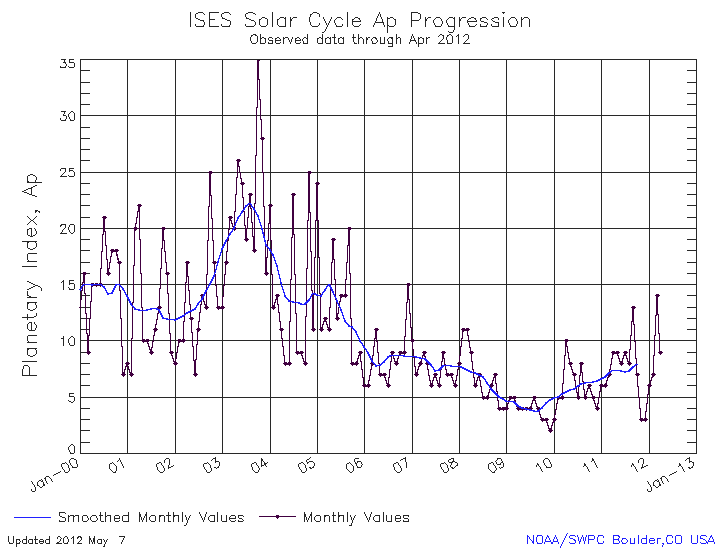
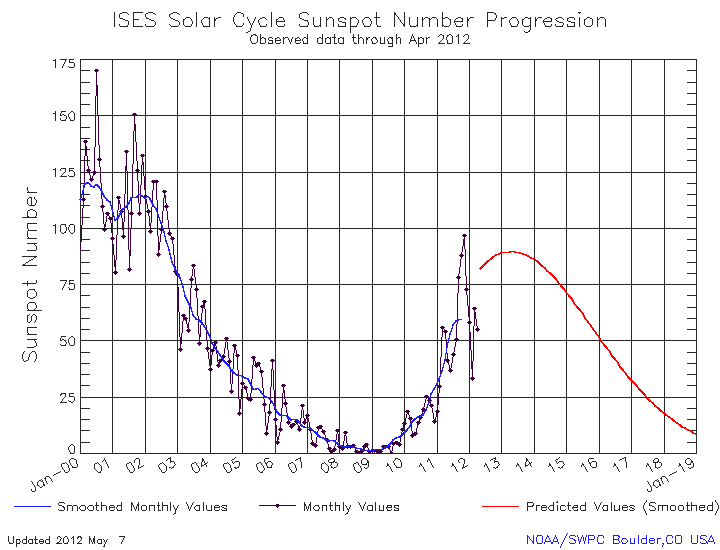
Generally speaking, Solar Cycle 24’s April sunspots numbers, F10.7cm flux and the geomagnetic field Ap index all indicate reduced solar actively.  NASA as well most of the experts in this field agree that Solar Cycle 24 will be a record setter of a sort—least active in about 100 years.  One need not base this on computer models or some consensus, however.  All that is required is to look at the data.  I do not think anyone has a handle on why Cycle 24 is acting this way.  There are many theories and perhaps one of them is correct. Will Cycle 25 continue this downward trend?  Click on the charts to improve clarity.

cbdakota

California Law “Global Warming Solutions Act”—Is It A Black Hole?


The California environmentalists got Governor Schwarzenegger and the legislators to pass the “Global Warming Solutions Act” in 2006.   The law called “AB 32” is sweeping in its authority to regulate fossil fuels.  The stated objective of AB 32 is to implement a “transformative” standard that will reduce carbon emissions to 1990 levels by 2020.  In 2013, electric power and major industrial emitters of about 160million metric tons of carbon dioxide equivalent (MTCO2e) will be compelled to begin reductions. This will require fuel-switching, new lower-emitting plants and contracting for lower-carbon generated power form out of state. The program is essentially Cap and Trade.  In 2015, transportation, natural gas, smaller emitters, etc accounting for about 230MTCO2e will be required to begin reductions.   How this sector is to accomplish this is not clear and what ever it is, is expected to be expensive.   Off-sets seem to be one way but these are limited and further, no emitter can use more than 8% offsets to comply with the law.

AB32 has not gone unchallenged.  For one challenge, the Renewable Fuel Association (RFA), mainly representing ethanol producers say they will be ruled out of the California market.  The law is based on the study of total emission from “seed to wheel” and California Air Resources Board (CARB) sets a standard that the ethanol producers say makes compliance too expensive.  The RFA  got an injunction to stop implementation saying that the law was  unconstitutional because it violates the commerce clause which was intended to stop states from introducing laws that would discriminate against businesses located in other states.  But the US Court of Appeal (9th District) has now lifted the injunction.  The ruling on AB 32’s constitutionality is expected soon and the lifting of the injunction probably indicates they will say it is constitutional.

AB 32 was the product of Western Climate Initiative (WCI) that was formed in 2007.  The partners in the WCI were California, Arizona, New Mexico, Oregon and Washington and later expanded by the addition of Montana and Utah plus the Canadian Provinces of British Columbia, Manitoba, Ontario and Quebec 2008. Each State or Province would not bound by AB32; they would have to pass similar bills in their respective legislative bodies.

All the US states dropped out when AB 32 was passed obviously not on-board with the size and scope of the act and that it was unlikely to get passed in their respective states.  The four Canadian Provinces have remained and have issued AB 32 as guidelines.   It would seem that the tar sands oil in Canada would be negatively affected by these guidelines if they become law in the four Provinces.

The trend for California to get their electrical power from out of state will be affected by this law as well.  CARB wants to limit “leakage” where emissions drop only because the generation source is out of the state.  So any emissions that occur in the process of generating the imported electricity are to be accounted for.

So why the comment about a black hole?  The size of the California market is huge. In the years past,  if California made an environmental change, the nation often followed. The Federal Clean Air Act was pretty much a product of California. Before retirement I pushed a program to amend the Clean Air Act to permit the use of up to 5% methanol mixed with ethanol in gasoline.  It was necessary to work with CARB if you wanted to do business in California. At that time they wanted to use methanol but not as a low level blend but as the primary fuel.  I think CARB and California have become too zealous.  The fact that all the states dropped out of the WCI is pretty telling.   When the price of electricity, gasoline, and other fossil fuel associated products get way out of step with rest of the nation and more industries flee the cost burden to more friendly states, I hope California residents get the message.

Next posting will look at the Californian’s wanting more solar power.  I don’t believe they know how costly this will be.

cbdakota

Revised NASA Cycle 24 Sunspot Forecast


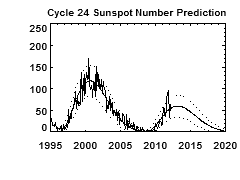
Dr Hathaway of NASA has revised his Cycle 24 sunspot forecast.   He predicts a smoothed sunspot number maximum of about 60 in the Spring of next year.  Cycle 24 will be the smallest in about 100 years.  For the record, his forecast graphed is shown below:

He has revised his prediction method as follows:

Recent work [see Hathaway Solar Physics; 273, 221 (2011)] indicates that the equatorward drift of the sunspot latitudes as seen in the Butterfly Diagram follows a standard path for all cycles provided the dates are taken relative to a starting time determined by fitting the full cycle. Using data for the current sunspot cycle indicates a starting date of May of 2008. Fixing this date and then finding the cycle amplitude that best fits the sunspot number data yields the current (revised) prediction.

To read more of the NASA report click here.

A reminder, Hathaway uses the smoothed International Sunspot Numbers and not the NOAA count. The International Sunspot Number for historical reasons [to be compatible with Rudolf Wolf’s count for 1849 to 1865] is reported as 0.6 x the actual count, while the NOAA count is just the raw count [actually = 10 x number of groups + number of spots].

This has not been an easy road for Cycle 24 sunspot predictions.  See the links below to get an idea how far Cycle 24 has been cut back over recent times.

https://cbdakota.wordpress.com/2012/03/06/cycle-24-february-update/

https://cbdakota.wordpress.com/2011/10/11/september-solar-cycle-24-activity-increased/

https://cbdakota.wordpress.com/2011/09/20/solar-cycle-24-august-update/

https://cbdakota.wordpress.com/2011/08/16/solar-cycle-24-continues-to-under-perform-the-early-projections/

The April Sunspot report will be out early next week and will be posted for your examination.

cbdakota

Electric Car Sales Update –April 2012


The electric vehicle sales were slower in April than in March.  March sales were about 4,000 and in April the number dropped to about 3,500.

The GM Volt sales were down in April versus March. The March sales of 2,289 were the highest monthly Volt sales ever.  In April,  sales dropped to 1,462. GM had forecast Volt sales in 2011 to be 10,000 but only sold about 7,700.  This year they forecast sales of 45,000 but now are backing off saying they will match supply to demand in view of the year to date sales of 5,377.

Nissan is sticking to its 2012 forecast of Leaf sales of 20,000.  Sales in April were 370 and the year to date shows sales of 2,103.   So they have to sell about 18,000 in the remaining 9 months.  Anyone placing bets on the likelihood of accomplishing that goal?

Two more items of interest.   Ford did not sell any Focus Electrics for the third straight month.  The sales since introduction of the Focus Electric in December 2011 are one dozen.  The second item, according to The Detroit News, is that Toyota Prius sales were the best ever at 1,654 for the month of April.  This is a surprise as it means that the Volt outsold the Prius in March.  Interestingly it was the two hybrids, Prius and Volt  that made up about 90% of the April electric vehicle sales.

cbdakota

Automotive Engineering Execs Pessimistic About Electric Car Sales


The Society of Automotive Engineers (SAE) World Congress was held April 24 &25 in Detroit.  Ford, GM and Chrysler representatives were pessimistic about the future of electric vehicles according to an article in the Wall Street Journal (WSJ).   This is somewhat surprising in that the President has been promoting electric vehicles as a centerpiece of his auto-industry policy.  President Obama has offered $2.4 billion in grants to boost some 48 projects related to electric vehicles or battery production according to the WSJ. This may have required some amount of courage as we know the Administration is a major partner in both GM and Chrysler.

Obama has set a goal of 1 million electric vehicles on the road by 2015.   But if you listen to the auto company engineering execs, it would seem that Obama’s goal is not likely to be met.  Fundamentally they see the buyers not interested in the high price of the electric vehicles and the execs don’t see the prices dropping real soon.

Joseph Bakaj, vice president for powertrain engineering at Ford said:” “By 2025, we see battery electric vehicles still with too long a payback, and inadequate range,”

Sam Winegarden, executive director of powertrain-engine engineering at General Motors Co. made a similar point with a chart comparing the amount of energy delivered by a given volume or mass of fuel. On his chart, lithium-ion batteries, used in electric cars such as the Nissan Leaf and GM’s plug-in hybrid Chevrolet Volt, were ranked close to zero compared to gasoline and diesel fuels, which delivered the most energy for the least amount of weight and cost to the consumer.”The rumored death of the internal combustion engine is premature,” Mr. Winegarden said.

Chris Cowland, director of advanced powertrains at Chrysler Group LLC, offered some revealing figures. A conventional, gasoline-fueled internal combustion engine and transmission make up about 10% of the cost of a $30,000 car, or about $3,000, he said. Ford Chief Executive Alan Mulally at a green-car forum in New York City last week said batteries for the electric Ford Focus cost $12,000 to $15,000 for a car that is priced at $39,200, about $15,000 more than a petroleum-fueled Focus.

Robert Bienenfeld, senior manager for environment and energy strategy at Honda Motor Co.’s U.S. arm, said that by 2025, a customer who buys a plug-in hybrid could wait 10 years to recover the added upfront costs, compared with a 2025 car outfitted with a more efficient gasoline engine and transmission. The payback for an all-electric car would be even longer

Nissan on the other hand is bullish about electric cars. According to the Nashville Business Journal, Brendan Jones, director of Nissan Leaf Marketing and Sales Strategy said that the Leaf buyers have an average household income of $131,000.

I would be optimistic if the typical buyer were someone in the mid $50s income range.

h/t The Hockey Schtick

cbdakota