Category Archives: sun and climate

Reliable Solar Cycle Forecasting Requirements


Dr David Hathaway is NASA’s solar cycle guru.  In 2010, he published in Solar Physics a review of the methods used to forecast solar cycle activity.   The review, titled TheSolar Cycle” is worth reading.  He discusses many of the techniques currently in use that purport to be the method for solar cycle forecasting. 

This post will only look at the key features that Hathaway says must be explained by any viable theory or model in order to provide a reliable forecast. 

The Abstract for “The Solar Cycle”  follows:

The Solar Cycle is reviewed. The 11-year cycle of solar activity is characterized by the rise and fall in the numbers and surface area of sunspots. We examine a number of other solar activity indicators including the 10.7 cm radio flux, the total solar irradiance, the magnetic field, flares and coronal mass ejections, geomagnetic activity, galactic cosmic ray fluxes, and radioisotopes in tree rings and ice cores that vary in association with the sunspots. We examine the characteristics of individual solar cycles including their maxima and minima, cycle periods and amplitudes, cycle shape, and the nature of active latitudes, hemispheres, and longitudes. We examine long-term variability including the Maunder Minimum, the Gleissberg Cycle, and the Gnevyshev–Ohl Rule. Short-term variability includes the 154-day periodicity, quasi-biennial variations, and double peaked maxima. We conclude with an examination of prediction techniques for the solar cycle.

Hathaway lists the critical features for making an accurate forecast:  

Understanding the solar cycle remains as one of the biggest problems in solar physics. It is also one of the oldest. Several key features of the solar cycle have been reviewed here and must be explained by any viable theory or model.  (I am adding several charts to aid in visualize his thinking.)

  • The solar cycle has a period of about 11 years but varies in length with a standard deviation of about 14 months.
  • Each cycle appears as an outburst of activity that overlaps with both the preceding and following cycles by about 18 months.
  • Solar cycles are asymmetric with respect to their maxima – the rise to maximum is shorter than the decline to minimum and the rise time is shorter for larger amplitude cycles.
  • Big cycles usually start early and leave behind a short preceding cycle and a high minimum of activity.
  • The activity bands widen during the rise to maximum and narrow during the decline to minimum.
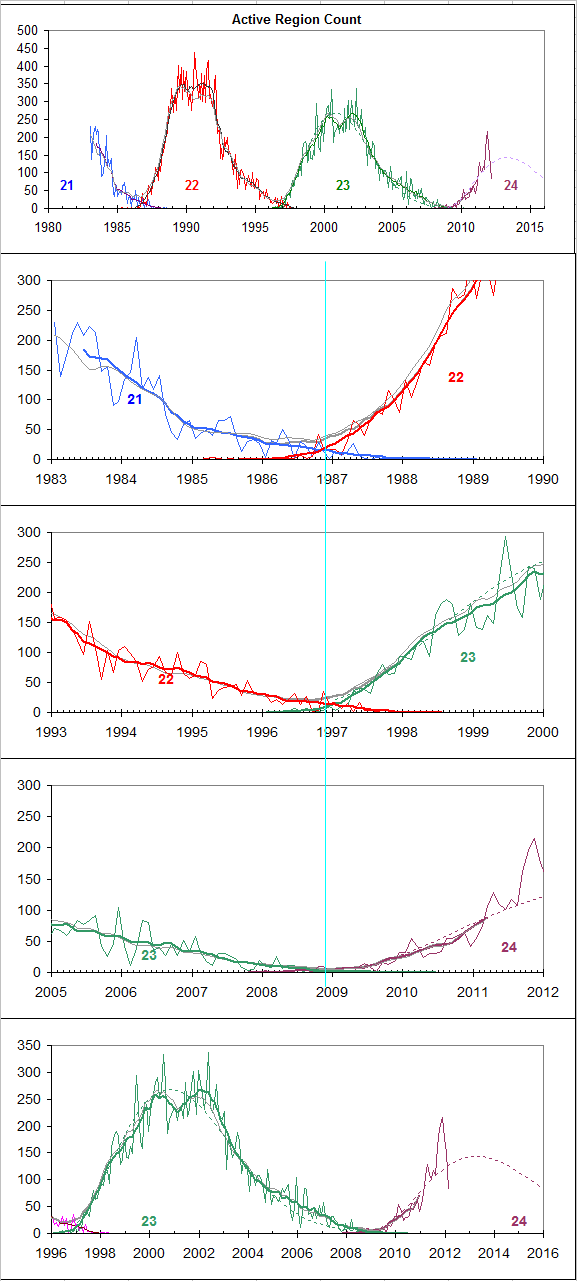
These  sunspot charts show the last stages of cycle 21, cycles 23 and 23 fully and the current status of cycle 24.  The overlapping between the end of one cycle and the start of the other is apparent.   The relatively steep rise in the sunspot count at the begining of a new cycle and the more gradual decent.  Cycle 24’s rise is not nearly as steep as its predecessors.  Charts by Leif Svalgaard.
  • Sunspots erupt in low latitude bands on either side of the equator and these bands drift toward the equator as each cycle progresses.
  • At any time one hemisphere may dominate over the other but the northern and southern hemispheres never get completely out of phase.
  • Sunspots erupt in groups extended in longitude but more constrained in latitude with one magnetic polarity associated with the leading (in the direction of rotation) spots and the opposite polarity associated with the following spots.
  • The leading spots in a group are positioned slightly equatorward of the following spots and this tilt increases with latitude.
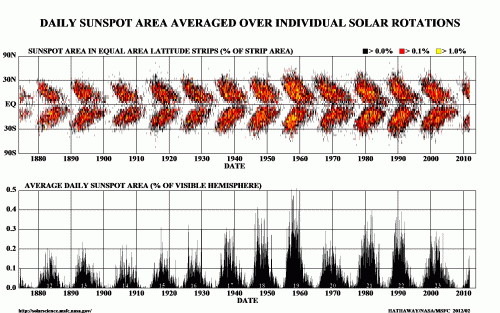
Butterfly Diagram: All the sunspots in a give cycle are plotted on the charts above. The initial sunspots appear at about 30° North and South lattitude. As new spots appear they tend to get closer to the equator. Each solar cycle ends, nominally, when the spots reach the equator. Charts by Solar Physics Group @ NASA

  • The polar fields reverse polarity during each cycle at about the time of cycle maximum.
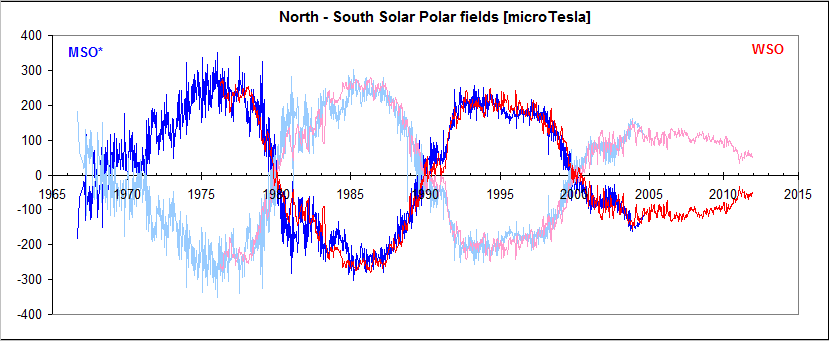
Solar Magnetic Fields: This chart shows the North and South magnetic fields reversing at the end of a solar cycle. Note how weak the magnetic fields are for the start of the current cycle 24. Chart by Leif Svalgaard.

  • Cycle amplitudes exhibit weak quasi-periodicities like the 7 to 8-cycle Gleissberg Cycle.

The Gleissberg Cycle is a period of about 80 to 90 years that overlays the well established 11 year cycle.  The theory is that solar maxima and solar minima are forced by the gravitational pull of the major planets.  The specific alignment, particularily Jupiter and also Saturn Neptune and Uranus have a major effect on the Sun’s activity.  To see graphics of the alignment of these major planets, click here.

  • Cycle amplitudes exhibit extended periods of inactivity like the Maunder Minimum.
  • Solar activity exhibits quasi-periodicities at time scales shorter than 11 years.
  • Predicting the level of solar activity for the remainder of a cycle is reliable 2 – 3 years after cycle minimum.

Hathaway tells us that theory must be able to predict the preceding.  Until then,  people will continue to predict the features of the next solar cycle but it may be just luck if they get it right.

cbdakota

January 2012 Global Temperature


The only global temperature report that I really trust is the UAH satellite readings that Dr Roy Spencer manages.  The temperature in January took the expected drop.

Chart courtesy of Dr Spencer’s  Global Warming blog. (click on chart to enlarge)

The January temperature is equivalent to the January 2011 but below 2009 and 2010 January temps.  If the forecast of a very weak solar Cycle 25  comes to pass, we should see some record lows in coming years.

cbdakota

Forecasting Cycle 25—Great Conveyor Belt Theory


The last post reviewed a forecasted solar Cycle 25 based upon measuring the magnetic field of sunspots.   This posting uses the speed of the Sun’s Great Conveyor Belt(GCB) to forecast Cycle 25. This method considers sunspots as an indicator but the GCB speed determines how many sunspots appear.  I am not sure who, but perhaps Dibyendu Nandi of the Indian Institute of Science and Education and Research in Kolkata (aka, Calcutta) and his team  can claim this theory. The GCB has been studied for a number of years.  NASA Science says: “The Great Conveyor Belt is a massive circulating current of fire (hot plasma) within the sun. It has two branches, north and south, each taking about 40 years to complete one circuit.“  “The plasma flows travel along the Sun’s surface and plunge inward at the poles, and reappear again at the Sun’s equator.  When the sunspots begin to decay, surface currents sweep up their magnetic remains and pull them down inside the star; 300,000km below the surface, the sun’s magnetic dynamo amplifies the decaying magnetic fields.  Re-animated the sunspots become buoyant and bob up to the surface like a cork in water—voila! A new solar cycle is born.”

These belts can be likened to the Earth’s ocean currents.

NASA’s artistic sketch of the belt.

A May 2006 posting on Science News has Dr Hathaway predicting that Cycle 24 sunspots numbers would be perhaps greater than Cycle 23 (this part of the prediction is not faring well.) and Cycle 25 would be perhaps half of Cycle 23.  Dr Hathaway said that these predictions were based on a deceleration of these belts to 0.75m/s in the North and 0.35m/s in the south.  He said “We’ve never seen speeds so low”.    Hathaway in a September 2011 posting said:”…….that as the number of sunspots increases on the Sun, the speed of the GCB decreases and vice versa: fewer sunspots and the faster the speed of the Belt.”   This is somewhat contradictory,  because if the GCB speed is slowing down, based on his theory,  there would be more spots.

Dr. Nandi  adds some clarification when he lays out his theory here: “The fast-moving belt rapidly dragged sunspot corpses down to sun’s inner dynamo for amplification. At first glance, this might seem to boost sunspot production, but no. When the remains of old sunspots reached the dynamo, they rode the belt through the amplification zone too hastily for full re-animation.  Sunspot production was stunted.”  Nandi  then adds that late in the decade, “….according to the model, the Conveyor Belt slowed down again, allowing magnetic fields to spend more time in the amplification zone, but the damage was already done.  New sunspots were in short supply.  Adding insult to injury, the slow moving belt did little to assist re-animated sunspots on their journey back to the surface, delaying the onset of Solar Cycle 24.”  

Hathaway’s sunspot predictions are in Red.   Also on this chart, in Pink, are the Cycle 24 sunspot predictions by NCAR’s Mausumi Dikpata and her team based on their observations of the GCB.

Nandi  has made a presentation “Forecasting the Solar Cycle”at the Harvard Smithsonian Center for Astrophysics, Cambridge, USA  but I can not access the paper.

This theory says that the change of speed of the GCB predestines the solar çycle  robustness or lack there of.  For some insight of how they are able to track these plasma flows/GCBs/jet streams, click here.

Like the declining sunspot magnetic field, the theory of the GCB seem to me to be describing consequences of some other forcing that is not known or understood.  I think it likely that Cycle 25 will be weak.  However, until we know more about the functioning of the Sun,  we will be forecasting like the weather casters—tomorrow will be rainy because rain clouds are blowing our way from the west.  Like all of these theories, only time will tell if they are really capable of predicting accurately Cycle strength.

We are not through with Cycle prediction theories.  Next posting will discuss the bicentennial decrease in Total Solar Irradiance (TSI) unbalancing the Earth’s thermal budget.

cbdakota

Forecasting Cycle 25–Livingston and Penn Method


As Cycle 24 has not yet achieved a Solar Maximum, it may seem a little early to begin forecasting Cycle 25.  But several forecasts have been made.  A recent posting in WattsUpWithThat notes such forecasts by Penn and Livingston and by David Hathaway.

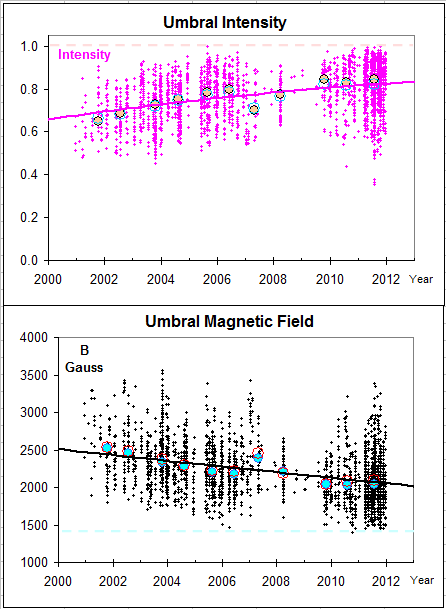
You remember from previous postings on this site, that Penn and Livingston have been measuring Sunspot magnetic field strength and the temperature and luminosity of the umbra.   They began this study in 1990 and as of 2010 they have analyzed some 17,000 spots. Plotted on the chart below are data from their paper LONG-TERM EVOLUTION OF SUNSPOT MAGNETIC FIELDS through 2010 and additional readings since:

Chart courtesy of Lief Svalgaard

Focusing on the bottom chart, sunspots are plotted against magnetic field strength and time. The individual dots are representative of sunspots.  The larger blue dot represents the normalized sunspot number for each year. The black line is the trend line for the umbral magnetic field of the sunspots. The horizontal blue line indexes a magnetic field strength of ca. 1500 Gauss. Note that the sunspots extend vertically above the trend line, and below the trend line but not below the 1500 Gauss line.  The two scientists speculate that sunspots do not form when the magnetic field strength is less than 1500 Gauss.  If the trend line continues on this same slope, somewhere around the year 2025+/- at least half of the sunspots will disappear.

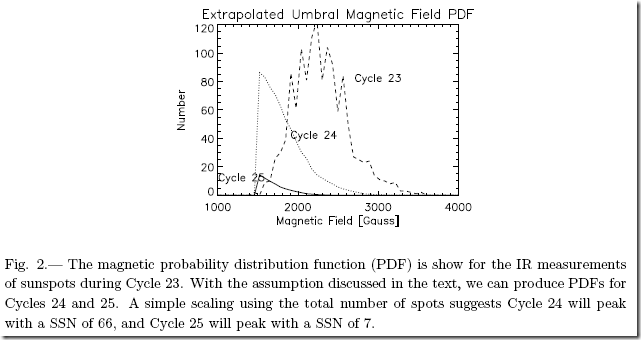
Using a linear decrease of 65 Gauss per year and a cycle duration of 11 years, they computed the magnetic probability distribution function for Cycles 24 and 25. Using this, a sunspot number is forecast. Cycles 24 and 25 are shown along with actual data from Cycle 23 in the chart below from their paper:

Chart provided by David Archibald, from the paper by Livingston and Penn.

The contrast of Cycle 24 and specifically Cycle 25 from the completed Cycle 23 is quite dramatic.  The Cycle 24 forecast, so far, seems to be reasonably in tune with actual data.  At a Cycle 25 sunspot number of 7, David Archibald says it would be the lowest sunspot number for a Cycle in 300 years!!!!

Livingston and Penn say that if the linear decrease were 50 Gauss per year rather than 65, the Cycle 25 sunspot number would be 20 which is still a very low number.

Livingston and Penn caution that it is always risky to extrapolate linear trends.

Next posting on this topic will be an examination of David Hathaway’s 2006 forecast of both Cycle 24 and Cycle 25.  It will also discuss one of the underlying theories for the decrease in sunspots.

cbdakota

Are Sunspots Going to Disappear by 2015?


To reacquaint you with this topic, lets do a little review.  Livingston and Penn have been measuring the umbral intensity of sunspots and the corresponding magnetic field that spawns them since 1990.  In 2006 they submitted a paper to the journal “Science” reporting on their efforts and suggested that if the trend of weaker sunspot magnetic fields continued at its current rate, they would be too weak to produce sunspots.  This paper was rejected in peer review. Undeterred, they have continued to study these phenomena and so far, they seem to be on to something.

Sunspots are the product of the enormous magnetic fields created on the Sun. What make them especially interesting is that the Earth’s climate and sunspots have a high degree of correlation.   Periods where the climate has cooled off seem to coincide with periods of few sunspots and periods of warmer climate seem to coincide with periods of high sunspot counts.

Sunspots appear as dark spots on the face of the Sun.  Very strong magnetic forces (thousands of times stronger than Earths magnetic field) block the hot solar plasma and sunspots are the result.  The spots are cooler than the surrounding surface of the Sun.  NASA says that the spots are about 3700K versus 5700K for the surrounding photosphere.

©UCAR, image courtesy Matthias Rempel, NCAR

The photo sh0ws the “spot” (the umbra) surrounded by the penumbra that is shaped by the magnetic lines of force. 

Livingston and Penn have studied over 1700 spots and they see a trend in which the darkest parts of the sunspot umbra have become warmer (45K per year) and their magnetic field strengths have decreased (77 Gauss per year**), independently of the normal 11-year sunspot cycle.

The latest data is shown in the two charts, UMBRAL INTENSITY AND UMBRAL MAGNETIC FIELD.

Charts courtesy of Leif Svalgaard

The umbral intensity is a measurement of the light from the umbra (the dark center) and compared to a measurement of the light from a calm sun surface.  Note that the umbra is getting hotter and brighter as the umbral magnetic field gets weaker.  The two scientists believe that if the magnetic field weakens to ≈1500 gauss, the sunspots will not form.   If the trend continues linearly,  that could happen in this decade. 

If there are no visible sunspots in Cycle 25,  it could mean that we would be experiencing a solar minimum like the Maunder minimum that heralded in the Little Ice Age. It should be noted that while this is a suggestion, rather than a promise, it certainly is consistent with the observable trend of a less energetic Sun.

** Gauss is measure of the strength of a magnetic field.  Its units are Maxwells per square centimeter.  A small bar magnet will range from 40 to 100 gauss. The Sun’s average magnetic field strength is 1 and the Earth’s is 0.5.

cbdakota


Cycle 24 November 2011 Update


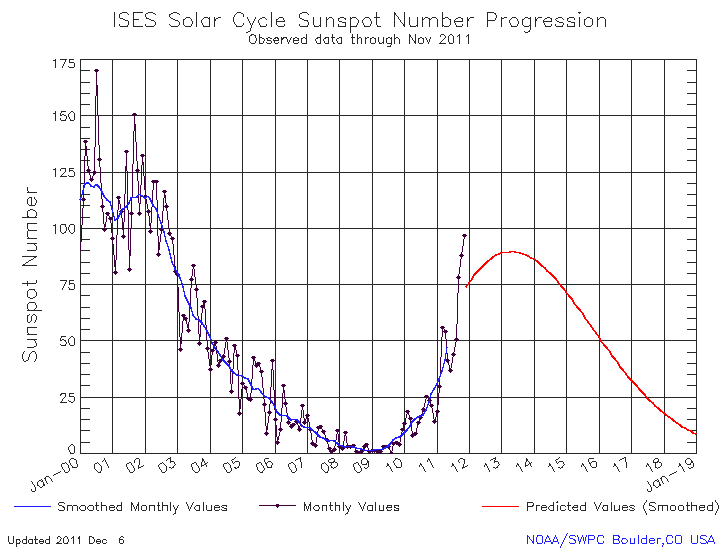
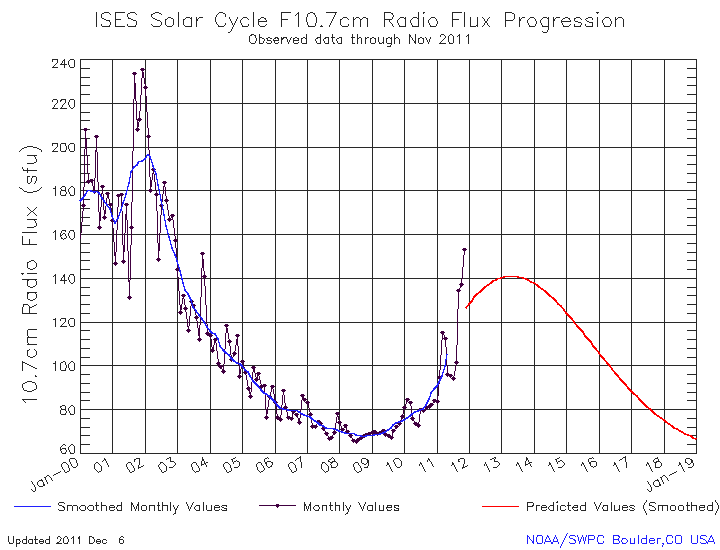
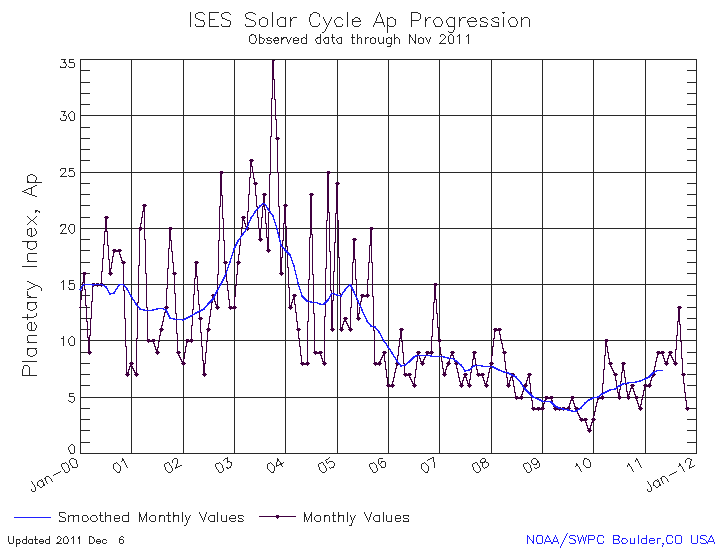
November Cycle 24 monthly sunspot count was nearly 100, which is by far the most active period since the cycle began.    The same goes for the F 10.7 Radio Flux that racked up a value of about 155.  But of these numbers are well below those of Cycle 23 at its peak.  Cycle 23 peak sunspot count was 170 and its F10.7 was about 235.   See the  November NOAA/SWPC charts below:

CLICK ON CHARTS FOR BETTER VIEW

Solar Activity/Geomagnetism

The Ap index is a good proxy for overall solar activity. For two months it has declined.  We are seeing Cycle 24 peaks in F10.7, and sunspots simultaneously with this drop in Ap.  It may mean that the spots and F10.7 may soon be trending downward as well.

If you  are interested,  the following is a brief explanation of the various ways geomagnetism is expressed.

The magnetic activity indices K, Kp and ap are designed to measure the variations in the geomagnetic field that arise from current systems caused by regular solar radiation changes. Other irregular current systems produce magnetic field changes caused by the interaction of the solar wind with the magnetosphere, by the magnetosphere itself, by the interactions between the magnetosphere and ionosphere, and by the ionosphere itself.

The planetary 3-hour range index Kp is the mean K-index from 13 geomagnetic observatories.  The scale is 0 to 9 expressed in thirds of a unit, 5-  is 4 2/3, 5 is 5 and 5+ is 5 1/3.  This planetary index is designed to measure particle radiation by its magnetic effects.  The 3-hourly ap (equivalent range) index is derive from the Kp index as follows:

Kp = 0o   0+   1-   1o   1+   2-   2o   2+   3-   3o   3+   4-   4o   4+

ap =  0     2     3      4     5     6     7       9    12   15    18     22   27   32

Kp = 5-    5o    5+   6-   6o    6+    7-     7o     7+     8-     8o     8+    9-     9o

ap = 39   48   56    67   80   94   111  132    154   179   207  236  300  400

Now one more derivation to get to the Ap index.   The  Ap index is defined as the earliest occurring maximum 24-hour value  obtained by computing an 8-point running average of successive 3-hour ap indices during a geomagnetic storm event.

cbdakota

Keystone Pipeline Delayed For Campaign Contributions


Several months ago, I wrote about the current Administrations efforts to sink coal, natural gas and oil.  They are still planning to do that. Today the Obama Administration announced that they needed more time to ponder the question of the Keystone XL pipeline that will bring Canadian crude oil to the US where we would refine it and market it.  They have studied this issue for 18 months without making a final decision.  The Washington Post’s publication Politico.com said today: President Barack Obama was caught between a green and a blue place on the Keystone XL oil pipeline — the environmentalists who insisted he reject the proposal in order to earn their support in 2012 and labor unions excited at the prospect of jobs.

On Thursday, Obama’s State Department punted a verdict on Keystone until 2013, and while his administration is busy claiming the decision has nothing to do with politics, try telling that to everyone in Washington.   

The Politico gave the reason: Sierra Club Executive Director Michael Brune had recently told reporters Obama’s decision on Keystone would “have a very big impact” on whether the nation’s largest environmental group funnels resources more toward congressional races rather than the race for the White House.

To read more of the Politico.com story click here.

The following excerpt is from my posting  Obama Plans to Nationalize the Energy Companies

Classic wrong headedness is illustrated by diddling over access to Canada’s rich tar sands.  From the IBD posting “China has its eye on Canada’s oil”:

Together, the U.S. and Canada have enough oil and natural gas locked up in shale formations, tar sands, Alaska, the Canadian Arctic and the Outer Continental Shelf to make OPEC pound sand. But we won’t drill for ours and apparently; we don’t want Canada’s.

With more than 170 billion barrels, Alberta has the world’s third-largest oil reserves, behind only Saudi Arabia and Venezuela and ahead of Russia and Iran. Daily production of 1.5 million barrels from the oil sands is expected to nearly triple to 3.7 million by 2025. The only question is, will this crude be flowing south to U.S. refineries or west for export to China?

At issue is the Keystone XL pipeline, parts of which have already been built, that would bring Alberta oil to Texas Gulf Coast refineries. The pipeline also could transport oil extracted from shale formations in the Rocky Mountain West.  The U.S. Geological Survey estimates the region, dubbed the Persia of the West, may hold more than 1.5 trillion barrels of oil, six times the proven reserves of Saudi Arabia, and enough to meet U.S. oil needs for the next two centuries. By 2015, oil executives and industry analysts say, the oil-rich lands of the West, including North Dakota’s booming Bakken formation, could produce 2 million barrels a day, more than the pre-Deepwater Horizon production rate in the Gulf of Mexico.

Environmental groups oppose Keystone XL on the grounds that tar-sands extraction harms the environment through water pollution, greenhouse gas emissions and potential pipeline leaks. The State Department, which must approve any pipeline entering the U.S. across international borders, has withheld its approval pending a final decision Nov. 1.  The Chinese aren’t waiting. Sinopec, a Chinese state-controlled oil company, has a stake in a $5.5 billion plan to build the Northern Gateway Pipeline from Alberta to the Pacific Coast province of British Columbia. Alberta Finance Minister Lloyd Snelgrove met this month with Sinopec and CNOOC, China’s other big oil company, and representatives of China’s banks.

While the U.S. dithers with concerns about “dirty oil” from Alberta’s rich tar sands, energy-hungry China makes Ottawa an offer it might not refuse. Memo to Washington: Pipelines can run west as well as south.

Some of you maybe saying, if you have read this far,  ‘well we have to get off fossil fuels before the Earth experiences a catastrophe from man-made global warming’.  I don’t know how much attention you have been paying to this subject but the Global temperatures have not been increasing for the past 10 to 13 years! The temperature is not rising while at the same time, the boogeyman in all of this controversy, atmospheric CO2 content has been increasing throughout this period.  Just so you don’t think I have invented the idea of a decade or more of flat temperatures, those that favor the theory of man-made global warming agree. Last week, Greenwire published the thoughts of the major warmer scientists  (Hansen, Trenberth, Santer, Solomon, Wild, etc.) about the fact that the temperature is at a standstill.  They are at a loss to explain why the temperature is not rising.  They have many theories but no answers. Some in that group are beginning to see that the quieter-than-usual Sun may be the real reason.    To see the Greenwire story, “Provoked scientists try to explain lag in global temperatures” click here.

cbdakota

September Solar Cycle 24 Activity Increased


September Sunspot and Flux (F 10.7) data indicate a step change in Cycle 24 activity.  It was enough to cause Dr Hathaway to revise his Sunspot prediction chart once again.  He raised all three ranges, high, mid and low upward.  The mid-range was bumped up about 15%. (Click on Charts for better view.)   The Sunspot chart from NOAA/SWPC shown below indicates a monthly value increase from about 50 to 80 sunspots.  This chart suggests that the actual data is on track to match their prediction. And the Solar Radio             flux is tracking the NOAA/SWPC prediction. The Sun has a mind (or some kind of mechanism) of its own. To date in October   the Planetary A index is low and this usually means a less active Sun.  Will the numbers for Sunspots and Solar Radio Flux for the month of October drop?   Put in a planetary a index.   cbdakota

The Federal Government Should Not Be Financing “Renewable Fuels” Projects


Much has been revealed in the recent weeks about Solyndra and the developing scandal that followed the bankruptcy of the company after having received a $523 billion dollar, low interest loan from the Obama Administration.  Much is yet to be learned, and it did not get advanced by the Top Officials of Solyndra pleading the 5th Amendment at the House of Representatives hearing on Friday 23 September.

The Institute for Energy Research condensed a report by ABC on the Solyndra fiasco in to 5 Reasons why the federal government should exit the finance business.  Those reasons are as follows:

First, the government loaned Solyndra money at a really, really low interest rate—a mere 1.025 percent quarterly. In fact, this was the lowest rate provided for any green energy project.

Second, this low rate was in spite of “red flags” about the risk of investing in Solyndra. One outside rating agency rated Solyndra only a B+ and another rated Solyndra only as “Fair” for credit worthiness.

Third, Obama’s Department of Energy announced the loans before the due diligence was complete and even after auditors raised concerns. But this was not for lack of attention because even the President visited the plant and praised Solyndra as an example of the future of energy.

Fourth, according to ABC News, “Solyndra’s most prolific financial backer is George Kaiser, an Oklahoma oil billionaire who was a bundler of campaign donations for Obama’s 2008 race. Kaiser’s Argonaut Ventures and its affiliates have been the single largest shareholder of Solyndra, according to SEC filings and other records.” This connection alone should have caused pause for the federal government when considering an expedited loan arrangement.

And last, and in my mind, by far the worst, Kaiser and his Argonaut Ventures are first in line to recoup their investment in Solynda in bankruptcy proceedings. As ABC News explains, “Energy officials confirmed this arrangement, saying that private investors including Kaiser would first recoup their $75 million, then the U.S. government would have a chance to recover $150 million of its investment. If any money is left, the private investors and the U.S. government would divvy up the remainder in equal shares.”

In sum, the Obama administration rammed through a half billion loan on very favorable terms to a shaky company, run by a George Kaiser, one of President Obama’s largest fundraisers. If Kaiser and his company made money with Solyndra, they would keep the profits and if Solyndra failed, as in this case, they still get their money back while the taxpayer is left holding the bag.”

Any Questions?

cbdakota

If They Could REALLY Model Global Climate Only One Model Would Be Needed


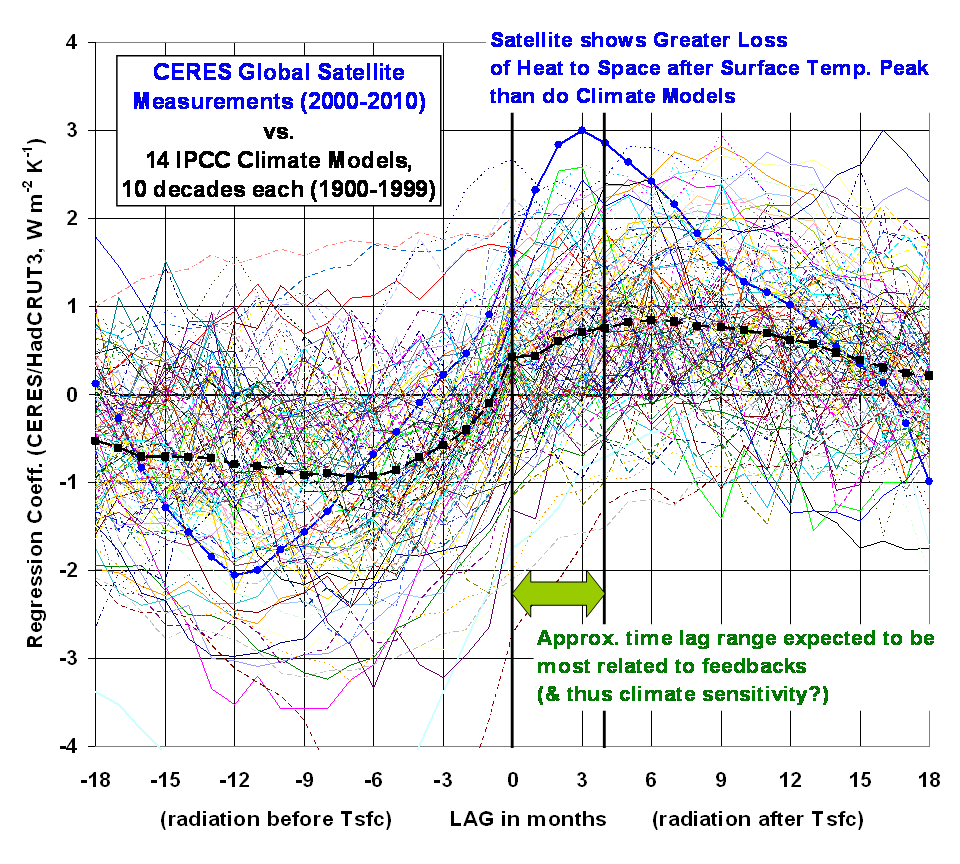
The chart below is from Dr Roy Spencer’s blog “Global Warming”.  It shows the output from 14 different climate models versus the CERES Global satellite measurement of heat loss into space.  This chart was assembled in response to criticism by Warmers that he had cherry picked the climate models he used to contrast their performance versus his work in a recently published paper in Remote Sensing. Following the post publication criticism, Dr Spencer has done a little tweaking but nothing that changes his conclusions.   See here  and here for discussion of this issue.

But this posting is not to review the bidding on Dr Spencer’s paper.   It is to talk about the Warmer’ Global Climate Models.  Whenever I see this assembly of Warmer Global Climate Models output, I wonder why anyone believes the predictions they make.  If they could REALLY model our global climate they would only need one model.   Instead, all 14 give different results!!!   Does that really instill you with a lot of confidence in their ability to do skillful prediction?    What the 14 models do is allow them to make predictions based upon the most extreme model output.  It also allows them to match just about any condition at any time with at least one of the models.  Think—-A stopped watch tells the right time two times a day.

cbdakota