Category Archives: sun and climate

Dr Evans:”Climate Models Are Violently At Odds With Reality”


Dr. David Evans has posted “Four Fatal Pieces of Evidence” demonstrating that using computer climate models as the basis for man-made global warming (AGW)  theory is,  in Dr. Evans’ view,  “violently at odds with reality”. He maintains there is “no empirical evidence that global warming is mainly man-made.  If there was, we would have heard about it.  Tens of billions of dollars have been spent looking for it.”Dr Evans uses four pieces of evidence to illustrate his position.

First: Evans examines the Climate Model predictions made by James Hansen (the so-called godfather of AGW) during his testimony to the US Congress in 1988.(click on chart to enlarge)
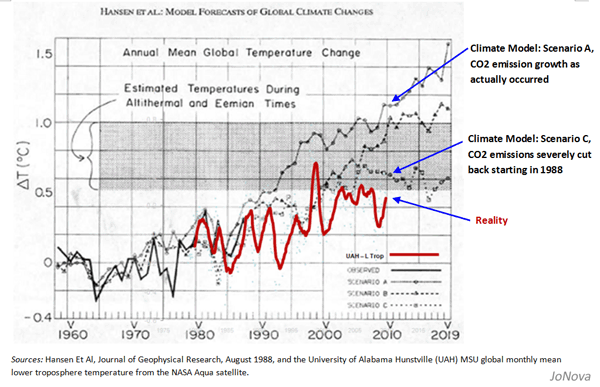
Evans says:”… the actual temperature rises are about a third of what he predicted. Remember, they have been saying the “science is settled” since the early 80’s, and the models now are essentially the same as they were then.

Furthermore, Hansen’s models predicted the temperature rise if human carbon dioxide emissions were cut back drastically starting in 1988, such that by year 2000 the atmospheric carbon dioxide level was not rising at all. But in reality, the temperature did not even rise that much. Which proves that the climate models don’t have a clue about the effect of carbon dioxide on world temperature.”

Second: Evans looks at ocean warming.  This is a better gauge of global warming than is measuring atmospheric temperature fluctuations.  The Argo Buoys were put into service in 2003.  The measurements of ocean temperatures prior to the Argo program are suspect in my view.  Nothing before 2003 remotely resembles the scope of Argo measurements.(click on chart to enlarge)
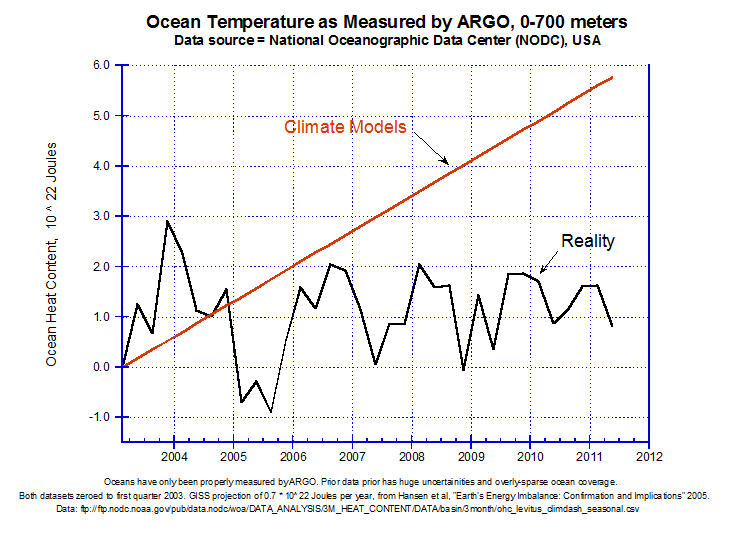
Evans says: the climate models predict the oceans should be warming. We’ve only been measuring ocean temperature properly since 2003, using the ARGO system. In ARGO, a buoy duck dives down to 2000m, slowly ascends and reads the temperatures on the way, then radios the result back by satellite to HQ. Three thousand ARGO buoys patrol the oceans constantly. They say that the ocean temperature since 2003 has been basically flat. Again, reality is very different to the climate models.

Thirdly: Evans looks at the “hotspot” which was  a climate computer prediction  which is the  Warmers’ proof of the positive feedback.  Feedback that is able to take a weak CO2 forcing signal and double or triple it.   Unfortunately for the advocates of this hypothesis, the hotspot does not exist.(click on chart to enlarge)

Evans says: “the climate models predict a particular pattern of atmospheric warming during periods of global warming. In particular, the most prominent change they predict is a warming in the tropics about 10 km up, the so-called “hotspot”. But we have been measuring atmospheric temperatures by weather balloons since the 1960s, and millions of weather balloons say there was no such hotspot during the last warming from 1975 to 2001. The hotspot is integral to their theory, because it would be evidence of the extra evaporation and thickening of the water vapor blanket that produces two thirds of the warming in the climate models…”

Fourthly:  Evans hits on one of the most discussed topic in recent times—that of outgoing radiation into space.    Note in the chart below that the top row left is the actual measurements of outgoing radiation by the stat elite ERBE program (Earth Radiation Budget Experiment-click here for more information.)   The other boxes are climate model predictions. (Chart source=Lindzen and Choi 2009)
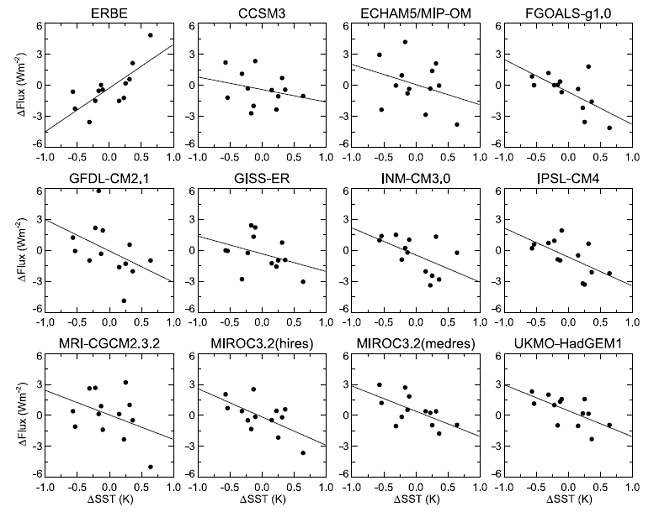
Evans says: “satellites have measured the outgoing radiation from the earth and found that the earth gives off more heat when the surface is warmer, and less heat in months when the earth’s surface is cooler. Who could have guessed? But the climate models say the opposite, that the Earth gives off less heat when the surface is warmer, because they trap heat too aggressively (positive feedback). Again, the climate models are violently at odds with reality.”

Evans sums up saying:” Those are four independent pieces of evidence that the climate models are fundamentally flawed. Anyone one of them, by itself, disproves the theory of man-made global warming. There are also other, more complex, pieces of evidence. Remember, there is no direct evidence that man causes global warming, so if the climate models are wrong then so is the theory.”

Read all of Evan’s posting here.

cbdakota
Solar Cycle 24 August Update


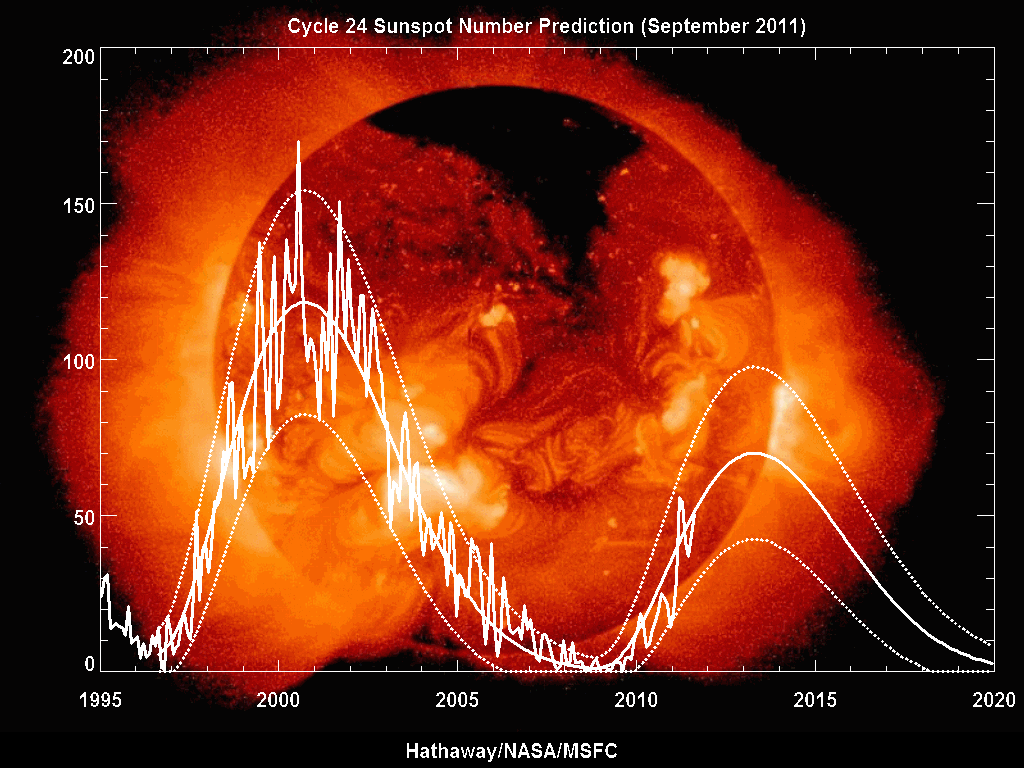
Solar Cycle 24 August Sunspot and Solar Flux data continues to paint a picture of a much less active Sun when compared against the previous Cycle 23.

First, David Hathaway’s September edition of his sunspot predictions. Hathaway has a mid, high and low range chart with the actual data slightly below the mid-range forecast.  The Hathaway midrange predicts a maximum monthly high of about 70 Sunspots in early 2013.   Cycle 23 experienced a maximum monthly high of about 120 in 2001.

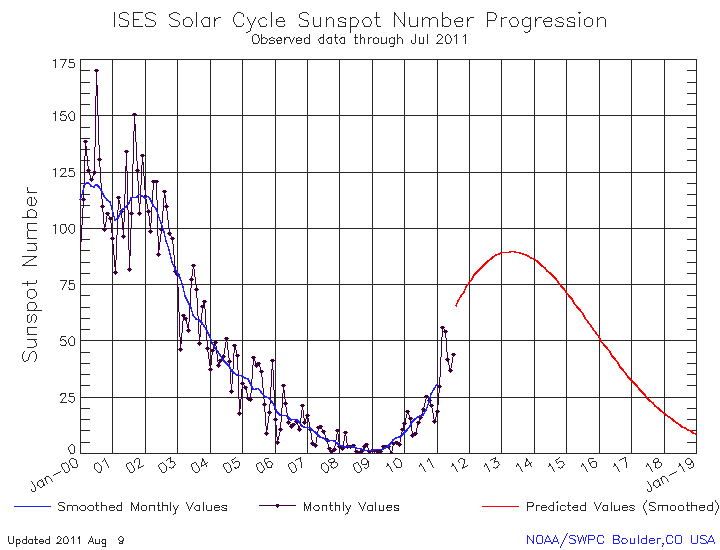
NOAA  sunspot prediction chart has only a single line which predicts a maximum monthly of about 90 sunspots.    It is shown below:

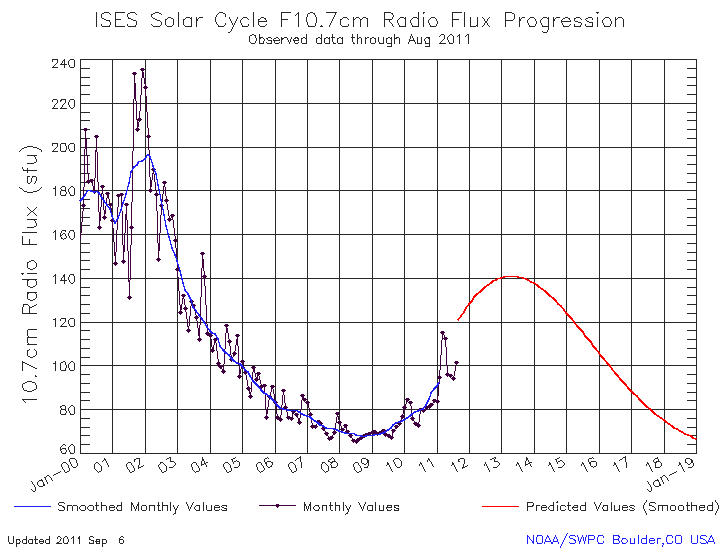
Solar flux through August appears to be trending below the NOAA prediction for Cycle 24.  The NOAA Cycle 24 solar flux prediction is for a peak of 140 in 2013.   This contrasts with  the Cycle 23 maximum of about 195 in 2002.    See the NOAA chart below:

cbdakota

Solar Cycle 24 Continues to Under Perform the Early Projections.


Cycle 24 Sunspots count continues to underperform early forecasts.   Chief forecaster, David Hathaway, Ph.D., Heliospheric Team Leader, NASA Marshall Space Flight Center, Huntsville, Alabama has frequently revised his forecast of maximum monthly average Sunspot count.  A look at the lowering of the NASA forecast over the years:

Before I pile it too heavily on Dr. Hathaway, most of the experts were as wrong as he was.  One of the few that accurately forecast Cycle 24 was Dr. Lief Svalgaard of the Helioseismic and Magnetic team of Stanford’s Solar Dynamics Observatory (SDO),   Svalgaard predicted 75 as the maximum number in 2004 and has since revised it downward to 72.

Show below is the Cycle 24 recorded Sunspot monthly average numbers through July 2011 versus the current NOAA forecast of 90.

Before you begin to question my grasp of consistency in numbers, please be aware that the Sunspot number is measured several different ways.   The folks in business recognize this and have put together a team to try to bring about uniformity.  One of the more obvious questions is —are we reading more sunspots now because we have much better optics?  The following abstract from this program lays out some of the problems.

The Sunspot number (SSN) record (1610-present) is the primary time sequence of solar and solar-terrestrial physics, with application to studies of the solar dynamo, space weather, and climate change. Contrary to common perception, and despite its importance, the international sunspot number (as well as the alternative widely-used group SSN) series is inhomogeneous and in need of calibration. We trace the evolution of the sunspot record and show that significant discontinuities arose in ~1885 (resulting in a ~50% step in the group SSN) and again when Waldmeier took over from Brunner in 1945 (~20% step in Zürich SSN). We follow Wolf and show how the daily range of geomagnetic activity can be used to maintain the sunspot calibration and use this technique to obtain a revised, homogeneous, and single sunspot series from 1835-2011.

Where do we go from here?

Find and Digitize as many 19thcentury geomagnetic hourly values as possible

Determine improved adjustment factors based on the above and on model of the ionosphere

Co-operate with agencies producing sunspot numbers to harmonize their efforts in order to produce an adjusted and accepted sunspot record that can form a firm basis for solar-terrestrial relations, e.g. reconstructions of solar activity important for climate and environmental changes

To learn more about sunspot counting click here.

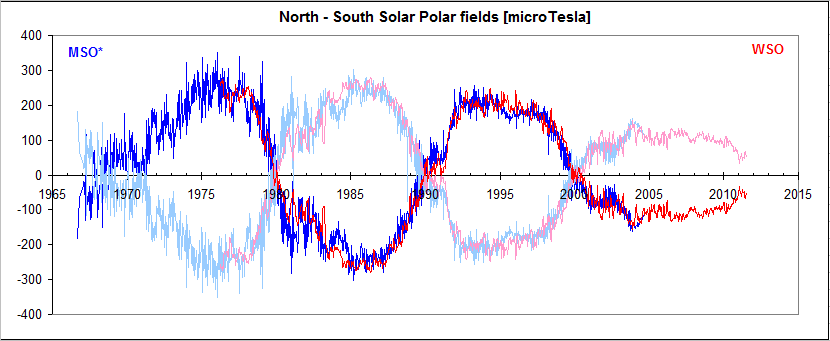
As the magnetic fields are what drive sunspots, here is a current look at Sun’s north and south magnetic fields:

Chart Courtesy of Wilson Solar Observatory

It is obvious that Cycle 24 is different from the Cycles 21, 22 and 23 that precede it.   The magnetic field strength is much weaker and angle of approach to the X axis (0 microTesla line) is very much steeper than that of Cycle 24. Click here, here and here for further discussion of the magnetic field.

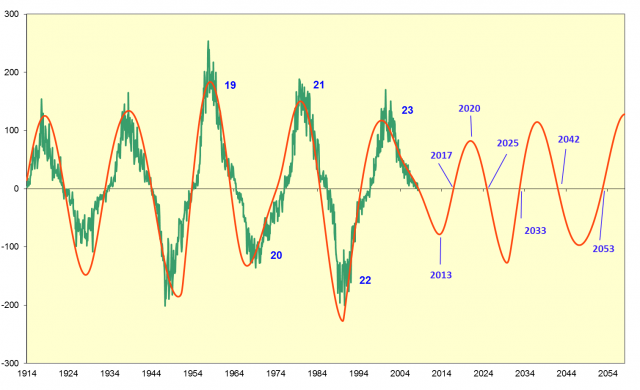
How about a look ahead to cycle 25 and beyond.  I don’t know enough to have much confidence in this forecast Ed Fix, but David Archibald seems to think it is viable.  Click here for more info:

The green line is the solar cycle record from 1914 to 2010, with alternate cycles reversed. Solar Cycles 19 to 23 are annotated. The red line is the model output, from which the lengths of individual solar cycles in the mid-21st Century can be calculated.

Mr. Fix has Cycle 25 duplicating the current Cycle 24.  Cycles 26,and 27 are about half again as large as 24 and 25. Even so his forecast for Cycles through 28 are all considerably less active than Cycles 18 through 23.  Does this mean an extended global cooling?

cbdakota

“Cheshire Cat Sunspots”-Livingston and Penn


Future sunspots may behave like the Cheshire Cat“the smile is there (magnetic fields) but the body is missing (no dark markings)“.   Dr Bill Livingston and Dr Matt Penn of the National Solar Observatory have been recording the average magnetic field strength of sunspots for the past 13 years.  What they have found is a decline of about 50 gauss per year during Cycle 23 and continuing in Cycle 24.   See their chart below:

Typical sunspot magnetic field strength registers about “2500 to 3500 gauss” based upon their research.  But Cycle 24 spots are running about 2000 gauss and Livingston and Penn are estimating that if the sunspot field strength drops to 1500 gauss: “the spots will largely disappear as the magnetic field is no longer strong enough to overcome forces on the solar surface.”   That could occur in the next ten years, coinciding with Cycle 25.

Traditionally the measurements of sunspots seem to have focused on visible light and magnetic flux.  Livingston and Penn emphasized the sunspot IR and magnetic field strength and that has brought a new perspective which seems to correlate with the other recent discoveries that were announced on 14 June 2011 at the AAS meeting in Las Cruces NM.

Dr Leif Svalgaard used Livingston and Penn data to illustrate the interrelationship of the magnetic field strength and visibility.

The pink line is visibility where 1 means invisibility.  This “visibility/invisibility” is somewhat perverse.  The spot (black) will no longer be seen because its temperature at the Sun’s surface is essentially the same as the surrounding gases. The black line is magnetic field strength.

Sunspots appear dark because they are cooler than the rest of the solar surface.  From posting by Space.com: “The dark, heart of a sunspot, called the umbra, is surrounded by a brighter edge know as the penumbra, which is made of numerous dark and light filaments more than 1,200 miles long.   They are relatively thin at approximately 90miles in width, making it difficult to resolve the detail of how they arise.

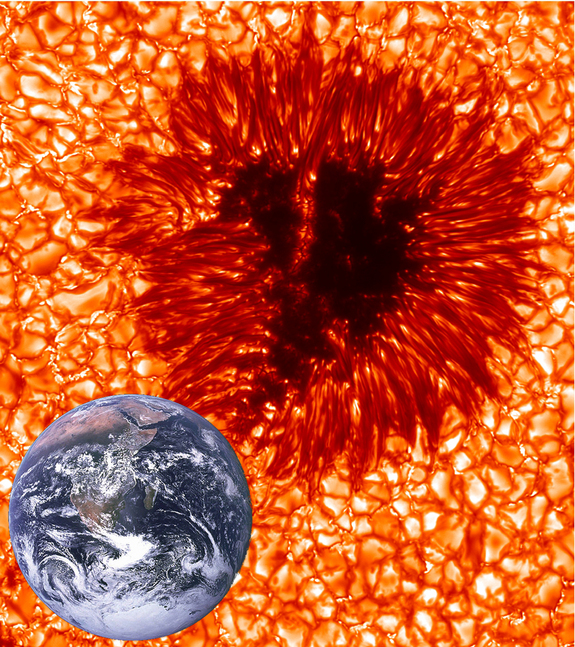
A photo of a sunspot taken in May 2010, with Earth shown to scale. The image has been colorized for aesthetic reasons. This image with 0.1 arcsecond resolution from the Swedish 1-m Solar Telescope represents the limit of what is currently possible in terms of spatial resolution.

Now scientists have discovered these columns are rapid downflows and upflows of gas, matching recent theoretical models and computer simulations suggesting these filaments are generated by the movement of hot and cold gases known as convective flow.

The researchers used the Swedish 1-meter Solar Telescope to focus on a sunspot on May 23, 2010. They found dark downflows of more than 2,200 miles per hour (3,600 kph) and bright upflows of more than 6,600 miles per hour (10,800 kph). The models suggest that columns of hot gas rise up from the interior of the sunspot, widen, cool and then sink downward while rapidly flowing outward.

Solar Cycle 24-A Game Changer Revisited


On the 14th of June at the AAS conference in Las Cruces,  a group of scientist from the National Solar Observatory (NSO) suggested that the familiar sunspot cycle may be shutting down.   They observed that the spots were fading (weaker), that the current Cycle 24 was showing fewer spots and that Cycle 25 was behind the normal schedule in its formation.

Sunspots have been recorded for hundreds of years and they are a very visible proxy for solar activity.  Solar activity is also visible in the numbers and strength of flares and coronal mass ejections (CME).  The solar cycle is nominally about 11 years in duration.  It begins with a relatively quiet sun and then there is a ramping up of sunspots, etc. maximizing  about half way through a cycle.   At this time the Sun’s north and south magnetic poles “flip” and sunspots, etc. begin ramping down to a relatively quiet Sun.

Drs.Frank  Hill  of the NSO explains that he and his team are using “helioseismology to measure sun-wide oscillations of the solar surface”.   Sound waves of extremely low frequency that emanate from deep within the Sun induce up-and-down oscillations in the sun’s outer gas layer. Measurements of these surface motions can be used to make maps of solar surface velocity, called Dopplergrams, from which physical conditions such as temperature, composition and the interior magnetic field can be inferred.  Dr. Hill reported on “a jet-stream-like flow within the sun that they have been monitoring since 1995 using helioseismology.

The stream, which is coincident with the sunspots, has an east-west zonal flow inside the Sun at about 4000 miles beneath the Sun’s surface.   The following figure presented at the Conference is illustrative of what Hill and his team have discovered.

The annotated chart’s  yellow and red bands trace the solar jet streams.  The black contours denote sunspot activity.   Cycle 24 (the current cycle) streams can be seen beginning about 1998-1999 at about 60° lattitude north and south.  These streams begin converging toward the equator.  At about 22°, sunspot activity begins.  Ultimately the streams will reach the equator at a time of solar maximum.  See Cycle 24 and the Butterfly Diagram for more on this.

The stream that began at the 60° latitude splits with part of it going toward the poles and the other part toward the equator.

Note that Cycle 23 stream heading for the equator was more active when it reached approximately 22°  than is Cycle 24 and that the angle of approach to the equator was steeper than that currently occurring in Cycle 24.   Dr Hill reports that it took  3 years for Cycle 24 to cover a ten-degree range that only took 2 years for Cycle 23.   Thus Cycle 24 is “slower” than Cycle 23.

The determination of this magnetic jet stream was first made by the   instrumentation on the SOHO satellite launched  December 2, 1995 using  a Michelson Doppler Imager.  It was replaced by a Helioseismic and Magnetic Imager (HMI) in Feb 2010 on a Solar Dynamics Observation satellite.  The HMI is said to be many time more sensitive and it will report almost continuously.    The unit uses a 16 million-pixel camera  configured to show blue images where the Sun’s  oscillations are moving the surface toward the HMI camera and red when it moves away.  The satellite is in orbit about 22,000 miles above the Earth’s surface at about the point where the Sun’s and the Earth’s gravitational pull are equal.

Richard Altrock, manager of the Air Force’s coronal research program has observed that the remnants of the magnetic jet stream go poleward as far as 85° where they die.

Returning to the figure it can be noted that Cycle 24 magnetic jet stream was forming in the 1998-2000 timeframe.   Noted on the figure is “Cycle 25??? 2019? 2030?”. Dr Hill points out that the magnetic jet stream for Cycle 25 should have been forming already but there is no sign of it yet.  The press release for regarding this situation suggests that: Cycle 25 will be greatly reduced or may not happen at all.

Latter, I will post on the work by Matt Penn and William Livingston that shows a weakening trend in the strength of the sunspots.

So what do we make of this?  Because of the satellite programs underway in the US and Europe primarily, we are probably doubling our knowledge of the Sun every few year.  But we still don’t know much about the Sun.  Reading the postings on this topic leads me to believe that the solar experts are not of one mind on the idea that this means the climate is about to get much cooler.
My bias is to say that we are going to see years of global cooling.  I say that based upon the reconstructed history of the Maunder and other minimums.  The only good thing I believe that can come from a period of cooling is to put a stake in the heart of the corrupt science that is the AGW theory.  I am not sure we can say with any certainty that more CO2 in the atmosphere and perhaps more naturally caused global warming is a bad thing. Who is to say that 2 or 3 more degrees would be bad.  Only the models in their ignorance are sure of this.  But extended cold could cause a lot of starvation.  Lets hope this does not happen.

So,  stayed tuned.

cbdakota

SOLAR CYCLE 24 and the SUNSPOT BUTTERFLY DIAGRAM


I posted Solar Cycle 24- A Game Changer? which discussed the weak cycle 24 and what it might mean in terms of a cooler global climate.  As the posting was getting quite long, I elected to leave out the Butterfly Diagram for later posting.  So, now is later.

Cycle 24 is the plot just beginning now, 2010 and 2011.  The leftmost “butterfly” is Cycle 11.  (click on the chart to enlarge)

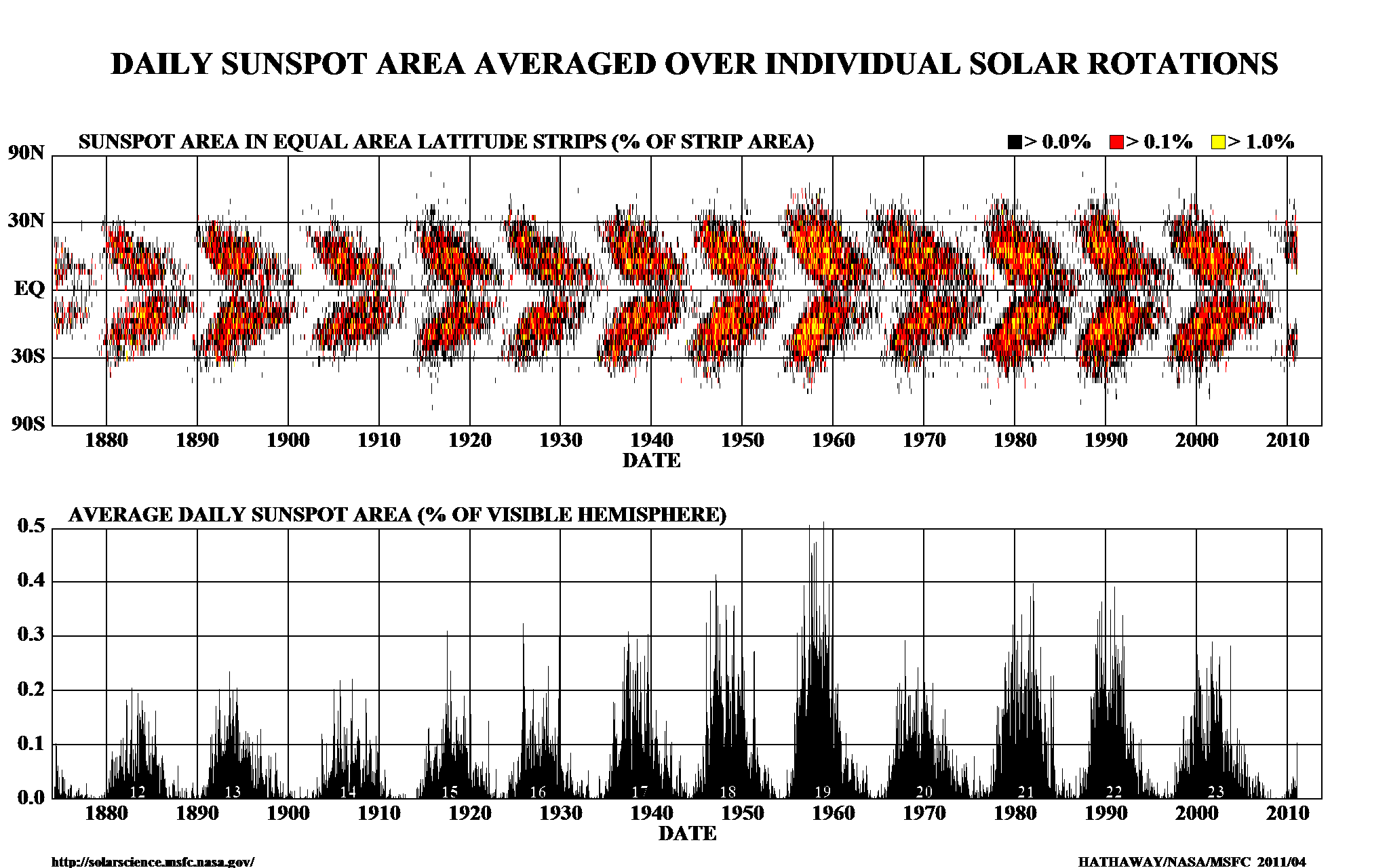
This figure is sometimes known as the Maunder Butterfly Chart as Maunder seems to be the first person to recognize the unique pattern formed by plotting the position of the sunspots on the face of the sun versus time.  When a new solar cycle begins, the sunspots become numerous.  In the beginning they appear away from the equator at about 35 degrees south and 35 degrees north.   With time the spots begin to converge at the equator.  When the “minimum” occurs, the spots  are basically upon the equator.

The butterfly chart for Cycle 24 is perhaps  showing sunspot formations that are relatively fewer than in recent Cycles 22 and 23.  Cycle 24 seems to resemble cycles that occurred many years ago.  If you occasionally check the progress of the spots toward the equator, you might be able to make a good guess on the length of Cycle 24.   Will it be much less than the average of 11 years?  The experts probably have a better feel than we amateurs,  but I am pretty sure that they would not bet the farm on their feel.

There is an interesting paper “First Solar Butterfly Diagram from Schwabe’s Observations 1825 1867” by Rainer Arlt and Anastasia Abdolvand, This paper uses the spots recorded by Schwabe during the named period to assemble butterfly diagrams for Cycles 7, 8 , 9  and 10.  These are the butterfly diagrams that immediately precede those in my first chart.  Cycle 8 was a weak cycle according to the authors.

cbdakota

SOLAR CYCLE 24–A Game Changer?


The current solar cycle 24 might be a game changer in the global climate debate.   It is showing early signs of reaching the solar Maximum in two short years.  Solar Maximums on average occur some 5 to 6 years in to a typical 11-year cycle.

The Sun has a cycle of about 11 years from minimum to maximum and back to minimum magnetic activity.  This cycle can be observed by the numbers of sunspots formed on the surface of the Sun.  During a cycle, the sunspot numbers increase, flares are common and coronal mass ejections occur until the Sun’s polarity “flips”.   This usually is the point at which the so-called solar maximum is reached. The activity on the Sun begins to decrease.  The cycle eventually reaches a point where very few sunspots are observed.  This is the completion of a cycle.

The chart below shows the magnetic fields of several previous solar cycles and the current cycle 24.  The North polar field is nearing the zero on its way to swapping sides with the south polar field.  Note, also, that the magnitude of cycle 24’s field is not as large as the previous cycles.

Chart Source:   http//wso.stanford.edu

Cycle 24 has been a maverick.  Initially the solar cycle gurus said it would perform about the same as the previous two cycles—22 and 23.  However it did not seem to want to begin and when it did, it has under preformed expectations so significantly that the performance forecast has had to be lowered many times.   Cycle 24 has more in common with cycles of years ago that also exhibited reduced solar activity.  These cycles coincided with global cooling.

Galileo began counting sunspots in 1610.  Daily counting began  1749.   From 1645 to 1715, there were very few sunspots.  This period is known as the Maunder Minimum.   Few sunspots were visible during the period from 1790 until 1830. This period is known as the Dalton Minimum. Corresponding to the period of time that included the Maunder and the Dalton Minimums, the Earths climate was comparatively cool.  The climatic period, know as the “Little Ice Age” lasted from 1450 until 1820.  The chart below shows correlation between sunspots and the Minimums.

  (The chart shows non-systematically collected  sunspot numbers in red. Systematically collected observation spots are in blue.)
Chart courtesy of Robert A Rohde for Global Warming Art

Here is the current plot of sunspot count for cycle 24.   Also note how low the forecast of peak sunspot activity is compared to the previous cycle. Click Chart for clarity.

The “predicted values”  would indicate that the cycle 24 maximum will occur in 2013.   After a big jump in March,  the April count is heading down and so far the May sunspot count is rather low.

So, solar activity for cycle 24 is quite low compared to recent cycles.    But can we be sure that cycle 24 wont become very active?  No we can’t.  Can we be sure that if cycle 24 is short (less than 11 years) the climate will cool off?  No we can’t.    What we can say is that low solar activity appears to correlate with a cooler climate.

Why would a less active Sun result in lower global temperature?  The amount of radiation from the Sun to Earth does not vary much year to year.  No one knows for certain if the variation is enough to raise or lower global temperatures.  The Sun’s magnetic field weakens when the Sun is less active. Some theorize that this lets in cosmic rays and that these rays form low altitude clouds.  Low altitude clouds do lower the Earth’s temperature.  My philosophy is:  Even though the exact mechanism linking the Sun and global change has not been definitely established,  it is kind of like gravity–it is obvious.  If cycle 24 continues on its current track, we may see more confirmation that low activity correlates with cooler weather.  We will have to wait for several years to know.  Stay tuned.

cbdakota

NEAR EARTH ASTEROID DUE IN NOVEMBER


There are many asteroids out there and NASA’s Deep Space Network tries to keep track of those that will pass near the Earth.  They are reporting that asteroid 2005 YU55 will fly by at 0.85 lunar distances.  Which is another way of saying it will be closer to us than the moon (1.0 lunar distance).  It is pretty big too, at 400 feet in diameter.  It was discovered in 2005 (note the identification of this asteroid begins with 2005) by Tucson’s Lunar and Planetary Laboratory.

It will be so close that NASA spokesman says:

Yeomans said that with new radar capabilities at Goldstone in California — part of NASA’s Deep Space Network — there is a good chance of obtaining radar imaging of 2005 YU55 down to the 5-meter resolution level. Doing so, he said, would mean obtaining higher spatial resolution of the object than that attained by recent spacecraft flyby missions.

“So we like to think of this opportunity as a close flyby mission with Earth as the spacecraft,” Yeomans told SPACE.com. “When combined with ground-based optical and near-infrared observations, the radar data should provide a fairly complete picture of one of the larger potentially hazardous asteroids,” he said.

More about this flyby is available on the Fox News posting which you can read by clicking here.

There is an interesting site that daily posts the upcoming near Earth fly bys and can be seen by clicking here.

cbdakota

BBC SCIENCE PROPAGANDA


Propelled by the Climategate email scandal, cooling global temperatures, total failure of the Copenhagen climate conference, many false and otherwise erroneous reports in the IPCC 4th report on Climate Change, etc. the public is becoming aware of the bill of goods that has been feed to them in recent years by the mainstream media, Al Gore, and politicians of all stripes who want to tax and regulate you. Polls show waning  support for draconian taxes and regulation  in order to cut fossil fuel CO2 emissions.

This past week, the BBC aired a program they produced titled “Science Under Attack”.   The objective of the program was to bolster the man-made global warming theory (AGW).

So how good was the BBC’s “Science Under Attack”?

A desperate and sleazy program according to Christopher Booker as told in his posting “How BBC warmists abuse the science”:

The formula the BBC uses in its forlorn attempts to counterattack has been familiar ever since its 2008 series Climate Wars. First, a presenter with some scientific credentials comes on, apparently to look impartially at the evidence. Supporters of the cause are allowed to put their case without challenge. Hours of film of climate-change “deniers” are cherrypicked for soundbites that can be shown, out of context, to make them look ridiculous. The presenter can then conclude that the “deniers” are a tiny handful of eccentrics standing out against an overwhelming scientific “consensus”.

The scientist picked to front the progamme was Sir Paul Nurse, a Nobel Prize-winning geneticist, now President of the Royal Society (which has been promoting warmist orthodoxy even longer than the BBC). The cue to justify the programme’s title was all the criticism which greeted those Climategate emails leaked from Sir Paul’s old university, East Anglia, showing how scientists had been manipulating their data to support the claim that temperatures have recently risen to unprecedented levels.

One of the two “deniers” chosen to be stitched up, in classic BBC fashion, was the Telegraph’s James Delingpole. He has spoken for his own experience on our website. Still worse, however, was the treatment of Professor Fred Singer, the distinguished 86-year-old atmospheric physicist who set up the satellite system for the US National Weather Bureau. We saw Nurse cosying up to Singer in a coffee house, then a brief clip of the professor explaining how a particular stalagmite study had shown temperature fluctuations correlating much more neatly with solar activity than with levels of CO2. This snippet enabled Nurse to imply that Singer’s scepticism is based on one tiny local example, whereas real scientists look at the overall big picture. No mention of the 800-page report edited by Singer in which dozens of expert scientists challenge the CO2 orthodoxy from every angle.

For those that attend to the Climate Change Sanity postings routinely  (see) will instantly spot how poor the programming was and how little about the subject, Sir Paul Nurse knows when your read the following Booker comments:

The most telling moment, however, came in an interview between Nurse and a computer-modelling scientist from Nasa, presented as a general climate expert although he is only a specialist in ice studies. Asked to quantify the relative contributions of CO2 to the atmosphere by human and natural causes, his seemingly devastating reply was that 7 gigatons (billion tons) are emitted each year by human activity while only 1 gigaton comes from natural sources such as the oceans. This was so much the message they wanted that Nurse invited him to confirm that human emissions are seven times greater than those from all natural sources.

This was mind-boggling. It is generally agreed that the 7 billion tonnes of CO2 due to human activity represent just over 3 per cent of the total emitted. That given off by natural sources, such as the oceans, is vastly greater than this, more than 96 per cent of the total. One may argue about the “carbon cycle” and how much CO2 the oceans and plants reabsorb. But, as baldly stated, the point was simply a grotesque misrepresentation, serving, like many of the programme’s other assertions, only to give viewers a wholly misleading impression.

You can read James Delingpoles discussion of the Nurse “gotcha interview” here.

For 10 years Peter Sissons was the BBC evening news anchor.   In his recently published memoirs, he says:

“The BBC became a propaganda machine for climate change zealots, and I was treated as a lunatic for daring to dissent”.

The BBC and the Warmists desperation in producing a program like this is palpable and it argues strongly that the BBC has lost its integrity.

cbdakota

COLLEGE STUDENTS LACK SCIENTIFIC LITERACY


Last week was one of lows and highs.  I went back to South Dakota to say my goodbyes to my sister. She passed away some 7 hours after I got to the hospital. The highs were the young people that gathered for the funeral.  Mainly grandchildren and other kin of my sister. The children ranged from grade school to Grad school to graduated and off to work.   After spending time with them, it seems clear that we will be putting our nation into good hands.

Some probably do not share my political philosophy, However, I am hopeful that Winston Churchill’s view of the stages of life will play out when he said,  “If you are young and not a liberal, you have no heart.  If you are growing old and are not a conservative, you have no brain.”

But brains they do have no mater their political philosophy.   And those that have thought about Climate Change have open minds.

After reading the result of a recent Michigan State study, which concluded that College Students lack scientific literacy, I wondered if there are college students or grads, unlike my Sister’s kin, that do not have open minds and need a little background to begin formulating their own opinion about climate change.

Quoting the MSU researchers:

The researchers assessed the fundamental science knowledge of more than 500 students at 13 U.S. colleges in courses ranging from introductory biology to advanced ecology.

Most students did not truly understand the processes that transform carbon. They failed to apply principles such as the conservation of matter, which holds that when something changes chemically or physically, the amount of matter at the end of the process needs to equal the amount at the beginning. (Matter doesn’t magically appear or disappear.)

Students trying to explain weight loss, for example, could not trace matter once it leaves the body; instead they used informal reasoning based on their personal experiences (such as the fat “melted away” or was “burned off”). In reality, the atoms in fat molecules leave the body (mostly through breathing) and enter the atmosphere as carbon dioxide and water.

Most students also incorrectly believe plants obtain their mass from the soil rather than primarily from carbon dioxide in the atmosphere. “When you see a tree growing,” Anderson said, “it’s a lot easier to believe that tree is somehow coming out of the soil rather than the scientific reality that it’s coming out of the air.”

The oxygen we breathe is primarily released from plants when photosynthesis takes place breaking the CO2 molecule, recombining it with water to produce a sugar.  The excess oxygen from the photosynthesis reaction is now a waste product and expelled to the atmosphere.

The above Graph is a product of  Onimoto.com

Without atmospheric CO2, there would be no plants.  Without plants there would be no life on this planet.   It offends me when I read media articles that call CO2 a POLLUTANT.

Because the Researcher’s objective for this work is to gain acolytes to the Church of Man Made Global Warming, my next posting will be to show that CO2 is not a big factor in the Greenhouse effect.

To read the MSU press release click here.

cbdakota