Category Archives: Renewable Energy

The Impending Collapse Of The Global Warming Scare


I am reblogging the “The Impending Collapse of the Global Warming Scare“.  That’s the title of a posting by Francis Menton on the Manhattan Contrarian blog.  His description of the state of the catastrophic man-made global warming theory and how it got to be so pervasive if not persuasive is spot on.  He outlines why he thinks the new administration will take actions that will ultimately cause its collapse.  I think he is right that if the funding dries up, or is finally given to skeptics too, the science will finally put the computer forecast science out of business. 

There is a caution in my mind.  And that is I think the really wealthy NGOs like World Wildlife Fund and wealthy people like Soros and Styer who have political reasons to want to continue the scare will put up an enormous fight to keep it alive.  The scare tactics will not diminish, but with the help of the liberal media, the scare stories will reach new heights.  I hope I am wrong about this.

cbdakota

Continue reading

Trump Ignores Gore And DiCaprio Advice


Several days ago, on one of the mainstream media TV programs,  two taking heads could not understand how President Elect Donald Trump could appoint a man, who is a skeptic,  to be the EPA head. How, they said, could Trump do this when both Al Gore and Leonardo Di Caprio had just talked to him.  How monumentally ignorant do you have to be to think that those two really know much about climate?

Gore said in his “Inconvenient Truth (Nobel Peace Prize winner, which also tells you how ignorant the Judges are too.) presentation while showing ice core CO2 and temperature data relationship,   that the most important part of the relationship is that “where there is more CO2, the temperature gets warmer.”

Gore did not know he was incorrectly reading the ice core chart which actually show that temperature rises and CO2 levels follow.  And when temperature falls, so does the atmospheric CO2 levels.  See  these posting for more on the ice cores data     here   here  and here.

The following excerpt from the “Great Global Warming Swindle” video,  shows Gore misinterpreting the data.

The entire Great Global Warming Swindle video follows this on YouTube if you wish to watch it.  Its worth your time.

So Gore’s most important inconvenient truth was not factual.

cbdakota


Want-To-Be Warmers Are Only Getting Part Of The Story


This posting uses an article from the Cosmopolitan magazine. Not a place where you would expect to find something about global warming. The title of the piece is “8 Signs You’re Not the Environmentalist You Think You Are” by Yvette d’Entremont. It is not too profound but it has a lot of honest values that most would be environmentalist never are exposed to. I have extracted just pieces of the author’s reasons why they have been misled. If you read all of her article, she makes some more good points

gorecarbonman

The following are the eight signs:

1. You buy only organic.

Organic is definitely not better for you, and it uses older, dirtier farming techniques that are, across the board, not as environmentally friendly. Contrary to rumors, organic farming uses pesticides, in some cases equally toxic pesticides that need to be applied more frequently.

Continue reading

The First US Nuke In 20 Years Goes Online—TVA Project


The Tennessee Valley Authority (TVA) announced that the Watt Bar Unit 2 nuclear generation unit is now online at full power, providing commercial electrical energy.  It is the first new nuclear power generation unit in 20 years.  Good for them. TVA has 6 other Nukes providing power.

wattsbarnukes

TVA president and CEO Bill Johnson said:

“TVA’s mission is to make life better in the Valley by providing reliable, low-cost energy, protecting our area’s natural resources and working to attract business and growth – all priorities simultaneously supported by the completion of Watts Bar Unit 2..”

A Westinghouse pressurized water reactor is expected to generate 1,150 megawatts (summer net capability). The capital cost of the complete generation unit was $4.7 billion.

Continue reading

Pew Research Report Data Not Supported By The Interviews. Human Caused CO2 Claimed To Be 48% But In Reality Is 31%


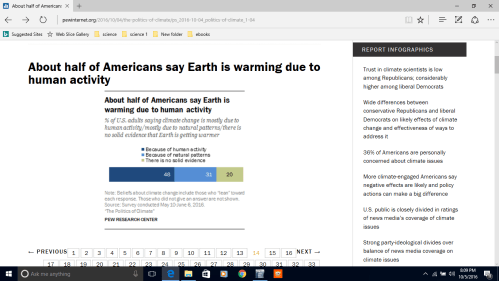
Pew Research Center has just released a survey of American’s opinions about global warming. They interviewed about 1500 people over a period from 10 May to 6 June this year. There are many findings but the one I want to take issue with is their claim that about half of the American’s interviewed say Earth is warming due to human activity. From the Pew Research Center survey the chart displayed says that 48% believe Earth is warming because of human activity, 31% because of natural patterns and 20% say there is no solid evidence that Earth is getting warmer.

2016-10-05-3

The Pew document presents the results of the interviews. The above conclusion was made from the following interviews:

2016-10-05


Above is the first interview results. Only 26% said global warming is caused by human activity. Wow that would not do. I guess they were saying “how can we fix this. We can’t publish this.” So they came up with a plan.

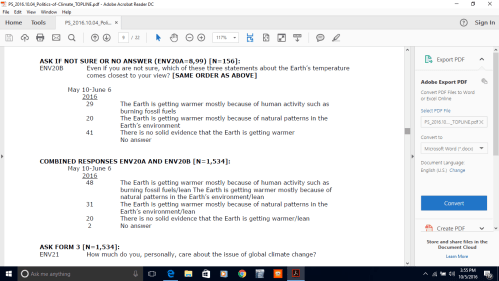
Some of the interviewed said they were not sure or had no answer. So they decided to re-interview these people to see which of the three statements would be their second choice. Now there were 1534 interviewees in the beginning. Thus the “not sures” and the “no answers” would be 0.15X1534=230 people. In the next chart it appears that they only re-interviewed only 156 of the 230. Below are the results of the re-interview.

2016-10-05-1

The results of the re-interview is that 29% said their second choice would be human caused warming, 20% said the warming was natural and 41% there was no evidence that the world is getting warmer.

Now comes the magic. You can see it in the bottom part of the above chart where it says the “combined responses” gave a new set of percentages for each of the three possible answers. However the answer for one of the three changed. It now includes both human caused and natural caused warming even though there still is a natural caused warming category.

I have gone through the math. The “human caused” in the first interview was 26% or 398 people. The “natural” was 45% or 690 people. “No evidence” was 14% or 215 people. As noted above the number re interviewed was 156 although the percentage would have called for 230. Note also that the percentage listed in the chart is only 90% or 140 people. The bottom line for people actually giving an opinion looks to be 1443 rather than the 1534 they began with. But the discrepancies in total number make little difference to the outcome. The human caused would be 398 original people plus 45 of the re interviewed for a total of 443 representing the share of the total 31%. Natural 690 plus 31 for a total of 721 and 50%. No evidence came in with 215 plus 64 for 279 and 19%. So only 31% said warming was human caused.

Obviously the surveyors could not let the initial result stand—–only 26% thought warming in human caused. So they came up with a way to obscure the results.

I have plowed through the rest of the interview material. It is obvious that most of the people have little concept of the issues surrounding renewable fuels/renewable energy.

2016-10-05-6

Their level of the science knowledge is probably pretty well summed up by the interview question shown above where they were asked to name the major gas that makes up our atmosphere. Seventy-three per cent did not know the answer. I would hazard a guess that most of our politician would do no better on that question.

If you want to look in detail at the full report and the interviews click here and then click on “Complete Report PDf

cbdakota

UK Scientist Doubts Decarbonization by 2050 Is Possible. Thinks Other Unfunded Threats Are More Compelling.


M J Kelly, Electrical Engineering Division Department of Engineering, Universtiy of Cambridge has written “Lessons from Technology Development for Energy and Sustainability” and posted on the  Cambridge Journals on Line.

The following is the Abstract from his posting where he sets up the quandary that faces the organizations wishing to decarbonize the planet by 2050.

There are lessons from recent history of technology introductions which should not be forgotten when considering alternative energy technologies for carbon dioxide emission reductions.

The growth of the ecological footprint of a human population about to increase from 7B now to 9B in 2050 raises serious concerns about how to live both more efficiently and with less permanent impacts on the finite world. One present focus is the future of our climate, where the level of concern has prompted actions across the world in mitigation of the emissions of CO2. An examination of successful and failed introductions of technology over the last 200 years generates several lessons that should be kept in mind as we proceed to 80% decarbonize the world economy by 2050. I will argue that all the actions taken together until now to reduce our emissions of carbon dioxide will not achieve a serious reduction, and in some cases, they will actually make matters worse. In practice, the scale and the different specific engineering challenges of the decarbonization project are without precedent in human history. This means that any new technology introductions need to be able to meet the huge implied capabilities. An altogether more sophisticated public debate is urgently needed on appropriate actions that (i) considers the full range of threats to humanity, and (ii) weighs more carefully both the upsides and downsides of taking any action, and of not taking that action.


M J Kelly discusses this issue at length in his posting and I suggest you read it in its entirety . This posting will look at conclusions and some suggestions Kelly derives when he examined the current  programs to reduce CO2. He’s not optimistic that decarbonization has much of a chance of accomplishing what the greens want. In fact he thinks the money could be spend better on addressing more immediate threats than those posed by the so-call catastrophic global warming. Here he summarizes his thoughts:

It is surely time to review the current direction of the decarbonization project which can be assumed to start in about 1990, the reference point from which carbon dioxide emission reductions are measured. No serious inroads have been made into the lion’s share of energy that is fossil fuel based. Some moves represent total madness. The closure of all but one of the aluminium smelters that used gas-fired electricity in the UK (because of rising electricity costs from the green tariffs that are over and above any global background fossil fuel energy costs) reduces our nation’s carbon dioxide emissions. 62 However, the aluminium is now imported from China where it is made with more primitive coal-based sources of energy, making the global problem of emissions worse! While the UK prides itself in reducing indigenous carbon dioxide emissions by 20% since 1990, the attribution of carbon emissions by end use shows a 20% increase over the same period.

Interestingly, he talks about the UK exporting manufacturing to other nations in order to reduce CO2 emissions.  Then the goods from these nations come back to the UK made in less efficient factories and the attributed CO2 result in an increase in the UK net emissions.     

It is also clear that we must de-risk all energy infrastructure projects over the  next two decades. While the level of uncertainty remains high, the ‘insurance policy’ justification of urgent large-scale intervention is untenable, and we do not pay premiums if we would go bankrupt as a consequence. Certain things we do not insure against, such as a potential future mega-tsunami, 64 or a supervolcano, 65 or indeed a meteor strike, even though there have been over 20 of these since 2000 with the local power of the Hiroshima bomb! 66 Using a significant fraction of the global GDP to possibly capture the benefits of a possibly less troublesome future climate leaves more urgent actions not undertaken.

Two important points remain. The first is that there is no alternative to business as usual carrying on, with one caveat expressed in the following paragraph. Since energy use has a cost, it is normal business practice to minimize energy use, by increasing energy efficiency (see especially the recent improvement in automobile performance), 67 using less resource material and more effective recycling. These drivers have become more intense in recent years, but they were always there for a business trying to remain competitive.

The second is that, over the next two decades, the single place where the greatest impact on carbon dioxide emissions can be achieved is in the area of personal behaviour. Its potential dwarfs that of new technology interventions. Within the EU over the last 40 years there has been a notable change in public attitudes and behaviour in such diverse arenas as drinking and driving, smoking in public confined spaces, and driving without a seatbelt. If society’s attitude to the profligate consumption of any materials and resources including any forms of fuel and electricity was to regard this as deeply antisocial, it has been estimated we could live something like our present standard of living on half the energy consumption we use today in the developed world. 68 This would mean fewer miles travelled, fewer material possessions, shorter supply chains, and less use of the internet. While there is no public appetite to follow this path, the short term technology fix path is no panacea.

Over the last 200 years, fossil fuels have provided the route out of grinding poverty for many people in the world (but still less than half of all people) and Fig. 1 shows that this trend is certain to continue for at least the next 20 years based on the technologies of scale that are available today. A rapid decarbonization is simply impossible over the next 20 years unless the trend of a growing number who succeed to improve their lot is stalled by rich and middle class people downgrading their own standard of living. The current backlash against subsidies for renewable energy systems in the UK, EU and USA is a sign that all is not well with current renewable energy systems in meeting the aspirations of humanity.

Figure 1. (a) The 40% growth of global energy consumption since 1995 and the projected 40% growth until 2035, with most of the growth between 1995 and 2035 being provided by fossil fuels, 21and (b) the cause of this growth is the rise in the number of people living in the middle class as described in the text. 22


Finally, humanity is owed a serious investigation of how we have gone so far with the decarbonization project without a serious challenge in terms of engineering reality. Have the engineers been supine and lacking in courage to challenge the orthodoxy? Or have their warnings been too gentle and dismissed or not heard? Science and politicians can take too much comfort from undoubted engineering successes over the last 200 years. When the sums at stake are on the scale of 1–10% of the world’s GDP, this is a serious business.

cbdakota

*M.J. Kelly (2016). Lessons from technology development for energy and sustainability. MRS Energy & Sustainability, 3, E3 doi:10.1557/mre.2016.3.


Denying the Climate Catastrophe: 1. Introduction (Warren Meyers Essay)


Warren Meyers is posting on his website, Coyoteblog.com an essay on Global Warming (aka global climate change). Meyers is quite good as an explainer of issues because he can do it without making them too complex for most people to understand. The following, is the first of perhaps 6 parts. I plan on rebloging them all.

cbdakota

click to enlarge

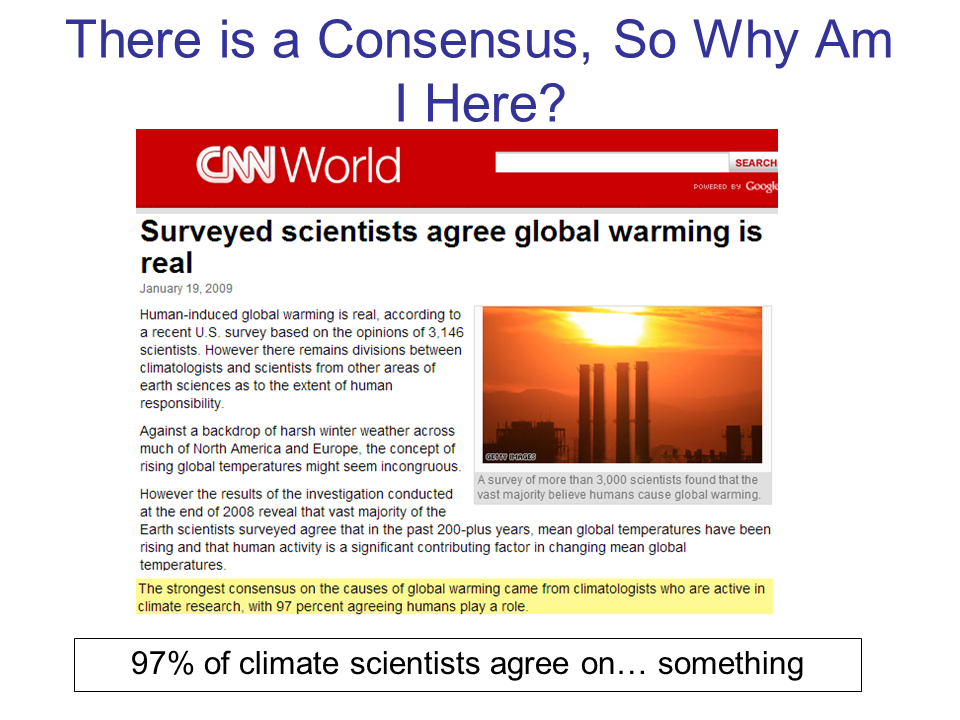
I suppose the first question I need to answer is:  why should you bother reading this?  We are told the the science is “settled” and that there is a 97% consensus among scientists on …. something.  Aren’t you the reader just giving excess credence to someone who is “anti-science” just by reading this?

Well, this notion that the “debate is over” is one of those statements that is both true and not true.  There is something approaching scientific consensus for certain parts of anthropogenic global warming theory — for example, the fact that CO2 is a greenhouse gas and that concentrations of it in the atmosphere have a warming effect on the Earth is pretty much undisputed in all but the furthest reaches of the scientific community.

But it turns out that other propositions that are important to the debate on man-made global warming are far less understood scientifically, and the near certainty on a few issues (like the existence of the greenhouse gas effect) is often used to mask real questions about these other propositions.  So before we go any further , it is critical for us to get very clear what exact proposition we are discussing.

At this point I have to tell a story from over thirty years ago when I saw Any Rand speak at Northeastern University (it’s hard to imagine any university today actually allowing Rand on campus, but that is another story).  In the Q&A period at the end, a woman asked Rand, “Why don’t you believe in housewives?” and Rand answered, in a very snarky fashion, “I did not know housewives were a matter of belief.”   What the woman likely meant to ask was “Why don’t you believe that being a housewife is a valid occupation for a woman?”  But Rand was a bear for precision in language and was not going to agree or disagree with a poorly worded proposition.

I am always reminded of this story when someone calls me a climate denier.  I want to respond, in Rand’s Russian accent, “I did not know that climate was a matter of belief?”

But rather than being snarky here, let’s try to reword the “climate denier” label and see if we can get to a proposition with which I can agree or disagree.

Am I, perhaps, a “climate change denier?”  Well, no.  I don’t know anyone who is.  The world has had warm periods and ice ages.  The climate changes.

OK, am I a “man-made climate change denier?”  No again.  I know very few people, except perhaps for a few skeptics of the talkshow host variety, that totally deny any impact of man’s actions on climate.  Every prominent skeptic I can think of acknowledges multiple vectors of impact by man on climate, from greenhouse gas emissions to land use.

Continue reading

Small-Scale Renewables Program Failure.


Operation of a small-scale wind farm was undertaken at Lake Land College** about 4 years ago. Now the College is planing to tear down the two wind turbines because of high maintenance cost and the wind farm’s inability to provide the College’s power requirements.

According to a Daily Caller posting, the turbines returned a negative 99.6% return on investment. The posting tells us the  College got  $987,697.20 in taxpayer support for the wind power. The turbines were funded from a $2.5 million grant from the US Department of Labor.

two wind mills

The college has spent $240,000 in parts and labor attempting to keep the wind turbines in operation. But they are now inoperable with an  estimated cost of $100,000 to get them back online.

From the Daily Callers posting:

“School officials’ original estimates found the turbine would save it $44,000 in electricity annually, far more than the $8,500 they actually generated. Under the original optimistic scenario, the turbines would have to last for 22.5 years just to recoup the costs, not accounting for inflation. If viewed as an investment, the turbines had a return of negative 99.14 percent.”

“Even though the college wants to tear down one of the turbines, they are federal assets and “there is a process that has to be followed” according to Allee. (Allee is the Director of Public Relations)

“The turbines became operational in 2012 after a 5-year long building campaign intended to reduce the college’s carbon dioxide (CO2) emissions to fight global warming. Even though the turbines cost almost $1 million, but the college repeatedly claimed they’d save money in the long run.”

But the College nor the US Government are not through with renewable power despite this lesson. According to the Daily Caller posting we learn that they are going solar:

“Lake Land plans to replace the two failed turbines with a solar power system paid for by a government grant. “[T]he photovoltaic panels are expected to save the college between $50,000 and $60,000 this year,”Allee told the DCNF.”

Because the wind farm was planned to be a teaching tool for the College students. It could be that some of maintenance was done be the students. However, maintenance must have been lead by professionals.

Third world countries have vast and legitimate needs for electricity for their people. But the greens tell the third world countries that they do not want to provide them with fossil fuel powered plants. And the World Bank says it will not provide them funding for fossil fuel plant. A study done in a remote part of India found that spreading solar cells around did not work because they needed many trained people distributed through out the area the solar cells were being placed and they just did not have that kind of talent. Enough talent can be concentrated in a power plant. Someday these countries, as they advance, will develop these people but they do not exist now. The people in this part of India, of course did not like loosing power every night, either.

You also wonder who in the Department of Labor determines the appropriateness of these awards. Already having put $2.2million in renewables, they are going for more.

I hope the College knows that they wont have power in the evening. (sarc)

cbdakota.

**Lake Land College, located in Mattoon, Illinois, is a two year community college.

ExxonMobil’s— “The Outlook For Energy-View to 2040″


The ExxonMobil Report contains a wealth of information. This posting will look at the status of renewable energy in the context of the world forecasts. While there are a number of postings that contend that renewables will be a dominate player, logic says that will not be true. One recent posting declares that within ten years the world could be supplied exclusively by renewable. I would take that bet on the other side.

First some background from the ExxonMobil Report.

The world population will grow from 7.2 billion in 2014 to 9 billion in 2040. India will replace China as the world’s most populated nation at 1.6 billion people. The globes energy demand will increase by 25% from 2014 to 2040. The report believes without their forecasted improvements in energy use, demand would be double their 2040 forecast shown in the report’s 2040 forecast.

The chart below is their forecast of world energy demand 2014 to 2040:  (click on charts to enlarge)


global fundamentals energy demand_full
The dashed line is the demand without the efficiency improvement forecast in the Report.

Continue reading

Mr President, You Owe American An Apology.


Rebloging a posting from Oilpro.com titled “Mr. President, you owe America an apology. We did drill our way to $2 gas.”  

The President has done about everything imaginable to make the price we pay for energy skyrocket. He has prevented drilling for oil on Federal lands but he obama-rising-gas-prices-cartoon-four-more-yearscould not do anything about State and private land. It is disgraceful that the media lets him get away with his retrospective claims that the lower prices were his doing. He even claimed he had approved oil being pipelined from Canada.

Anyway, Marita Noon tells of the misinformation that the President feeds to low information crowd.

cbdakota

‘’’’’’’’’’’’’’’’’’’’’’’’’’’’’’’’’’’’’’’’’’’’’’’’’’’’’’’’’’’’’’’’’’’’’’’’’’’’’’’’’’’’’’’’’’’’’’’’’’’’’’’’’’’’’’’’’’’’’’’’’’’’’’’’’’’’’’’’’’’’’’’’’’’’’’’’’’’’

MY PRESIDENT YOU OWE AMERICAN AN APOLOGY. WE DID DRILL OUR WAY TO $2.00 GAS.

“We can’t just drill our way to lower gas prices,” President Obama told an audience four years ago at the University of Miami. Like this year, it was an election year and Obama was running for re-election. Later in his speech, he added: “anybody who tells you that we can drill our way out of this problem doesn’t know what they’re talking about, or just isn’t telling you the truth.” He scoffed at the Republicans for believing that drilling would result in $2 gasoline—remember this was when prices at the pump, in many places, spiked to more than $4 a gallon: “You can bet that since it is an election year, they’re already dusting off their three-point plans for $2 gas. I’ll save you the suspense: Step one is drill, step two is drill, step three is drill.”

Well, Mr. President, you owe America, and the Republicans, an apology. Your snarky comments were wrong. The Republican’s supposed three-point plan, which you mocked, was correct.

Continue reading