Category Archives: Oil and Gas Exploration

Crude Oil Sales Ban Must Be Lifted


This site has written before (click here)  about the crippling of the US petroleum producers by not permitting them to sell crude oil outside of the US. The posting crude-oil-diagram-barrel-price-32155165warned of continuing loss of American jobs and resulting in higher crude oil prices.   Now the chairman and CEO of Continental Resources (Harold Hamm) tells why the ban on US crude oil sales must be lifted. In a WSJ online posting, he says this:

” The situation is urgent, as OPEC’s recent predatory pricing tactics are also hurting America and prematurely ending the boom in U.S. oil production due to hydraulic fracturing, known as fracking, and horizontal drilling. The U.S. rig count has dropped by more than 50% since Thanksgiving, according to the oilfield services company Baker Hughes. More than 126,000 oil and gas workers have been laid off, and job losses are expected to double if the export ban is not lifted.”

Continue reading

OPEC Strategy Report Says Two More Years Of A Crude Oil Glut


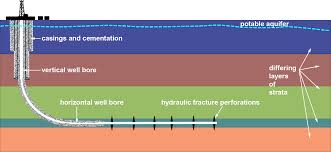
frackingimagesOPEC meets 5 June in Geneva to discuss the cartel’s strategy for the coming years.  Reuters News Agency has obtained the draft report of OPEC’s long-term strategy. This report’s content will be a key discussion at the meeting. The report suggests that the global oil glut could persist for the next two years.   In general that seems like pretty good news for the world and specifically for U.S. if not for the OPEC cartel and Russia.

The drop in oil prices that began late last year did not shut down the fracking wells that were already producing as the wells continued to operate to cover their variable costs. It did cause drill rigs to be cut every week for 23 weeks. Reuters reports that only one rig was cut the week of 18 May.   Experts seem to agree that fracking can be profitable at a West Texas Intermediate (WTI) price around $60/barrel. That price level should bring on more fracking operations. Today’s price is $59.89. (changes often.)

Continue reading

Potential Shutdowns Of Fracking Wells Looms–But Not Caused By Low OPEC Prices


Some of the Texas and North Dakota fracking oil wells were thought to not be profitable at the low crude oil prices that Saudi Arabia had engineered. But most of them have weathered the storm.   Drilling has slowed down however. World wide, except for the Middle East, rig count is down.

shale gas plays

Continue reading

Keystone Pipeline In The News Again


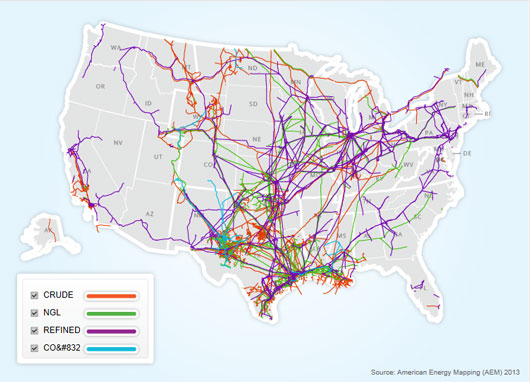
First the Keystone XL pipeline (KXL) was not authorized by President Obama because he and the Governor of Nebraska were worried about pipeline failure. I wonder if they considered how many pipelines are in operation today and how few problems they have caused. Over 2.4 millions of miles of underground pipelines in the U.S. carry natural gas and liquid petroleum. The majority of those miles are carrying natural gas; however, over 180,000 miles of pipeline move liquid petroleum. Below are two maps showing the major routes of these pipelines:

Liquid-Pipelines-map-530Petroleum Pipelines

Continue reading

“Drill Baby Drill”.   Does The President Think We Don’t Remember What He Said?


oil-fuel-of-the-pastPresident Obama has made it nearly impossible to access off-shore and Federal Lands for oil and natural gas development. See here and here. He campaigned in 2012 (He always is campaigning— he is much better at that than governing) saying that “Drill Baby Drill” was an empty slogan which would have no effect on crude oil prices. See the following Fox News report:

Back when gas topped $4 a gallon, Republicans chanted “drill, baby, drill” at rallies across the country — arguing more domestic drilling would increase supplies, reduce dependence on foreign oil and boost the U.S. economy.

Continue reading

Why Are Crude Oil Prices Falling? And Will We Regret It?


Saudi Arabia is a major producer and seller of crude oil as well as the unelected leader of the Organization of Petroleum Exporting Countries (OPEC). Saudi has, in the past, adjusted its production (and thus sale of crude oil) to keep the price OPECnetoilexportrevs2013chart2at a level that OPEC desired. For example, if global demand for crude softened, Saudi would cut back production to match demand thus stabilizing the price. The Department of Energy chart shows how Saudi dominates OPEC export sales.

This autumn the demand for OPEC crude fell—but, Saudi decided not to balance supply and demand.   Consequently the price of crude oil has dropped to about 50% of what it was at its high in June 2014.

Continue reading

Administration’s Agencies And Radical Greens Collude On Policy


The EPA has devised a system to write policy that favors the radical green NGOs.  The EPA is able to, in effect, legislate.  This is done by using the courts to issue Consent Decrees outlining policy “agreements.   Once issued, the agreements set out in the Consent Decrees are very difficult to get changed.

Back in the 1960tys, activist groups began what is now called “reform litigation”.  Initially these litigated cases were to pursue the litigant’s idea of needed prison reforms.  But with time, reform litigation spread and it is getting major use by the EPA and radical greens to shape environmental policy.  Here is how it works  according to Bob Beuprez’s posting “How the EPA connives with Greens on Policy”:

How have these overtly political groups obtained such access to policy decisions that have the power to destroy industries and eliminate jobs? The answer lies in the “sue and settle” legal technique.

Continue reading

Will The OPEC Cartel Break Up?


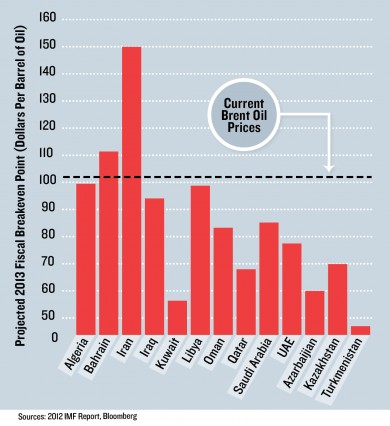
Because the OPEC cartel provides about 40% of the world’s crude oil, it has been able to control the crude oil price.  Its members meet and set the amount of crude they will produce for sale opposite the forecast world demand.  They can reduce or increase production to raise or lower prices. Other major crude producers outside of OPEC have been able to sell all their crude oil but acting independently are unable to displace OPEC’s role as the selling price arbiter.   As you would expect, OPEC wants the price to be high but recognizes that if they set it too high, demand will drop and competitors will be encouraged to prospect for more crude.   Within OPEC, the members have their own issues that make setting the production levels and thus the price, not easy.  However, Saudi Arabia, currently the world’s largest producer of  crude oil,  is said to be the primary voice in this process.  When the OPEC members meet, as they did on May 31st, to set the production level/price, one big factor was how much of their government’s budget is derived from the oil revenues.  And what is the price of crude oil that makes that budget whole? The graph below, from the American Interest’s posting “OPEC Sweats: How Low Can Oil Prices Go?illustrates the price needed to balance their government’s budget:

2013_fiscal_breakeven_point-e1370293236725

Continue reading

Why Has The Price Of Gasoline Gone Up.


The US Department of Energy’s Energy Information Agency (EIA) says that the recent rise in gasoline prices was due in part to an increase in the cost of crude oil and the “crack price spread”. The average U.S. retail price for regular motor gasoline is up about 45 cents per gallon since the start of 2013, reaching $3.75 per gallon on February 18.  Crack price spread is defined as: “Crack spreads are differences between wholesale petroleum product prices and crude oil prices. These spreads are often used to estimate refining margins. Crack spreads are a simple measure based on one or two products produced in a refinery (usually gasoline and distillate fuel). They do not take into consideration all refinery product revenues and exclude refining costs other than the cost of crude oil.”

Continue reading

US PRODUCED 83% OF THE ENERGY IT CONSUMED IN 2012


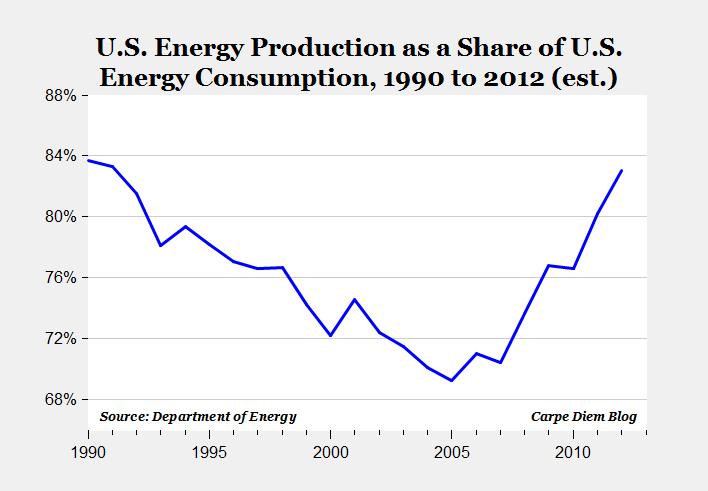
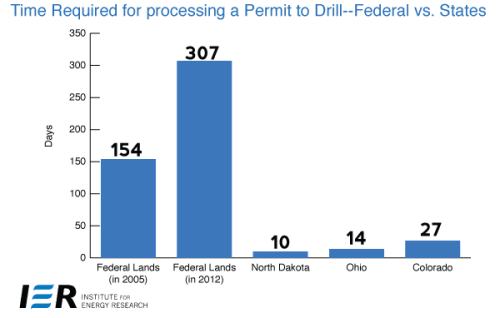
The US is making progress in becoming self-sufficient energy-wise.  The posting “Energy Charts of the Day” on the American Enterprise Institute blog site shows a projection  that 83% of the energy used in the US was produced in the US.  Behind this improvement has been State and private ownership of oil and gas plays.  To achieve a permit to drill in North Dakota takes 10 days.  The federal government take 307 days to process a permit to drill.

aeichartenergyprodcons

From the AEI blog we have:

1. Thanks largely to the recent significant increases in the domestic production of fossil fuel energy (oil and natural gas), the U.S. was more energy self-sufficient in 2012 than at any time in the last two decades.  Based on data for the first nine months of 2012, the U.S. last year produced more than 83% of the energy it consumed for the first time since 1991 (see chart above).
GovoilPermits

2. From the article “Economics of the Bakken Oil Boom: What the Rest of the Nation is Missing,” in today’s Canada Free Press:

The Bakken development in North Dakota should be an example for the nation, indicating what could be accomplished with the right energy policies to decrease unemployment, raise government revenues, increase per capita income, decrease poverty, and help produce the nation’s major energy source.

So far, the hydraulic fracturing revolution that has created these positive economic developments is largely confined to production on private and state lands, due to governmental policies reducing opportunities on federal lands and a punitive federal regulatory environment. Even though there are massive shale oil and oil shale resources on federal lands, federal policies are choking off any production increases. Here’s one illustrious example: it takes the federal government 307 days to process a permit to drill, but it only takes North Dakota 10 days (see chart below)

See also “President’s Pants On Fire……”

cbdakota