Category Archives: IPCC

Chevy Sells More Than 2000 Volts In March


The Washington Post reports that Volt sales were the best ever in March, selling more than 2000.  The figure sounds high to me but we will see tomorrow when GM  releases the official sales figures.

3 April Update.  GM reports that March sales of the Volt were 2,289 units.  

GM normally shuts down their production lines for two weeks in July to make the change-over for the next year’s model. However the inventory build-up of Volts at the dealerships may cause the company to take an extra week of down time on the Volt production line in July.  If the sales stay strong, they may cancel that extra week.

cbdakota

Global Temperature Update—February 2012


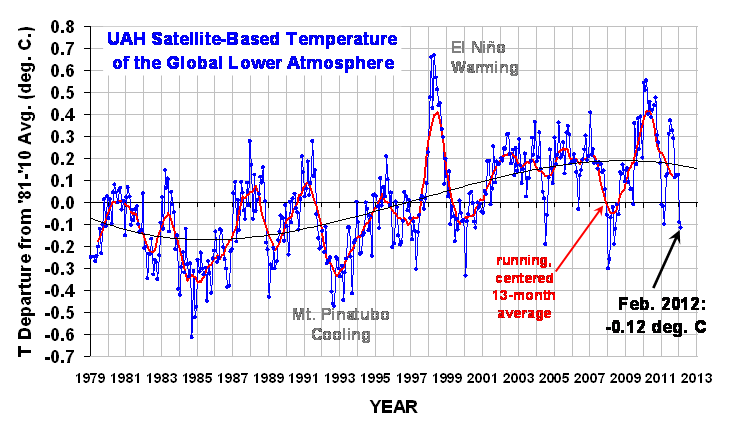
The UAH satellite global temperatures have been posted by Dr Roy Spencer on his website.  The February temperature anomaly is -0.12 C.   That is just slightly down from the January number of -0.09C.

Above is Dr Spencer’s chart (click on it to enlarge) of the global temperature anomalies since the start of the satellite temperature-measuring program in the late seventies.  The average global temperature departure is about 0.16C warmer that the average temperature for the period 1981-2010.  Dr Spencer might not approve of this calculation but 0.16 C over that 30-year period might indicate a warming of about 0.6C per century.  Further, if solar Cycle 24 and the next Cycle 25 perform as many are now forecasting, we may see the anomaly go negative for many years.

cbdakota

Lubos Motl’s 104 Reasons To Be A Skeptic


Lubos Motl’s skeptical website, The Reference Frame, is widely read and cited.  Motl counters John Cook’s assertions about man-made global warming.  Motl provides background science that will serve skeptics in any discussion and/or debate.  Motl introduces his material as follows:

John Cook, a former student of physics in Australia, has constructed an interesting website trying to attack the opinions of climate skeptics.

It’s been in my climate bookmarks for quite some time but no one really cared about it so I didn’t want to respond. However, his talking counter-points were recently adopted by an iPhone application. Moreover, Andrew Revkin promoted the website, too. So let us look at his points and counter-points.

Motl matches the headings from Cook’s listing of “myths” and Motl adds his view illustrating what the real story is. Below are two of the 104 topics so you can get a flavor of what is included. To read to all of Motl’s work click here.

On his (Cook) website, you can currently see 102 observations by the skeptics (or some skeptics); 2 of them were added by March 29th and I can’t constantly update this web page so that he’s likely to surpass his 104 points sometime in the future. Each of the “slogans” is accompanied by a short attempted rebuttal by John Cook. And if you click it, you get to a long rebuttal. So let’s look at them:

1. It’s the sun: I agree with Richard Lindzen that it’s silly to try to find “one reason behind all climate change”, because the climate is pretty complex and clearly has lots of drivers, and this applies to the opinion that “everything is in the Sun”, too. Cook shows that the solar irradiance is too small and largely uncorrelated to the observed changes of temperatures. I agree with that: a typical 0.1% change of the output is enough for a 0.025% change of the temperature in Kelvins which is less than 0.1 °C and unlikely to matter much. But I find it embarrassing for a student of solar physics such as himself to be so narrow-minded. The Sun influences the Earth’s atmosphere not only directly by the output but also indirectly, by its magnetic field and its impact on the cosmic rays (via solar wind etc.) and other things. He has completely ignored all these things. Of course, I am actually not certain that these effects are very important for the climate but the evidence – including peer-reviewed articles – is as diverse as the evidence supporting CO2 as an important driver.

104. Southern sea ice is increasing: Cook agrees but says that it surely has nothing to do with warming or global climate change. It must be due to “complex phenomena” such as changes of the winds and circulation. Note that such comments would be unthinkable if he tried to discuss the Northern sea ice. As we have noticed, all “warming” observations are about the climate, important signals that you should appreciate, worship, extrapolate, and be afraid of. On the other hand, all “cooling” observations are just an irrelevant weather that you should dismiss, humiliate, and spit on. With such a biased attitude, it shouldn’t be shocking that Mr Cook ends up with an irrational orthodoxy based on 104 largely obscure misinterpretations, misunderstandings, and myths – and that his opinions about the most important questions are upside down.

Go through all of them, you will might learn something that you didn’t know.

cbdakota

Reliable Solar Cycle Forecasting Requirements


Dr David Hathaway is NASA’s solar cycle guru.  In 2010, he published in Solar Physics a review of the methods used to forecast solar cycle activity.   The review, titled TheSolar Cycle” is worth reading.  He discusses many of the techniques currently in use that purport to be the method for solar cycle forecasting. 

This post will only look at the key features that Hathaway says must be explained by any viable theory or model in order to provide a reliable forecast. 

The Abstract for “The Solar Cycle”  follows:

The Solar Cycle is reviewed. The 11-year cycle of solar activity is characterized by the rise and fall in the numbers and surface area of sunspots. We examine a number of other solar activity indicators including the 10.7 cm radio flux, the total solar irradiance, the magnetic field, flares and coronal mass ejections, geomagnetic activity, galactic cosmic ray fluxes, and radioisotopes in tree rings and ice cores that vary in association with the sunspots. We examine the characteristics of individual solar cycles including their maxima and minima, cycle periods and amplitudes, cycle shape, and the nature of active latitudes, hemispheres, and longitudes. We examine long-term variability including the Maunder Minimum, the Gleissberg Cycle, and the Gnevyshev–Ohl Rule. Short-term variability includes the 154-day periodicity, quasi-biennial variations, and double peaked maxima. We conclude with an examination of prediction techniques for the solar cycle.

Hathaway lists the critical features for making an accurate forecast:  

Understanding the solar cycle remains as one of the biggest problems in solar physics. It is also one of the oldest. Several key features of the solar cycle have been reviewed here and must be explained by any viable theory or model.  (I am adding several charts to aid in visualize his thinking.)

  • The solar cycle has a period of about 11 years but varies in length with a standard deviation of about 14 months.
  • Each cycle appears as an outburst of activity that overlaps with both the preceding and following cycles by about 18 months.
  • Solar cycles are asymmetric with respect to their maxima – the rise to maximum is shorter than the decline to minimum and the rise time is shorter for larger amplitude cycles.
  • Big cycles usually start early and leave behind a short preceding cycle and a high minimum of activity.
  • The activity bands widen during the rise to maximum and narrow during the decline to minimum.
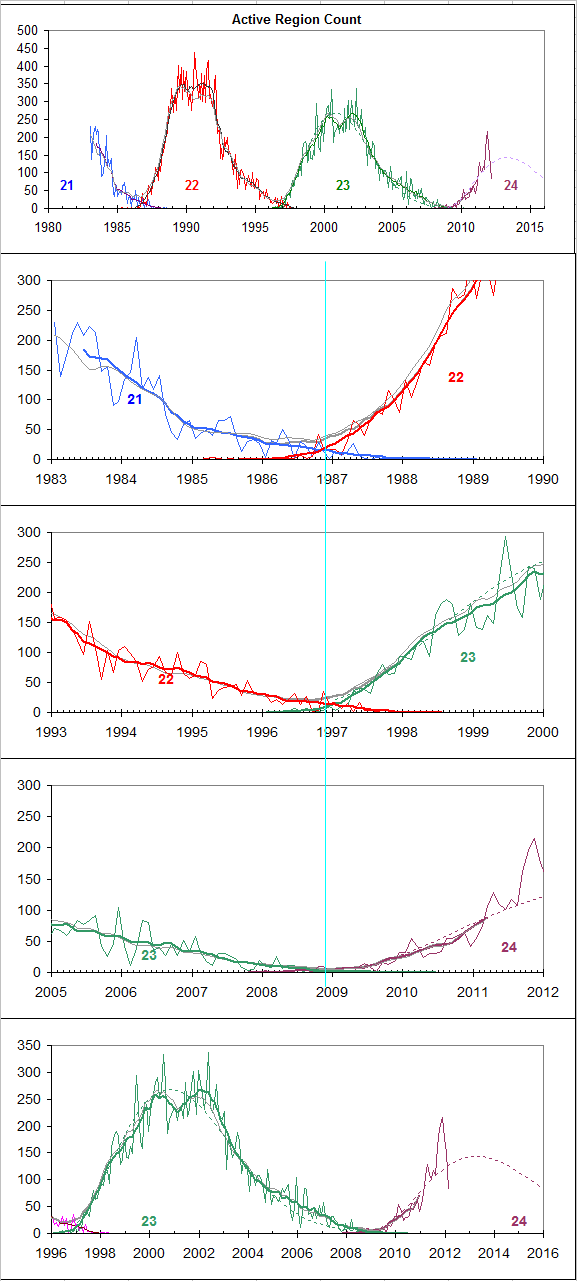
These  sunspot charts show the last stages of cycle 21, cycles 23 and 23 fully and the current status of cycle 24.  The overlapping between the end of one cycle and the start of the other is apparent.   The relatively steep rise in the sunspot count at the begining of a new cycle and the more gradual decent.  Cycle 24’s rise is not nearly as steep as its predecessors.  Charts by Leif Svalgaard.
  • Sunspots erupt in low latitude bands on either side of the equator and these bands drift toward the equator as each cycle progresses.
  • At any time one hemisphere may dominate over the other but the northern and southern hemispheres never get completely out of phase.
  • Sunspots erupt in groups extended in longitude but more constrained in latitude with one magnetic polarity associated with the leading (in the direction of rotation) spots and the opposite polarity associated with the following spots.
  • The leading spots in a group are positioned slightly equatorward of the following spots and this tilt increases with latitude.

Butterfly Diagram: All the sunspots in a give cycle are plotted on the charts above. The initial sunspots appear at about 30° North and South lattitude. As new spots appear they tend to get closer to the equator. Each solar cycle ends, nominally, when the spots reach the equator. Charts by Solar Physics Group @ NASA

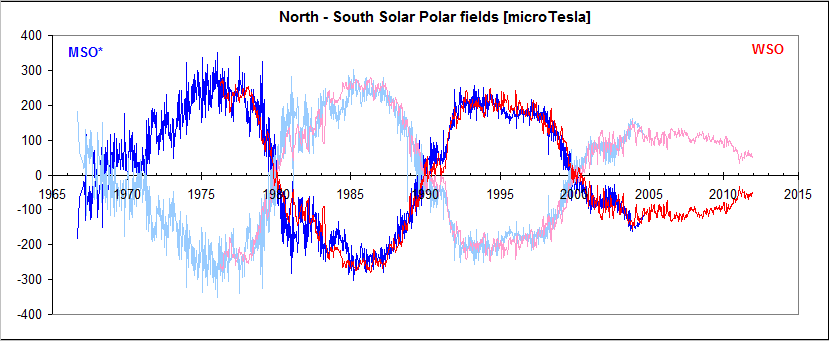
  • The polar fields reverse polarity during each cycle at about the time of cycle maximum.

Solar Magnetic Fields: This chart shows the North and South magnetic fields reversing at the end of a solar cycle. Note how weak the magnetic fields are for the start of the current cycle 24. Chart by Leif Svalgaard.

  • Cycle amplitudes exhibit weak quasi-periodicities like the 7 to 8-cycle Gleissberg Cycle.

The Gleissberg Cycle is a period of about 80 to 90 years that overlays the well established 11 year cycle.  The theory is that solar maxima and solar minima are forced by the gravitational pull of the major planets.  The specific alignment, particularily Jupiter and also Saturn Neptune and Uranus have a major effect on the Sun’s activity.  To see graphics of the alignment of these major planets, click here.

  • Cycle amplitudes exhibit extended periods of inactivity like the Maunder Minimum.
  • Solar activity exhibits quasi-periodicities at time scales shorter than 11 years.
  • Predicting the level of solar activity for the remainder of a cycle is reliable 2 – 3 years after cycle minimum.

Hathaway tells us that theory must be able to predict the preceding.  Until then,  people will continue to predict the features of the next solar cycle but it may be just luck if they get it right.

cbdakota

Warmer “Ethics” Leader Fakes Identity to Steal Documents


Peter Gleick, who stole the Heartland Institute Board of Director documents under false pretenses, is the Chair of the American Geophysical Union (AGU) Task Force on Scientific Integrity!!!!   How is that for irony and perhaps it speaks to the overall integrity of the Warmer cause.

Someone made up a fake cover letter to accompany the stolen documents and sent out a package to Warmer supporters in the media.  In the fake cover letter, Heartland is saying that they are going to spend $100,000 in schools with the objective of providing information that would show that “the topic of climate change is controversial and uncertain – two key points that are effective at dissuading teachers from teaching science”.   NOT TO TEACH SCIENCE!  Heartland did not write the cover letter.  Gleick says he is not guilty of writing the cover letter.  Those are leading the investigation believe he did write it.  He has resigned his position as the head of the Scientific Integrity Task Force.

However Gleick says it really wasn’t his fault:“My judgment was blinded by my frustration with the ongoing efforts — often anonymous, well-funded, and coordinated — to attack climate science and scientists and prevent this debate, and by the lack of transparency of the organizations involved.”   So it is Heartland’s fault. They are so well funded.

Jo Nova’s blog has the following table showing only a few of the Warmer organizations’ funding versus Heartland Institute funding:

Entity USD
Greenpeace  $300m  2010 Annual Report
WWF  $700m  ”  ($524m Euro)
Pew Charitable Trust  $360m 2010 Annual Report
Sierra Club  $56m 2010 Annual Report
US government funding for climate science and technology  $7,000m  “Climate Money” 2009
US government funding for “climate related appropriations” $1,300m USAID 2010
US government funding for skeptical scientists     $ 0
Heartland Institute $7m  (actually $6.4m)

Nova’s table highlights the vast discrepancy in funding.  She adds: “So what the expose shows is that the Heartland Institute punches far above its weight with an incredibly efficient budget.” To see Jo Nova’s full posting click here.

Why are the Skeptics becoming so successful in getting their message across?  It is not that they have a lot of money.  It certainly isn’t the media that seem only interested in press releases from the Warmers.  It is not the Governments of the world that support only Warmer climate research.  Its not the school districts that make Al Gore’s “An Inconvenient Truth” required viewing.

But rather it is the Internet where people can judge the available reports for themselves. It the exposure of the Warmer leaders hiding the truth, gaming the science, denying Skeptics access to publication of their studies etc. as exposed by Climate Gate.  It is also a public that is weary of Warmer shrill claims of impending disaster—which never materialize.

cbdakota

The Warmers—-The Gang That Can’t Shoot Straight


Last year the Warmers were defending the IPCC’s Fourth Assessment Report’s conclusion that the Himalayan glaciers would disappear by 2035.   Oops, they then said, we meant 2350.  Even so, we are being told that the glaciers were melting and so quickly that the people in Asia would be in big trouble when there was no more melt water.  They believed that melting of Himalayan glacial ice was equivalent to 50 billion tons of water every year.  But now a study  ( lead scientist John Wahr and team) published in Nature tells that the Himalayan glaciers have lost no ice over the last decade. The measurements of global ice for this study were done using satellites.   According to the report:

The reason for the radical reappraisal of ice melting in Asia is the different ways in which the current and previous studies were conducted. Until now, estimates of melt water loss for all the world’s 200,000 glaciers were based on extrapolations of data from a few hundred monitored on the ground. Those glaciers at lower altitudes are much easier for scientists to get to and so were more frequently included, but they were also more prone to melting.

The bias was particularly strong in Asia, said Wahr:

“Their extrapolation is really tough as only a handful of lower-altitude glaciers are monitored and there are thousands there very high up.”

Satellite data for the rest of the world’s glaciers were also measured and the team reported no changes in the melt rate.

Glaciers have been melting for the last 10,000 years.   The question is really— is the present rate particularly unusual?  This study certainly puts into question the warmers previous assertion that it is.  Isn’t this just one more indication that there has been no statistically significant global warming over the past decade.

But whenever a study comes out like this, it is required to say—- nothing has changed, CO2 is still the problem.    Prof Jonathan Bamber, the director of the Bristol Glaciology Centre said:

“The new data does not mean that concerns about climate change are overblown in any way. It means there is a much larger uncertainty in high mountain Asia than we thought. Taken globally all the observations of the Earth’s ice – permafrost, Arctic sea ice, snow cover and glaciers – are going in the same direction.

NOT OVERBLOWN?????  (Just more uncertainty!!)

Professor Bamber also participated in an online Q and A session.  He responded to a question from “On Earth” as follows:

OnEarth. For Antarctica and Greenland the results from this study are in very good agreement with most recent previous estimates of mass loss from the ice sheets so it doesn’t change our view of what these are doing.

I have always had a lot of respect for “most recent previous estimates..” what ever they are.

Are we to assume that much stress is being felt in Asian lands where the Himalayan ice melt is so important according to the IPCC?  If there is no net change in total ice as the study tells us, does that mean there is a vastly reduced melt water flow?  By the way, there are many studies that say the monsoons are the principal source of the water these Asian countries rely upon.

To read more click here and here.

cbdakota

To Maintain Their Integrity, Scientists Need to Become Skeptics


If the first release of Climategate emails in November of 2009 wasn’t enough to convince people that a small group of superwarmer scientists have been advancing the theory of man-made global warming through manipulation, this newly released batch (generally called Climategate 2) should convince them.

First of all, why should anyone care if this “small” group of superwarmers is doing bad things?  The reason is that this small group controls the dialogue on this subject. It manipulates the data to comply with their point of view; it writes the critical parts of the IPCC reports; it decides what is published and what is not published; and, it punishes scientists and organizations that don’t toe the line.  While we are being squeezed financially, they are pulling in millions of dollars in grants and honors.

The people that need to step up and put an end to this charade are the good and descent scientists that have been taken in by the superwarmers.   They suffer from a confirmation bias that has to be pretty hard to sustain these days of no global temperature rise, falling sea levels and all the climategate email revelations, just to name a few things.   These scientists must stand up against the blind allegiance that their professional societies maintain to catastrophic man-made global warming theory.  Certainly there are enough reasons for them to become skeptics.   They should be comfortable in saying that until there is more proof and open discussions of the science of the global climate, they no longer are going to support the  warmer supergroup.  Until that happens, the media will continue to uncritically pass on to the public anything the superwarmers tell them because they always use in their defense “almost all scientist agree with the supergroup”.

By the way, for those of you are under the impression that members of the warmer supergroup have been investigated and exonerated, you need to read up on this and you will learn that the exoneration was predetermined.  For one good read on this, see here.

cbdakota

Son of Climategate-New Emails Released


Just released are a new batch of emails from that group of global warming alarmist matching those released two years ago.  These new emails show the same pattern as before—  manipulating data (“hiding the decline”);  not allowing anything that did not conform to their theory of global warming get into the IPCC climate report;   intimidating Journals to prevent them from publishing studies that refuted man-made global warming; and destroying or concealing data/ correspondence requested by Freedom Of Information Acts.

The irony of this new release is that the “scientists” claimed that the first release was theft and asked the police to find the guilty party.  The police are said to have accumulated about 250,000 emails  during their investigation. The police have just released 5000 of them!!!  Maybe the police thought the bigger villains were the writers of these email.

Several posting have lifted some of the emails from the list of 500.  To get a look at these, check out these sites.  Here, here and here

GRAPH THAT FOOLED THE WORLD


On Sunday, October 30, the London Daily Mail published the following two graphs.

The first graph labeled “Graph That Fooled The World” came from the BEST study that was released prior to peer review and publication.    The lead author Professor Richard Muller and his team from Berkley (University of California) Earth Surface Team (BEST) claimed that the chart showed that–the planet has warmed by almost a degree centigrade since 1950 and is warming continuously.  He said according to the Mail that the research: “proved you should not be a sceptic, at least not any longer.”  This graph was presented to the MSM over a week ago.  It was reprinted for today’s edition along with the second graph which is new.

From the Mail:

It was cited uncritically by, among others, reporters and commentators from the BBC, The Independent, The Guardian, The Economist and numerous media outlets in America.

The Washington Post said the BEST study had ‘settled the climate change debate’ and showed that anyone who remained a sceptic was committing a ‘cynical fraud’.

But today The Mail on Sunday can reveal that a leading member of Prof Muller’s team has accused him of trying to mislead the public by hiding the fact that BEST’s research shows global warming has stopped.

Prof Judith Curry, who chairs the Department of Earth and Atmospheric Sciences at America’s prestigious Georgia Institute of Technology, said that Prof Muller’s claim that he has proven global warming sceptics wrong was also a ‘huge mistake’, with no scientific basis.

The second graph titled The Inconvenient Truth uses the BEST data that show global temperatures at a standstill.  This Graph was not sent to the media by Muller.

The Mail adds these comments by Professor Curry:

As for the graph disseminated to the media, she said: ‘This is “hide the decline” stuff. Our data show the pause, just as the other sets of data do. Muller is hiding the decline.

‘To say this is the end of scepticism is misleading, as is the statement that warming hasn’t paused. It is also misleading to say, as he has, that the issue of heat islands has been settled.’

Yesterday Prof Muller insisted that neither his claims that there has not been a standstill, nor the graph, were misleading because the project had made its raw data available on its website, enabling others to draw their own graphs.

However, he admitted it was true that the BEST data suggested that world temperatures have not risen for about 13 years. But in his view, this might not be ‘statistically significant’, although, he added, it was equally possible that it was – a statement which left other scientists mystified. (added emphasis)

And you should probably not hold your breath waiting for a mea culpa from the MSM  for their jumping on a story that was at a minimum misleading if not intentionally wrong.

There is another posting  that Greenwire  titled “Provoked scientists try to explain lag in global warming.”  The expert warmer scientists, in their own words, can not answer this question.  Interestingly, they have many theories but no CONSENSUS.   Obivouly nothing any of them say can possibly be correct if there is no CONSENSUS.   I will comment on that posting next.

For a full reading of the Mail story, click here.

cbdakota

Can We Really Call Climate Science A Science?


Can We Really Call Climate Science A Science?  That is the question asked in a Forbes Posting.  The author, Paul Roderick Gregory, cites the prevailing warmist’s narrative that says all but a tiny minority of scientist believes that global warming is man- made.  Gregory likens this to Stalin telling Trotsky (the dissident) it is what the poliburo says it is regardless if it is true or not.

Gregory  writes: The “warmist” consensus view of “climate science” is represented at a popular level by advocates like Al Gore and at the scientific and technical level by the UN’s Intergovernmental Panel on Climate Change (IPCC), as supported by researchers at East Anglia (Phil Jones) and Penn State (Michael Mann). This panoply of people and organizations is the equivalent of the Central Committee in my Stalin dialog above.   “Skeptics” (the equivalent of Trotsky above) are individual scientists and advocates who stake out positions at odds with the IPCC-Central Committee orthodoxy.

Gregory says that three recent events make him think of this Stalin analogy:

First, Ivar Giaever, the 1973 winner of the Nobel Prize in physics, resigned from the American Physical Society over his disagreement with its statement that “the evidence (on warming alarmism) is incontrovertible.”

Gregory adds: The Giaever story starkly disputes warmist claims of “inconvertible evidence.   Despite the press’s notable silence on such matters, there are a large number of prominent scientists with solid scholarly credentials who disagree with the IPCC-Central Committee. Those who claim “proven science” and “consensus” conveniently ignore such scientists.

Second, the editor of Remote Sensing resigned and disassociated himself from a skeptical paper co-authored  by University of Alabama Climate Scientist Roy Spencer after an avalanche of criticism by “warmists.

The author believes that the Remote Sensing editor’s action was bizarre and unprofessional. He adds : In all fields of scientific inquiry, journal editors base their publication decisions on reports of referees, who are supposed to be experts in the area. Presumably, in the case of the Spencer paper, referees supported its publication.  Even if there had been a negative report, good editors often publish controversial papers to open a scholarly dialog. (Can anyone think of a topic that is more controversial and more in need of open scholarly dialog than global warming

Third, the New York Times and other major media are ridiculing Texas Governor Rick Perry for saying that global warming is “not proven.” Their message: Anyone who does not sign on to global warming alarmism is an ignorant hayseed and clearly not presidential material.

Regarding the criticism of Rick Perry he says: The media is tarring  and feathering  Rick Perry, we now see,  for agreeing with Nobel laureate Giaever and a host of other prominent scientists.  I guess if Perry is a know-nothing Texas hick (or worse, a pawn of  Big Oil) so is every other scientist who dares to disagree with the IPCC Central Committee. Such intimidation  chillingly makes politicians, public figures, and scientists fearful of deviating one inch from orthodoxy.

He summarizes this situation saying: False claims of consensus and inconvertible truth reveal a political or ideological agenda wrapped in the guise of science.  The incontrovertible bad behavior of the warmists has led skeptics to suspect base motives, and who could blame them.

And I will add that this is why the skeptics suspect the base motives  of the warmist’s allies —- the mainstream media.

Read this Gregory’s full post by clicking here

cbdakota